
In the course of evaluating the antiderivative

I have stumbled across a very curious trigonometric identity:






where 


I will now show that 


To show that

I could do this with a calculator…
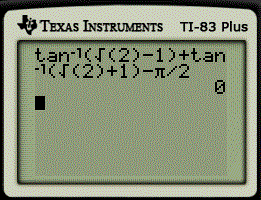 …but that would be cheating.
Instead, let 



Indeed, by SOHCAHTOA, the angles 

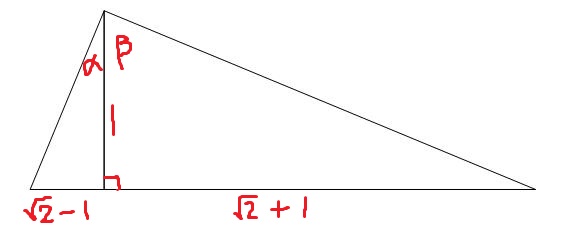 The two small right triangles make one large triangle, and I will show that the large triangle is also a right triangle. To do this, let’s find the lengths of the three sides of the large triangle. The length of the longest side is clearly

Next, for the small right triangle containing

So let me redraw the figure, eliminating the altitude from the previous figure:
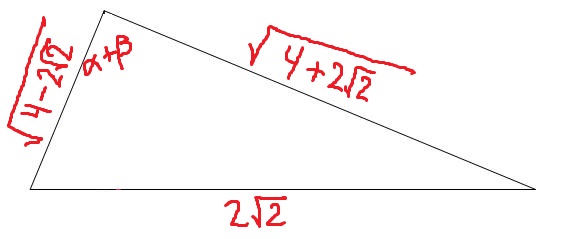
Notice that the condition of the Pythagorean theorem is satisfied, since

or

Therefore, by the converse of the Pythagorean theorem, the above figure must be a right triangle (albeit a right triangle with sides of unusual length), and so 
To show that 


![= \tan^{-1} ( -[x\sqrt{2} + 1] ) + \tan^{-1}( -[x \sqrt{2} - 1])](https://s0.wp.com/latex.php?latex=%3D+%5Ctan%5E%7B-1%7D+%28+-%5Bx%5Csqrt%7B2%7D+%2B+1%5D+%29+%2B+%5Ctan%5E%7B-1%7D%28+-%5Bx+%5Csqrt%7B2%7D+-+1%5D%29&bg=ffffff&fg=000000&s=0&c=20201002)

![= - \left[ \tan^{-1} ( x\sqrt{2} + 1 ) + \tan^{-1}( x \sqrt{2} - 1) \right]](https://s0.wp.com/latex.php?latex=%3D+-+%5Cleft%5B+%5Ctan%5E%7B-1%7D+%28+x%5Csqrt%7B2%7D+%2B+1+%29+%2B+%5Ctan%5E%7B-1%7D%28+x+%5Csqrt%7B2%7D+-+1%29+%5Cright%5D&bg=ffffff&fg=000000&s=0&c=20201002)

Therefore, 
 Mean Green Math