Engaging students: Solving logarithmic equations

In my capstone class for future secondary math teachers, I ask my students to come up with ideas for engaging their students with different topics in the secondary mathematics curriculum. In other words, the point of the assignment was not to devise a full-blown lesson plan on this topic. Instead, I asked my students to think about three different ways of getting their students interested in the topic in the first place.

I plan to share some of the best of these ideas on this blog (after asking my students’ permission, of course).

This student submission again comes from my former student Caitlin Kirk. Her topic: how to engage Algebra II or Precalculus students when solving logarithmic equations.

green line

B. Curriculum: How does this topic extend what your students should have learned in previous courses?

Logarithms are a topic that appears at multiple levels of high school math. In Algebra II, students are first introduced to logarithms when they are asked to identify graphs of parent functions including f (x) = logax. Later in the same class, they learn to formulate equations and inequalities based on logarithmic functions by exploring the relationship between logarithms and their inverses. From there, they can develop a definition of a logarithm.

Solving logarithmic equations extends what students learned about logarithms in Algebra II. Once a proper definition of logarithms has been established, along with a graphical foundation of logs, students learn to solve logarithmic equations.  Properties of logarithms are used to expand, condense, and solve logarithms without a calculator in Pre Calculus. Practical applications of the logarithmic equation also follow from previous skills. Students learn to calculate the pH of a solution, decibel voltage gain, intensity of earthquakes measure on the Richter scale, depreciation, and the apparent loudness of sound using logarithms.

green line

C. Culture: How has this topic appeared in the news?

One application of logarithmic equations is calculating the intensity of earthquakes measured on the Richter scale using the following equation:

R = \log(A/P)

where A is the amplitude of the tremor measured in micrometers and P is the period of the tremor (time of one oscillation of the earth’s surface) measured in seconds.

Reports of earthquake activity appear in the news often and are always accompanied by a measurement from the Richter scale. One such report can be found here: http://www.bbc.co.uk/news/world-asia-20638696. As the story says, a 7.3 magnitude earthquake struck off the coast of Japan in December of 2012, and created a small tsunami. There were six aftershocks of this quake whose Richter scale measurements are also given. The article also explains how Japan has been able to enact an early warning system that predicts the intensity of an earthquake before it causes damage. All of the calculations given in this story, and almost all others involving earthquakes, involves the use of the Richter scale logarithmic equation.

green line

D. History: What are the contributions of various cultures to this topic?

The development of logarithms saw contributions from several different countries beginning with the Babylonians (2000-1600 BC) who developed the first known mathematical tables. They also introduced square multiplication in which they simply but accurately multiplied two numbers using only addition and subtraction. Michael Stifel, of Germany, was the first mathematician to use an exponent in 1544. He developed an early version of the logarithmic table containing integers and powers of 2. Perhaps the most important contribution to logarithms came from John Napier in Scotland in 1619. He, like the Babylonians, was working with on breaking multiplication, division, and root extraction down to only addition and subtraction. Therefore, he created the “logarithm” L of a number N defined as follows:

N = 10^7 (1-10^{-7})^L

for which he wrote \hbox{NapLog}(N) = L.

 Napier’s definition of the logarithm led to the following logarithmic identities that are still taught today:


\hbox{NapLog}(\sqrt{N_1N_2}) = \frac{1}{2} (\hbox{NapLog} N_1 + \hbox{NapLog} N_2)

\hbox{NapLog}(10^{-7} N_1 N_2) = \hbox{NapLog} N_1 + \hbox{NapLog} N_2

\hbox{NapLog} \left( 10^{-7} \displaystyle \frac{N_1}{N_2} \right)= \hbox{NapLog} N_1 - \hbox{NapLog} N_2

Henry Briggs, in England, published his work on logarithms in 1624, which included logarithms of 30,000 natural numbers to the 14th decimal place worked by hand! Shortly after, back in Germany, Johannes Kepler used a logarithmic scale on a Cartesian plane to create a linear graph the elliptical shape of the cosmos.  In 1632, in Italy, Bonaventura Cavalieri published extensive tables of logarithms including the logs of trig functions (excluding cosine).  Finally, Leonhard Euler made one of the most commonly known contributions to logarithms by making the number e = 2.71828\dots the base of the natural logarithm (which was also developed by Napier). While it is untrue, as is commonly believed, that Euler invented the number 2.71828\dots, he did give it the name e. He was interested in the number because he wanted to calculate the amount that would result from continually compounded interested on a sum of money and the number 2.71828\dots kept appearing as a constant in his equation. Therefore he tied e to the natural logarithm that was not as widely used because it did not have a base.

Logarithms were developed as a result of the contributions of many cultures spanning Europe and beyond, dating back over 4000 years.

Reminding students about Taylor series (Part 5)

Sadly, at least at my university, Taylor series is the topic that is least retained by students years after taking Calculus II. They can remember the rules for integration and differentiation, but their command of Taylor series seems to slip through the cracks. In my opinion, the reason for this lack of retention is completely understandable from a student’s perspective: Taylor series is usually the last topic covered in a semester, and so students learn them quickly for the final and quickly forget about them as soon as the final is over.

Of course, when I need to use Taylor series in an advanced course but my students have completely forgotten this prerequisite knowledge, I have to get them up to speed as soon as possible. Here’s the sequence that I use to accomplish this task. Covering this sequence usually takes me about 30 minutes of class time.

I should emphasize that I present this sequence in an inquiry-based format: I ask leading questions of my students so that the answers of my students are driving the lecture. In other words, I don’t ask my students to simply take dictation. It’s a little hard to describe a question-and-answer format in a blog, but I’ll attempt to do this below.

In the previous posts, I described how I lead students to the definition of the Maclaurin series

f(x) = \displaystyle \sum_{k=0}^{\infty} \frac{f^{(k)}(0)}{k!} x^k,

which converges to f(x) within some radius of convergence for all functions that commonly appear in the secondary mathematics curriculum.

green line

Step 5. That was easy; let’s try another one. Now let’s try f(x) = \displaystyle \frac{1}{1-x} = (1-x)^{-1}.

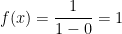
What’s f(0)? Plugging in, we find f(x) = \displaystyle \frac{1}{1-0} = 1.

Next, to find f'(0), we first find f'(x). Using the Chain Rule, we find f'(x) = -(1-x)^{-2} \cdot (-1) = \displaystyle \frac{1}{(1-x)^2}, so that f'(0) = 1.

Next, we differentiate again: f'(x) = (-2) \cdot (1-x)^{-3} \cdot (-1) = \displaystyle \frac{2}{(1-x)^3}, so that f''(0) = 2.

Hmmm… no obvious pattern yet… so let’s keep going.

For the next term, f'''(x) = (-3) \cdot 2(1-x)^{-4} \cdot (-1) = \displaystyle \frac{6}{(1-x)^4}, so that f'''(0) = 6.

For the next term, f^{(4)}(x) = (-4) \cdot 6(1-x)^{-5} \cdot (-1) = \displaystyle \frac{24}{(1-x)^5}, so that f^{(4)}(0) = 24.

Oohh… it’s the factorials again! It looks like f^{(n)}(0) = n!, and this can be formally proved by induction.

Plugging into the series, we find that

\displaystyle \frac{1}{1-x} = \sum_{n=0}^\infty \frac{n!}{n!} x^n = \sum_{n=0}^\infty x^n = 1 + x + x^2 + x^3 + \dots.

Like the series for e^x, this series converges quickest for x \approx 0. Unlike the series for e^x, this series does not converge for all real numbers. As can be checked with the Ratio Test, this series only converges if |x| < 1.

The right-hand side is a special kind of series typically discussed in precalculus. (Students often pause at this point, because most of them have forgotten this too.) It is an infinite geometric series whose first term is $1$ and common ratio $x$. So starting from the right-hand side, one can obtain the left-hand side using the formula

a + ar + ar^2 + ar^3 + \dots = \displaystyle \frac{a}{1-r}

by letting a=1 and $r=x$. Also, as stated in precalculus, this series only converges if the common ratio satisfies $|r| < 1$, as before.

In other words, in precalculus, we start with the geometric series and end with the function. With Taylor series, we start with the function and end with the series.

green line

Step 6. A whole bunch of other Taylor series can be quickly obtained from the one for \displaystyle \frac{1}{1-x}. Let’s take the derivative of both sides (and ignore the fact that one should prove that differentiating this infinite series term by term is permissible). Since
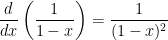
\displaystyle \frac{d}{dx} \left( \frac{1}{1-x} \right) = \frac{1}{(1-x)^2}

and

\displaystyle \frac{d}{dx} \left( 1 + x + x^2 + x^3 + x^4 + \dots \right) = 1 + 2x + 3x^2 + 4x^3 + \dots,

we have

\displaystyle \frac{1}{(1-x)^2} = 1 + 2x + 3x^2 + 4x^3 + \dots.

____________________

Next, let’s replace x with -x in the Taylor series in Step 5, obtaining


\displaystyle \frac{1}{1+x} = 1 - x + x^2 - x^3 + x^4 - x^5 \dots

Now let’s take the indefinite integral of both sides:

\displaystyle \int \frac{dx}{1+x} = \int \left( 1 - x + x^2 - x^3 + x^4 - x^5 \dots \right) \, dx

\ln(1+x) = \displaystyle x - \frac{x^2}{2} + \frac{x^3}{3} -\frac{ x^4}{4} + \frac{x^5}{5} -\frac{ x^6}{6} \dots + C

To solve for the constant of integration, let x = 0:

\ln(1) = 0+ C \Longrightarrow C = 0

Plugging back in, we conclude that

\ln(1+x) = x - \displaystyle \frac{x^2}{2} + \frac{x^3}{3} -\frac{ x^4}{4} + \frac{x^5}{5} -\frac{ x^6}{6} \dots

The Taylor series expansion for \ln(1-x) can be found by replacing x with -x:

\ln(1-x) = -x - \displaystyle \frac{x^2}{2} - \frac{x^3}{3} -\frac{ x^4}{4} - \frac{x^5}{5} -\frac{ x^6}{6} \dots

Subtracting, we find

\ln(1+x) - \ln(1-x) = \ln \displaystyle \left( \frac{1+x}{1-x} \right) = 2x + \frac{2x^3}{3}+ \frac{2x^5}{5} \dots

My understanding is that this latter series is used by calculators when computing logarithms.

____________________

Next, let’s replace x with -x^2 in the Taylor series in Step 5, obtaining

\displaystyle \frac{1}{1+x^2} = 1 - x^2 + x^4 - x^6 + x^8 - x^{10} \dots

Now let’s take the indefinite integral of both sides:

\displaystyle \int \frac{dx}{1+x^2} = \int \left(1 - x^2 + x^4 - x^6 + x^8 - x^{10} \dots\right) \, dx

\tan^{-1}x = \displaystyle x - \frac{x^3}{3} + \frac{x^5}{5} -\frac{ x^7}{7} + \frac{x^9}{9} -\frac{ x^{11}}{11} \dots + C

To solve for the constant of integration, let x = 0:

\tan^{-1}(1) = 0+ C \Longrightarrow C = 0

Plugging back in, we conclude that

\tan^{-1}x = \displaystyle x - \frac{x^3}{3} + \frac{x^5}{5} -\frac{ x^7}{7} + \frac{x^9}{9} -\frac{ x^{11}}{11} \dots

____________________

In summary, a whole bunch of Taylor series can be extracted quite quickly by differentiating and integrating from a simple infinite geometric series. I’m a firm believer in minimizing the number of formulas that I should memorize. Any time I personally need any of the above series, I’ll quickly use the above steps to derive them from that of \displaystyle \frac{1}{1-x}.

Laws of Logarithms

One of the most common student mistakes with logarithms is thinking that

\log_b(x+y) = \log_b x + \log_b y.

When I first started my career, I referred to this as the Third Classic Blunder. The first classic blunder, of course, is getting into a major land war in Asia. The second classic blunder is getting into a battle of wits with a Sicilian when death is on the line. And the third classic blunder is thinking that \log_b(x+y) somehow simplfies as \log_b x + \log_b y.

Sadly, as the years pass, fewer and fewer students immediately get the cultural reference. On the bright side, it’s also an opportunity to introduce a new generation to one of the great cinematic masterpieces of all time.

One of my colleagues calls this mistake the Universal Distributive Law, where the \log_b distributes just as if x+y was being multiplied by a constant. Other mistakes in this vein include  \sqrt{x+y} = \sqrt{x} + \sqrt{y}  and  (x+y)^2 = x^2 + y^2.

Along the same lines, other classic blunders are thinking that

\left(\log_b x\right)^n  simplifies as  \log_b \left(x^n \right)

and that

\displaystyle \frac{\log_b x}{\log_b y}  simplifies as  \log_b \left( \frac{x}{y} \right).

I’m continually amazed at the number of good students who intellectually know that the above equations are false but panic and use them when solving a problem.