Confirming Einstein’s Theory of General Relativity With Calculus, Part 9: Pedagogical Thoughts

At long last, we have reached the end of this series of posts.

The derivation is elementary; I’m confident that I could have understood this derivation had I seen it when I was in high school. That said, the word “elementary” in mathematics can be a bit loaded — this means that it is based on simple ideas that are perhaps used in a profound and surprising way. Perhaps my favorite quote along these lines was this understated gem from the book Three Pearls of Number Theory after the conclusion of a very complicated proof in Chapter 1:

You see how complicated an entirely elementary construction can sometimes be. And yet this is not an extreme case; in the next chapter you will encounter just as elementary a construction which is considerably more complicated.

Here are the elementary ideas from calculus, precalculus, and high school physics that were used in this series:

  • Physics
    • Conservation of angular momentum
    • Newton’s Second Law
    • Newton’s Law of Gravitation
  • Precalculus
    • Completing the square
    • Quadratic formula
    • Factoring polynomials
    • Complex roots of polynomials
    • Bounds on \cos \theta and \sin \theta
    • Period of \cos \theta and \sin \theta
    • Zeroes of \cos \theta and \sin \theta
    • Trigonometric identities (Pythagorean, sum and difference, double-angle)
    • Conic sections
    • Graphing in polar coordinates
    • Two-dimensional vectors
    • Dot products of two-dimensional vectors (especially perpendicular vectors)
    • Euler’s equation
  • Calculus
    • The Chain Rule
    • Derivatives of \cos \theta and \sin \theta
    • Linearizations of \cos x, \sin x, and 1/(1-x) near x \approx 0 (or, more generally, their Taylor series approximations)
    • Derivative of e^x
    • Solving initial-value problems
    • Integration by u-substitution

While these ideas from calculus are elementary, they were certainly used in clever and unusual ways throughout the derivation.

I should add that although the derivation was elementary, certain parts of the derivation could be made easier by appealing to standard concepts from differential equations.

One more thought. While this series of post was inspired by a calculation that appeared in an undergraduate physics textbook, I had thought that this series might be worthy of publication in a mathematical journal as an historical example of an important problem that can be solved by elementary tools. Unfortunately for me, Hieu D. Nguyen’s terrific article Rearing Its Ugly Head: The Cosmological Constant and Newton’s Greatest Blunder in The American Mathematical Monthly is already in the record.

Confirming Einstein’s Theory of General Relativity With Calculus, Part 8: Second- and Third-Order Approximations

In this series, I’m discussing how ideas from calculus and precalculus (with a touch of differential equations) can predict the precession in Mercury’s orbit and thus confirm Einstein’s theory of general relativity. The origins of this series came from a class project that I assigned to my Differential Equations students maybe 20 years ago.

In this series, we found an approximate solution to the governing initial-value problem

u''(\theta) + u(\theta) = \displaystyle \frac{1}{\alpha} + \delta [u(\theta)]^2

u(0) = \displaystyle \frac{1 + \epsilon}{\alpha}

u'(0) = 0,

where u = \displaystyle \frac{1}{r}, \displaystyle \frac{1}{\alpha} = \frac{GMm^2}{\ell^2}, \delta = \displaystyle \frac{3GM}{c^2}, G is the gravitational constant of the universe, m is the mass of the planet, M is the mass of the Sun, \ell is the constant angular momentum of the planet, \epsilon is the eccentricity of the orbit, and c is the speed of light.

We used the following steps to find an approximate solution.

Step 0. Ignore the general-relativity contribution and solve the simpler initial-value problem

u_0''(\theta) + u_0(\theta) = \displaystyle \frac{1}{\alpha}

u_0(0) = \displaystyle \frac{1 + \epsilon}{\alpha}

u_0'(0) = 0,

which is a zeroth-order approximation to the real initial-value problem. We found that the solution of this differential equation is

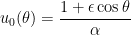
u_0(\theta) = \displaystyle \frac{1 + \epsilon \cos \theta}{\alpha},

which is the equation of an ellipse in polar coordinates.

Step 1. Solve the initial-value problem

u_1''(\theta) + u_1(\theta) = \displaystyle \frac{1}{\alpha} + \delta [u_0(\theta)]^2

u_1(0) = \displaystyle \frac{1 + \epsilon}{\alpha}

u_1'(0) = 0,

which partially incorporates the term due to general relativity. This is a first-order approximation to the real differential equation. After much effort, we found that the solution of this initial-value problem is

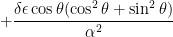
u_1(\theta) = \displaystyle \frac{1 + \epsilon \cos \theta}{\alpha} + \frac{\delta}{\alpha^2} + \frac{\delta \epsilon^2}{2\alpha^2} + \frac{ \delta\epsilon}{\alpha^2} \theta \sin \theta - \frac{ \delta \epsilon^2}{6\alpha^2} \cos 2\theta - \frac{\delta(3+\epsilon^2)}{3\alpha^2} \cos \theta.

For large values of \theta, this is accurately approximated as:

u_1(\theta) \approx \displaystyle \frac{1 + \epsilon \cos \theta}{\alpha} + \frac{ \delta\epsilon}{\alpha^2} \theta \sin \theta,

which can be further approximated as

u_1(\theta) \approx \displaystyle \frac{1}{\alpha} \left[ 1 + \epsilon \cos \left( \theta - \frac{\delta \theta}{\alpha} \right) \right].

From this expression, the precession in a planet’s orbit due to general relativity can be calculated.

Roughly 20 years ago, I presented this application of differential equations at the annual meeting of the Texas Section of the Mathematical Association of America. After the talk, a member of the audience asked what would happen if we did this procedure yet again to find a second-order approximation. In other words, I was asked to consider…

Step 2. Solve the initial-value problem

u_2''(\theta) + u_2(\theta) = \displaystyle \frac{1}{\alpha} + \delta [u_1(\theta)]^2

u_2(0) = \displaystyle \frac{1 + \epsilon}{\alpha}

u_2'(0) = 0.

It stands to reason that the answer should be an even more accurate approximation to the true solution u(\theta).

I didn’t have an immediate answer for this question, but I can answer it now. Letting Mathematica do the work, here’s the answer:

Yes, it’s a mess. The term in red is u_0(\theta), while the term in yellow is the next largest term in u_1(\theta). Both of these appear in the answer to u_2(\theta).

The term in green is the next largest term in u_2(\theta), with the highest power of \theta in the numerator and the highest power of \alpha in the denominator. In other words,

u_2(\theta) \approx \displaystyle \frac{1 + \epsilon \cos \theta}{\alpha} + \frac{ \delta\epsilon}{\alpha^2} \theta \sin \theta -\frac{\delta^2 \epsilon}{2\alpha^3} \theta^2 \cos \theta.

How does this compare to our previous approximation of

u(\theta) \approx \displaystyle \frac{1}{\alpha} \left[ 1 + \epsilon \cos \left( \theta - \frac{\delta \theta}{\alpha} \right) \right]?

Well, to a second-order Taylor approximation, it’s the same! Let

f(x) = \displaystyle \frac{1}{\alpha} \left[ 1 + \epsilon \cos \left( \theta - x \right) \right].

Expanding about x = 0 and treated \theta as a constant, we find

f(x) \approx f(0) + f'(0) x + \displaystyle \frac{f''(0)}{2} x^2 = \displaystyle \frac{1}{\alpha} \left[ 1 + \epsilon \cos \left( \theta\right) \right] + \frac{\epsilon}{\alpha} x \sin \theta - \frac{\epsilon}{2\alpha} x^2 \cos \theta.

Substituting x = \displaystyle \frac{\delta \theta}{\alpha} yields the above approximation for u_2(\theta).

Said another way, proceeding to a second-order approximation merely provides additional confirmation for the precession of a planet’s orbit.

Just for the fun of it, I also used Mathematica to find the solution of Step 3:

Step 2. Solve the initial-value problem

u_3''(\theta) + u_3(\theta) = \displaystyle \frac{1}{\alpha} + \delta [u_2(\theta)]^2

u_3(0) = \displaystyle \frac{1 + \epsilon}{\alpha}

u_3'(0) = 0.

I won’t copy-and-paste the solution from Mathematica; unsurpisingly, it’s really long. I will say that, unsurprisingly, the leading terms are

u_3(\theta) \approx \displaystyle \frac{1 + \epsilon \cos \theta}{\alpha} + \frac{ \delta\epsilon}{\alpha^2} \theta \sin \theta -\frac{\delta^2 \epsilon}{2 \alpha^3} \theta^2 \cos \theta  -\frac{\delta^3 \epsilon}{6\alpha^4} \theta^3 \sin \theta.

I said “unsurprisingly” because this matches the third-order Taylor polynomial of our precession expression. I don’t have time to attempt it, but surely there’s a theorem to be proven here based on this computational evidence.

Confirming Einstein’s Theory of General Relativity With Calculus, Part 6k: Solving New Differential Equation with Method of Undetermined Coefficients

In this series, I’m discussing how ideas from calculus and precalculus (with a touch of differential equations) can predict the precession in Mercury’s orbit and thus confirm Einstein’s theory of general relativity. The origins of this series came from a class project that I assigned to my Differential Equations students maybe 20 years ago.

We have shown that the motion of a planet around the Sun, expressed in polar coordinates (r,\theta) with the Sun at the origin, under general relativity follows the initial-value problem

u''(\theta) + u(\theta) = \displaystyle \frac{1}{\alpha} + \frac{\delta}{\alpha^2} + \frac{\delta \epsilon^2}{2\alpha^2} + \frac{2\delta \epsilon \cos \theta}{\alpha^2} + \frac{\delta \epsilon^2 \cos 2\theta}{2\alpha^2},

u(0) = \displaystyle \frac{1}{P},

u'(0) = 0,

where u = \displaystyle \frac{1}{r}, \displaystyle \frac{1}{\alpha} = \frac{GMm^2}{\ell^2}, \delta = \displaystyle \frac{3GM}{c^2}, G is the gravitational constant of the universe, m is the mass of the planet, M is the mass of the Sun, \ell is the constant angular momentum of the planet, c is the speed of light, and P is the smallest distance of the planet from the Sun during its orbit (i.e., at perihelion).

In recent posts, we used the method of undetermined coefficients to show that the general solution of the differential equation is

u(\theta) = c_1 \cos \theta + c_2 \sin \theta + \displaystyle \frac{1}{\alpha} + \frac{\delta}{\alpha^2} + \frac{\delta \epsilon^2}{2\alpha^2} +\frac{\delta \epsilon}{\alpha^2} \theta \sin \theta- \frac{\delta \epsilon^2}{6\alpha^2} \cos 2\theta.

We now use the initial conditions to find the constants c_1 and c_2. (We did this earlier when we solved the differential equation via variation of parameters, but we repeat the argument here for completeness.) From the initial condition u(0) = \displaystyle \frac{1}{P} = \frac{1+\epsilon}{\alpha}, we obtain
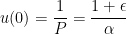
u(0) = \displaystyle c_1 \cos 0 + c_2 \sin 0 + \displaystyle \frac{1}{\alpha} +  \frac{\delta}{\alpha^2} + \frac{\delta \epsilon^2}{2\alpha^2} + \frac{\delta \epsilon \cdot 0 \cdot \sin 0}{\alpha^2} -\frac{\delta \epsilon^2 \cos 0}{6\alpha^2}

\displaystyle \frac{1+\epsilon}{\alpha} = c_1 + \displaystyle \frac{1}{\alpha} +  \frac{\delta}{\alpha^2} + \frac{\delta \epsilon^2}{2\alpha^2}  -\frac{\delta \epsilon^2}{6\alpha^2}

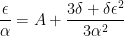
\displaystyle \frac{\epsilon}{\alpha} = c_1 + \displaystyle \frac{3\delta +\delta \epsilon^2}{3\alpha^2},

so that

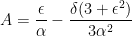
c_1 = \displaystyle \frac{\epsilon}{\alpha} - \frac{\delta(3 + \epsilon^2)}{3\alpha^2}.

Next, we compute u'(\theta) and use the initial condition u'(0) = 0:

u'(\theta) = \displaystyle -c_1 \sin \theta + c_2 \cos \theta + \frac{\delta \epsilon}{\alpha^2} (\sin \theta + \theta \cos \theta) + \frac{\delta \epsilon^2 \sin 2\theta}{3\alpha^2}

u'(0) = \displaystyle -c_1 \sin 0 + c_2 \cos 0 + \frac{\delta \epsilon}{\alpha^2} (\sin 0 + 0  \cos 0) + \frac{\delta \epsilon^2 \sin 0}{3\alpha^2}

0 = c_2.

Substituting these values for c_1 and c_2, we finally arrive at the solution

u(\theta) = \displaystyle \left(\frac{\epsilon}{\alpha} - \frac{\delta(3 + \epsilon^2)}{3\alpha^2} \right) \cos \theta + \displaystyle \frac{1}{\alpha} +  \frac{\delta}{\alpha^2} + \frac{\delta \epsilon^2}{2\alpha^2} + \frac{\delta \epsilon \theta \sin \theta}{\alpha^2} -\frac{\delta \epsilon^2 \cos 2\theta}{6\alpha^2}

= \displaystyle \frac{1 + \epsilon \cos \theta}{\alpha} + \frac{\delta}{\alpha^2} + \frac{\delta \epsilon^2}{2\alpha^2} + \frac{ \delta\epsilon}{\alpha^2} \theta \sin \theta - \frac{ \delta \epsilon^2}{6\alpha^2} \cos 2\theta - \frac{\delta(3+\epsilon^2)}{3\alpha^2} \cos \theta.

Confirming Einstein’s Theory of General Relativity With Calculus, Part 6c: Solving New Differential Equation with Variation of Parameters

In this series, I’m discussing how ideas from calculus and precalculus (with a touch of differential equations) can predict the precession in Mercury’s orbit and thus confirm Einstein’s theory of general relativity. The origins of this series came from a class project that I assigned to my Differential Equations students maybe 20 years ago.

Under general relativity, the motion of a planet around the Sun —in polar coordinates (r,\theta), with the Sun at the origin — satisfies the initial-value problem

u''(\theta) + u(\theta) = \displaystyle \frac{1}{\alpha} + \delta \left( \frac{1 + \epsilon \cos \theta}{\alpha} \right)^2,

u(0) = \displaystyle \frac{1}{P},

u'(0) = 0,

where u = \displaystyle \frac{1}{r}, \displaystyle \frac{1}{\alpha} = \frac{GMm^2}{\ell^2}, \delta = \displaystyle \frac{3GM}{c^2}, G is the gravitational constant of the universe, m is the mass of the planet, M is the mass of the Sun, \ell is the constant angular momentum of the planet, c is the speed of light, and P is the smallest distance of the planet from the Sun during its orbit (i.e., at perihelion).

We now take the perspective of a student who is taking a first-semester course in differential equations. There are two standard techniques for solving a second-order non-homogeneous differential equations with constant coefficients. One of these is the method of variation of parameters. First, we solve the associated homogeneous differential equation

u''(\theta) + u(\theta) = 0.

The characteristic equation of this differential equation is r^2 + 1 = 0, which clearly has the two imaginary roots r = \pm i. Therefore, two linearly independent solutions of the associated homogeneous equation are u_1(\theta) = \cos \theta and u_2(\theta) = \sin \theta.

(As an aside, this is one answer to the common question, “What are complex numbers good for?” The answer is naturally above the heads of Algebra II students when they first encounter the mysterious number i, but complex numbers provide a way of solving the differential equations that model multiple problems in statics and dynamics.)


According to the method of variation of parameters, the general solution of the original nonhomogeneous differential equation

u''(\theta) + u(\theta) = g(\theta)

is

u(\theta) = f_1(\theta) u_1(\theta) + f_2(\theta) u_2(\theta),

where

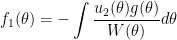
f_1(\theta) = -\displaystyle \int \frac{u_2(\theta) g(\theta)}{W(\theta)} d\theta ,

f_2(\theta) = \displaystyle \int \frac{u_1(\theta) g(\theta)}{W(\theta)} d\theta ,

and W(\theta) is the Wronskian of u_1(\theta) and u_2(\theta), defined by the determinant

W(\theta) = \displaystyle \begin{vmatrix} u_1(\theta) & u_2(\theta) \\ u_1'(\theta) & u_2'(\theta) \end{vmatrix}  = u_1(\theta) u_2'(\theta) - u_1'(\theta) u_2(\theta).

Well, that’s a mouthful.

The only good news is that W is easy to compute. Since u_1(\theta) = \cos \theta and u_2(\theta) = \sin \theta, we have

W(\theta) = (\cos \theta)(\cos \theta) - (\sin \theta)(-\sin \theta) = \cos^2 \theta + \sin^2 \theta = 1

from the usual Pythagorean trigonometric identity. Therefore, the denominators in the integrals for f_1(\theta) and f_2(\theta) essentially disappear.

Unfortunately, computing f_1(\theta) and f_2(\theta), using

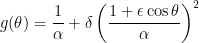
g(\theta) = \displaystyle \frac{1}{\alpha} + \delta \left( \frac{1 + \epsilon \cos \theta}{\alpha} \right)^2,

is a beast, requiring the creative use of multiple trigonometric identities. We begin with f_1(\theta), using the substitution t = \cos \theta:

f_1(\theta) = -\displaystyle \int \left[ \frac{1}{\alpha} + \delta \left( \frac{1 + \epsilon \cos \theta}{\alpha} \right)^2 \right] \sin \theta \, d\theta

= \displaystyle \int \left[ \frac{1}{\alpha} + \delta \left( \frac{1 + \epsilon t}{\alpha} \right)^2 \right] \, dt

= \displaystyle \int \left[ \frac{1}{\alpha} + \delta \left( \frac{1 + \epsilon t}{\alpha} \right)^2 \right] \, dt

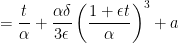
= \displaystyle \frac{t}{\alpha} +  \frac{\alpha\delta}{3\epsilon} \left( \frac{1 + \epsilon t}{\alpha} \right)^3 + a

= \displaystyle \frac{\cos \theta}{\alpha} +  \frac{\alpha\delta}{3\epsilon} \left( \frac{1 + \epsilon \cos \theta}{\alpha} \right)^3 + a,

where we use +a for the constant of integration instead of the usual +C. Second,

f_2(\theta) = \displaystyle \int \left[ \frac{1}{\alpha} + \delta \left( \frac{1 + \epsilon \cos \theta}{\alpha} \right)^2 \right] \cos\theta \, d\theta.

Unfortunately, this is not easily simplified with a substitution, so we have to expand the integrand:

f_2(\theta) = \displaystyle \int \left[ \frac{\cos \theta}{\alpha} + \frac{\delta \cos \theta}{\alpha^2} + \frac{2 \delta \epsilon \cos^2 \theta}{\alpha^2} + \frac{\delta \epsilon^2 \cos^3 \theta}{\alpha^2} \right] \, d\theta

= \displaystyle \int \left[ \frac{\cos \theta}{\alpha} + \frac{\delta \cos \theta}{\alpha^2} + \frac{\delta \epsilon (1 + \cos 2 \theta)}{\alpha^2} + \frac{\delta \epsilon^2 \cos \theta \cos^2 \theta}{\alpha^2} \right] \, d\theta

= \displaystyle \int \left[ \frac{\cos \theta}{\alpha} + \frac{\delta \cos \theta}{\alpha^2} + \frac{\delta \epsilon}{\alpha^2} + \frac{\delta \epsilon \cos 2 \theta}{\alpha^2}+ \frac{\delta \epsilon^2 \cos \theta (1- \sin^2 \theta)}{\alpha^2} \right] \, d\theta

= \displaystyle \int \left[ \frac{\cos \theta}{\alpha} + \frac{\delta (1 + \epsilon^2) \cos \theta}{\alpha^2}  + \frac{\delta \epsilon}{\alpha^2} + \frac{\delta \epsilon \cos 2 \theta}{\alpha^2} - \frac{\delta \epsilon^2 \cos \theta \sin^2 \theta}{\alpha^2} \right] \, d\theta

= \displaystyle \frac{\sin\theta}{\alpha} + \frac{\delta (1 + \epsilon^2) \sin\theta}{\alpha^2}  + \frac{\delta \epsilon \theta}{\alpha^2} + \frac{\delta \epsilon \sin 2 \theta}{2\alpha^2} - \frac{\delta \epsilon^2 \sin^3 \theta}{3\alpha^2} + b,

using +b for the constant of integration. Therefore, by variation of parameters, the general solution of the nonhomogeneous differential equation is



u(\theta) = f_1(\theta) u_1(\theta) + f_2(\theta) u_2(\theta)

= \displaystyle \left( \frac{\cos \theta}{\alpha} +  \frac{\delta}{3\alpha^2\epsilon} \left( 1 + \epsilon \cos \theta \right)^3 + a \right) \cos \theta

+ \displaystyle \left(\frac{\sin\theta}{\alpha} + \frac{\delta (1 + \epsilon^2) \sin\theta}{\alpha^2}  + \frac{\delta \epsilon \theta}{\alpha^2} + \frac{\delta \epsilon \sin 2 \theta}{2\alpha^2} - \frac{\delta \epsilon^2 \sin^3 \theta}{3\alpha^2} + b  \right) \sin \theta

= a\cos \theta + b \sin \theta + \displaystyle \frac{\cos^2 \theta + \sin^2 \theta}{\alpha} +  \frac{\delta \cos \theta}{3\alpha^2\epsilon} +  \frac{\delta \cos^2 \theta}{\alpha^2} +  \frac{\delta \epsilon \cos^3 \theta}{\alpha^2}+  \frac{\delta\epsilon^2 \cos^4 \theta}{3\alpha^2}

+ \displaystyle \frac{\delta \sin^2 \theta}{\alpha^2} + \frac{\delta \epsilon^2 \sin^2\theta}{\alpha^2}  + \frac{\delta \epsilon \theta \sin \theta}{\alpha^2} + \frac{\delta \epsilon \sin \theta\sin 2 \theta}{2\alpha^2} - \frac{\delta \epsilon^2 \sin^4 \theta}{3\alpha^2}

= a\cos \theta + \displaystyle \frac{\delta \cos \theta}{3\alpha^2\epsilon} + b \sin \theta + \displaystyle \frac{1}{\alpha} +  \frac{\delta (\cos^2 \theta+\sin^2 \theta)}{\alpha^2} +  \frac{\delta \epsilon \cos^3 \theta}{\alpha^2}+  \frac{\delta\epsilon^2 \cos^4 \theta}{3\alpha^2}

\displaystyle + \frac{\delta \epsilon^2 \sin^2\theta}{\alpha^2}  + \frac{\delta \epsilon \theta \sin \theta}{\alpha^2} + \frac{\delta \epsilon \sin \theta\sin 2 \theta}{2\alpha^2} - \frac{\delta \epsilon^2 \sin^4 \theta}{3\alpha^2}

= a\cos \theta+ \displaystyle \frac{\delta \cos \theta}{3\alpha^2\epsilon}  + b \sin \theta + \displaystyle \frac{1}{\alpha} +  \frac{\delta}{\alpha^2} + \frac{\delta \epsilon \theta \sin \theta}{\alpha^2} +  \frac{\delta \epsilon \cos^3 \theta}{\alpha^2} + \frac{\delta \epsilon \sin \theta\sin 2 \theta}{2\alpha^2}

\displaystyle + \frac{\delta \epsilon^2 \sin^2\theta}{\alpha^2}  + \frac{\delta \epsilon^2 (\cos^4 \theta -\sin^4 \theta)}{3\alpha^2}

= a\cos \theta + \displaystyle \frac{\delta \cos \theta}{3\alpha^2\epsilon} + b \sin \theta + \displaystyle \frac{1}{\alpha} +  \frac{\delta}{\alpha^2} + \frac{\delta \epsilon \theta \sin \theta}{\alpha^2}  +  \frac{\delta \epsilon \cos^3 \theta}{\alpha^2} + \frac{\delta \epsilon \sin \theta \cdot 2 \sin \theta \cos \theta}{2\alpha^2}

\displaystyle + \frac{\delta \epsilon^2 (1-\cos 2\theta)}{2\alpha^2}  + \frac{\delta \epsilon^2 (\cos^2 \theta +\sin^2\theta)(\cos^2 \theta - \sin^2 \theta)}{3\alpha^2}

= a\cos \theta+ \displaystyle \frac{\delta \cos \theta}{3\alpha^2\epsilon} + b \sin \theta + \displaystyle \frac{1}{\alpha} +  \frac{\delta}{\alpha^2} + \frac{\delta \epsilon \theta \sin \theta}{\alpha^2}  +  \frac{\delta \epsilon \cos^3 \theta}{\alpha^2} + \frac{\delta \epsilon \sin^2 \theta\cos 2 \theta}{\alpha^2}

\displaystyle + \frac{\delta \epsilon^2}{2\alpha^2} -\frac{\delta \epsilon^2 \cos 2\theta}{2\alpha^2}  + \frac{\delta \epsilon^2 \cos 2 \theta}{3\alpha^2}

= a\cos \theta + \displaystyle \frac{\delta \cos \theta}{3\alpha^2\epsilon}+ b \sin \theta + \displaystyle \frac{1}{\alpha} +  \frac{\delta}{\alpha^2} + \frac{\delta \epsilon^2}{2\alpha^2} + \frac{\delta \epsilon \theta \sin \theta}{\alpha^2} -\frac{\delta \epsilon^2 \cos 2\theta}{6\alpha^2}

\displaystyle   +  \frac{\delta \epsilon \cos^3 \theta}{\alpha^2} + \frac{\delta \epsilon \sin^2 \theta\cos \theta}{\alpha^2}

= a\cos \theta + \displaystyle \frac{\delta \cos \theta}{3\alpha^2\epsilon}+ b \sin \theta + \displaystyle \frac{1}{\alpha} +  \frac{\delta}{\alpha^2} + \frac{\delta \epsilon^2}{2\alpha^2} + \frac{\delta \epsilon \theta \sin \theta}{\alpha^2} -\frac{\delta \epsilon^2 \cos 2\theta}{6\alpha^2}

\displaystyle   +  \frac{\delta \epsilon \cos \theta (\cos^2 \theta + \sin^2 \theta)}{\alpha^2}

= a\cos \theta + \displaystyle \frac{\delta \cos \theta}{3\alpha^2\epsilon}+ b \sin \theta + \displaystyle \frac{1}{\alpha} +  \frac{\delta}{\alpha^2} + \frac{\delta \epsilon^2}{2\alpha^2} + \frac{\delta \epsilon \theta \sin \theta}{\alpha^2} -\frac{\delta \epsilon^2 \cos 2\theta}{6\alpha^2} +  \frac{\delta \epsilon \cos \theta}{\alpha^2}

= \displaystyle \left(a +  \displaystyle \frac{\delta}{3\alpha^2\epsilon} +  \frac{\delta \epsilon}{\alpha^2} \right) \cos \theta + b \sin \theta + \displaystyle \frac{1}{\alpha} +  \frac{\delta}{\alpha^2} + \frac{\delta \epsilon^2}{2\alpha^2} + \frac{\delta \epsilon \theta \sin \theta}{\alpha^2} -\frac{\delta \epsilon^2 \cos 2\theta}{6\alpha^2}

= \displaystyle A \cos \theta + b \sin \theta + \displaystyle \frac{1}{\alpha} +  \frac{\delta}{\alpha^2} + \frac{\delta \epsilon^2}{2\alpha^2} + \frac{\delta \epsilon \theta \sin \theta}{\alpha^2} -\frac{\delta \epsilon^2 \cos 2\theta}{6\alpha^2} ,

where A is another arbitrary constant.

Next, we use the initial conditions to find the constants A and b. From the initial condition u(0) = \displaystyle \frac{1}{P} = \frac{1+\epsilon}{\alpha}, we obtain

u(0) = \displaystyle A \cos 0 + b \sin 0 + \displaystyle \frac{1}{\alpha} +  \frac{\delta}{\alpha^2} + \frac{\delta \epsilon^2}{2\alpha^2} + \frac{\delta \epsilon \cdot 0 \cdot \sin 0}{\alpha^2} -\frac{\delta \epsilon^2 \cos 0}{6\alpha^2}

\displaystyle \frac{1+\epsilon}{\alpha} = A + \displaystyle \frac{1}{\alpha} +  \frac{\delta}{\alpha^2} + \frac{\delta \epsilon^2}{2\alpha^2}  -\frac{\delta \epsilon^2}{6\alpha^2}

\displaystyle \frac{\epsilon}{\alpha} = A + \displaystyle \frac{3\delta +\delta \epsilon^2}{3\alpha^2},

so that

A = \displaystyle \frac{\epsilon}{\alpha} - \frac{\delta(3 + \epsilon^2)}{3\alpha^2}.

Next, we compute u'(\theta) and use the initial condition u'(0) = 0:

u'(\theta) = \displaystyle -A \sin \theta + b \cos \theta + \frac{\delta \epsilon}{\alpha^2} (\sin \theta + \theta \cos \theta) + \frac{\delta \epsilon^2 \sin 2\theta}{3\alpha^2}

u'(0) = \displaystyle -A \sin 0 + b \cos 0 + \frac{\delta \epsilon}{\alpha^2} (\sin 0 + 0  \cos 0) + \frac{\delta \epsilon^2 \sin 0}{3\alpha^2}

0 = b.

Substituting these values for A and b, we finally arrive at the solution

u(\theta) = \displaystyle \left(\frac{\epsilon}{\alpha} - \frac{\delta(3 + \epsilon^2)}{3\alpha^2} \right) \cos \theta + \displaystyle \frac{1}{\alpha} +  \frac{\delta}{\alpha^2} + \frac{\delta \epsilon^2}{2\alpha^2} + \frac{\delta \epsilon \theta \sin \theta}{\alpha^2} -\frac{\delta \epsilon^2 \cos 2\theta}{6\alpha^2}

= \displaystyle \frac{1 + \epsilon \cos \theta}{\alpha} + \frac{\delta}{\alpha^2} + \frac{\delta \epsilon^2}{2\alpha^2} + \frac{ \delta\epsilon}{\alpha^2} \theta \sin \theta - \frac{ \delta \epsilon^2}{6\alpha^2} \cos 2\theta - \frac{\delta(3+\epsilon^2)}{3\alpha^2} \cos \theta.

Confirming Einstein’s Theory of General Relativity With Calculus, Part 5b: Deriving Orbits under Newtonian Mechanics with Calculus

In this series, I’m discussing how ideas from calculus and precalculus (with a touch of differential equations) can predict the precession in Mercury’s orbit and thus confirm Einstein’s theory of general relativity. The origins of this series came from a class project that I assigned to my Differential Equations students maybe 20 years ago.

We previously showed that if the motion of a planet around the Sun is expressed in polar coordinates (r,theta), with the Sun at the origin, then under Newtonian mechanics (i.e., without general relativity) the motion of the planet follows the differential equation
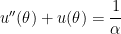
u''(\theta) + u(\theta) = \displaystyle \frac{1}{\alpha},

where u = 1/r and \alpha is a certain constant. We will also impose the initial condition that the planet is at perihelion (i.e., is closest to the sun), at a distance of P, when \theta = 0. This means that u obtains its maximum value of 1/P when \theta = 0. This leads to the two initial conditions

u(0) = \displaystyle \frac{1}{P} \qquad \hbox{and} \qquad u'(0) = 0;

the second equation arises since u has a local extremum at \theta = 0.

In the previous post, we confirmed that

u(\theta) = \displaystyle \frac{1 + \epsilon \cos \theta}{\alpha}

solved this initial-value problem. However, the solution was unsatisfying because it gave no indication of where this guess might have come from. In this post, I suggest a series of questions that good calculus students could be asked that would hopefully lead them quite naturally to this solution.

Step 1. Let’s make the differential equation simpler, for now, by replacing the right-hand side with 0:

u''(\theta) + u(\theta) = 0,

or

u''(\theta) = -u(\theta).

Can you think of a function or two that, when you differentiate twice, you get the original function back, except with a minus sign in front?

Answer to Step 1. With a little thought, hopefully students can come up with the standard answers of u(\theta) = \cos \theta and u(\theta) = \sin \theta.

Step 2. Using these two answers, can you think of a third function that works?

Answer to Step 2. This is usually the step that students struggle with the most, as they usually try to think of something completely different that works. This won’t work, but that’s OK… we all learn from our failures. If they can’t figure out, I’ll give a big hint: “Try multiplying one of these two answers by something.” In time, they’ll see that answers like u(\theta) = 2\cos \theta and u(\theta) = 3\sin \theta work. Once that conceptual barrier is broken, they’ll usually produce the solutions u(\theta) = a \cos \theta and u(\theta) = b \sin \theta.

Step 3. Using these two answers, can you think of anything else that works?

Answer to Step 3. Again, students might struggle as they imagine something else that works. If this goes on for too long, I’ll give a big hint: “Try combining them.” Eventually, we hopefully get to the point that they’ll see that the linear combination u(\theta) = a \cos \theta + b \sin \theta also solves the associated homogeneous differential equation.

Step 4. Let’s now switch back to the original differential equation u''(\theta) + u(\theta) = \displaystyle \frac{1}{\alpha}. Let’s start simple: u''(\theta) + u(\theta) = 5. Can you think of an easy function that’s a solution?

Answer to Step 4. This might take some experimentation, and students will probably try unnecessarily complicated guesses first. If this goes on for too long, I’ll give a big hint: “Try a constant.” Eventually, they hopefully determine that if u(\theta) = 5 is a constant function, then clearly u'(\theta) = 0 and u''(\theta) = 0, so that u''(\theta) + u(\theta) = 5.

Step 5. Let’s return to u''(\theta) + u(\theta) = \displaystyle \frac{1}{\alpha}. Any guesses on an answer to this one?

Answer to Step 5. Hopefully, students quickly realize that the constant function u(\theta) = \displaystyle \frac{1}{\alpha} works.

Step 6. Let’s review. We’ve shown that anything of the form u(\theta) = a\cos \theta + b \sin \theta is a solution of u''(\theta) + u(\theta) = 0. We’ve also shown that u(\theta) = \displaystyle\frac{1}{\alpha} is a solution of u''(\theta) + u(\theta) = \displaystyle \frac{1}{\alpha}. Can you think use these two answers to find something else that works?

Answer to Step 6. Hopefully, with the experience learned from Step 3, students will guess that u(\theta) = a\cos \theta + b\sin \theta + \displaystyle \frac{1}{\alpha} will work.

Step 7. OK, that solves the differential equation. Any thoughts on how to find the values of a and b so that u(0) = \displaystyle \frac{1}{P} and u'(0) = 0?

Answer to Step 7. Hopefully, students will see that we should just plug into u(\theta):

u(0) = a \cos 0 + b \sin 0 + \displaystyle \frac{1}{\alpha}

\displaystyle \frac{1}{P} = a + \frac{1}{\alpha}

\displaystyle \frac{1}{P} - \frac{1}{\alpha} = a

\displaystyle \frac{\alpha - P}{\alpha P} = a

To find b, we first find u'(\theta) and then substitute \theta = 0:

u'(\theta) = -a \sin \theta + b \cos \theta

u'(0) = -a \sin 0 + b \cos 0

0 = b.

From these two constants, we obtain

u(\theta) = \displaystyle \frac{\alpha - P}{\alpha P}  \cos \theta + 0 \sin \theta + \displaystyle \frac{1}{\alpha}

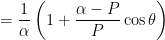
= \displaystyle \frac{1}{\alpha} \left(  1 + \frac{\alpha-P}{P} \cos \theta \right)

= \displaystyle \frac{1 + \epsilon \cos \theta}{\alpha},

where \epsilon = \displaystyle \frac{\alpha - P}{P}.

Finally, since r = 1/u, we see that the planet’s orbit satisfies
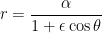
r = \displaystyle \frac{\alpha}{1 + \epsilon \cos \theta},

so that, as shown earlier in this series, the orbit is an ellipse with eccentricity \epsilon.

Confirming Einstein’s Theory of General Relativity With Calculus, Part 5a: Confirming Orbits under Newtonian Mechanics with Calculus

In this series, I’m discussing how ideas from calculus and precalculus (with a touch of differential equations) can predict the precession in Mercury’s orbit and thus confirm Einstein’s theory of general relativity. The origins of this series came from a class project that I assigned to my Differential Equations students maybe 20 years ago.

We previously showed that if the motion of a planet around the Sun is expressed in polar coordinates (r,\theta), with the Sun at the origin, then under Newtonian mechanics (i.e., without general relativity) the motion of the planet follows the differential equation

u''(\theta) + u(\theta) = \displaystyle \frac{1}{\alpha},

where u = 1/r and \alpha is a certain constant. We will also impose the initial condition that the planet is at perihelion (i.e., is closest to the sun), at a distance of P, when \theta = 0. This means that u obtains its maximum value of 1/P when \theta = 0. This leads to the two initial conditions

u(0) = \displaystyle \frac{1}{P} \qquad \hbox{and} \qquad u'(0) = 0;

the second equation arises since u has a local extremum at \theta = 0.

In the next few posts, we’ll discuss the solution of this initial-value problem. Today’s post would be appropriate for calculus students, which is confirming that

u(\theta) = \displaystyle \frac{1 + \epsilon \cos \theta}{\alpha}

solves this initial-value problem, where \epsilon = \displaystyle \frac{\alpha-P}{P}. Since r is the reciprocal of u, we infer that

r = \displaystyle \frac{\alpha}{1 + \epsilon \cos \theta}.

As we’ve already seen in this series, this means that the orbit of the planet is a conic section — either a circle, ellipse, parabola, or hyperbola. Since the orbit of a planet is stable and \epsilon = 0 is extremely unlikely, this means that the planet orbits the Sun in an ellipse, with the Sun at one focus of the ellipse.
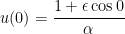
So, for a calculus student to verify that planets move in ellipses, one must check that

u(\theta) = \displaystyle \frac{1 + \epsilon \cos \theta}{\alpha}

is a solution of the initial-value problem

u''(\theta) + u(\theta) = \displaystyle \frac{1}{\alpha},

u(0) = \displaystyle \frac{1}{P},

u'(0) = 0.

The second line is easy to check:

u(0) = \displaystyle \frac{1 + \epsilon \cos 0}{\alpha}

= \displaystyle \frac{1 + \epsilon}{\alpha}

= \displaystyle \frac{1 + \displaystyle \frac{\alpha-P}{P}}{\alpha}

= \displaystyle \frac{1}{\alpha} \frac{P + \alpha - P}{P}

= \displaystyle \frac{1}{\alpha} \frac{\alpha}{P}

= \displaystyle \frac{1}{P}.

The third line is also easy to check:

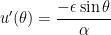
u'(\theta) = \displaystyle \frac{-\epsilon \sin \theta}{\alpha}

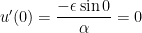
u'(0) = \displaystyle \frac{-\epsilon \sin 0}{\alpha} = 0.

To check the first line, we first find u''(\theta):

u''(\theta) = \displaystyle \frac{-\epsilon \cos \theta}{\alpha},

so that

u''(\theta) + u(\theta) = \displaystyle \frac{-\epsilon \cos \theta}{\alpha} + \frac{1 + \epsilon \cos \theta}{\alpha} = \frac{1}{\alpha},

thus confirming that u(\theta) = \displaystyle \frac{1 + \epsilon \cos \theta}{\alpha} solves the initial-value problem.

While the above calculations are well within the grasp of a good Calculus I student, I’ll be the first to admit that this solution is less than satisfying. We just mysteriously proposed a solution, seemingly out of thin air, and confirmed that it worked. In the next post, I’ll proposed a way that calculus students can be led to guess this solution. Then, we talk about finding the solution of this nonhomogeneous initial-value problem using standard techniques from differential equations.

Acceleration

The following two questions came from a middle-school math textbook. The first is reasonable, while the second is a classic example of an author being overly cute when writing a homework problem.

  1.  A car slams on its brakes, coming to a complete stop in 4 seconds.  The car was traveling north at 60mph. Calculate the acceleration.
  2. A rocket blasts off. At 10 seconds after blast off, it is at 10,000 feet, traveling at 3600mph.  Assuming the direction is up, calculate the acceleration.

For the first question, we’ll assume constant deceleration (after all, this comes from a middle-school textbook). First, let’s convert from miles per hour to feet per second:

60 ~ \frac{\hbox{mile}}{\hbox{hour}} = 60 ~ \frac{\hbox{mile}}{\hbox{hour}} \times \frac{1 ~ \hbox{hour}}{3600 ~ \hbox{second}} \times \frac{5280 ~ \hbox{feet}}{1 ~ \hbox{mile}} = 88~ \frac{\hbox{feet}}{\hbox{second}}

The deceleration is therefore equal to the change in velocity over time, or

\frac{-88 ~ \hbox{feet/second}}{4 ~ \hbox{second}} = -22 ~\hbox{ft/s}^2

Now notice the word north in the statement of the first question. This bit of information is irrelevant to the problem. I presume that the writer of the problem wants students to practice picking out the important information of a problem from the unimportant… again, a good skill for students to acquire.

green line

Let’s now turn to the second question. At first blush, this also has irrelevant information…  it is at 10,000 feet. So I presume that the author wants students to solve this in exactly the same way:

3600 ~ \frac{\hbox{mile}}{\hbox{hour}} = 3600 ~ \frac{\hbox{mile}}{\hbox{hour}} \times \frac{1 ~ \hbox{hour}}{3600 ~ \hbox{second}} \times \frac{5280 ~ \hbox{feet}}{1 ~ \hbox{mile}} = 5280 ~ \frac{\hbox{feet}}{\hbox{second}}

for an acceleration of

\frac{5280 ~ \hbox{feet/second}}{10 ~ \hbox{second}} = 528 ~\hbox{ft/s}^2

The major flaw with this question is that the acceleration of the rocket completely determines the distance that the rocket travels. While middle-school students would not be expected to know this, we can use calculus to determine the distance. Since the initial position and velocity are zero, we obtain

x''(t) = 528

x'(t) = \int 528 \, dt = 528t + C

x'(0) = 528(0) + C

0 = C

\therefore x'(t) = 528t + 0 = 528t

x(t) = \int 528t \, dt = 264t^2 + C

x(0) = 264(0)^2 + C

\therefore x(t) = 264t^2 + 0 = 264t^2

Therefore, the rocket travels a distance of 264 ~ \hbox{feet/second}^2 \times (10 ~ \hbox{second})^2 = 26400 ~ \hbox{feet}. In other words, not 10,000 feet.

As a mathematician, this is the kind of error that drives me crazy, as I would presume that the author of this textbook should know that he/she just can’t make up a distance in the effort of making a problem more interesting to students.