Formula for an infinite geometric series (Part 11)

Many math majors don’t have immediate recall of the formula for an infinite geometric series. They often can remember that there is a formula, but they can’t recollect the details. While it’s I think it’s OK that they don’t have the formula memorized, I think is a real shame that they’re also unaware of where the formula comes from and hence are unable to rederive the formula if they’ve forgotten it.

In this post, I’d like to give some thoughts about why the formula for an infinite geometric series is important for other areas of mathematics besides Precalculus. (There may be others, but here’s what I can think of in one sitting.)

1. An infinite geometric series is actually a special case of a Taylor series. (See https://meangreenmath.com/2013/07/05/reminding-students-about-taylor-series-part-5/ for details.) Therefore, it would be wonderful if students learning Taylor series in Calculus II could be able to relate the new topic (Taylor series) to their previous knowledge (infinite geometric series) which they had already seen in Precalculus.

2. An infinite geometric series is also a special case of the binomial series (1+x)^n, when n does not have to be a positive integer and hence Pascal’s triangle cannot be used to find the expansion.

3. Infinite geometric series is a rare case when an infinite sum can be found exactly. In Calculus II, a whole battery of tests (e.g., the Root Test, the Ratio Test, the Limit Comparison Test) are introduced to determine whether a series converges or not. In other words, these tests only determine if an answer exists, without determining what the answer actually is.

Throughout the entire undergraduate curriculum, I’m aware of only four types of series that can actually be evaluated exactly.

  • An infinite geometric series with -1 < r < 1
  • The Taylor series of a real analytic function. (Of course, an infinite geometric series is a special case of a Taylor series.)
  • A telescoping series. For example, using partial fractions and cancelling a bunch of terms, we find that

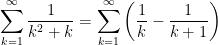
\displaystyle \sum_{k=1}^\infty \frac{1}{k^2+k} = \displaystyle \sum_{k=1}^\infty \left( \frac{1}{k} - \frac{1}{k+1} \right)

\displaystyle \sum_{k=1}^\infty \frac{1}{k^2+k} = \displaystyle \left( 1 - \frac{1}{2} \right) + \left( \frac{1}{2} - \frac{1}{3} \right) \dots

\displaystyle \sum_{k=1}^\infty \frac{1}{k^2+k} = 1

4. Infinite geometric series are essential for proving basic facts about decimal representations that we often take for granted.

5. Properties of an infinite geometric series are needed to find the mean and standard deviation of a geometric random variable, which is used to predict the number of independent trials needed before an event happens. This is used for analyzing the coupon collector’s problem, among other applications.

Formula for an infinite geometric series (Part 10)

I conclude this series of posts by considering the formula for an infinite geometric series. Somewhat surprisingly (to students), the formula for an infinite geometric series is actually easier to remember than the formula for a finite geometric series.

One way of deriving the formula parallels the derivation for a finite geometric series. If a_1, a_2, a_3, \dots are the first terms of an infinite geometric sequence, let

S = a_1 + a_2 + a_3 + \dots

Recalling the formula for an geometric sequence, we know that

a_2 = a_1 r

a_3 = a_1 r^2

\vdots

Substituting, we find

S = a_1 + a_1 r+ a_1 r^2 \dots

Once again, we multiply both sides by -r.

-rS = -a_1r - a_1 r^2- a_1 r^3 \dots

Next, we add the two equations. Notice that almost everything cancels on the right-hand side… except for the leading term a_1.  (Unlike yesterday’s post, there is no “last” term that remains since the series is infinite.) Therefore,

S - rS = a_1

S(1-r) = a_1

S = \displaystyle \frac{a_1}{1-r}

A quick pedagogical note: I find that this derivation “sells” best to students when I multiply by -r and add, as opposed to multiplying by r and subtracting.

green line

The above derivation is helpful for remembering the formula but glosses over an extremely important detail: not every infinite geometric series converges. For example, if a_1 = 1 and r = 2, then the infinite geometric series becomes

1 + 2 + 4 + 8 + 16 + \dots,

which clearly does not have a finite answer. We say that this series diverges. In other words, trying to evaluate this sum makes as much sense as trying to divide a number by zero: there is no answer.

That said, it can be shown that, as long as -1 < r < 1, then the above geometric series converges, so that

a_1 + a_1 r + a_1 r^2 + \dots = \displaystyle \frac{a_1}{1-r}

The formal proof requires the use of the formula for a finite geometric series:

a_1 + a_1 r + a_1 r^2 + \dots + a_1 r^{n-1} = \displaystyle \frac{a_1(1-r^n)}{1-r}

We then take the limit as n \to \infty:

\displaystyle \lim_{n \to \infty} a_1 + a_1 r + a_1 r^2 + \dots + a_1 r^{n-1} = \displaystyle \lim_{n \to \infty} \frac{a_1(1-r^n)}{1-r}

a_1 + a_1 r + a_1 r^2 + \dots = \displaystyle \lim_{n \to \infty} \frac{a_1(1-r^n)}{1-r}

On the right-hand side, the only piece that contains an n is the term r^n. If -1 < r < 1, then r^n \to 0 as n \to \infty. (This limit fails, however, if r \ge 1 or r \le -1.) Therefore,

a_1 + a_1 r + a_1 r^2 + \dots = \displaystyle \lim_{n \to \infty} \frac{a_1(1-0)}{1-r} = \displaystyle \frac{a_1}{1-r}

Formula for an infinite geometric series (Part 9)

I continue this series of posts by considering the formula for an infinite geometric series. Somewhat surprisingly (to students), the formula for an infinite geometric series is actually easier to remember than the formula for a finite geometric series.

One way of deriving the formula parallels yesterday’s post. If a_1, a_2, a_3, \dots are the first terms of an infinite geometric sequence, let

S = a_1 + a_2 + a_3 + \dots

Recalling the formula for an geometric sequence, we know that

a_2 = a_1 r

a_3 = a_1 r^2

\vdots

Substituting, we find

S = a_1 + a_1 r+ a_1 r^2 \dots

For example, if a_1 = \displaystyle \frac{1}{2} and r = \displaystyle \frac{1}{2}, we have

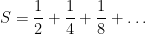
S = \displaystyle \frac{1}{2} + \frac{1}{4} + \frac{1}{8} + \dots

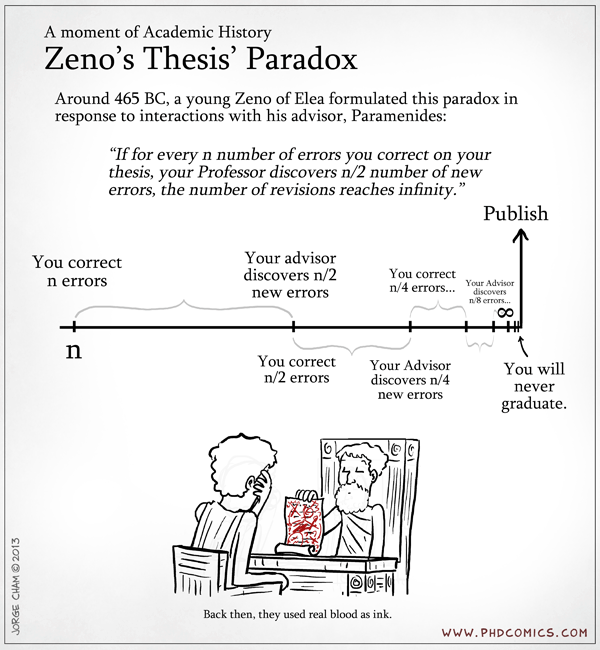
This is perhaps the world’s most famous infinite series, as this is the subject of Zeno’s paradox. When I teach infinite series in class, I often engage the students by reminding students about Zeno’s paradox and then show them this clip from the 1994 movie I.Q.

This clip is almost always a big hit with my students.

Even after showing this clip, some students resist the idea that an infinite series can have a finite answer. For such students, I use a physical demonstration: I walk half-way across the classroom, then a quarter, and so on… until I walk head-first into a walk at full walking speed. The resulting loud thud usually confirms for students that an infinite sum can indeed have a finite answer.

green line

P.S. PhD Comics recently had a cartoon concerning Zeno’s paradox. Source: http://www.phdcomics.com/comics/archive.php?comicid=1610

phd071913s_zeno

Here’s another one. Source: http://www.xkcd.com/994/

xkcdadvent_calendar

Formula for a finite geometric series (Part 8)

As I’ve said before, I’m not particularly a fan of memorizing formulas. Apparently, most college students aren’t fans either, because they often don’t have immediate recall of certain formulas from high school when they’re needed in the collegiate curriculum.

While I’m not a fan of making students memorize formulas, I am a fan of teaching students how to derive formulas. Speaking for myself, if I ever need to use a formula that I know exists but have long since forgotten, the ability to derive the formula allows me to get it again.

Which leads me to today’s post: the derivation of the formulas for the sum of a finite geometric series. This topic is commonly taught in Precalculus but, in my experience, is often forgotten by students years later when needed in later classes.

green lineLike its counterpart for arithmetic series, the formula for a finite geometric series can be derived using the patented Bag of Tricks. Socrates gave the Bag of Tricks to Plato, Plato gave it to Aristotle, it passed down the generations, my teacher taught the Bag of Tricks to me, and I teach it to my students.

If a_1, \dots, a_n are the first n terms of an geometric sequence, let

S = a_1 + a_2 + a_3 + \dots + a_{n-1} + a_n

Recalling the formula for an geometric sequence, we know that

a_2 = a_1 r

a_3 = a_1 r^2

\vdots

a_{n-1} = a_1 r^{n-2}

a_n = a_1 r^{n-1}

Substituting, we find

S = a_1 + a_1 r+ a_1 r^2 \dots + a_1 r^{n-2} + a_1 r^{n-1}

At this point, we use something different from the patented Bag of Tricks: we multiply both sides by -r.

-rS = -a_1r - a_1 r^2- a_1 r^3 \dots - a_1 r^{n-1} - a_1 r^n

Next, we add the two equations. Notice that almost everything cancels on the right-hand side. The a_1 r cancel, the a_1 r^2 cancel, yada yada yada, and the a_1 r^{n-1} cancel. The only terms that remain are a_1 and -a_1 r^n. So

S - rS = a_1 - a_1 r^n

S(1-r) = a_1 (1- r^n)

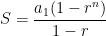
S = \displaystyle \frac{a_1 ( 1-r^n) }{1-r}

A quick pedagogical note: I find that this derivation “sells” best to students when I multiply by -r and add, as opposed to multiplying by r and subtracting.

green line

This formula is also a straightforward consequence of the factorization formula

x^n - y^n = (x-y)(x^{n-1} + x^{n-2} y + \dots +x y^{n-2} + y^{n-1})

Just let x=1 and y=r, and then multiply both sides by the first term a_1.

However, in my experience, most students don’t have instant recall of this formula either. They can certainly remember the formula for the difference of two squares (which is a special case of the above formula), but they often can’t remember that the difference of two cubes has a formula. (And, while I’m on the topic, they also can’t remember that the sum of two cubes can always be factored.)

green line

Pedagogically, the most common mistake that I see students make when using this formula is using the wrong exponent on the right-hand side. For example, suppose the problem is to simplify

48 +24+ 12 + 6 + 3 + 1.5 + 0.75 + 0.375

Here’s the common mistake: student solve for n using the formula for a geometric sequence. They solve for the unknown exponent (often using logarithms) and find that 0.375 = 48 (0.5)^7. They conclude that n=7, and then plug into for formula for a geometric series:

S = \displaystyle \frac{48 ( 1-(0.5)^7) }{1-0.5} = 95.25 (incorrect)

This answer is clearly wrong, since the sum of the original series must have a 5 in the thousandths place. The answer 95.25 is the correct answer to the wrong question — that’s the sum of the first seven terms of the sequence (stopping at 0.75), but the original series has eight terms. Using the formula correctly, we find

S = \displaystyle \frac{48 ( 1-(0.5)^8) }{1-0.5} = 95.625 (correct)

Not surprisingly, the difference between the incorrect and correct answers is 0.375, the eighth term.

To help students avoid this mistake, I re-emphasize that the number n stands for the number of terms in the series. In particular, it does not mean the exponent needed to give the last term in the series. That exponent, of course, is n-1, not n.

Why does 0.999… = 1? (Part 3)

In this series, I discuss some ways of convincing students that 0.999\dots = 1 and that, more generally, a real number may have more than one decimal representation even though a decimal representation corresponds to only one real number. This can be a major conceptual barrier for even bright students to overcome. I have met a few math majors within a semester of graduating — that is, they weren’t dummies — who could recite all of these ways and were perhaps logically convinced but remained psychologically unconvinced.

Method #4. This is a direct method using the formula for an infinite geometric series… and hence will only be convincing to students if they’re comfortable with using this formula. By definition,

0.999\dots = \displaystyle \frac{9}{10} + \frac{9}{100} + \frac{9}{1000} + \dots

This is an infinite geometric series. Its first term is \displaystyle \frac{9}{10}, and the common ratio needed to go from one term to the next term is \displaystyle \frac{1}{10}. Therefore,

0.999\dots = \displaystyle \frac{ \displaystyle \frac{9}{10}}{ \quad \displaystyle 1 - \frac{1}{10} \quad}

0.999\dots = \displaystyle \frac{ \displaystyle \frac{9}{10}}{ \quad \displaystyle \frac{9}{10} \quad}

0.999\dots = 1

Thoughts on 1/7 and other rational numbers (Part 7)

In a previous post concerning roundoff error, I mentioned that the number 1/10 equals

\displaystyle \frac{1}{2^4} + \frac{1}{2^5} +\frac{1}{2^8} + \frac{1}{2^9} + \frac{1}{2^{12}} + \frac{1}{2^{13}} + \dots

In other words, the binary expansion of 1/10 is

0.0001100110011001100110011001100....

That’s the expansion of the fraction in base 2, as opposed to base 10.

In the previous post, I verified that the above infinite series actually converges to 1/10:

S = \displaystyle \left(\frac{1}{2^4} + \frac{1}{2^5}\right) +\left(\frac{1}{2^8} + \frac{1}{2^9}\right) + \left(\frac{1}{2^{12}} + \frac{1}{2^{13}}\right) + \dots

S = \displaystyle \frac{3}{2^5} + \frac{3}{2^9} + \frac{3}{2^{13}} + \dots

S = \displaystyle \frac{\displaystyle \frac{3}{2^5}}{\quad \displaystyle 1 - \frac{1}{2^4} \quad}

S = \displaystyle \frac{\displaystyle \frac{3}{32}}{\quad \displaystyle \frac{15}{16} \quad}

S = \displaystyle \frac{3}{32} \times \frac{16}{15}

S = \displaystyle \frac{1}{10}

Still, a curious student may wonder how one earth one could directly convert 1/10 into binary without knowing the above series ahead of time.

This can be addressed by using the principles that we’ve gleaned in this study of decimal representations, except translating this work into the language of base 2. In the following, I will use the subscripts \hbox{ten} and \hbox{two} so that I’m clear about when I’m using decimal and binary, respectively.

To begin, we note that 10_{\hbox{\scriptsize ten}} = 1010_{\hbox{\scriptsize two}} = 10_{\hbox{\scriptsize two}} \times 101_{\hbox{\scriptsize two}}. (In other words, ten is equal to two times five.) So, following Case 3 of the previous post, we will attempt to write the denominator in the form

10_{\hbox{\scriptsize two}}^d \left(10_{\hbox{\scriptsize two}}^k - 1 \right), or 2_{\hbox{\scriptsize ten}}^d \left(2_{\hbox{\scriptsize ten}}^k - 1 \right)

  • If k = 1_{\hbox{\scriptsize ten}}, then 2_{\hbox{\scriptsize ten}}^1 - 1 = 1_{\hbox{\scriptsize ten}}, but 1_{\hbox{\scriptsize ten}} \div 5_{\hbox{\scriptsize ten}}  is not an integer.
  • If k = 2_{\hbox{\scriptsize ten}}, then 2_{\hbox{\scriptsize ten}}^2 - 1 = 3_{\hbox{\scriptsize ten}}, but 3_{\hbox{\scriptsize ten}} \div 5_{\hbox{\scriptsize ten}}  is not an integer.
  • If k = 3_{\hbox{\scriptsize ten}}, then 2_{\hbox{\scriptsize ten}}^3 - 1 = 7_{\hbox{\scriptsize ten}}, but 7_{\hbox{\scriptsize ten}} \div 5_{\hbox{\scriptsize ten}}  is not an integer.
  • If k = 4_{\hbox{\scriptsize ten}}, then 2_{\hbox{\scriptsize ten}}^4 - 1 = 15_{\hbox{\scriptsize ten}}. This time, 15_{\hbox{\scriptsize ten}} \div 5_{\hbox{\scriptsize ten}} = 3_{\hbox{\scriptsize ten}}. Written in binary,

101_{\hbox{\scriptsize two}} \times 11_{\hbox{\scriptsize two}} = 1111_{\hbox{\scriptsize two}}

We now return to the binary representation of 1/10_{\hbox{\scriptsize ten}} = 1/1010_{\hbox{\scriptsize two}}.

\displaystyle \frac{1}{1010_{\hbox{\scriptsize two}}} = \displaystyle \frac{1}{1010_{\hbox{\scriptsize two}}} \times \frac{11_{\hbox{\scriptsize two}}}{11_{\hbox{\scriptsize two}}}

\displaystyle \frac{1}{1010_{\hbox{\scriptsize two}}} = \frac{11_{\hbox{\scriptsize two}}}{11110_{\hbox{\scriptsize two}}}

Therefore, the binary representation has a delay of one digit and a repeating block of four digits:

\displaystyle \frac{1}{1010_{\hbox{\scriptsize two}}} = 0.0\overline{0011}

Naturally, this matches the binary representation given earlier.

Thoughts on 1/7 and other rational numbers (Part 5)

Students are quite accustomed to obtaining the decimal expansion of a fraction by using a calculator. Here’s an (uncommonly, I think) taught technique for converting certain fractions into a decimal expansion without using long division and without using a calculator. I’ve taught this technique to college students who want to be future high school teachers for several years, and it never fails to surprise.

First off, it’s easy to divide any number by a power of 10, or 10^k. For example,

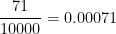
\displaystyle \frac{4312}{1000} = 4.312 and \displaystyle \frac{71}{10000} = 0.00071

What’s less commonly known is that it’s also easy to divide by 10^k - 1, or 99\dots 9, a numeral with k consecutive 9s. (This number can be used to prove the divisibility rules for 3 and 9 and is also the subject of one of my best math jokes.) The rule can be illustrated with a calculator:

TI999

In other words, if M < 10^k - 1, then the decimal expansion of \displaystyle \frac{M}{10^k-1} is a repeating block of k digits containing the numeral M, possibly adding enough zeroes to fill all k digits.

To prove that this actually works, we notice that

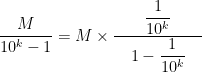
\displaystyle \frac{M}{10^k - 1} = M \times \frac{ \displaystyle \frac{1}{10^k}}{\quad \displaystyle 1 - \frac{1}{10^k} \quad}

 \displaystyle \frac{M}{10^k - 1} = M \times \left(\displaystyle \frac{1}{10^k} + \frac{1}{10^{2k}} + \frac{1}{10^{3k}} + \dots \right)

\displaystyle \frac{M}{10^k-1} = M \times 0.\overline{00\dots01}

The first line is obtained by multiplying the numerator and denominator by \displaystyle \frac{1}{10^k}. The second line is obtained by using the formula for an infinite geometric series in reverse, so that the first term is \displaystyle \frac{1}{10^k} and the common ratio is also \displaystyle \frac{1}{10^k}. The third line is obtained by converting the series — including only powers of 10 — into a decimal expansion.

If M > 10^k - 1, then the division algorithm must be used to get a numerator that is less than 10^k-1. Fortunately, dividing big numbers by 10^k-1 is quite easy and can be done without a calculator. For example, let’s find the decimal expansion of \displaystyle \frac{123456}{9999} without a calculator. First,

123456 = 12(10000) + 3456

123456 = 12(9999 + 1) + 3456

123456 = 12(9999) + 12(1) + 3456

123456 = 12(9999) + 3468

Therefore,

\displaystyle \frac{123456}{9999} = \displaystyle \frac{12(9999) + 3468}{9999}

\displaystyle \frac{123456}{9999} = \displaystyle \frac{12(9999)}{9999} + \frac{3468}{9999}

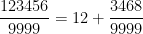
\displaystyle \frac{123456}{9999} = \displaystyle 12 + \frac{3468}{9999}

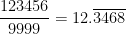
\displaystyle \frac{123456}{9999} = \displaystyle 12.\overline{3468}

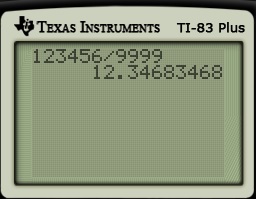
This can be confirmed with a calculator. Notice that the repeating block doesn’t quite match the digits of the numerator because of the intermediate step of applying the division algorithm.

TI9999

green line

In the same vein, it’s also straightforward to find the decimal expansion of fractions of the form \displaystyle \frac{M}{10^d (10^k-1)}, so that the denominator has the form 99\dots9900\dots00. This is especially easy if M < 10^k -1. For example,

\displaystyle \frac{123}{99900} = \frac{1}{100} \times \frac{123}{999} = \frac{1}{100} \times 0.\overline{123} = 0.00\overline{123}

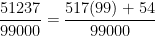
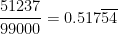
On the other hand, if M > 10^k-1, then the division algorithm must be applied as before. For example, let’s find the decimal expansion of \displaystyle \frac{51237}{99000}. To begin, we need to divide the numerator by 99, as before. Notice that, for this example, an extra iteration of the division algorithm is needed to get a remainder less than 99.

51237 = 512(100) + 37

51237 = 512(99 + 1) + 37

51237 = 512(99) + 512 + 37

51237 = 512(99) + 549

51237= 512(99) + 5(100) + 49

51237 = 512(99) + 5(99 + 1) + 49

51237 = 512(99) + 5(99) + 5 + 49

51237 = 517(99) + 54

Therefore,

\displaystyle \frac{51237}{99000} = \displaystyle \frac{517(99) + 54}{99000}

\displaystyle \frac{51237}{99000} = \displaystyle \frac{517(99)}{99000} + \frac{54}{99000}

\displaystyle \frac{51237}{99000} = \displaystyle \frac{517}{1000} + \frac{54}{99000}

\displaystyle \frac{51237}{99000} = 0.517 + 0.000\overline{54}

\displaystyle \frac{51237}{99000} = 0.517\overline{54}

In particular, notice that the three 0s in the denominator correspond to a delay of length 3 (the digits 517), while the 99 = 10^2 - 1 in the denominator corresponds to the repeating block of length 2.
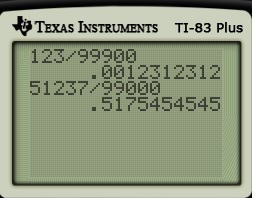
These can be confirmed for students who may be reluctant to believe that decimal expansions can be found without a calculator.

TI99000

Thoughts on 1/7 and other rational numbers (Part 4)

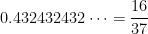
In Part 3 of this series, I considered the conversion of a repeating decimal expansion into a fraction. This was accomplished by an indirect technique which was pulled out of the patented Bag of Tricks. For example, if x = 0.\overline{432} = 0.432432432\dots, we start by computing 1000x and then subtracting.

1000x = 432.432432\dots

x = 0.432432\dots

999x = 432

x = \displaystyle \frac{432}{999} = \displaystyle \frac{16}{37}

As mentioned in Part 3, most students are a little bit skeptical that this actually works, and often need to type the final fraction into a calculator to be reassured that the method actually works. Most students are also a little frustrated with this technique because it does come from the Bag of Tricks. After all, the first two steps (setting the decimal equal to x and then multiplying x by 1000) are hardly the most intuitive things to do first… unless you’re clairvoyant and know what’s going to happen next.

In this post, I’d like to discuss a more direct way of converting a repeating decimal into a fraction. In my experience, this approach presents a different conceptual barrier to students. This is a more direct approach, and so students are more immediately willing to accept its validity. However, the technique uses the formula for an infinite geometric series, which (unfortunately) most senior math majors cannot instantly recall. They’ve surely seen the formula before, but they’ve probably forgotten it because a few years have passed since they’ve had to extensively use the formula.

Anyway, here’s the method applied to 0.\overline{432}. To begin, we recall the meaning of a decimal representation in the first place:

0.432432432 \dots = \displaystyle \frac{4}{10} + \frac{3}{100} + \frac{2}{1000} + \displaystyle \frac{4}{10^4} + \frac{3}{10^5} + \frac{2}{10^6} + \displaystyle \frac{4}{10^7} + \frac{3}{10^8} + \frac{2}{10^9} + \dots

Combining fractions three at a time (matching the length of the repeating block), we get

0.432432432 \dots = \displaystyle \frac{432}{10^3} + \displaystyle \frac{432}{10^6} + \frac{432}{10^9} + \dots

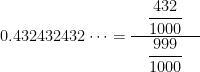
This is an infinite geometric series whose first term is \displaystyle \frac{432}{10^3}, and the common ratio that’s multiplied to go from one term to the next is \displaystyle \frac{1}{10^3}. Using the formula for an infinite geometric series and simplifying, we conclude
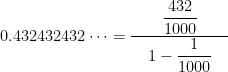
0.432432432 \dots = \displaystyle \frac{ \quad \displaystyle \frac{432}{1000} \quad }{\quad 1 - \displaystyle \frac{1}{1000} \quad}

0.432432432 \dots = \displaystyle \frac{ \displaystyle \quad \frac{432}{1000} \quad}{ \displaystyle \quad \frac{999}{1000} \quad}

0.432432432 \dots = \displaystyle \frac{ 432}{ 999}

0.432432432 \dots = \displaystyle \frac{ 16}{ 37}

green line

For what it’s worth, the decimal representation could have been simplified by using three separate geometric series. Some students find this to be more intuitive, combining the unlike fractions at the final step as opposed to the initial step.

0.432432432 \dots = \left( \displaystyle \frac{4}{10} + \frac{4}{10^4} + \displaystyle \frac{4}{10^7} + \dots \right)

\quad \quad \quad \quad + \left( \displaystyle \frac{3}{100} + \frac{3}{10^5} + \displaystyle \frac{3}{10^8} + \dots \right)

+ \left( \displaystyle \frac{2}{1000} + \frac{2}{10^6} + \displaystyle \frac{2}{10^9} + \dots \right)

0.432432432 \dots = \displaystyle \frac{ \quad \displaystyle \frac{4}{10} \quad }{\quad 1 - \displaystyle \frac{1}{1000} \quad} + \frac{ \quad \displaystyle \frac{3}{100} \quad }{\quad 1 - \displaystyle \frac{1}{1000} \quad} + \frac{ \quad \displaystyle \frac{2}{1000} \quad }{\quad 1 - \displaystyle \frac{1}{1000} \quad}

0.432432432 \dots = \displaystyle \frac{ \quad \displaystyle \frac{4}{10} \quad }{\quad \displaystyle \frac{999}{1000} \quad} + \frac{ \quad \displaystyle \frac{3}{100} \quad }{\quad \displaystyle \frac{999}{1000} \quad} + \frac{ \quad \displaystyle \frac{2}{1000} \quad }{\quad \displaystyle \frac{999}{1000} \quad}

0.432432432 \dots = \displaystyle \frac{ 400}{ 999} + \frac{30}{999} + \frac{2}{999}

0.432432432 \dots = \displaystyle \frac{ 432}{ 999}

0.432432432 \dots = \displaystyle \frac{ 16}{ 37}

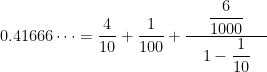
green lineFinally, this direct technique also works for repeating decimals with a delay, like 0.41\overline{6}.

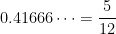
0.41666\dots = \displaystyle \frac{4}{10} + \frac{1}{100} + \left( \frac{6}{1000} + \frac{6}{10^4} + \frac{6}{10^5} + \dots \right)

0.41666\dots = \displaystyle \frac{4}{10} + \frac{1}{100} + \displaystyle \frac{ \quad \displaystyle \frac{6}{1000} \quad }{\quad 1 - \displaystyle \frac{1}{10} \quad}

0.41666\dots = \displaystyle \frac{4}{10} + \frac{1}{100} +\displaystyle \frac{ \quad \displaystyle \frac{6}{1000} \quad }{\quad \displaystyle \frac{9}{10} \quad}

0.41666\dots = \displaystyle \frac{4}{10} + \frac{1}{100} +\frac{6}{900}

0.41666\dots = \displaystyle \frac{375}{900}

0.41666\dots = \displaystyle \frac{5}{12}

Reminding students about Taylor series (Part 5)

Sadly, at least at my university, Taylor series is the topic that is least retained by students years after taking Calculus II. They can remember the rules for integration and differentiation, but their command of Taylor series seems to slip through the cracks. In my opinion, the reason for this lack of retention is completely understandable from a student’s perspective: Taylor series is usually the last topic covered in a semester, and so students learn them quickly for the final and quickly forget about them as soon as the final is over.

Of course, when I need to use Taylor series in an advanced course but my students have completely forgotten this prerequisite knowledge, I have to get them up to speed as soon as possible. Here’s the sequence that I use to accomplish this task. Covering this sequence usually takes me about 30 minutes of class time.

I should emphasize that I present this sequence in an inquiry-based format: I ask leading questions of my students so that the answers of my students are driving the lecture. In other words, I don’t ask my students to simply take dictation. It’s a little hard to describe a question-and-answer format in a blog, but I’ll attempt to do this below.

In the previous posts, I described how I lead students to the definition of the Maclaurin series

f(x) = \displaystyle \sum_{k=0}^{\infty} \frac{f^{(k)}(0)}{k!} x^k,

which converges to f(x) within some radius of convergence for all functions that commonly appear in the secondary mathematics curriculum.

green line

Step 5. That was easy; let’s try another one. Now let’s try f(x) = \displaystyle \frac{1}{1-x} = (1-x)^{-1}.

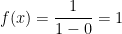
What’s f(0)? Plugging in, we find f(x) = \displaystyle \frac{1}{1-0} = 1.

Next, to find f'(0), we first find f'(x). Using the Chain Rule, we find f'(x) = -(1-x)^{-2} \cdot (-1) = \displaystyle \frac{1}{(1-x)^2}, so that f'(0) = 1.

Next, we differentiate again: f'(x) = (-2) \cdot (1-x)^{-3} \cdot (-1) = \displaystyle \frac{2}{(1-x)^3}, so that f''(0) = 2.

Hmmm… no obvious pattern yet… so let’s keep going.

For the next term, f'''(x) = (-3) \cdot 2(1-x)^{-4} \cdot (-1) = \displaystyle \frac{6}{(1-x)^4}, so that f'''(0) = 6.

For the next term, f^{(4)}(x) = (-4) \cdot 6(1-x)^{-5} \cdot (-1) = \displaystyle \frac{24}{(1-x)^5}, so that f^{(4)}(0) = 24.

Oohh… it’s the factorials again! It looks like f^{(n)}(0) = n!, and this can be formally proved by induction.

Plugging into the series, we find that

\displaystyle \frac{1}{1-x} = \sum_{n=0}^\infty \frac{n!}{n!} x^n = \sum_{n=0}^\infty x^n = 1 + x + x^2 + x^3 + \dots.

Like the series for e^x, this series converges quickest for x \approx 0. Unlike the series for e^x, this series does not converge for all real numbers. As can be checked with the Ratio Test, this series only converges if |x| < 1.

The right-hand side is a special kind of series typically discussed in precalculus. (Students often pause at this point, because most of them have forgotten this too.) It is an infinite geometric series whose first term is $1$ and common ratio $x$. So starting from the right-hand side, one can obtain the left-hand side using the formula

a + ar + ar^2 + ar^3 + \dots = \displaystyle \frac{a}{1-r}

by letting a=1 and $r=x$. Also, as stated in precalculus, this series only converges if the common ratio satisfies $|r| < 1$, as before.

In other words, in precalculus, we start with the geometric series and end with the function. With Taylor series, we start with the function and end with the series.

green line

Step 6. A whole bunch of other Taylor series can be quickly obtained from the one for \displaystyle \frac{1}{1-x}. Let’s take the derivative of both sides (and ignore the fact that one should prove that differentiating this infinite series term by term is permissible). Since
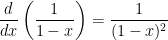
\displaystyle \frac{d}{dx} \left( \frac{1}{1-x} \right) = \frac{1}{(1-x)^2}

and

\displaystyle \frac{d}{dx} \left( 1 + x + x^2 + x^3 + x^4 + \dots \right) = 1 + 2x + 3x^2 + 4x^3 + \dots,

we have

\displaystyle \frac{1}{(1-x)^2} = 1 + 2x + 3x^2 + 4x^3 + \dots.

____________________

Next, let’s replace x with -x in the Taylor series in Step 5, obtaining


\displaystyle \frac{1}{1+x} = 1 - x + x^2 - x^3 + x^4 - x^5 \dots

Now let’s take the indefinite integral of both sides:

\displaystyle \int \frac{dx}{1+x} = \int \left( 1 - x + x^2 - x^3 + x^4 - x^5 \dots \right) \, dx

\ln(1+x) = \displaystyle x - \frac{x^2}{2} + \frac{x^3}{3} -\frac{ x^4}{4} + \frac{x^5}{5} -\frac{ x^6}{6} \dots + C

To solve for the constant of integration, let x = 0:

\ln(1) = 0+ C \Longrightarrow C = 0

Plugging back in, we conclude that

\ln(1+x) = x - \displaystyle \frac{x^2}{2} + \frac{x^3}{3} -\frac{ x^4}{4} + \frac{x^5}{5} -\frac{ x^6}{6} \dots

The Taylor series expansion for \ln(1-x) can be found by replacing x with -x:

\ln(1-x) = -x - \displaystyle \frac{x^2}{2} - \frac{x^3}{3} -\frac{ x^4}{4} - \frac{x^5}{5} -\frac{ x^6}{6} \dots

Subtracting, we find

\ln(1+x) - \ln(1-x) = \ln \displaystyle \left( \frac{1+x}{1-x} \right) = 2x + \frac{2x^3}{3}+ \frac{2x^5}{5} \dots

My understanding is that this latter series is used by calculators when computing logarithms.

____________________

Next, let’s replace x with -x^2 in the Taylor series in Step 5, obtaining

\displaystyle \frac{1}{1+x^2} = 1 - x^2 + x^4 - x^6 + x^8 - x^{10} \dots

Now let’s take the indefinite integral of both sides:

\displaystyle \int \frac{dx}{1+x^2} = \int \left(1 - x^2 + x^4 - x^6 + x^8 - x^{10} \dots\right) \, dx

\tan^{-1}x = \displaystyle x - \frac{x^3}{3} + \frac{x^5}{5} -\frac{ x^7}{7} + \frac{x^9}{9} -\frac{ x^{11}}{11} \dots + C

To solve for the constant of integration, let x = 0:

\tan^{-1}(1) = 0+ C \Longrightarrow C = 0

Plugging back in, we conclude that

\tan^{-1}x = \displaystyle x - \frac{x^3}{3} + \frac{x^5}{5} -\frac{ x^7}{7} + \frac{x^9}{9} -\frac{ x^{11}}{11} \dots

____________________

In summary, a whole bunch of Taylor series can be extracted quite quickly by differentiating and integrating from a simple infinite geometric series. I’m a firm believer in minimizing the number of formulas that I should memorize. Any time I personally need any of the above series, I’ll quickly use the above steps to derive them from that of \displaystyle \frac{1}{1-x}.