Earlier in this series, I gave three different methods of showing that

Using the fact that

is independent of

, I’ll now give a fourth method.

Since
is independent of
, I can substitute any convenient value of
that I want without changing the value of
. As shown in previous posts, substituting

yields the following simplification:



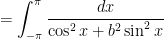

The four roots of the denominator satisfy

So far, I’ve handled the cases  and
and  . In today’s post, I’ll start considering the case
  .
.
Factoring the denominator is a bit more complicated if . Using the quadratic equation, we obtain

However, unlike the cases  , the right-hand side is now a complex number. So, To solve for
  , I’ll use DeMoivre’s Theorem and some surprisingly convenient trig identities. Notice that
 .
.
Therefore, the four complex roots of the denominator satisfy  , or
, or  . This means that all four roots can be written in trigonometric form so that
 ,
,
where  is some angle. (I chose the angle to be instead of
  for reasons that will become clear shortly.)
I’ll begin with solving
 .
.
Matching the real and imaginary parts, we see that
 ,
,

This completely matches the form of the double-angle trig identities
 ,
,
 ,
,
and so the problem reduces to solving
,
where $\sin \phi = |b|$ and $\cos \phi = \sqrt{1-b^2}$. By De Moivre’s Theorem, I can conclude that the two solutions of this equation are
 ,
,
or
 .
.
I could re-run this argument to solve  and get the other two complex roots. However, by the Conjugate Root Theorem, I know that the four complex roots of the denominator
  must come in conjugate pairs. Therefore, the four complex roots are
 .
.
Therefore, I can factor the denominator as follows:
![u^4 + (4 b^2 - 2) u^2 + 1 = (u - [\sqrt{1-b^2} + i|b|])(u - [\sqrt{1-b^2} - i|b|])](https://s0.wp.com/latex.php?latex=u%5E4+%2B+%284+b%5E2+-+2%29+u%5E2+%2B+1+%3D+%28u+-+%5B%5Csqrt%7B1-b%5E2%7D+%2B+i%7Cb%7C%5D%29%28u+-+%5B%5Csqrt%7B1-b%5E2%7D+-+i%7Cb%7C%5D%29&bg=ffffff&fg=000000&s=0&c=20201002)
![\qquad \times (u - [-\sqrt{1-b^2} + i|b|])(u - [-\sqrt{1-b^2} + i|b|])](https://s0.wp.com/latex.php?latex=%5Cqquad+%5Ctimes+%28u+-+%5B-%5Csqrt%7B1-b%5E2%7D+%2B+i%7Cb%7C%5D%29%28u+-+%5B-%5Csqrt%7B1-b%5E2%7D+%2B+i%7Cb%7C%5D%29&bg=ffffff&fg=000000&s=0&c=20201002)
![= (u - \sqrt{1-b^2} - i|b|)(u - \sqrt{1-b^2} + i|b])](https://s0.wp.com/latex.php?latex=%3D+%28u+-+%5Csqrt%7B1-b%5E2%7D+-+i%7Cb%7C%29%28u+-+%5Csqrt%7B1-b%5E2%7D+%2B+i%7Cb%5D%29&bg=ffffff&fg=000000&s=0&c=20201002)

![= ([u - \sqrt{1-b^2}]^2 +b^2)([u + \sqrt{1-b^2}]^2 +b^2)](https://s0.wp.com/latex.php?latex=%3D+%28%5Bu+-+%5Csqrt%7B1-b%5E2%7D%5D%5E2+%2Bb%5E2%29%28%5Bu+%2B+%5Csqrt%7B1-b%5E2%7D%5D%5E2+%2Bb%5E2%29&bg=ffffff&fg=000000&s=0&c=20201002)
To double-check my work, I can directly multiply this product:
![([u - \sqrt{1-b^2}]^2 +b^2)([u + \sqrt{1-b^2}]^2 +b^2)](https://s0.wp.com/latex.php?latex=%28%5Bu+-+%5Csqrt%7B1-b%5E2%7D%5D%5E2+%2Bb%5E2%29%28%5Bu+%2B+%5Csqrt%7B1-b%5E2%7D%5D%5E2+%2Bb%5E2%29&bg=ffffff&fg=000000&s=0&c=20201002)

![= ([u^2 +1] - 2u\sqrt{1-b^2})([u^2+1] + 2u\sqrt{1-b^2})](https://s0.wp.com/latex.php?latex=%3D+%28%5Bu%5E2+%2B1%5D+-+2u%5Csqrt%7B1-b%5E2%7D%29%28%5Bu%5E2%2B1%5D+%2B+2u%5Csqrt%7B1-b%5E2%7D%29&bg=ffffff&fg=000000&s=0&c=20201002)
![= [u^2+1]^2 - [2u\sqrt{1-b^2}]^2](https://s0.wp.com/latex.php?latex=%3D+%5Bu%5E2%2B1%5D%5E2+-+%5B2u%5Csqrt%7B1-b%5E2%7D%5D%5E2&bg=ffffff&fg=000000&s=0&c=20201002)

![= u^4 + u^2 (2 - 4[1-b^2]) + 1](https://s0.wp.com/latex.php?latex=%3D+u%5E4+%2B+u%5E2+%282+-+4%5B1-b%5E2%5D%29+%2B+1&bg=ffffff&fg=000000&s=0&c=20201002)
 .
.
So, at last, I can rewrite the integral as
![Q = \displaystyle \int_{-\infty}^{\infty} \frac{ 2(1+u^2) du}{ ([u - \sqrt{1-b^2}]^2 +b^2)([u + \sqrt{1-b^2}]^2 +b^2)}](https://s0.wp.com/latex.php?latex=Q+%3D+%5Cdisplaystyle+%5Cint_%7B-%5Cinfty%7D%5E%7B%5Cinfty%7D+%5Cfrac%7B+2%281%2Bu%5E2%29+du%7D%7B+%28%5Bu+-+%5Csqrt%7B1-b%5E2%7D%5D%5E2+%2Bb%5E2%29%28%5Bu+%2B+%5Csqrt%7B1-b%5E2%7D%5D%5E2+%2Bb%5E2%29%7D&bg=ffffff&fg=000000&s=0&c=20201002)
I’ll continue with this fourth evaluation of the integral, continuing the case , in tomorrow’s post.

, what is
?


 and then employing the substitution
  (after using trig identities to adjust the limits of integration).


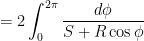 ,
, and
and  (and
(and  is a certain angle that is now irrelevant at this point in the calculation).
 to evaluate this last integral. Now, I’ll instead use contour integration; see
  ,
,![\cos \phi = \displaystyle \frac{1}{2} \left[z + \displaystyle \frac{1}{z} \right]](https://s0.wp.com/latex.php?latex=%5Ccos+%5Cphi+%3D+%5Cdisplaystyle+%5Cfrac%7B1%7D%7B2%7D+%5Cleft%5Bz+%2B+%5Cdisplaystyle+%5Cfrac%7B1%7D%7Bz%7D+%5Cright%5D&bg=ffffff&fg=000000&s=0&c=20201002)

 to a the unit circle
  , a closed counterclockwise contour in the complex plane:
![Q = 2 \displaystyle \oint_C \frac{\displaystyle -\frac{i}{z} dz}{S + \displaystyle \frac{R}{2} \left[z + \displaystyle \frac{1}{z} \right]}](https://s0.wp.com/latex.php?latex=Q+%3D+2+%5Cdisplaystyle+%5Coint_C+%5Cfrac%7B%5Cdisplaystyle+-%5Cfrac%7Bi%7D%7Bz%7D+dz%7D%7BS+%2B+%5Cdisplaystyle+%5Cfrac%7BR%7D%7B2%7D+%5Cleft%5Bz+%2B+%5Cdisplaystyle+%5Cfrac%7B1%7D%7Bz%7D+%5Cright%5D%7D&bg=ffffff&fg=000000&s=0&c=20201002)


 and
and  in terms of
  and
and  . I’ll begin with

![\displaystyle \frac{1}{2} \left[z + \displaystyle \frac{1}{z} \right] = \cos \phi](https://s0.wp.com/latex.php?latex=%5Cdisplaystyle+%5Cfrac%7B1%7D%7B2%7D+%5Cleft%5Bz+%2B+%5Cdisplaystyle+%5Cfrac%7B1%7D%7Bz%7D+%5Cright%5D+%3D+%5Ccos+%5Cphi&bg=ffffff&fg=000000&s=0&c=20201002)
![z - \displaystyle \frac{1}{z} = \cos \phi + i \sin \phi - [ \cos \phi - i \sin \phi]](https://s0.wp.com/latex.php?latex=z+-+%5Cdisplaystyle+%5Cfrac%7B1%7D%7Bz%7D+%3D+%5Ccos+%5Cphi+%2B+i+%5Csin+%5Cphi+-+%5B+%5Ccos+%5Cphi+-+i+%5Csin+%5Cphi%5D&bg=ffffff&fg=000000&s=0&c=20201002)
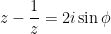
![\displaystyle \frac{1}{2i} \left[z - \displaystyle \frac{1}{z} \right] = \sin\phi](https://s0.wp.com/latex.php?latex=%5Cdisplaystyle+%5Cfrac%7B1%7D%7B2i%7D+%5Cleft%5Bz+-+%5Cdisplaystyle+%5Cfrac%7B1%7D%7Bz%7D+%5Cright%5D+%3D+%5Csin%5Cphi&bg=ffffff&fg=000000&s=0&c=20201002)
 :
:





 .
. to
to  , so that


 in terms of
  :
:


![= \displaystyle \frac{ 2 - [ 1 + \tan^2 x])}{1 + \tan^2 x}](https://s0.wp.com/latex.php?latex=%3D+%5Cdisplaystyle+%5Cfrac%7B+2+-+%5B+1+%2B+%5Ctan%5E2+x%5D%29%7D%7B1+%2B+%5Ctan%5E2+x%7D&bg=ffffff&fg=000000&s=0&c=20201002)

 by
by  :
: .
. in terms of
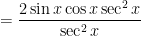


 .
. .
.
![du = \displaystyle \frac{1}{2} \left[ 1 + \tan^2 \displaystyle \frac{\phi}{2} \right] d\phi](https://s0.wp.com/latex.php?latex=du+%3D+%5Cdisplaystyle+%5Cfrac%7B1%7D%7B2%7D+%5Cleft%5B+1+%2B+%5Ctan%5E2+%5Cdisplaystyle+%5Cfrac%7B%5Cphi%7D%7B2%7D+%5Cright%5D+d%5Cphi&bg=ffffff&fg=000000&s=0&c=20201002)
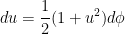

 by again dividing the region of integration:
 ,
, .
. , I employ the substitution
  , so that
  and
and  . Also, the interval of integration changes from
  to
to  , so that
 :
: ,
, becomes
 allows me to shift the interval of integration.
 by dividing the region of integration:
 ,
, .
. , I employ the substitution
  , so that
  and
and  . Also, the interval of integration changes from
  to
to  , so that
 :
: ,
, becomes
 .
. , so that
  and the interval of integration changes from
  to
to  .
.![2 a \sin \theta + (1 - a^2 - b^2) \cos \theta = R \displaystyle \left[ \frac{2a}{R} \sin \theta + \frac{1-a^2-b^2}{R} \cos \theta \right]](https://s0.wp.com/latex.php?latex=2+a+%5Csin+%5Ctheta+%2B+%281+-+a%5E2+-+b%5E2%29+%5Ccos+%5Ctheta+%3D+R+%5Cdisplaystyle+%5Cleft%5B+%5Cfrac%7B2a%7D%7BR%7D+%5Csin+%5Ctheta+%2B+%5Cfrac%7B1-a%5E2-b%5E2%7D%7BR%7D+%5Ccos+%5Ctheta+%5Cright%5D&bg=ffffff&fg=000000&s=0&c=20201002) ,
, ,
, .
.![2 a \sin \theta + (1 - a^2 - b^2) \cos \theta = R [\cos \theta \cos \alpha + \sin \theta \sin \alpha]](https://s0.wp.com/latex.php?latex=2+a+%5Csin+%5Ctheta+%2B+%281+-+a%5E2+-+b%5E2%29+%5Ccos+%5Ctheta+%3D+R+%5B%5Ccos+%5Ctheta+%5Ccos+%5Calpha+%2B+%5Csin+%5Ctheta+%5Csin+%5Calpha%5D&bg=ffffff&fg=000000&s=0&c=20201002)

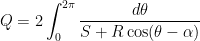 ,
, , so that
  . Also, the limits of integration change from
  to
to  , so that

 by dividing the interval of integration (not to be confused with the
  and
and  used in the previous method), where

 , so that
  and
and  . Under this substitution, the interval of integration changes from $2\pi \le \theta \le 4\pi$ to $0 \le u \le 2\pi$, and so
 and
and  — to rewrite
 .
. Mean Green Math