

Field Guide to Math on the National Mall
For anyone visiting my old stomping grounds of Washington, D.C., this summer, the Mathematical Association of America has compiled its Field Guide to Math on the National Mall. For example:
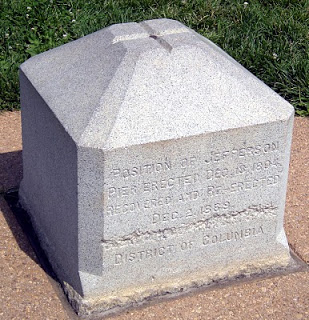
Washington, D.C., was planned around a large right triangle, with the White House at the triangle’s northern vertex and the U.S. Capitol at its eastern vertex, linked by Pennsylvania Avenue (as the hypotenuse). A 1793 survey established the location of the triangle’s 90° vertex, and Thomas Jefferson, when he was Secretary of State, had a wooden post installed to mark the spot. This post was replaced in 1804 by a more substantial marker, which came to be known as the Jefferson Pier.
Clowns and Graphing Rational Functions
I thought I had heard every silly mnemonic device for remembering mathematical formulas, but I recently heard a new one: the clowns BOBO, BOTU, and BETC for remembering how to graph rational functions.
- BOB0: bigger (exponent) on bottom,
- BOTU: bigger on top, undefined
- BETC: bottom equals top eponent, coefficients (i.e., the ratio of coefficients)

Which naturally leads to this pearl of wisdom:

Impossible Cylinder
I didn’t believe this counterintuitive trick until I tried it myself… the instructions can be found at http://www.maa.org/…/horizons/RichesonImpossibleCylinder.pdf
How to Draw with Math

UCLA mathematicians bring ocean to life for Disney’s ‘Moana’
From the UCLA news service:
UCLA mathematicians bring ocean to life for Disney’s ‘Moana’
From the second paragraph:
“In general, the animators and artists at the studios want as little to do with mathematics and physics as possible, but the demands for realism in animated movies are so high,” [UCLA mathematician Joseph] Teran said. “Things are going to look fake if you don’t at least start with the correct physics and mathematics for many materials, such as water and snow. If the physics and mathematics are not simulated accurately, it will be very glaring that something is wrong with the animation of the material.”
I recommend the whole article.
Not Real

Five Simple Math Problems No One Can Solve
From Popular Mechanics: 5 Simple Math Problems No One Can Solve. The list:
- The Collatz conjecture.
- The moving sofa problem.
- The perfect cuboid problem.
- The inscribed square problem.
- The happy ending problem.
Venn diagram
A nice article on recent progress on solving the twin prime conjecture
The twin prime conjecture (see here, here and here for more information) asserts that there are infinitely many primes that have a difference of 2. For example:
3 and 5 are twin primes;
5 and 7 are twin primes;
11 and 13 are twin primes;
17 and 19 are twin primes;
29 and 31 are twin primes; etc.
While most mathematicians believe the twin prime conjecture is correct, an explicit proof has not been found. Indeed, this has been one of the most popular unsolved problems in mathematics — not necessarily because it’s important, but for the curiosity that a conjecture so simply stated has eluded conquest by the world’s best mathematicians.
Still, research continues, and some major progress has been made in the past few years. (I like sharing this story with my students to convince them that not everything that can be known about mathematics has been figure out yet — a misconception encouraged by the structure of the secondary curriculum — and that research continues to this day.) Specifically, it was recently shown that, for some integer 
http://video.newyorker.com/watch/annals-of-ideas-yitang-zhang-s-discovery-2015-01-28
http://www.newyorker.com/magazine/2015/02/02/pursuit-beauty
For more on recent progress:

