Engaging students: Parallel and perpendicular lines

In my capstone class for future secondary math teachers, I ask my students to come up with ideas for engaging their students with different topics in the secondary mathematics curriculum. In other words, the point of the assignment was not to devise a full-blown lesson plan on this topic. Instead, I asked my students to think about three different ways of getting their students interested in the topic in the first place.

I plan to share some of the best of these ideas on this blog (after asking my students’ permission, of course).

This student submission again comes from my former student Andrew Cory. His topic, from Algebra: parallel and perpendicular lines.

green line

A2. How could you as a teacher create an activity or project that involves your topic?

An activity can be done with students by giving them a map, with a series of roads that run perpendicular or parallel to each other, asking them to identify pairs of perpendicular and parallel roads. To go beyond this, students can then find the slopes of a set of perpendicular or parallel lines on their own, then be asked to identify how they relate to one another. This will eventually lead them to being able to come up with a general rule to finding lines that are perpendicular or parallel to each other. Students can then be asked to create their own streets that will be perpendicular or parallel to some of the streets given. After this, students should be confident going from the representational model of perpendicular and parallel lines to graphing them on a cartesian plane.


green line

B2. How does this topic extend what your students should have learned in previous courses?

Studying perpendicular and parallel lines builds on a student’s knowledge of being able to calculate equations of lines and slopes given different amounts of initial information. It extends their knowledge of calculating slopes, and allows them to do it in reverse. Instead of getting two points to find the slope of the line, they may be given one point and the equation of a perpendicular or parallel line. This allows students to extend and apply their knowledge of linear equations, and gives them more situations to apply it to. This can then be extended to more challenging word problems, challenging students to come up with issues that require related slopes.


green line

E1. How can technology be used to effectively engage students with this topic?

Desmos can be very useful with engaging students in anything related to geometry or graphs. There are many resources within the website beyond just graphing two lines and viewing the relationship. A teacher can create their own activities within the website to allow students to explore a concept such as perpendicular and parallel lines, or they could use a pre-existing one created and shared by another educator. These activities give a great visual model of how perpendicular and parallel lines look, and then allow it for students to easily get the equations for each of the lines. Using Desmos can give students the capabilities of generating formulas and relationships on their own, without needing to be told what they are from their teachers. This will allow students a quicker path to mastery of the topic, and will lead them to applying it in a wider variety of areas more quickly than a student who is just told that slopes of parallel lines are equal and slopes of perpendicular lines are opposite reciprocals.


Engaging students: Adding, subtracting, and multiplying matrices

In my capstone class for future secondary math teachers, I ask my students to come up with ideas for engaging their students with different topics in the secondary mathematics curriculum. In other words, the point of the assignment was not to devise a full-blown lesson plan on this topic. Instead, I asked my students to think about three different ways of getting their students interested in the topic in the first place.

I plan to share some of the best of these ideas on this blog (after asking my students’ permission, of course).

This student submission again comes from my former student Diana Calderon. Her topic, from Algebra: adding, subtracting, and multiplying matrices.

green line

How could you as a teacher creates an activity or project that involves your topic?

As a teacher I would do a foldable activity in which the students will have to fill in the blank in the front of the foldable that would allow them to discover how addition, multiplication and subtraction work for matrices. Once they open the foldable, they would have to do different examples and get to also create one. Out of the problems that the students create, as a teacher, I would choose one of each and allow them to go up to the board and explain how they did it and address any misconceptions that may have happened when they were discovering how the concepts work. I plan on doing my foldable with color coding so that the students can see where the numbers in the columns and rows changed when the matrices were added, multiplied, or subtracted, I will most likely limit the matrices to vary from 2×1,2×2,2×3,3×2,and 3×3.

green line

How does this topic extend what your students should have learned in previous courses?

– The topic of adding, subtracting and multiplying matrices allows students to extend their knowledge when it comes to adding, multiplying or subtracting polynomials. I can show the students how a polynomial is similar to a 1×1 matrix. Another subject that they may see something similar to matrices would be in Biology with the punnett squares, it can be as basic as doing it for one generation or two and then go from there on. As said in the article “Use of Matrices to Determine Genetic Probability” by Andrew Almendarez, “Through prescribed manipulations and interpretations matrices can be used to represent and solve physical problems. One such problem is finding the probability of a certain genotype within a population over multiple generations.”, this also ties into probability which they most likely learned the previous year. It would be good to tell them that if they are interested in the medical lab field for example, “trying to breed cows that produce the most milk. If cows of a certain genotype were known to produce more milk than others it is useful to know how many cows of that genotype there will be after a number of generations, and what will maximize the proportion of that genotype in the future. This is where the Punnett is used in conjunction with matrices”.

green line


How has this topic appeared in pop culture (movies, TV, music, video games, etc.)?

The topic of matrix multiplication came up when I looked in the news. Recently, apple has been one of the most popular brands when it comes to computers, cellular devices, TV, ear phones, etc. With that being said, every year or so they release a new “it” item. This month they are releasing the new iPhone 11, which overall in my opinion is the best cellular device one can get, it has a sleek professional design, great camera, a huge amount of storage embedded within itself and many other useful resources that one utilizes in their everyday life. In the article “iPhone 11: Apple’s A13 Bionic Chip Enables More Than Just Faster Speed” it mentions matrices and how “The A13 Bionic has a whopping 8.5 billion second-generation seven-nanometer transistors, up from 6.9 billion in the previous generation. It can perform one trillion operations per second, thanks in part to new machine learning accelerators that can run matrix multiplication six times faster.”. For me it is amazing to know just how fast these devices can calculate anything and everything one wants to find out instead of doing it by hand.

Citations:
• Use of Matrices to Determine Genetic Probability
https://www.academia.edu/20442574/Use_of_Matrices_to_Determine_Genetic_Probability

• iPhone 11: Apple’s A13 Bionic Chip Enables More Than Just Faster Speed
https://www.inverse.com/article/59239-a13-chip-faster-more-efficient


Engaging students: Making and interpreting bar charts, frequency charts, pie charts, and histograms

In my capstone class for future secondary math teachers, I ask my students to come up with ideas for engaging their students with different topics in the secondary mathematics curriculum. In other words, the point of the assignment was not to devise a full-blown lesson plan on this topic. Instead, I asked my students to think about three different ways of getting their students interested in the topic in the first place.

I plan to share some of the best of these ideas on this blog (after asking my students’ permission, of course).

This student submission comes from my former student Johnny Aviles. His topic, from Pre-Algebra: making and interpreting bar charts, frequency charts, pie charts, and histograms.

green line

A2. How could you as a teacher create an activity or project that involves your topic?

I would create a project where my students would make and interpreting bar charts, frequency charts, pie charts, and histograms. First, I would begin by using the class as data by asking them questions and use a specific chart for each question. For example, I would ask “who here is Team iPhone? Team Android? or who doesn’t care?” Essentially, I will be separating the class in select groups based on their preference of phone. I will then create a pie chart of the class based on their choice. I then would do more examples of the other charts and explain the purpose of each one and when to use it. After some more examples and practice for them to familiarize themselves with the charts, I will assign the project. I would then divide the class into 4 groups and evenly assign a chart to each student to find a real-world example to apply and create their own specified chart that they’ll present. (I divide the class to ensure that every chart gets represented.) The purpose of the project is for all the students to not only be exposed to all the charts but to also apply them and understand the use for each one.


green line

B1. How can this topic be used in your students’ future courses in mathematics or science?

In terms of mathematics, bar charts, frequency charts, pie charts, and histograms are very essential forms of data. These charts are widely used in nearly every future math or science course of students. As appose of a large spreadsheet of data that is hard to interpret, this topic provides a more organized and visual way to provide that collected data and to find useful information. A great example of using this topic is statistics. a spread sheet in given and then transformed in the form of a histogram that would give information of its distribution. With this chart, one can find things such as mean and standard deviation. Statistics also test hypothesis that require data to decide whether or not a certain drug would be effective based on data from frequency charts or histograms. These charts are also widely used in science. They can record the population of a given species, growth of bacteria in a given time, surveys, etc. There are endless possibilities in which these graphs can be applied in students’ future subjects.

green line

C3. How has this topic appeared in the news?

With the vast categories the news covers, there are many examples where bar charts, frequency charts, pie charts, and histograms have been used. The news is for the common people and the common person has socially acquired a short attention span. The news can’t just give a sheet of numbers and expect people to know what it means and let alone look at it. These charts are provided for everyone to be given vast amounts of data gathered in aesthetically pleasing chart that can be quickly interpreted. The weather uses data from previous years to predict what we could be facing in terms of temperature and rain on any given month or season. Sports are all stats that have been recorded and can predict the outcomes of future games and players stats. When a top new story unravels, news channels are quick to look up stats that relate to story and compare data for the viewer. These charts appear in the news frequently and are vital to be comprehended to future students.


Engaging students: Finding points on the coordinate plane

In my capstone class for future secondary math teachers, I ask my students to come up with ideas for engaging their students with different topics in the secondary mathematics curriculum. In other words, the point of the assignment was not to devise a full-blown lesson plan on this topic. Instead, I asked my students to think about three different ways of getting their students interested in the topic in the first place.

I plan to share some of the best of these ideas on this blog (after asking my students’ permission, of course).

This student submission comes from my former student Tiger Hersh. His topic, from Pre-Algebra: finding points on the coordinate plane.

green line

A2 : How could you as a teacher create an activity or project that involves your topic?

To find a point on a 2-D coordinate plane we would need to have an x-axis and y-axis. Many things in the real world could act as a coordinate plane and that could also be used to create an activity or project. One of those things could be where the students could use a Nerf gun and fire it at a wall with a coordinate plane. This activity would not only be engaging for students but also help them understand how to plot the points on a coordinate plane, but also show students how to find the point on the coordinate plane.

Students will group up and take turns firing darts at a wall that would have a coordinate plane on it. Each group will have different color darts to indicate where each group has plotted their point. Each student in each group will fire two darts at the coordinate plane; After each student has finished plotting their points they will approximate the point and record it down on their worksheet.

green line

Curr1 : How can this topic be used in your students’ future courses in mathematics or science?

Plotting points on a 2-D coordinate plane is used in almost every future course in mathematics. You can observe the usage of 2-D coordinate planes in Geometry, Algebra 1, Algebra 2, Pre-Cal, and so on.
In Geometry you can plot the points of a triangle on the coordinate plane to then find the distance between them with the distance formula or you could find the midpoint between each point using the midpoint formula. These are only some examples that plot points on the 2-D coordinate plane.

In Algebra 1/2 you can see that you can find the slope between two points using the slope equation. You can also use this concept to plot points for equations that involve the slope-intercept form, polynomials, the unit circle, shapes, etc. The points that are plotted could also show what is happening over a period of time and also give us an idea what the equation is trying to tell us.

In Pre-cal you plot points on a coordinate plane in the equation x^2+y^2=1 to form the unit circle and also plot points when you have to rotate or transform a shape or equation.


green line

Cul1 : How has this topic appeared in pop culture (movies, TV, current music, video games, etc.)?

The game Starcraft 2 is a real-time strategy (RTS) game where you have to build an economy to fuel an army and beat the opponent by destroying their infrastructure, economy, or army. Interestingly when you build your building you notice that you are building on a 2-D coordinate plane.

The game itself is in its own 2-D coordinate plane where you have to plan where to move at certain points and also place your buildings at certain points to either block off a ramp or create a concave for your units so that they are able to deal more damage towards the opponent. There are also times in the game where you have to keep in mind about key parts in the map where your opponent is, where your next bases are, where proxies are, and where to set up counter attacks on your opponent.


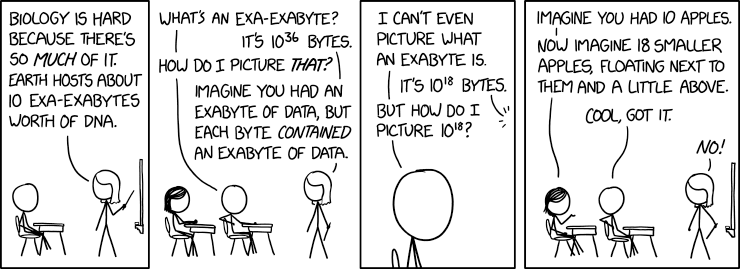
Visualizing One Million vs. One Billion

From the YouTube description: “There are lots of ways to compare a million to a billion, but most of them use volume. And I think that’s a mistake, because volume just isn’t something the human brain is great at. So instead, here’s the difference between a million and a billion, in a more one-dimensional way: distance.

The video is more than an hour long, which is the point. In the last minute of the video, he mentions what a trillion would be in the same scenario.

Engaging students: The field axioms

In my capstone class for future secondary math teachers, I ask my students to come up with ideas for engaging their students with different topics in the secondary mathematics curriculum. In other words, the point of the assignment was not to devise a full-blown lesson plan on this topic. Instead, I asked my students to think about three different ways of getting their students interested in the topic in the first place.

I plan to share some of the best of these ideas on this blog (after asking my students’ permission, of course).

This student submission again comes from my former student Andrew Sansom. His topic, from Pre-Algebra: the field axioms of arithmetic (the distributive law, the commutativity and associativity of addition and multiplication, etc.).

green line

Algebra, from one perspective, is the use of numbers’ and operations’ properties to manipulate expressions. Some of these properties, called the field axioms, are crucial to being able to easily solve equations. These properties include associativity, commutativity, distributivity, identity, and inverse. To better appreciate how these properties are so helpful in algebra, it is useful to explore some examples of operations that do not obey these laws.

A1. What interesting (i.e., uncontrived) word problems using this topic can your students do now?

Example 1: The Average (Mean) is Not Associative

Part 1
A math teacher Mrs. Taylor instructs a class of three students: Alice, Bob, and Charlie. The class took an exam last week, but Charlie was sick and missed the test, so he took it today. Mrs. Taylor promised the class that if the class average on the exam was high enough, she would give them all candy. If Alice scored a 96 and Bob scored an 83, what was the class average (the average of those two students) after the first day of the exam?

mean(A,B)= \frac{(A+B}{2}=

Part 2
After Charlie took the exam (he scored an 89), Mrs. Taylor wanted to know if she had to calculate the average from scratch (i.e. add all three scores and divide by three), or if she could just average the previous mean and Charlie’s score (i.e. add your answer from part 1 and Charlie’s score and divide by 2), since she already had done some arithmetic and didn’t want to waste time. Would she find the same answer if she tried both methods? If not, which one is correct? Why?
mean(mean(A,B),C)= \frac{ \frac{A+B}{2} +C}{2} =

mean(A,B)= \frac{A+B+C}{3}=

Part 3
After her discovery in Part 2, Mrs. Taylor is curious if she first found the mean of Bob and Charlie’s grades, then averaged it with Alice’s grade, if it would be the same as an answer above. Is it? Why or why not?

mean(A,mean(B,C))=\frac{A+ \frac{B+C}{2} }{2}=

Part 4
What does it mean for an operation to be associative? How does this activity show that the average (mean) is not associative? Why does this mean you have to be extra careful when solving problems with averages?

Example 2: Subtraction is Not Commutative

Part 1
Mrs. Taylor likes to visit Alaska during the summer. When she arrived in Anchorage, it was 10F, but a snowstorm caused the temperature to drop by 21F. Write an equation with subtraction to find the new temperature the next day.

The next summer, when Mrs. Taylor arrives in Anchorage, it is 21F but the temperature drops 10F. Write an equation with subtraction to find the new temperature the next day.

Part 2
What does it mean for an operation to be commutative? Based on what you found in Part 1, is subtraction commutative? Why or why not? Why does that mean you need to be extra careful when solving problems with subtraction?


green line

B2. How does this topic extend what your students should have learned in previous courses?

Prior to pre-algebra, students should be proficient in arithmetic. In that study, they should have been exposed to fact families, which are simple examples of the inverse elements of addition and multiplication. The field axioms generalize these ideas to other objects. Students also should have realized that subtraction and division do not commute, though they likely never used that name. They also likely realized that addition by 0 or multiplication by 1 do not affect the value of the other element. By learning the names of these different properties, students build upon their prior experience to be able to label and acknowledge when these properties appear in other contexts.


green line

B1. How can this topic be used in your students’ future courses in mathematics or science?

Although high school students will spend most of their time working in fields, instead of other algebraic structures such as non-Abelian groups or noncommutative rings, an appreciation and awareness of the field axioms while studying pre-algebra will prepare them for solving equations involving exponents (for example, intuitively questioning whether 2^x=x^2, which are trivially different, but not obvious to the novice). Furthermore, most Algebra II classes do briefly study Matrix Algebra, which is noncommutative (i.e. matrix multiplication does not commute), which causes many interesting conundrums for the uninitiated student while trying to solve problems. This appreciation of the field axioms prepares them for later study in Linear Algebra and Abstract Algebra. Outside of their math classes, vector fields form a critical part of physics, even at the high school level. Although most high school students do not realize it, they have to use the field axioms all the time to solve physics problems.

References:
Use of the mean as a simple example of a non-associative operation courtesy of StackExchange user “Accumulation” on the thread “Non-Associative Operations” (https://math.stackexchange.com/a/2892589)


Living Proof: Stories of Resilience Along the Mathematical Journey

Quoting shamelessly from https://blogs.ams.org/inclusionexclusion/2019/06/26/living-proof-a-must-read/:

The AMS and MAA have recently published a phenomenal collection of essays entitled “Living Proof: Stories of Resilience Along the Mathematical Journey”, edited by Allison K. Henrich, Emille D. Lawrence, Matthew A. Pons, and David G. Taylor. The book is free, and features an astounding group of contributing authors. The stories are organized around common themes in the experiences. Part I is about math getting hard and people hitting a wall. Part II is about struggling to belong in math (and is particularly well aligned with the goals of this blog). Part III is about persevering through and overcoming difficulties. And Part IV is about the sometimes challenge of integrating our mathematical identities with the rest of our lives.

I’ve read this compendium of 41 two- and three-page essays myself, and I highly recommend it as a way of encouraging young mathematician to persist along the journey.

Mathematics is about wonder, creativity and fun, so let’s teach it that way

I enjoyed this opinion piece at phys.org about project-based instruction in mathematics. A sample quote:

Mathematician Jo Boaler from the Stanford Graduate School of Education says that a “wide gulf between real mathematics and school mathematics is at the heart of the math problems we face in school education.”

Of the subject of mathematics, Boaler notes that: “Students will typically say it is a subject of calculations, procedures, or rules. But when we ask mathematicians what math is, they will say it is the study of patterns that is an aesthetic, creative, and beautiful subject. Why are these descriptions so different?”

She points out the same gulf isn’t seen if people ask students and English-literature professors what literature is about.

In the process of constructing the RabbitMath curriculum, problems or activities are included when team members find them engaging and a challenge to their intellect and imagination. Following the analogy with literature, we call the models we are working with mathematical novels.