There are two natural ways of computing 
Method #1.


The same expression would be obtained if we had started with 
Method #2. Since 


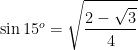

Therefore,
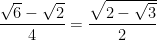
which may be verified by squaring both sides.
There are two natural ways of computing
Method #1.
The same expression would be obtained if we had started with
Method #2. Since
Therefore,
which may be verified by squaring both sides.
Here’s a square root that looks like a total mess:
Just look at this monstrosity, which has a triply-embedded square root! But then look what happens when I plug into a calculator:
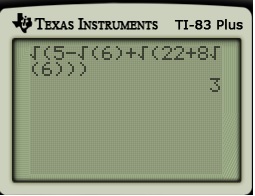
Hmmm. How is that possible?!?!
I’ll give the answer after the thought bubble, if you’d like to think about it before seeing the answer.

Let’s start from the premise that 
This last line is correct, using the formula 
 This suggests a general method for constructing such hairy square roots. To begin, start with any similar expression, such as
Then we create a nested square root:
Then I get rid of the square root on the left hand side:
Then I add or subtract something so that the left-hand side becomes a perfect square.
Finally, I take the square root of both sides:
Then I show the right-hand side to my students, ask them to plug into their calculators, and ask them to figure out what happened.
In my capstone class for future secondary math teachers, I ask my students to come up with ideas for engaging their students with different topics in the secondary mathematics curriculum. In other words, the point of the assignment was not to devise a full-blown lesson plan on this topic. Instead, I asked my students to think about three different ways of getting their students interested in the topic in the first place.
I plan to share some of the best of these ideas on this blog (after asking my students’ permission, of course).
This student submission comes from my former student Claire McMahon. Her topic, from Geometry: the proof that the measures of the angles in a triangle add to 
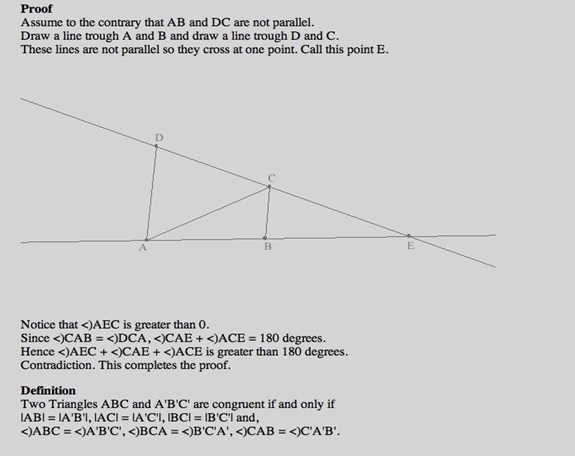
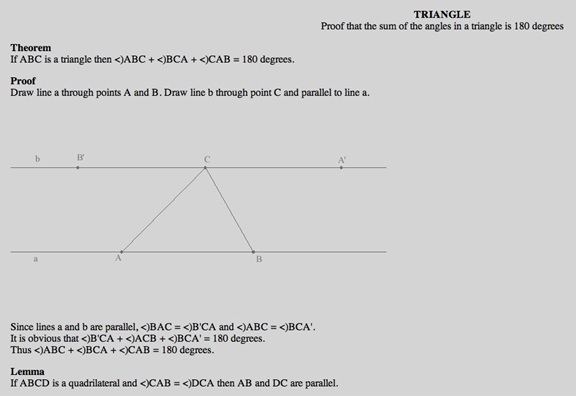
One of the hardest concepts in math is learning how to prove something that is already considered to be correct. One of the more difficult concepts to teach could also be said on how to prove things that you had already believed and accepted in the first place. One of these concepts happens to be that a triangle’s angles are always going to add up to 180 degrees. Here is one of the proofs that I found that is absolutely simplistic and most kids will agree with you on it:

This particular proof is from the website http://www.mathisfun.com. This is a great website to simply explain most math concepts and give exercises to practice those math facts. For the more skeptical student, you can use a form of Euclidean and modern fact base to prove this more in depth. I found this proof on http://www.apronus.com/geometry/triangle.htm. Here you will see that there is no question as to why the proof above works and how it doesn’t work when you do a proof by contradiction.
I stumbled across this awesome website that very simply put into context how easy it would be to prove that a triangle’s angles will always add up to 180 degrees. In this activity you take the same triangle 3 times and then have them place all three of the angles on a straight line. This proves that the angles in a triangle will always equal 180 degrees, which is a concept that should have already been taught as a straight line having an “angle” measure of 180. The website for this can be found here: http://www.regentsprep.org/Regents/math/geometry/GP5/TRTri.htm.
The triangle is the basis for a lot of math. There is one very important person that really started playing with the idea of a triangle and how 3 straight lines that close to form a figure has a certain amount of properties and similarities to parallels and other figures like it. We base a whole unit on special right triangles in geometry in high school and never know exactly where the term right angle is derived. This man that made the right angle so important in math is none other than Euclid himself. While Euclid never introduced angle measures, he made it very apparent that 2 right angles are always going to be equal to the interior angles of a triangle. Not only did Euclid prove this but he did so in a way that relates to all types of triangles and their similar counterparts using only a straight edge and a compass, pretty impressive!!
Shamelessly stolen from a friend:
How do you tell the difference between a plumber and a chemist?
Ask them to pronounce unionized.
I suggest the following activity for bright middle-school students who think that they know everything that there is to know about fractions.
The approximation to 


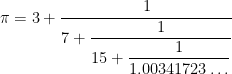
It turns out that this is the best rational approximation to 

Step 1. To begin, let’s find 
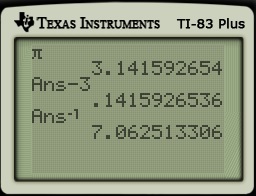
This calculation has shown that
If we ignore the 
Step 2. However, there’s no reason to stop with one reciprocal, and this might give us some even better approximations. Let’s subtract 
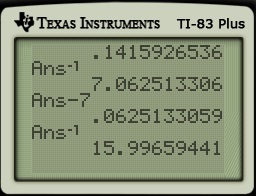
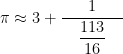
At this point, we have shown that
If we round the final denominator down to 
Step 3. Continuing with the next denominator, we subtract

At this point, we have shown that
If we round the final denominator down to 
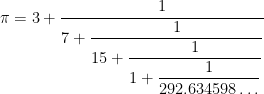
Step 4. Let me show one more step.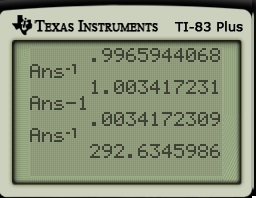
At this point, we have shown that
If we round the final denominator down to 
The calculations above are the initial steps in finding the continued fraction representation of
But I would like to point out one important property of the convergents that we found above, which were
All of these fractions are pretty close to 

In fact, these are the first terms in a sequence of best possible rational approximations to $\pi$ up to the given denominator. In other words:
is the best rational approximation to using a denominator less than $106$. In other words, no integer over  will be any closer to than . No integer over
  will be any closer to than . And so on, all the way up to denominators of
  . Small wonder that we usually teach children the approximation
  .
. , the fraction
  is the best rational approximation to using a denominator less than
  .
. is the best rational approximation to using a denominator less than
  .
.As noted above, the ancient Chinese mathematicians were superior to the ancient Greeks in this regard, as they were able to develop the approximation 
In my capstone class for future secondary math teachers, I ask my students to come up with ideas for engaging their students with different topics in the secondary mathematics curriculum. In other words, the point of the assignment was not to devise a full-blown lesson plan on this topic. Instead, I asked my students to think about three different ways of getting their students interested in the topic in the first place.
I plan to share some of the best of these ideas on this blog (after asking my students’ permission, of course).
This student submission again comes from my former student Maranda Edmonson. Her topic, from Pre-Algebra: the field axioms of arithmetic (the distributive law, the commutativity and associativity of addition and multiplication, etc.).
B. Curriculum: How can this topic be used in your students’ future courses in mathematics or science?
It is safe to say that the field axioms are used in all mathematics classes once they are introduced. As students, we know them to be rules for how to simplify or expand expressions, solving equations, or just manipulating numbers and expressions. As instructors, we know them to be a solid foundation for further mathematical understanding. “In mathematics or logic, [an axiom is] an unprovable rule or first principle accepted to be true because it is self-evident or particularly useful” (Merriam-Webster.com). Is the distributive property not useful? Isn’t the associative property self-evident? We learn these axioms, master them during the first lesson we encounter them, and they stick with us. Why? Because they are obvious “rules” that we use and apply to all aspects of mathematics. They are a foundation on which we, as instructors, wish to build upon a greater mathematical understanding.
B. Curriculum: How does this idea extend what your students should have learned in previous courses?
When students first begin to learn addition they are learning the associative property as well. Think about it – when kids learn about the expanded form of a number, they are already seeing that when you add more than two numbers together they equal the same thing, no matter what order they are being added in. For example:
and so on. Kids tend to add numbers in the order that they are given. However, when they start learning little tricks (say, their tens facts), then they will start seeing how the numbers work together. For example: 


E. Technology: How can technology be used to effectively engage students with this topic?
Math and music are always a good combination. Honestly, who doesn’t hum “Pop! Goes the Weasel” every time they need to use the quadratic formula? This YouTube video (the link is below) is of some students singing a song about the associative, commutative and distributive properties. The video is difficult to hear unless you turn the volume up, and the quality is not the greatest. However, the students in the video get the point across about what the axioms are and that they only apply to addition and multiplication. Note that you only need to watch the first three minutes of the video. The last minute and a half or so is irrelevant to the axioms themselves.
Over the summer, I occasionally teach a small summer math class for my daughter and her friends around my dining room table. Mostly to preserve the memory for future years… and to provide a resource to my friends who wonder what their children are learning… I’ll write up the best of these lesson plans in full detail.
This was a fun activity that took a couple of hours: designing a model Solar System. I chose the scale so that most of the planets would fit on a straight section of sidewalk near my house; of course, the scale could be changed to fit the available space.
For my particular audience of students, I also worked through the basics of the metric system as well as decimals.
This lesson plan is written in a 5E format — engage, explore, explain, elaborate, evaluate — which promotes inquiry-based learning and fosters student engagement.
P.S. For what it’s worth, the world’s largest model solar system can be found in Sweden.
In my capstone class for future secondary math teachers, I ask my students to come up with ideas for engaging their students with different topics in the secondary mathematics curriculum. In other words, the point of the assignment was not to devise a full-blown lesson plan on this topic. Instead, I asked my students to think about three different ways of getting their students interested in the topic in the first place.
I plan to share some of the best of these ideas on this blog (after asking my students’ permission, of course).
This student submission comes from my former student Alyssa Dalling. Her topic, from Pre-Algebra: order of operations.
C. How has this topic appeared in pop culture (movies, TV, current music, video games, etc.)?
Hannah Montana is a Disney series that aired from 2006-2011. On this episode titled “Sleepwalk This Way”, Miley’s dad writes her a new song which she reads and doesn’t like. She decides to keep her dislike of the new song to herself causing her to start sleepwalking. In order to not tell her dad what she thinks of the song while sleepwalking, Miley stops sleeping which causes her many problems. One such problem occurs when Miley gets dressed in the wrong order causing her to get an unwanted result.
I would start out the class by showing the first 46 seconds of this Hannah Montana scene. (Editor’s note: Trust me, this is hilarious.) This scene is perfect for the engage because it is a way to relate the order of operations to getting dressed. After watching the scene, the teacher would explain that just like getting dressed in the proper order is important, the order of operations when doing math is as well. The students would learn PEMDAS (parenthesis, exponents, multiplication, division, addition, and subtraction) and try different problems to get them better acquainted with the concept.
B. How can this topic be used in your students’ future courses in mathematics or science?
The order of operations will be used in almost every math class following Pre-Algebra. One example is in Algebra II when students start working with problems involving simplifying numbers and multiple variables. One example is
Start out the class by asking students how the order of operations says to answer this question. Most students will follow method two below. Upon completion of this lesson, students will learn multiple methods of problem solving which expand their previous knowledge of order of operations.
The first method students can use is to raise the numerator and denominator to the third power before simplifying. By raising each variable to the third power, no rules in the order of operations will be broken showing the student there is more than one way to use the order of operations. (Reference Method One below).
The method most students will originally think of is simplifying the fraction before raising it to the third power. The student would follow their previous knowledge of PEMDAS in order to simplify the equation to the reduced form. (Reference Method Two below). In either case, the students will see that the solution can be found by using a variety of different means that all fall under the order of operations.
Method One:

Method Two:

Resources: http://www.glencoe.com/sec/math/algebra/algebra2/algebra2_05/extra_examples/chapter5/lesson5_1.pdf
B. How can this topic be used in your students’ future courses in mathematics or science?
An understanding of the order of operations is relied upon in Calculus as well. One application is when learning the chain rule. The following YouTube video does a fun job at explaining the chain rule by using a catchy song. The students are able to learn the rule and see examples that they can use to help them with this concept. Start it at 1:32 and end it at 2:10 (shown below).
The chain rule is used to find the derivative of the composition of two functions. So if 


Resources: http://archives.math.utk.edu/visual.calculus/2/chain_rule.4/index.html
In my capstone class for future secondary math teachers, I ask my students to come up with ideas for engaging their students with different topics in the secondary mathematics curriculum. In other words, the point of the assignment was not to devise a full-blown lesson plan on this topic. Instead, I asked my students to think about three different ways of getting their students interested in the topic in the first place.
I plan to share some of the best of these ideas on this blog (after asking my students’ permission, of course).
This student submission again comes from my former student Maranda Edmonson. Her topic, from Algebra: finding 

Applications: How could you as a teacher create an activity or project that involves your topic?
Culture: How has this topic appeared in pop culture (movies, TV, current music, video games, etc.)?
Technology: How can technology be used to effectively engage students with this topic?
This link is to a reflection by a mathematics teacher who used the popular TV show “The Big Bang Theory” to teach linear functions. She taught this lesson prior to teaching students about finding
ENGAGE:
One thing I would not change would be to show the students the above clip of the show where Howard and Sheldon are heatedly discussing crickets at the beginning of the activity. By showing the video at the beginning, students will be engaged and want to figure out what will be done throughout the lesson. Being a clip of a popular show that many probably watch during the week, students will be even more engaged and interested since they are able to watch something that they are already familiar with. Being something that they are already familiar with or can relate to, students have a tendency to remember the material or at least the topic longer than they would remember something that they were unfamiliar with or could not relate.
In the clip, Sheldon argues that the cricket the guys hear while eating dinner is a snowy tree cricket based on the temperature of the room and the frequency of chirps; Howard argues that it is an ordinary field cricket. The beginning of their discussion is as follows:
Sheldon: “Based on the number of chirps per minute, and the ambient temperature in this room, it is a snowy tree cricket.”
Howard: “Oh, give me a frickin’ break. How could you possibly know that?”
Sheldon: “In 1890, Amos Dolbear determined that there was a fixed relationship between the number of chirps per minute of the snowy tree cricket and the ambient temperature – a precise relationship that is not present with ordinary field crickets.”
The whole episode revolves around the guys finding the exact genus and species of the cricket, but that is not the importance here. The importance of this clip is the linear relationship between the temperature and the number of chirps per minute of the cricket, which the activity should then be centered around.
EXPLORE:
After showing the short clip, it could be beneficial to show students the Wikipedia link that discusses Dolbear’s Law. Toward the bottom of the page, the relationship is written out in several formats, but there is a basic linear function that students could focus on for the activity.
Assuming students know how to graph linear functions (as stated above, the link is for a lesson the teacher taught before teaching students about
EXPLAIN/ELABORATE/EVALUATE:
At this point, students should be able to state what changes they noticed with the graph – specifically where the graph crossed the axes as changes are made to the function. After they have explained what they found, fill in any gaps and correct vocabulary as needed. Basically, teach what little there is left for the lesson. Follow-up by providing extra examples or a worksheet for students to practice before giving them a quiz or test to assess their performance.