In this series, I’m exploring the following ancedote from the book Surely You’re Joking, Mr. Feynman!, which I read and re-read when I was young until I almost had the book memorized.
One day at Princeton I was sitting in the lounge and overheard some mathematicians talking about the series for e^x, which is 1 + x + x^2/2! + x^3/3! Each term you get by multiplying the preceding term by x and dividing by the next number. For example, to get the next term after x^4/4! you multiply that term by x and divide by 5. It’s very simple.
When I was a kid I was excited by series, and had played with this thing. I had computed e using that series, and had seen how quickly the new terms became very small.
I mumbled something about how it was easy to calculate e to any power using that series (you just substitute the power for x).
“Oh yeah?” they said. “Well, then what’s e to the 3.3?” said some joker—I think it was Tukey.
I say, “That’s easy. It’s 27.11.”
Tukey knows it isn’t so easy to compute all that in your head. “Hey! How’d you do that?”
Another guy says, “You know Feynman, he’s just faking it. It’s not really right.”
They go to get a table, and while they’re doing that, I put on a few more figures.: “27.1126,” I say.
They find it in the table. “It’s right! But how’d you do it!”
“I just summed the series.”
“Nobody can sum the series that fast. You must just happen to know that one. How about e to the 3?”
“Look,” I say. “It’s hard work! Only one a day!”
“Hah! It’s a fake!” they say, happily.
“All right,” I say, “It’s 20.085.”
They look in the book as I put a few more figures on. They’re all excited now, because I got another one right.
Here are these great mathematicians of the day, puzzled at how I can compute e to any power! One of them says, “He just can’t be substituting and summing—it’s too hard. There’s some trick. You couldn’t do just any old number like e to the 1.4.”
I say, “It’s hard work, but for you, OK. It’s 4.05.”
As they’re looking it up, I put on a few more digits and say, “And that’s the last one for the day!” and walk out.
What happened was this: I happened to know three numbers—the logarithm of 10 to the base e (needed to convert numbers from base 10 to base e), which is 2.3026 (so I knew that e to the 2.3 is very close to 10), and because of radioactivity (mean-life and half-life), I knew the log of 2 to the base e, which is.69315 (so I also knew that e to the.7 is nearly equal to 2). I also knew e (to the 1), which is 2. 71828.
The first number they gave me was e to the 3.3, which is e to the 2.3—ten—times e, or 27.18. While they were sweating about how I was doing it, I was correcting for the extra.0026—2.3026 is a little high.
I knew I couldn’t do another one; that was sheer luck. But then the guy said e to the 3: that’s e to the 2.3 times e to the.7, or ten times two. So I knew it was 20. something, and while they were worrying how I did it, I adjusted for the .693.
Now I was sure I couldn’t do another one, because the last one was again by sheer luck. But the guy said e to the 1.4, which is e to the.7 times itself. So all I had to do is fix up 4 a little bit!
They never did figure out how I did it.
My students invariably love this story; let’s take a look at the first calculation.
Feynman knew that  and
and  , so that
 .
.
That’s all well and good, but how did Feynman give an initial answer of  in his head? The book doesn’t say, but we can guess that he used the Taylor series approximation:


Therefore,


 .
.
However, I’m not going to lie… I have no idea (other than his sheer genius with numbers) how he was able to mentally tack on two extra digits. The above calculation, to four decimal places, yields  , which is incorrect in the fourth decimal place. Indeed, if we use the more precise value of
  , we would obtain

 ,
,
which is still incorrect in the fourth decimal place. In other words, Feynman could not have just used the first two terms of the Taylor expansion of  to obtain his answer of
  . Therefore, Feynman must have used the next term in the Taylor series expansion as well as at least five decimal places of
  to make this calculation:

And I have no idea how he could possibly have done this in his head in only a minute or two.




 .
.
 .
.
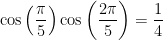
 -gon. For example, a regular pentagon can be used to show that
 ,
, .
. , so that
 .
.


 .
. to six or seven digits as well as computing the next term in the Taylor series expansion.
 .
.


 .
.


 .
. , much to the astonishment of his companions.
 to any power. The terms get very small very quickly because of the factorials in the denominator, thus lending itself to the computation of
  , they just had a book on the shelf.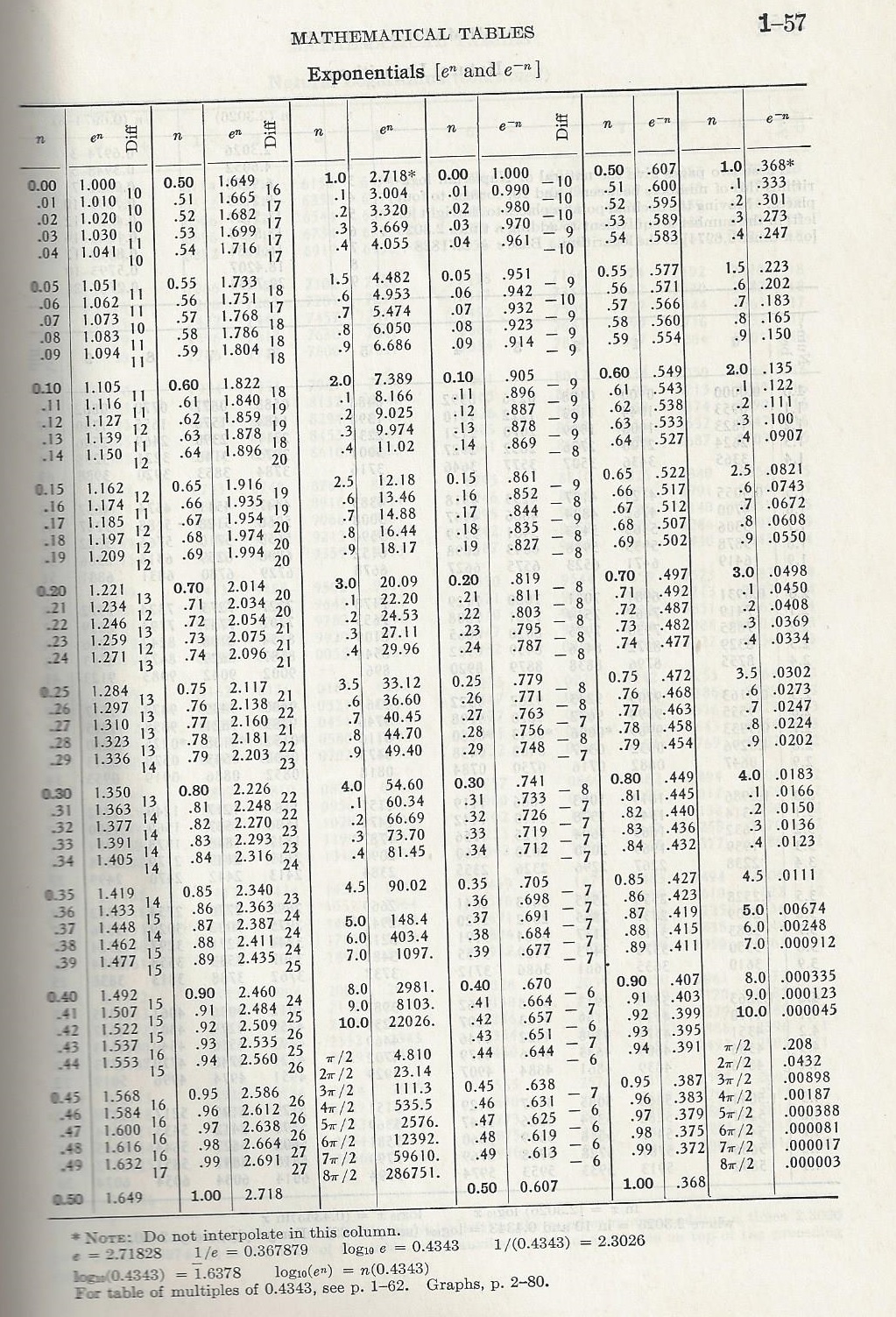
 . Somebody had computed all of these things (and plenty more) using the Taylor series, and they were compiled into a book and sold to mathematicians, scientists, and engineers.
