Different ways of solving a contest problem (Part 3)

The following problem appeared on the American High School Mathematics Examination (now called the AMC 12) in 1988:

If 3 \sin \theta = \cos \theta, what is \sin \theta \cos \theta?

When I presented this problem to a group of students, I was pleasantly surprised by the amount of creativity shown when solving this problem.

Yesterday, I presented a solution using a Pythagorean identity, but I was unable to be certain if the final answer was a positive or negative without drawing a picture. Here’s a third solution that also use a Pythagorean trig identity but avoids this difficulty. Again, I begin by squaring both sides.

9 \sin^2 \theta = \cos^2 \theta

9 (1 - \cos^2 \theta) = \cos^2 \theta

9 - 9 \cos^2 \theta = \cos^2 \theta

9 = 10 \cos^2 \theta

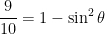
\displaystyle \frac{9}{10} = \cos^2 \theta

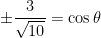
\displaystyle \pm \frac{3}{\sqrt{10}} = \cos \theta

Yesterday, I used the Pythagorean identity again to find \sin \theta. Today, I’ll instead plug back into the original equation 3 \sin \theta = \cos \theta:

3 \sin \theta = \cos \theta

3 \sin \theta = \displaystyle \frac{3}{\sqrt{10}}

\sin \theta = \displaystyle \pm \frac{1}{\sqrt{10}}

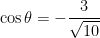
Unlike the example yesterday, the signs of \sin \theta and \cos \theta must agree. That is, if \cos \theta = \displaystyle \frac{3}{\sqrt{10}}, then \sin \theta = \displaystyle \frac{1}{\sqrt{10}} must also be positive. On the other hand, if \cos \theta = \displaystyle -\frac{3}{\sqrt{10}}, then \sin \theta = \displaystyle -\frac{1}{\sqrt{10}} must also be negative.

If they’re both positive, then

\sin \theta \cos \theta = \displaystyle \left( \frac{1}{\sqrt{10}} \right) \left( \frac{3}{\sqrt{10}} \right) =\displaystyle \frac{3}{10},

and if they’re both negative, then

\sin \theta \cos \theta = \displaystyle \left( -\frac{1}{\sqrt{10}} \right) \left( -\frac{3}{\sqrt{10}} \right) = \displaystyle \frac{3}{10}.

Either way, the answer must be \displaystyle \frac{3}{10}.

This is definitely superior to the solution provided in yesterday’s post, as there’s absolutely no doubt that the product \sin \theta \cos \theta must be positive.

Different ways of solving a contest problem (Part 2)

The following problem appeared on the American High School Mathematics Examination (now called the AMC 12) in 1988:

If 3 \sin \theta = \cos \theta, what is \sin \theta \cos \theta?

When I presented this problem to a group of students, I was pleasantly surprised by the amount of creativity shown when solving this problem.

Yesterday, I presented a solution using triangles. Here’s a second solution that I received: begin by squaring both sides and using a Pythagorean trig identity.

9 \sin^2 \theta = \cos^2 \theta

9 (1 - \cos^2 \theta) = \cos^2 \theta

9 - 9 \cos^2 \theta = \cos^2 \theta

9 = 10 \cos^2 \theta

\displaystyle \frac{9}{10} = \cos^2 \theta

\displaystyle \pm \frac{3}{\sqrt{10}} = \cos \theta

We use the Pythagorean identity again to find \sin \theta:

\displaystyle \frac{9}{10} = \cos^2 \theta

\displaystyle \frac{9}{10} = 1 - \sin^2 \theta

\sin^2 \theta = \displaystyle \frac{1}{10}

\sin \theta = \displaystyle \pm \frac{1}{\sqrt{10}}

Therefore, we know that

\sin \theta \cos \theta = \displaystyle \left( \pm \frac{1}{\sqrt{10}} \right) \left( \pm \frac{3}{\sqrt{10}} \right) = \displaystyle \pm \displaystyle \frac{3}{10},

so the answer is either \displaystyle \frac{3}{10} or \displaystyle -\frac{3}{10}. However, this was a multiple-choice contest problem and \displaystyle -\frac{3}{10} was not listed as a possible answer, and so the answer must be \displaystyle \frac{3}{10}.

green lineFor a contest problem, the above logic makes perfect sense. However, the last step definitely plays to the fact that this was a multiple-choice problem, and the concluding step would not have been possible had \displaystyle -\frac{3}{10} been given as an option.


Different ways of solving a contest problem (Part 1)

The following problem appeared on the American High School Mathematics Examination (now called the AMC 12) in 1988:

If 3 \sin \theta = \cos \theta, what is \sin \theta \cos \theta?

When I presented this problem to a group of students, I was pleasantly surprised by the amount of creativity shown when solving this problem.

Here’s the first solution that I received: draw the appropriate triangles for the angle \theta:

3 \sin \theta = \cos \theta

\tan \theta = \displaystyle \frac{1}{3}

Therefore, the angle \theta must lie in either the first or third quadrant, as shown. (Of course, \theta could be coterminal with either displayed angle, but that wouldn’t affect the values of \sin \theta or \cos \theta.)

AHSME problem

In Quadrant I, \sin \theta = \displaystyle \frac{1}{\sqrt{10}} and \cos \theta = \displaystyle \frac{3}{\sqrt{10}}. Therefore,

\sin \theta \cos \theta = \displaystyle \frac{1}{\sqrt{10}} \times \frac{3}{\sqrt{10}} = \displaystyle \frac{3}{10}.

In Quadrant III, \sin \theta = \displaystyle -\frac{1}{\sqrt{10}} and \cos \theta = -\displaystyle \frac{3}{\sqrt{10}}. Therefore,

\sin \theta \cos \theta = \displaystyle \left( - \frac{1}{\sqrt{10}} \right) \times \left( -\frac{3}{\sqrt{10}} \right) = \displaystyle \frac{3}{10}.

Either way, we can be certain that \sin \theta \cos \theta = \displaystyle \frac{3}{10}.

Mathematical induction and blank space

I tried out a one-liner in class that I’d been itching to try all summer.

I was introducing my students to proofs by mathematical induction; my example was showing that

1 + 3 + 5 + \dots + (2n-1) = n^2.

After describing the principle of mathematical induction, I wrote out the n = 1 step and the assumption for n = k:

n=1: 1=1^2, so this checks.

n =k: Assume that 1 + 3 + 5 + \dots + (2k-1) = k^2.

Then, for the inductive step, I had my students tell me what the left- and right-hand side would be if I substituted k+1 in place of n. I wrote the answer for the left-hand side at the top of the board, the answer for the right-hand side at the bottom of the board, and left plenty of blank space in between the two (which I would fill in shortly):

n = k+1:

1 + 3 + 5 \dots + (2k-1) + (2[k+1]-1) =

~

~

~

~

~

~

= (k+1)^2

So I explained that, to complete the proof by induction, all we had to do was convert the top line into the bottom line.

As my class swallowed hard as they thought about how to perform this task, I told them, “Yes, this looks really intimidating. Indeed, to quote the great philosopher, ‘You might think that I’m insane. But I’ve got a blank space, baby… and I’ll write your name.’ “

The one-liner provoked the desired response from my students… and after the laughter died down, we then worked through the end of the proof.

And, just in case you’ve been buried under a rock for the past few months, here’s the source material for the one-liner (which, at the time of this writing, is the second-most watched video on YouTube):

How I Impressed My Wife: Part 6g

This series was inspired by a question that my wife asked me: calculate

Q = \displaystyle \int_0^{2\pi} \frac{dx}{\cos^2 x + 2 a \sin x \cos x + (a^2 + b^2) \sin^2 x}

Originally, I multiplied the top and bottom of the integrand by \tan^2 x and performed a substitution. However, as I’ve discussed in this series, there are four different ways that this integral can be evaluated.
Starting with today’s post, I’ll begin a fifth method. I really like this integral, as it illustrates so many different techniques of integration as well as the trigonometric tricks necessary for computing some integrals.

green lineSince Q is independent of a, I can substitute any convenient value of a that I want without changing the value of Q. As shown in previous posts, substituting a =0 yields the following simplification:

Q = \displaystyle \int_0^{2\pi} \frac{dx}{\cos^2 x + 2 a \sin x \cos x + (a^2 + b^2) \sin^2 x}

= \displaystyle \int_{0}^{2\pi} \frac{dx}{\cos^2 x + 2 \cdot 0 \cdot \sin x \cos x + (0^2 + b^2) \sin^2 x}

= \displaystyle \int_{0}^{2\pi} \frac{dx}{\cos^2 x + b^2 \sin^2 x}

= \displaystyle \int_{-\pi}^{\pi} \frac{dx}{\cos^2 x + b^2 \sin^2 x}

= \displaystyle \int_{-\infty}^{\infty} \frac{ 2(1+u^2) du}{u^4 + (4 b^2 - 2) u^2 + 1}

= \displaystyle \lim_{R \to \infty} \oint_{C_R} \frac{ 2(1+z^2) dz}{z^4 + (4 b^2 - 2) z^2 + 1}

= 2\pi i \left[\displaystyle \frac{r_1}{r_1^2-1} + \displaystyle \frac{r_2}{r_2^2-1} \right],

where I’ve made the assumption that |b| < 1. In the above derivation, C_R is the contour in the complex plane shown below (graphic courtesy of Mathworld).

Also,

r_1 = \sqrt{1-b^2} + |b|i

and

r_2 = -\sqrt{1-b^2} + |b|i

are the two poles of the final integrand that lie within this contour.

It now remains to simplify the final algebraic expression. To begin, I note

\displaystyle \frac{r_1}{r_1^2-1} = \displaystyle \frac{\sqrt{1-b^2} + |b|i}{[\sqrt{1-b^2} + |b|i]^2 - 1}

= \displaystyle \frac{\sqrt{1-b^2} + |b|i}{1-b^2 + 2|b|i\sqrt{1-b^2} - |b|^2 - 1}

= \displaystyle \frac{\sqrt{1-b^2} + |b|i}{-2|b|^2 + 2|b|i\sqrt{1-b^2}}

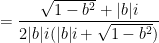
= \displaystyle \frac{\sqrt{1-b^2} + |b|i}{2|b|i(|b|i +\sqrt{1-b^2})}

= \displaystyle \frac{1}{2|b|i}.

Similarly,

\displaystyle \frac{r_2}{r_2^2-1} = \displaystyle \frac{-\sqrt{1-b^2} + |b|i}{[-\sqrt{1-b^2} + |b|i]^2 - 1}

= \displaystyle \frac{-\sqrt{1-b^2} + |b|i}{1-b^2 - 2|b|i\sqrt{1-b^2} - |b|^2 - 1}

= \displaystyle \frac{-\sqrt{1-b^2} + |b|i}{-2|b|^2 - 2|b|i\sqrt{1-b^2}}

= \displaystyle \frac{-\sqrt{1-b^2} + |b|i}{2|b|i(|b|i -\sqrt{1-b^2})}

= \displaystyle \frac{1}{2|b|i}.

Therefore,

Q = 2\pi i \left[\displaystyle \frac{r_1}{r_1^2-1} + \displaystyle \frac{r_2}{r_2^2-1} \right] = 2\pi i \left[ \displaystyle \frac{1}{2|b|i} + \frac{1}{2|b| i} \right] = 2\pi i \displaystyle \frac{2}{2|b|i} = \displaystyle \frac{2\pi}{|b|}.

green lineAnd so, at long last, I’ve completed a fifth different evaluation of Q.

How I Impressed My Wife: Part 6f

This series was inspired by a question that my wife asked me: calculate

Q = \displaystyle \int_0^{2\pi} \frac{dx}{\cos^2 x + 2 a \sin x \cos x + (a^2 + b^2) \sin^2 x}

Originally, I multiplied the top and bottom of the integrand by \tan^2 x and performed a substitution. However, as I’ve discussed in this series, there are four different ways that this integral can be evaluated.
Starting with today’s post, I’ll begin a fifth method. I really like this integral, as it illustrates so many different techniques of integration as well as the trigonometric tricks necessary for computing some integrals.
green lineSince Q is independent of a, I can substitute any convenient value of a that I want without changing the value of Q. As shown in previous posts, substituting a =0 yields the following simplification:

Q = \displaystyle \int_0^{2\pi} \frac{dx}{\cos^2 x + 2 a \sin x \cos x + (a^2 + b^2) \sin^2 x}

= \displaystyle \int_{0}^{2\pi} \frac{dx}{\cos^2 x + 2 \cdot 0 \cdot \sin x \cos x + (0^2 + b^2) \sin^2 x}

= \displaystyle \int_{0}^{2\pi} \frac{dx}{\cos^2 x + b^2 \sin^2 x}

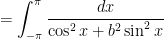
= \displaystyle \int_{-\pi}^{\pi} \frac{dx}{\cos^2 x + b^2 \sin^2 x}

= \displaystyle \int_{-\infty}^{\infty} \frac{ 2(1+u^2) du}{u^4 + (4 b^2 - 2) u^2 + 1}

= \displaystyle \lim_{R \to \infty} \oint_{C_R} \frac{ 2(1+z^2) dz}{z^4 + (4 b^2 - 2) z^2 + 1},

where C_R is the contour in the complex plane shown below (graphic courtesy of Mathworld).

Amazingly, contour integrals can be simply computed by evaluating the residues at every pole located inside of the contour. (See Wikipedia and Mathworld for more details.) I have already handled the case of |b| = 1 and |b| > 1. Today, I begin the final case of |b| < 1.

Earlier in this series, I showed that

z^4 + (4b^2 - 2) z^2 + 1 = (z^2 + 2z \sqrt{1-b^2} + 1)(z^2 - 2z \sqrt{1-b^2} + 1)

if |b| < 1, and so the quadratic formula can be used to find the four poles of the integrand:

r_1 = \sqrt{1-b^2} + |b|i,

r_2 = -\sqrt{1-b^2} + |b|i,

r_3 = \sqrt{1-b^2} - |b|i,

r_4 = -\sqrt{1-b^2} - |b|i.

Of these, only two lie (r_1 and r_2) within the contour for sufficiently large R (actually, for R > 1 since all four poles lie on the unit circle in the complex plane).

As shown earlier in this series, the residue at each pole is given by

\displaystyle \frac{r^2 + 1}{2r^3 + (4b^2-2)r}

I’ll now simplify this considerably by using the fact that r^4 + (4b^2-2)r^2 + 1 = 0 at each pole:

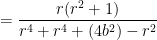
\displaystyle \frac{r^2 + 1}{2r^3 + (4b^2-2)r} = \displaystyle \frac{r(r^2+1)}{2r^4+(4b^2)-r^2}

= \displaystyle \frac{r(r^2+1)}{r^4+r^4 + (4b^2)-r^2}

= \displaystyle \frac{r(r^2+1)}{r^4-1}

= \displaystyle \frac{r(r^2+1)}{(r^2+1)(r^2-1)}

= \displaystyle \frac{r}{r^2-1}.

Therefore, to evaluate the contour integral, I simply the sum of the residues within the contour and multiply the sum by 2\pi i:

Q = \displaystyle \lim_{R \to \infty} \oint_{C_R} \frac{ 2(1+z^2) dz}{z^4 + (4 b^2 - 2) z^2 + 1} = 2\pi i \left[\displaystyle \frac{r_1}{r_1^2-1} + \displaystyle \frac{r_2}{r_2^2-1} \right].

green lineSo, to complete the evaluation of Q, I need to simplify the right-hand side. I’ll complete this in tomorrow’s post.

How I Impressed My Wife: Part 6e

This series was inspired by a question that my wife asked me: calculate

Q = \displaystyle \int_0^{2\pi} \frac{dx}{\cos^2 x + 2 a \sin x \cos x + (a^2 + b^2) \sin^2 x}

Originally, I multiplied the top and bottom of the integrand by \tan^2 x and performed a substitution. However, as I’ve discussed in this series, there are four different ways that this integral can be evaluated.
Starting with today’s post, I’ll begin a fifth method. I really like this integral, as it illustrates so many different techniques of integration as well as the trigonometric tricks necessary for computing some integrals.

 nvenient value of a that I want without changing the value of Q. As shown in previous posts, substituting a =0 yields the following simplification:

Q = \displaystyle \int_0^{2\pi} \frac{dx}{\cos^2 x + 2 a \sin x \cos x + (a^2 + b^2) \sin^2 x}

= \displaystyle \int_{0}^{2\pi} \frac{dx}{\cos^2 x + 2 \cdot 0 \cdot \sin x \cos x + (0^2 + b^2) \sin^2 x}

= \displaystyle \int_{0}^{2\pi} \frac{dx}{\cos^2 x + b^2 \sin^2 x}

= \displaystyle \int_{-\pi}^{\pi} \frac{dx}{\cos^2 x + b^2 \sin^2 x}

= \displaystyle \int_{-\infty}^{\infty} \frac{ 2(1+u^2) du}{u^4 + (4 b^2 - 2) u^2 + 1}

= \displaystyle \lim_{R \to \infty} \oint_{C_R} \frac{ 2(1+z^2) dz}{z^4 + (4 b^2 - 2) z^2 + 1}

= 2\pi \displaystyle \left[ \frac{1-r_1^2}{-2r_1^3 + (4b^2-2) r_1} +\frac{1-r_2^2}{-2r_2^3 + (4b^2-2) r_2} \right]

where I’ve assumed |b| > 1, the contour C_R in the complex plane is shown below (graphic courtesy of Mathworld),

and the positive constants r_1 and r_2 are given by

r_1 = \sqrt{2b^2 - 1 + 2|b| \sqrt{b^2 - 1}},

r_2 = \sqrt{2b^2 - 1 - 2|b| \sqrt{b^2 - 1}}.

Now we have the small matter of simplifying our expression for Q. Actually, this isn’t a small matter because Mathematica 10.1 is not able to simplify this expression much at all:

ResidueCalculation

Fortunately, humans can still do some things that computers can’t. The numbers r_1 and r_2 are chosen so that \pm ir_1 and \pm ir_2 are the roots of the denominator z^4 + (4 b^2 - 2) z^2 + 1. In other words,

[ir_1]^4 + (4b^2 - 2) [ir_1]^2 + 1 = r_1^4 - [4b^2-2] r_1^2 + 1 = 0,

r_2^4 - [4b^2-2] r_2^2 + 1 = 0

These relationships will be very handy for simplifying our expression for Q:

Q = 2\pi \displaystyle \left[ \frac{1-r_1^2}{-2r_1^3 + (4b^2-2) r_1} +\frac{1-r_2^2}{-2r_2^3 + (4b^2-2) r_2} \right]

= 2\pi \left[ \displaystyle \frac{r_1^2-1}{2r_1^3-(4b^2-2)r_1} + \frac{r_2^2-1}{2r_2^3-(4b^2-2)r_2} \right]

= 2\pi \left[ \displaystyle \frac{r_1(r_1^2-1)}{2r_1^4-(4b^2-2)r_1^2} + \frac{r_2(r_2^2-1)}{2r_2^4-(4b^2-2)r_2^2} \right]

= 2\pi \left[ \displaystyle \frac{r_1(r_1^2-1)}{r_1^4 + r_1^4-(4b^2-2)r_1^2} + \frac{r_2(r_2^2-1)}{r_2^4+r_2^4-(4b^2-2)r_2^2} \right]

= 2\pi \left[ \displaystyle \frac{r_1(r_1^2-1)}{r_1^4 -1} + \frac{r_2(r_2^2-1)}{r_2^4-1} \right]

= 2\pi \left[ \displaystyle \frac{r_1(r_1^2-1)}{(r_1^2 -1)(r_1^2+1)} + \frac{r_2(r_2^2-1)}{(r_2^2-1)(r_2^2+1)} \right]

= 2\pi \left[ \displaystyle \frac{r_1}{r_1^2+1} + \frac{r_2}{r_2^2+1} \right]

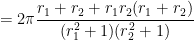
= 2\pi \displaystyle \frac{r_1(r_2^2+1)+(r_1^2+1)r_2}{(r_1^2+1)(r_2^2+1)}

= 2\pi \displaystyle \frac{r_1 r_2^2+r_1+r_1^2 r_2 +r_2}{(r_1^2+1)(r_2^2+1)}

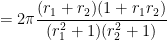
= 2\pi \displaystyle \frac{r_1 +r_2 + r_1 r_2 (r_1 + r_2)}{(r_1^2+1)(r_2^2+1)}

= 2\pi \displaystyle \frac{(r_1 +r_2)(1 + r_1 r_2)}{(r_1^2+1)(r_2^2+1)}


To complete the calculation, we recall that

r_1 = \sqrt{2b^2 - 1 + 2|b| \sqrt{b^2 - 1}},

r_2 = \sqrt{2b^2 - 1 - 2|b| \sqrt{b^2 - 1}},

so that

r_1^2 + r_2^2 = 4b^2 - 2,

r_1^2 r_2^2 = 1,

and hence

r_1 r_2 = 1

since r_1 and r_2 are both positive. Also,

(r_1 + r_2)^2 = r_1^2 + 2r_1 r_2 + r_2^2 = 4b^2 -2 + 2 = 4b^2,

so that

r_1 + r_2 = 2|b|.

Finally,

(r_1^2 + 1)(r_2^2 + 1) = (2b^2 + 2|b| \sqrt{b^2-1})(2b^2 - 2|b| \sqrt{b^2 -1})

= 4b^4 - 4b^2 (b^2-1)

= 4b^2.

Therefore,

Q = 2\pi \displaystyle \frac{(r_1 +r_2)(1 + r_1 r_2)}{(r_1^2+1)(r_2^2+1)} = 2\pi \displaystyle \frac{ 2|b| \cdot (1 + 1)}{4b^2} = \displaystyle \frac{8\pi |b|}{4 |b|^2} = \displaystyle \frac{2\pi}{|b|}.

green line

So far, I’ve evaluated the integral Q for the cases |b| = 1 and |b| > 1. Beginning with tomorrow’s post, I’ll evaluate the integral for the case |b| < 1. As it turns out, the method presented above will again be utilized for simplifying the two residues.

How I Impressed My Wife: Part 6d

This series was inspired by a question that my wife asked me: calculate

Q = \displaystyle \int_0^{2\pi} \frac{dx}{\cos^2 x + 2 a \sin x \cos x + (a^2 + b^2) \sin^2 x}

Originally, I multiplied the top and bottom of the integrand by \tan^2 x and performed a substitution. However, as I’ve discussed in this series, there are four different ways that this integral can be evaluated.
Starting with today’s post, I’ll begin a fifth method. I really like this integral, as it illustrates so many different techniques of integration as well as the trigonometric tricks necessary for computing some integrals.

 nvenient value of a that I want without changing the value of Q. As shown in previous posts, substituting a =0 yields the following simplification:

Q = \displaystyle \int_0^{2\pi} \frac{dx}{\cos^2 x + 2 a \sin x \cos x + (a^2 + b^2) \sin^2 x}

= \displaystyle \int_{0}^{2\pi} \frac{dx}{\cos^2 x + 2 \cdot 0 \cdot \sin x \cos x + (0^2 + b^2) \sin^2 x}

= \displaystyle \int_{0}^{2\pi} \frac{dx}{\cos^2 x + b^2 \sin^2 x}

= \displaystyle \int_{-\pi}^{\pi} \frac{dx}{\cos^2 x + b^2 \sin^2 x}

= \displaystyle \int_{-\infty}^{\infty} \frac{ 2(1+u^2) du}{u^4 + (4 b^2 - 2) u^2 + 1}

= \displaystyle \lim_{R \to \infty} \oint_{C_R} \frac{ 2(1+z^2) dz}{z^4 + (4 b^2 - 2) z^2 + 1}

= 2\pi \displaystyle \left[ \frac{1-r_1^2}{-2r_1^3 + (4b^2-2) r_1} +\frac{1-r_2^2}{-2r_2^3 + (4b^2-2) r_2} \right]

where I’ve assumed |b| > 1, the contour C_R in the complex plane is shown below (graphic courtesy of Mathworld),

and the positive constants r_1 and r_2 are given by

r_1 = \sqrt{2b^2 - 1 + 2|b| \sqrt{b^2 - 1}},

r_2 = \sqrt{2b^2 - 1 - 2|b| \sqrt{b^2 - 1}}.

Now we have the small matter of simplifying our expression for Q. Actually, this isn’t a small matter because Mathematica 10.1 is not able to simplify this expression much at all:

ResidueCalculation

Fortunately, humans can still do some things that computers can’t. As observed yesterday, The numbers r_1 and r_2 are chosen so that \pm ir_1 and \pm ir_2 are the roots of the denominator z^4 + (4 b^2 - 2) z^2 + 1, so that

r_1^2 + r_2^2 = 4b^2 - 2,

r_1 r_2 = 1.

These relationships will be very handy for simplifying our expression for Q:

Q = 2\pi \displaystyle \left[ \frac{1-r_1^2}{-2r_1^3 + (4b^2-2) r_1} +\frac{1-r_2^2}{-2r_2^3 + (4b^2-2) r_2} \right]

= 2\pi \left[ \displaystyle \frac{1-r_1^2}{r_1 (-2r_1^2 + 4b^2-2)} + \frac{1-r_2^2}{r_2(-2r_2^2 + 4b^2-2)} \right]

= 2\pi \left[ \displaystyle \frac{1-r_1^2}{r_1 (-2r_1^2 +r_1^2 + r_2^2)} + \frac{1-r_2^2}{r_2(-2r_2^2 + r_1^2 + r_2^2)} \right]

= 2\pi \left[ \displaystyle \frac{1-r_1^2}{r_1 (-r_1^2 +r_2^2)} + \frac{1-r_2^2}{r_2(r_1^2 -r_2^2)} \right]

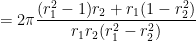
 = 2\pi \left[ \displaystyle \frac{r_1^2-1}{r_1 (r_1^2 -r_2^2)} + \frac{1-r_2^2}{r_2(r_1^2 -r_2^2)} \right]

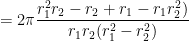
= 2\pi \displaystyle \frac{(r_1^2-1)r_2 + r_1(1-r_2^2)}{r_1 r_2 (r_1^2 -r_2^2)}

 = 2\pi \displaystyle \frac{r_1^2 r_2- r_2 + r_1- r_1 r_2^2)}{r_1 r_2 (r_1^2 -r_2^2)}

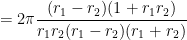
= 2\pi \displaystyle \frac{r_1 - r_2 + r_1 r_2 (r_1 - r_2)}{r_1 r_2 (r_1-r_2)(r_1 + r_2)}

= 2\pi \displaystyle \frac{(r_1 - r_2)(1 + r_1 r_2)}{r_1 r_2 (r_1-r_2)(r_1 + r_2)}

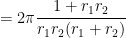
= 2\pi \displaystyle \frac{1 + r_1 r_2}{r_1 r_2 (r_1 + r_2)}

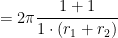
= 2\pi \displaystyle \frac{1 + 1}{1 \cdot (r_1 + r_2)}

= \displaystyle \frac{4\pi}{r_1 + r_2}

To complete the calculation, I observe that

(r_1 + r_2)^2 = r_1^2 + 2r_1 r_2 + r_2^2 = 4b^2 -2 + 2 = 4b^2,

so that

r_1 + r_2 = 2|b|.

Therefore,

Q = \displaystyle \frac{4\pi}{r_1 + r_2} = \displaystyle \frac{4\pi}{2|b|} = \displaystyle \frac{2\pi}{|b|}.

green line

In tomorrow’s post, I’ll present another way to simplify this nasty algebraic expression.

How I Impressed My Wife: Part 6c

This series was inspired by a question that my wife asked me: calculate

Q = \displaystyle \int_0^{2\pi} \frac{dx}{\cos^2 x + 2 a \sin x \cos x + (a^2 + b^2) \sin^2 x}

Originally, I multiplied the top and bottom of the integrand by \tan^2 x and performed a substitution. However, as I’ve discussed in this series, there are four different ways that this integral can be evaluated.
Starting with today’s post, I’ll begin a fifth method. I really like this integral, as it illustrates so many different techniques of integration as well as the trigonometric tricks necessary for computing some integrals.

green lineSince Q is independent of a, I can substitute any convenient value of a that I want without changing the value of Q. As shown in previous posts, substituting a =0 yields the following simplification:

Q = \displaystyle \int_0^{2\pi} \frac{dx}{\cos^2 x + 2 a \sin x \cos x + (a^2 + b^2) \sin^2 x}

= \displaystyle \int_{0}^{2\pi} \frac{dx}{\cos^2 x + 2 \cdot 0 \cdot \sin x \cos x + (0^2 + b^2) \sin^2 x}

= \displaystyle \int_{0}^{2\pi} \frac{dx}{\cos^2 x + b^2 \sin^2 x}

= \displaystyle \int_{-\pi}^{\pi} \frac{dx}{\cos^2 x + b^2 \sin^2 x}

= \displaystyle \int_{-\infty}^{\infty} \frac{ 2(1+u^2) du}{u^4 + (4 b^2 - 2) u^2 + 1}

= \displaystyle \lim_{R \to \infty} \oint_{C_R} \frac{ 2(1+z^2) dz}{z^4 + (4 b^2 - 2) z^2 + 1},

where C_R is the contour in the complex plane shown below (graphic courtesy of Mathworld).

Amazingly, contour integrals can be simply computed by evaluating the residues at every pole located inside of the contour. (See Wikipedia and Mathworld for more details.) I handled the case of |b| = 1 in yesterday’s post. Today, I’ll begin the case of |b| > 1.

To find the poles of the integrand, I use the quadratic formula to set the denominator equal to zero:


z^4 + (4 b^2 - 2) z^2 + 1 = 0

z^2 = \displaystyle \frac{2-4b^2 \pm \sqrt{(4b^2-2)^2 - 4}}{2}

z^2 = \displaystyle \frac{2-4b^2 \pm \sqrt{16b^4 - 16b^2 + 4 - 4}}{2}

z^2 = \displaystyle \frac{2-4b^2 \pm \sqrt{16b^4 - 16b^2}}{2}

z^2 = \displaystyle \frac{2-4b^2 \pm 4|b| \sqrt{b^2 - 1}}{2}

z^2 = 1-2b^2 \pm 2|b| \sqrt{b^2 - 1}

As shown earlier in this series, the right-hand side is negative if |b| > 1. So, for the sake of simplicity, I’ll define

r_1 = \sqrt{2b^2 - 1 + 2|b| \sqrt{b^2 - 1}},

r_2 = \sqrt{2b^2 - 1 - 2|b| \sqrt{b^2 - 1}},

so that the four poles of the integrand are ir_1, ir_2, -ir_1, and -ir_2. Of these, only two (ir_1 and ir_2) lie within the contour for sufficiently large R, and so I’ll need to compute the residues for these two poles.

Before starting that task, I notice that

z^4 + (4 b^2 - 2) z^2 + 1 = (z - ir_1)(z + ir_1)(z - ir_2)(z + ir_2),

or

z^4 + (4b^2 - 2)z^2 + 1 = (z^2 + r_1^2)(z^2 + r_2^2),

or

z^4 + (4b^2 -2)z^2 + 1 = z^4 + (r_1^2 + r_2^2) z^2 + r_1^2 r_2^2.

Matching coefficients, I see that

r_1^2 + r_2^2 = 4b^2 - 2,

r_1^2 r_2^2 = 1.

These will become very handy later in the calculation.

The integrand has the form \displaystyle g(z)/h(z), and each pole has order one. As shown earlier in this series, the residue at such pole is equal to

\displaystyle \frac{g(r)}{h'(r)}.

In this case, g(z) = 2(1+z^2) and h(z) = z^4 + (4b^2-2)z^2 + 1 so that h'(z) = 4z^3 + 2(4b^2-2)z, and so the residue at r_1 and r_2 are given by

\displaystyle \frac{2(1+[ir_1]^2)}{4 [ir_1]^3 + 2(4b^2-2) [ir_1]} = \displaystyle \frac{-i(1-r_1^2)}{-2r_1^3 + (4b^2-2) r_1}

and

\displaystyle \frac{2(1+[ir_2]^2)}{4 [ir_2]^3 + 2(4b^2-2) [ir_2]} = \displaystyle \frac{-i(1-r_2^2)}{-2r_2^3 + (4b^2-2) r_2}

Finally, to evaluate the contour integral, I simply the sum of the residues within the contour and then multiply the sum by 2\pi i:

Q = \displaystyle \lim_{R \to \infty} \oint_{C_R} \frac{ 2(1+z^2) dz}{z^4 + (4 b^2 - 2) z^2 + 1} = 2\pi i \left[\frac{-i(1-r_1^2)}{-2r_1^3 + (4b^2-2) r_1} +\frac{-i(1-r_2^2)}{-2r_2^3 + (4b^2-2) r_2} \right]

= 2\pi \displaystyle \left[ \frac{1-r_1^2}{-2r_1^3 + (4b^2-2) r_1} +\frac{1-r_2^2}{-2r_2^3 + (4b^2-2) r_2} \right]


green lineSo, to complete the evaluation of Q, I’m left with the small matter of simplifying the right-hand side. I’ll tackle this in tomorrow’s post.