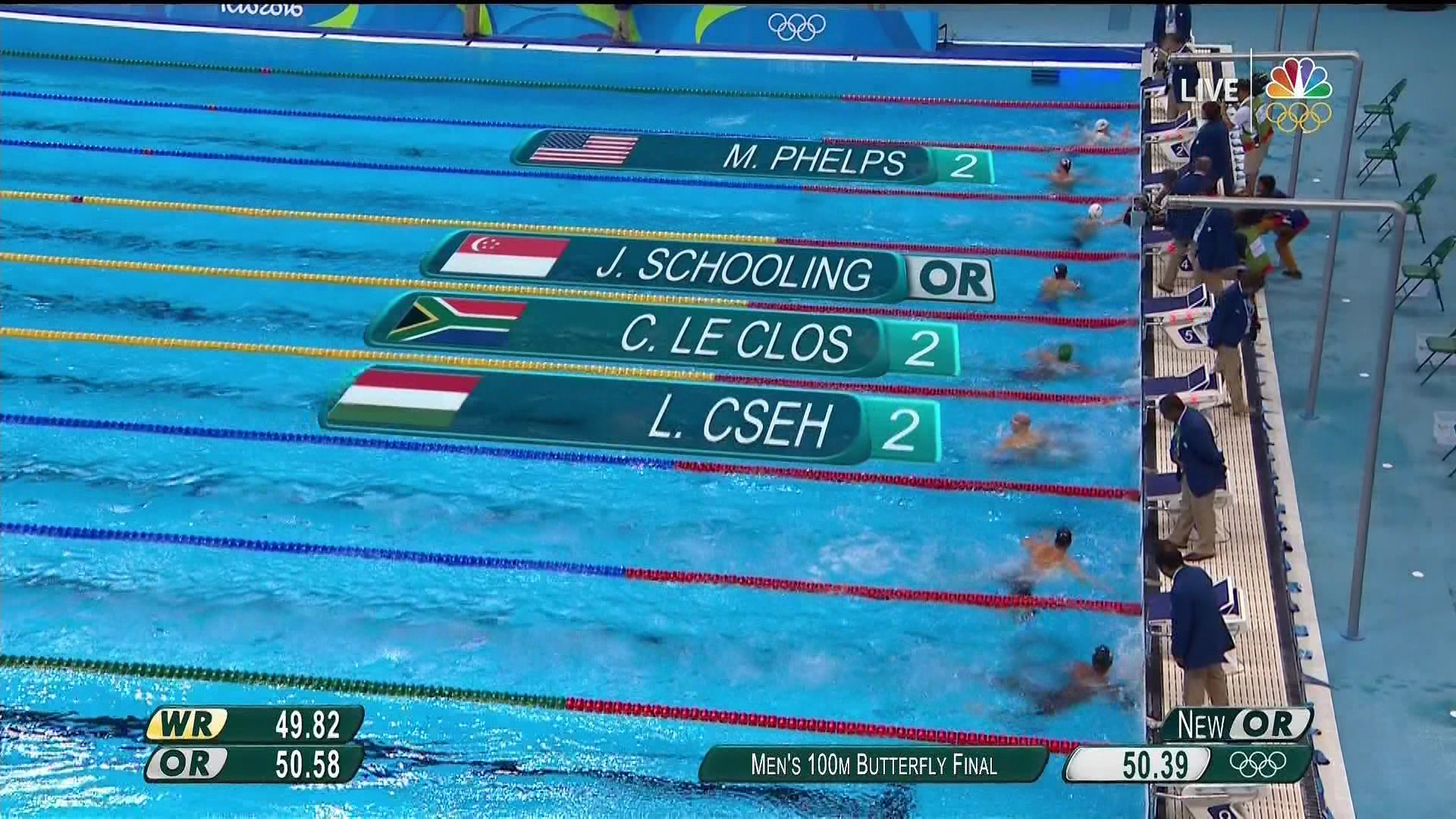
In 1972, Sweden’s Gunnar Larsson beat American Tim McKee in the 400m individual medley by 0.002 seconds. That finish led the governing body to eliminate timing by a significant digit. But why?
In a 50 meter Olympic pool, at the current men’s world record 50m pace, a thousandth-of-a-second constitutes 2.39 millimeters of travel. FINA pool dimension regulations allow a tolerance of 3 centimeters in each lane, more than ten times that amount. Could you time swimmers to a thousandth-of-a-second? Sure, but you couldn’t guarantee the winning swimmer didn’t have a thousandth-of-a-second-shorter course to swim. (Attempting to construct a concrete pool to any tighter a tolerance is nearly impossible; the effective length of a pool can change depending on the ambient temperature, the water temperature, and even whether or not there are people in the pool itself.)
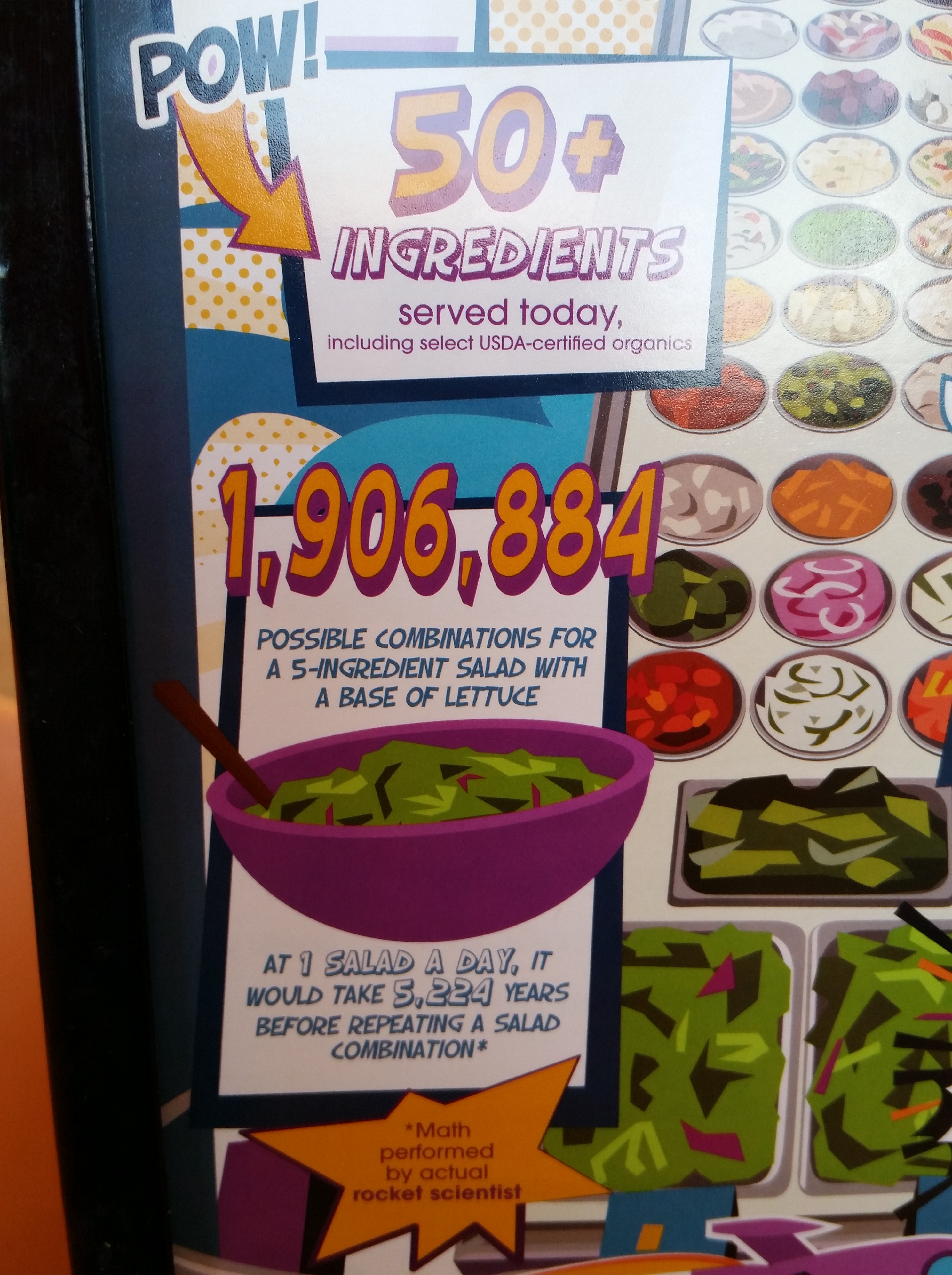
Jason’s Deli is one of my family’s favorite places for an inexpensive meal. Recently, I saw the following placard at our table advertising their salad bar:
The small print says “Math performed by actual rocket scientist”; let’s see how the rocket scientist actually did this calculation.
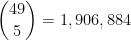
In yesterday’s post, I showed that the rocket scientist correctly calculated
.
To impress upon customers just how large this number is, the advertisers imagine eating a different salad every day until all 1,906,884 possibilities had been exhausted. Since there are 365 days in a year, apparently the rocket scientist divided:
Unfortunately, there’s a small problem: the rocket scientist forgot about leap years! Ignoring for now the adjustments of the Gregorian calendar (years divisible by 1000 but not 4000 aren’t leap years — so that 2000 was a leap year but 2100 won’t be), we should divide not by 365 but by 365.25:
Over a span of 5,220 years, there might be 3 or 4 extra leap days in the above calculation (depending on when someone starts eating the salads), not enough to throw off the above calculation by too much. So the correct answer, rounded to the nearest integer, really should have been 5,221 years.
All this to say, ignoring leap years caused the rocket scientist to give an answer that was off by 3.
“A question for English majors: Suppose you wanted to say that the digit 9 followed by a decimal point is the same as a plain 9 without a decimal point. You write something like “9. is the same as 9.” To my eye, that seems a bit strange. Or, once, when I was in high school, I wrote in an essay the sentence: Rocky owed Sylvia $2.. The first dot was for the decimal, and the second dot was the period. The teacher marked it wrong. Okay, English majors, here is your multiple-choice question: Is English harder than math? Here are your choices: ☐yes or ☐yes.”
Among the first billion prime numbers, for instance, a prime ending in 9 is almost 65 percent more likely to be followed by a prime ending in 1 than another prime ending in 9. In a paper posted online today [March 13, 2016], Kannan Soundararajan and Robert Lemke Oliver of Stanford University present both numerical and theoretical evidence that prime numbers repel other would-be primes that end in the same digit, and have varied predilections for being followed by primes ending in the other possible final digits…
This conspiracy among prime numbers seems, at first glance, to violate a longstanding assumption in number theory: that prime numbers behave much like random numbers. Most mathematicians would have assumed… that a prime should have an equal chance of being followed by a prime ending in 1, 3, 7 or 9 (the four possible endings for all prime numbers except 2 and 5).
In my capstone class for future secondary math teachers, I ask my students to come up with ideas for engaging their students with different topics in the secondary mathematics curriculum. In other words, the point of the assignment was not to devise a full-blown lesson plan on this topic. Instead, I asked my students to think about three different ways of getting their students interested in the topic in the first place.
I plan to share some of the best of these ideas on this blog (after asking my students’ permission, of course).
This student submission again comes from my former student Jennifer Elliott. Her topic, from Algebra: negative and zero exponents.
Technology Engage
I found the website, https://www.mangahigh.com/en-us/math_games/number/exponents/negative_exponents. It is an interactive game that gives a brief explanation of what negative and zero exponents are. Then you can select the difficulty level and the number or questions you wish the children to try. If this a new topic introduced, then the student may miss several. That is ok. As a teacher, you are setting a ground level for the direction of your teach. At the end of the lesson, you can utilize the same game to check the students’ new level of understanding for the topic.
Activity Engage
The students will engage in prior knowledge that might be needed to understand the idea behind negative and zero exponents. First I will make different notecards, some with definitions such as negative number, fractions, number line, and reciprocals and others. Then I will have some index cards with different exponents including positive, negative, and zero. The cards will have different values such as one might say 10^-1 and one might say 1/10. Every student will have a note card. I will have different sections set up in the room. Example would be definitions, 1, <1, and >1 and have students find which section they belong in. I could also have them find their card partner (different way of writing the same number) and the word matching the definition. Then maybe from there, that group find their counter-partner (I would maybe not use definitions for this part) such that the group with 10^-2 would find the group with 10^2. This would set up groups for them to explore the idea of negative and zero exponents.
This activity came from myself but I had some ideas from different pictures on Pinterest, but nothing in particular to source.)
Curriculum Engage
To show how this might be used later in class, I will work on the idea of decay. The idea of decay can be introduced in science and history off the top of my head. Although the students might be years away from the idea of physics and decay value, this will be a fun way to engage students and hopefully recall the information when a lesson on decay comes in the future. The idea is found on several different websites and has to do with the idea of exponential decay using M&M’s. The idea is to create (or use one of the several choices) of a table to record the data from the trials. The group(s) count the total number of M&M’s. The total is the starting number for trial 0. Trial number would be the first column. The second column would be the number of M&M’s. For trial one, you would dump the bag/cup of candy and the student would remove all the M&M’s that do not have the M showing. Shake the candy up again, and dumb out. Continue with trials until you do not have any M&M’s left. Then the third column will be what percentage of the bag they have left (example maybe ½ of the M&M’s remain.) This activity will lead to the discovery of decay and how it uses zero and negative exponents. The starting point of trial 0 has us with “1” bag/cup of candy and then it will decrease from there. Just like x^0=1 which is great than x^-2=1/2 and so on. At the end, of the complete lesson the idea of using negative exponents in sports, sound, radioactive waste, and scientific notation will be a start of what that students will learn in other subjects in the future.
In my capstone class for future secondary math teachers, I ask my students to come up with ideas for engaging their students with different topics in the secondary mathematics curriculum. In other words, the point of the assignment was not to devise a full-blown lesson plan on this topic. Instead, I asked my students to think about three different ways of getting their students interested in the topic in the first place.
I plan to share some of the best of these ideas on this blog (after asking my students’ permission, of course).
This student submission again comes from my former student Tiffany Jones. Her topic, from Algebra: using the point-slope equation of a line.
B1. How can this topic be used in your students’ future courses in mathematics or science?
The topic of using the point-slope equation of a line comes up in some of the early topics of Calculus 1 such as, how to find the equation of the tangent line of a curve at a given point. The slope, , of the tangent line of a curve at a given point, , is equal to the instantaneous rate of change or slope of the curve at that given point. The slope is calculated by evaluating the following limit:
If the difference quotient has a limit as h approaches zero, then that limit is called the derivative of the function at . Then, values of and are substituted into the point-slope equation of a line to determine the equation of the tangent line of a curve at a given point.
C1. How has this topic appeared in pop culture?
On December 31st 1965, Chuck Jones’ released an animated short titled “The Dot and The Line: A Romance in Low Mathematics”. This ten minute, Oscar-winning film explores the complex relationship between lines, dots, and disorganization. The Line as desperately in love with the Dot. Yet, the Dot is currently involved with a chaotic Squiggle. The Dot ignores the Line, disregarding him as boring and predictable. He lacks complexity. Through a montage following this rejection, the line teaches himself to create angles, form curves, and produce close-ended shapes as well. With this new confidence, he then reveals his newfound self to the Dot. The Dot sees that there is no method to the Squiggles madness.
While the topic of using the point slope equation of a line is not an explicit topic of the short, I feel that this video as an engage activity can be great conversation starter about the relationship between a point and a line. From there the lesson can go on to talk about the point-slope equation. Furthermore, this video can open discussions about the slope-intercept and the point-point forms of a line.
E1. How can technology be used to effectively engage students with this topic?
Explore Learning offers a Gizmo and worksheet on the point-slope form of a line. The Gizmo is an interactive simulator that allows the student to physically move the point around the Cartesian plane or use the sliders to adjust the point values and the slope value. The Gizmo shows the resulting line. I think that the use of such a tool can reinforce the relationship of a particular slope and a particular point to give an equation of a line.
The Gizmo offers to the slope-intercept form of the equation. So this simulator can also be used for a lesson on the slope-intercept form. Also, the Gizmo can place a right triangle along the line with leg lengths to show how the rise and run values change with the overall slope value.
Additionally, I think that this simulator can be used to allow the students to explore the equation. For instance, the students can see why when the graph is shifted to the left 2 units, the resulting equation has (x+2).
In my capstone class for future secondary math teachers, I ask my students to come up with ideas for engaging their students with different topics in the secondary mathematics curriculum. In other words, the point of the assignment was not to devise a full-blown lesson plan on this topic. Instead, I asked my students to think about three different ways of getting their students interested in the topic in the first place.
I plan to share some of the best of these ideas on this blog (after asking my students’ permission, of course).
This student submission again comes from my former student Diana A’Lyssa Rodriguez. Her topic, from Algebra: completing the square.
A2. How could you as a teacher create an activity or project that involves your topic?
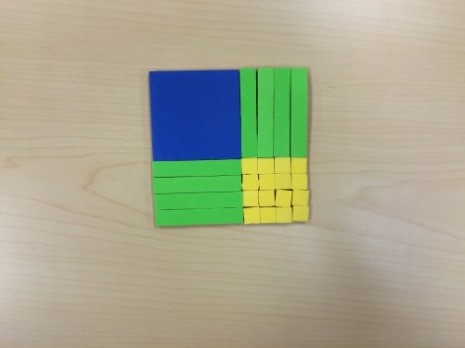
Using Algebra tiles is a great visual way for students to understand completing the square. The students start with the tiles that correspond to the given problem. The unit tiles are then flipped and moved to the other side of the equal sign. The remaining tiles are positioned into a square shape. The corner piece that appears to be missing will be filled unit tiles. What you do to one side, must be done to the other. Therefore the amount of unit tiles added to the square will also be added to the other side of the equation. Find the zero pairs and take them away. Then, find the corresponding tiles that will outline the square, so when multiplied together equals the equation.
Step 1:
Step 2:
Step 3:
Step 4:
Step 5:
Step 6:
Step 7:
Step 8:
D1. What interesting things can you say about the people who contributed to the discovery and/or the development of this topic?
Around 815 – 850 AD, a mathematician Muhammad ibn Musa al-Khwarizmi was hard at work discovering algebra. He was actually the first person to write a text about algebra. His focus for a lot of the text was the dimensions of a square. At the time it was not called completing the square, but Muhammad was the one who came up with it because it is exactly what he did in order to solve the different equations he had at the time. Very similar to the process described using algebra tiles, Muhammad also saw the equations in terms of actual shapes. One of the original problems he tried to solve was x2+10x=39. He looked at x2 as a square with length x and width x. He then created a rectangle with length 10 and width x. The area would equal 10x. To make his theory work he broke up the 10x rectangle into two squares with length x and width 5. Muhammad combined the x2 square and the two 5x pieces into an L shape. This partial square must equal some square with the value of 39. So he came to the conclusion that he had to fill in what was left of the L shape to make it a square. But in order to do that he had to add that same value to the other side. In this case he added 25 (which is 5×5). Muhammad’s final answer was (x+5)2=64, x=3. This was his method but at the time he couldn’t prove that it always worked. So if and when students participate in the algebra tiles activity, they are partaking in a small piece of history.
E1. How can technology be used to effectively engage students with this topic?
This video from Khan Academy is a great tool for completing the square. This video explains why we have to take half of the b value and square it (when looking at ax2+bx+c) to obtain the c value. When the students understand why we do something in math, they are more likely to be interested in the topic. The different colors that are used to write out the process allows the students to organize and understand completing the squares better. This particular video is also just long enough to capture the attention of the students but not so long as to lose it. Also, after hearing the same person explain math all the time, students may not understand it as well as they possibly could. So what is said in this video can easily be explained by the teacher but students sometimes need to hear a different voice explain a concept so they can gain a new perspective on the topic.
In my capstone class for future secondary math teachers, I ask my students to come up with ideas for engaging their students with different topics in the secondary mathematics curriculum. In other words, the point of the assignment was not to devise a full-blown lesson plan on this topic. Instead, I asked my students to think about three different ways of getting their students interested in the topic in the first place.
I plan to share some of the best of these ideas on this blog (after asking my students’ permission, of course).
This student submission again comes from my former student Zacquiri Rutledge. His topic, from probability: expressing a probability as a fraction and as a percentage.
Probability involves any kind of situation where the outcomes are known, but are not 100% certain. Examples of this could be things as simple as flipping a coin, to trying to predict the next card while playing blackjack. However, for a student who is just beginning to understand probability, I thought a word problem involving the rolling of a die would be just challenging enough. “You and your best friend have been playing Monopoly for hours. After several times around the board, you own a large amount of the properties and your friend is nearly bankrupt. In fact, your friend does not have enough money to survive landing on your Boardwalk property in the corner of the board. In order for your friend to land on this space, he/she would need to roll a 12. First, calculate the odds that one die will roll a 6 and express it both as a fraction and as a percentage. Then, calculate the odds that both dice will roll a 6 and express it both as a fraction and as a percentage.”
After learning the basics of probability as fractions and percentages, students can then begin to learn about how to change them into “odds”, or the probability of a series of actions. Since probability is simply the ratio between the desired number of outcomes and the total number of outcomes, only knowing how to write ratios will not help the student in calculating odds. By changing the probability ratio into a fraction, this will allow the student to easily apply the multiplication principle to a series of actions to find the larger probability ratio. From there the student will be able use previous experience of changing probability into a percentage to state how likely or unlikely a situation is.
Probability is found in many areas of culture and science. However, one of the most widely known forms of probability is in gambling. People all over the world gamble for money, for fun, and sometimes even for sport. A few of the common games people play in casinos are Roulette, Blackjack, and Texas Hold’em. Each one of these games has its own way in which it uses probability to make it more difficult for a player to make money.
To play a game of Roulette, all a player has to do is bet on which number, color, or set of numbers they think might win. On the table are the numbers 00, 0, and 1 through 36. 00 and 0 are both their own color, but 1 through 36 alternate between red and black. After the player bets, the rest of the game is controlled by “The House” or the casino. A ball is placed on a rotating circle that has all of the numbers listed one time on it with a slot in the middle for each one. As the ball rolls, it slows down and drops into one of these holes. This is where probability comes into play. Depending on the player’s bet, they have an x/38 chance of winning. If they select one number, it gives 1/38 or 2.6% chance; for 1-12 its 6/19 or 31.5%. By using a combination of bets, a player can increase their probability of winning by selecting more than one number. Due to Roulettes simplicity, it would make a good beginning topic for a student who is beginning to learn about probability.
Blackjack is game that uses cards to determine who wins or loses, instead of a ball and a wheel. The object of this game is to get as close to 21 as possible without going over, as well as attempting to beat the hand “The House” is holding. While there are a lot of calculations that must go in when calculating probability in a game of blackjack, it is possible to do it on a smaller scale. To do so, a player would have to look at what cards had come up in the past and then look to see what card it is that they need. Since there are only 4 of each card in the deck, assuming the player nor “The House” is holding the card he/she needs, the probability would be 4/(52 – y), where y is the number of cards that have already been shown and are not the card the player needs. Texas Hold’em uses this same kind of idea, but instead is used when playing against other people rather than against “The House”. This version of poker has become so well known, it is featured on an ESPN sports channel, where people play in a live tournament and compete for millions of dollars. What is significant about this channel is that they show what cards each of the players are holding as well as what cards are on the table. Then, once every player’s cards are seen, the channel shows on one side of the screen a player’s percent chance of winning. This percent is calculated by an analysis of what cards are in the player’s hand, what cards are in everyone else’s hands, and what cards are on the board. After analyzing the cards, it is then calculated what the probability is that the best possible cards the player needs are going to come up. Even though only basic probability is being used here, this is still on a much higher difficulty due to the amount of numbers that must be processed. However, given its complexity and how the probability can change by the turn of a card can make both Blackjack and Texas Hold’em an interesting topic for a student of probability.
In my capstone class for future secondary math teachers, I ask my students to come up with ideas for engaging their students with different topics in the secondary mathematics curriculum. In other words, the point of the assignment was not to devise a full-blown lesson plan on this topic. Instead, I asked my students to think about three different ways of getting their students interested in the topic in the first place.
I plan to share some of the best of these ideas on this blog (after asking my students’ permission, of course).
This student submission again comes from my former student Tiffany Jones. Her topic, from Algebra: square roots.
B.1 How can this topic be used in your students’ future courses in mathematics or science?
One area of mathematics I wish I had more practice with in grade school is numerical reasoning. I feel that, as a student, I was allowed to use my calculator too much and am struggling to remove my calculator crutch. I hope to encourage my students to sharpen their numerical reasoning skills and to not rely on their calculator. Does this number make sense? Is it too high, too low? Is a negative result valid given the scenario of the problem? The following video introduces a method to estimate the square root of non-perfect squares to the nearest tenth by hand:
“Estimating Square Roots To the Nearest Tenth by Hand” by Fort Bend Tutoring
It gives the students another tool for their toolbox of numerical reasoning, practice using formulas, reviews long division by hand, and strongly encourages students to remember the perfect squares.
I think that introducing this idea as an engage could intrigue student to wonder why the formula works and to wonder what else they are able to do quickly by hand.
Fort Bend Tutoring’s YouTube channel offers videos on a wide verity of high school mathematics topics and courses. The videos cover several examples. They are engaging, not dry and there is also a “theme song” to the videos. I feel that these videos can sever as a great addition to lessons as extra help to the students.
D.1 What interesting things can you say about the people who contributed to the discovery and/or the development of this topic?
The following story was first told to me in a calculus one course. While the telling of the story was to serve as amusement and did not directly relate to the topic of the day, it stuck with me. It comes to mind frequently when working with the Pythagorean theorem and with irrational squares. And when given this assignment, I saw square roots as an option, this story again came to mind. I think having an interesting story cross my mind makes a problem overall more fun. I would want to give that to my students. The article “The Dangerous Ratio” by Brain Clegg does a wonderful job of telling the story, its implications, and gives a mock dialogue so reads can work through the logic. At the end of the article, there is a link to an activity about the proof that the square root of 2 is irrational.
E.1
How can technology be used to effectively engage students with this topic?
I really like the idea of a flipped classroom and hope to be able to practice it in my classroom. While a completely flipped classroom will take some time to implement, videos such as Math Antics’ “Exponents & Square Roots” will be a great place to start.
This particular video address a previously learned topic, namely exponents and relates it to the new topic. It provides definitions and visuals to remember how the terms relate to each other and how to read the symbols. It goes through several examples of varying level and shows the viewer how to use technology such as calculators to solve hard problems. In addition, the video addresses some common misconceptions such as mistaking the root sign and the division sign. Moreover, it ties everything together with a quick review at the end.
One of my favorite aspects so of flipped classrooms, is that the student can review the video over and over. Math Antics does an excellent job of talking the math out to the viewer. The animations are amusing yet helpful. While a lot of information is covered, the video is not dry.
In my capstone class for future secondary math teachers, I ask my students to come up with ideas for engaging their students with different topics in the secondary mathematics curriculum. In other words, the point of the assignment was not to devise a full-blown lesson plan on this topic. Instead, I asked my students to think about three different ways of getting their students interested in the topic in the first place.
I plan to share some of the best of these ideas on this blog (after asking my students’ permission, of course).
This student submission again comes from my former student Taylor Vaughn. Her topic, from probability: combinations.
How could you as a teacher create an activity or project that involves your topic?
One interesting way that I thought about introducing combinations is bringing in combinations that students do often, but do not really think about. When it is known that the family is going on vacation, as a girl, the first thought is “what am I going to wear?” Being a girl, I was always told that I cant pack as much as I wanted to because I also wanted to bring extra clothes just in case I didn’t want to wear what I had planned for that day. One activity I thought bout is actually bring in a suitcase to class with clothes and try and plan a 3 day vacation and figure out how we, as a class, was going to pack this suitcase. I could include different scenarios such as, if the hotel has a laundry room, and how would being able to wash clothes and put them back in the suitcase change how we pack. Also, what happens if we add shoes and socks? How would this change affect the number of combinations we can have? I think it would be really cool for students to touch and play and bring in ideas that they don’t necessarily think has anything to do with math.
How has this topic appeared in pop culture (movies, TV, current music, video games, etc.)?
Everyone listens to music, but there are so many different types of genres, artists, and songs. Have you ever thought, “Will we ever run out of new music?” Well someone by the name of Michael has. He has done the research of what others say about the math of the order of the notes and how many combinations of these notes can we get that will create a new song
One activity that could be done after the video is given 8 notes, how many different measures could students in the class come up with. Then the whole class could see how many people got the same measure or did everyone get something completely different. Then you could also ask “Did we cover all the possibilities? How do we know? How can we show this mathematically?” Lastly, if there are so many possibilities, why are there so many songs with the melodies? There is a video that has one melody and sings a lot of songs to that one melody. (PG-13 Warning: gratuitous cursing near the end of the video.)
The one thing I didn’t like about the first video is the length and he makes connections about songs that are really outdated. SO this video has songs that will relate closer to this generation of students.
How can this topic be used in your students’ future courses in mathematics or science? In school, students that didn’t like math the way I did always asked, “Well when will we ever use this again?” Well even though we use combinations more than we think, it can also be used in later math classes. Ever thought that combinations had anything to do with Pascal’s triangle? What is Pascal’s triangle, you may ask? Well according to Math Is Fun, it is a pattern of numbers where the starting number is 1 and “each number is the two numbers above it added together (except for the edges, which are all “1”).” Well what if you are asked to find entry 20 of the triangle. The one thing I would do would keep the pattern of the triangle and write out all the entries until I got to that number, but using combinations you can get any entry you would like without writing all the entries out. The formula is where n is the row and k is where it is in the nth row.
While teaching this, I would definitely talk about factorial and how it relates to the lesson.
References
Stevens, Michael. “Will We Ever Run Out of New Music?” YouTube. YouTube, 20 Nov. 2012. Web. 02 Sept. 2015.
The Axis of Awesome. “4 Chords.” YouTube. YouTube, 20 July 2011. Web. 02 Sept. 2015.

 .
.





 Mean Green Math