
One of my guilty pleasures in the 1990s, when I was far too old to be watching children’s cartoons, was the fantastic show “Animaniacs.” In the clip below, Yakko Warner describes how to multiply 47 and 83.
Category: Popular Culture
Design Zone at Fort Worth Museum of Science and History
If you live in the Dallas-Fort Worth metroplex or are visiting this summer, I highly recommend Design Zone, which is on exhibit at the Fort Worth Museum of Science and History until September 7. I’ve been to a lot of science museums, so I don’t make the following statement lightly: this may well be the most fun and most engaging physics exhibit for children to enjoy that I’ve ever seen. There’s all kinds of things to lift, throw, balance, and blast off so that children have so much fun that they don’t even realize that they’ve learned something.
Here’s the information posted by the museum: http://fwmuseum.org/design-zone
Here’s a short promotional video:
And here’s a longer video describing the exhibit:
A Nice Visualization of Music
Optimally Dancing to “Shout”
From the dual categories of “Someone Had To Figure This Out” and “Applied Mathematics At Work,” FiveThirtyEight.com has used a little algebra to answer one of our generation’s most vexing questions:
What’s the proper rate of descent during the “a little bit softer now” portion of the song “Shout?”
Here’s the link to the article: http://fivethirtyeight.com/datalab/shout-isley-brothers/
And, in case you haven’t been to a wedding reception recently, here’s the song:
John Urschel, Ravens Offensive Lineman, Publishes Math Paper
I absolutely love this article from NPR: http://www.npr.org/blogs/thetwo-way/2015/03/20/394340722/john-urschel-ravens-offensive-lineman-publishes-math-paper?utm_source=facebook.com&utm_medium=social&utm_campaign=npr&utm_term=nprnews&utm_content=20150321
Some highlights:
John Urschel is an offensive lineman for the NFL Baltimore Ravens whose Twitter handle is @MathMeetsFball. He has bachelor’s and master’s degrees in math [from Penn State[, both with a 4.0 grade-point average. And this week he tweeted: “My paper, A Cascadic Multigrid Algorithm for Computing the Fiedler Vector…, has been published in the Journal of Computational Mathematics”
Here’s a link to his article: http://arxiv.org/abs/1412.0565.
Another great quote:
“I have a bright career ahead of me in mathematics. Beyond that, I have the means to make a good living and provide for my family, without playing football. I have no desire to try to accumulate $10 million in the bank; I already have more money in my bank account than I know what to do with. I drive a used hatchback Nissan Versa and live on less than $25k a year. It’s not because I’m frugal or trying to save for some big purchase, it’s because the things I love the most in this world (reading math, doing research, playing chess) are very, very inexpensive.”

Sets, Planets, and Comets
From the article “Sets, Planets, and Comets” that recently appeared in College Mathematics Journal.
Set is an enjoyable—even addictive—card game that challenges players to identifycertain visual patterns. A mathematically rich game, it provides ample opportunity forstudents and teachers to ponder combinatorial, algebraic, and geometric questions. Partof Set’s appeal is that once the fundamentals of the game are understood, it is nearlyimpossible to resist investigating its structure, whatever one’s background. We con-centrate on the geometry, introducing interesting objects we call planets and comets,which lead to an elegant variation on the game.
The full article can be found here: http://www.maa.org/sites/default/files/pdf/pubs/SetsPlanetsAndComets.pdf
Symphonic Equations: Waves and Tubes
This excellent and engaging video describes how sine and cosine functions can be applied to music.
A Review of WuzzitTrouble: an app for math education
 0
0
Most apps and computer games that claim to assist with the development of mathematical knowledge only focus on rote memorization. There’s certainly a place for rote memorization, but I’ve been very disappointed with the paucity of games that encourage mathematical creativity beyond, say, immediate recall of the times tables.
Enter WuzzitTrouble, a new app that was developed by Keith Devlin, a professor of mathematics at Stanford and one of the great popularizers of mathematics today. An introduction to WuzzitTrouble can be seen in this promotional video:
One minor complaint about WuzzitTrouble is that the first few levels are so easy that it’s easy for children to low-ball the game… in much the same way that the first few levels of Angry Birds are utterly easy. (My other complaints is that the game only assume one user, so that a parent can’t play the game without affecting a child’s settings.) However, the level of difficulty does eventually increase. Here’s another promotional video showing how to solve Level 1-25:
Here’s a sampling of some of the higher levels. Remember that the wheel has 65 steps along the circumference, as shown in the above picture and videos.
- Level 2-5: Using cog wheels of size 5 and 9, pick up keys at 23 and 36 and prizes at 27, 45, and 55.
- Level 2-15: Using cog wheels of size 5, 7, and 9, pick up keys at 11, 16, and 21 and prizes at 32 and 42.
- Level 2-25: Using cog wheels of size 5, 9, and 16, pick up keys at 24, 48, and 59; prizes at 11 and 37; and avoid a penalty at 64.
- Level 3-3: Using cog wheels of size 3, 4, and 5, pick up keys at 7, 17, and 27 and prizes at 12 and 22.
In the words of their promotional materials:
At InnerTube Games, we set out to design and build mobile casual video games and puzzles that can attract and engage a large number of players, yet are built on fundamental mathematical concepts and embed sound mathematics learning principles.
We start with one simple, yet powerful observation. A musical instrument won’t teach you about music. But when you pick up an instrument and start playing – badly at first – you cannot fail to learn about music. And the more you play, the more you learn. In fact, using that one instrument, you can go all the way from stumbling beginner to virtuoso concert performances. It’s the music that changes, not the instrument. In modern parlance, the instrument is a platform. And (well designed) platforms are good for learning because they make the learning meaningful and put the learner in charge.
InnerTube Games does not build video games to “teach mathematics.” Rather, we build instruments which you can play, and we design them so that when you play them, you cannot fail to learn about mathematics. Moreover, each single game can be used to deliver mathematical challenges of increasing sophistication.
Our vision for learning design is to build the game around core mathematical concepts and practice so it looks and plays like the familiar casual games on the market. As a result, you won’t be able to see the difference by playing the first few levels, or by watching someone else play. It’s the educational power under the hood that makes our games different.
We’re not making a secret of the fact that our games are math-based. It’s not “stealth learning;” it’s a form of learning through action that the brain finds natural, having much in common with what educational researchers call embodied learning.
Wuzzit Trouble is our first puzzle to reach the market. It is built around the important mathematical concepts of integer partitions–the expression of a whole number as a sum of other whole numbers–and Diophantine equations. At the easiest levels of the puzzle, these provide engaging practice in basic arithmetic, leading to arithmetical fluency.
But that’s just the start. Integer partitions and Diophantine equations are major areas of mathematics, still being worked on today by leading mathematicians.
Freeing the Wuzzits won’t take you into those dizzy realms—at least in the initial release, which comes loaded with puzzles aimed at the Elementary and Middle School levels. But as you progress, you will face challenges that increasingly require higher-order arithmetical thinking, algebraic thinking, strategy design and modification, optimization, and algorithm design, all crucial abilities in today’s world. Getting three stars can require considerable ingenuity.
As you attempt to free each Wuzzit and maximize your score, you will be developing and applying valuable conceptual, analytic thinking skills that sharpen your mind—all without lifting pencil to paper.
As educators and former educators, all of us at InnerTube are very aware of the importance of learners meeting agreed standards. In its initial release version Wuzzit Trouble provides natural learning in the following areas of the US Common Core Curriculum:
- *Grade 2, Operations & Algebraic Thinking #2
- *Grade 2, Number & Operations in Base Ten #2, #8
- *Grade 3, Operations & Algebraic Thinking #1, #4
- *Grade 4, Operations & Algebraic Thinking #5
- *Grade 6, Number System #5, #6
But we don’t want anyone to play our game purely to hit those Common Core markers. We want you to play it because it’s fun and challenging. Improvement in those CC areas comes automatically. Just like learning music by playing a musical instrument!
The analogy that I prefer is playing basketball. When young children are first learning to play basketball, there’s a place for learning how to dribble, how to pass, how to shoot free throws, etc. (These are analogous to learning how to add, subtract, multiply, and divide.) But children don’t just learn skills: they also go out and play. That’s where the WuzzitTrouble app fits in: it offers children a chance to just play with mathematics and enjoy it.
More references:
http://profkeithdevlin.org/2013/09/03/the-wuzzits-free-at-last/
From high school math teacher to quarterback for the Dallas Cowboys
I’ve never been a fan of the Dallas Cowboys, but Jon Kitna remains one of the good guys of the NFL. After retirement, he went to work as a math teacher and football coach at his high school alma mater, getting students with learning disabilities to understand algebra (and thus be prepared for higher-level math classes in later years).
After the unfortunate injury to starting quarterback Tony Romo, the Dallas Cowboys called upon Kitna for emergency service. He plans to donate his one-game salary back to the high school.
Reference: http://bleacherreport.com/articles/1901693-jon-kitnas-salary-decision-proves-his-return-is-noble
The Monty Hall Problem
In 1990 and 1991, columnist Marilyn vos Savant (who once held the Guinness World Record for “Highest IQ”) set off a small firestorm when a reader posed the famous Monty Hall Problem to her:
Suppose you’re on a game show, and you’re given the choice of three doors. Behind one door is a car, behind the others, goats. You pick a door, say #1, and the host, who knows what’s behind the doors, opens another door, say #3, which has a goat. He says to you, “Do you want to pick door #2?” Is it to your advantage to switch your choice of doors?
She gave the correct answer: it’s in your advantage to switch. This launched an avalanche of mail (this was the early 90’s, when e-mail wasn’t as popular) complaining that she gave the incorrect answer. Perhaps not surprisingly, none of the complainers actually tried the experiment for themselves. She explained her reasoning — in two different columns — and then offered a challenge:
And as this problem is of such intense interest, I’m willing to put my thinking to the test with a nationwide experiment. This is a call to math classes all across the country. Set up a probability trial exactly as outlined below and send me a chart of all the games along with a cover letter repeating just how you did it so we can make sure the methods are consistent.
One student plays the contestant, and another, the host. Label three paper cups #1, #2, and #3. While the contestant looks away, the host randomly hides a penny under a cup by throwing a die until a 1, 2, or 3 comes up. Next, the contestant randomly points to a cup by throwing a die the same way. Then the host purposely lifts up a losing cup from the two unchosen. Lastly, the contestant “stays” and lifts up his original cup to see if it covers the penny. Play “not switching” two hundred times and keep track of how often the contestant wins.
Then test the other strategy. Play the game the same way until the last instruction, at which point the contestant instead “switches” and lifts up the cup not chosen by anyone to see if it covers the penny. Play “switching” two hundred times, also.
You can read the whole exchange here: http://marilynvossavant.com/game-show-problem/
For much more information — and plenty of ways (some good, some not-so-good) of explaining this very counterintuitive result, just search “Monty Hall Problem” on either Google or YouTube.
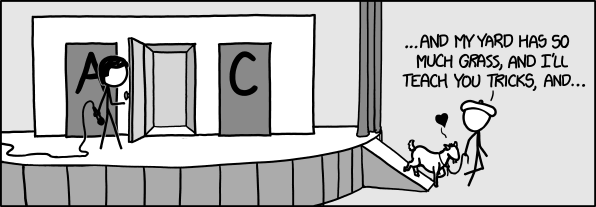
Source: http://www.xkcd.com/1282/
 Mean Green Math