
Watch a musician play the world’s largest instrument, an organ built by a Pentagon mathematician in Luray Caverns, Virginia. (This was a favorite destination of mine when I was a boy.)
Category: Popular Culture
Heat Index

Single-Digit NFL scores

Stay Focused
From Kirk Cousins, quarterback of the Washington Redskins:
Sometimes our guests ask why I have this hanging above my desk. It’s an old high school math quiz when I didn’t study at all and got a C+… just a subtle reminder to me of the importance of preparation. If I don’t prepare I get C’s!

Pizza Hut Pi Day Challenge: Index
I’m doing something that I should have done a long time ago: collecting a series of posts into one single post. The following links comprised my series on the 2016 Pizza Hut Pi Day Challenge.
Part 1: Statement of the problem.
Part 2: Using the divisibility rules for 1, 5, 9, 10 to reduce the number of possibilities from 3,628,800 to 40,320.
Part 3: Using the divisibility rule for 2 to reduce the number of possibilities to 576.
Part 4: Using the divisibility rule for 3 to reduce the number of possibilities to 192.
Part 5: Using the divisibility rule for 4 to reduce the number of possibilities to 96.
Part 6: Using the divisibility rule for 8 to reduce the number of possibilities to 24.
Part 7: Reusing the divisibility rule for 3 to reduce the number of possibilities to 10.
Part 8: Dividing by 7 to find the answer.
Facebook Birthday Problem: Part 5
Recently, I devised the following problem:
Suppose that you have n friends, and you always say “Happy Birthday” to each friend on his/her birthday. On how many days of the year will you not say “Happy Birthday” to one of your friends?
Until somebody tells me otherwise, I’m calling this the Facebook birthday problem in honor of Facebook’s daily alerts to say “Happy Birthday” to friends.
Here’s how I solved this problem. Let 


In yesterday’s post, I began the calculation of the standard deviation of 
![\hbox{Var}(N) = 365\displaystyle \left( \frac{1457}{1461} \right)^n \left[ 1 - \left( \frac{1457}{1461} \right)^n \right] + \displaystyle \left( \frac{1460}{1461} \right)^n \left[ 1 - \left( \frac{1460}{1461} \right)^n \right]](https://s0.wp.com/latex.php?latex=%5Chbox%7BVar%7D%28N%29+%3D+365%5Cdisplaystyle+%5Cleft%28+%5Cfrac%7B1457%7D%7B1461%7D+%5Cright%29%5En+%5Cleft%5B+1+-+%5Cleft%28+%5Cfrac%7B1457%7D%7B1461%7D+%5Cright%29%5En+%5Cright%5D+%2B+%5Cdisplaystyle+%5Cleft%28+%5Cfrac%7B1460%7D%7B1461%7D+%5Cright%29%5En+%5Cleft%5B+1+-+%5Cleft%28+%5Cfrac%7B1460%7D%7B1461%7D+%5Cright%29%5En+%5Cright%5D&bg=ffffff&fg=000000&s=0&c=20201002)
![+ \displaystyle (365)(364) \left[ \displaystyle \left( \frac{1453}{1461} \right)^n - \displaystyle \left( \frac{1457}{1461} \right)^{2n} \right] + 2 \sum_{k=1}^{365}\hbox{Cov}(I_k,I_{366})](https://s0.wp.com/latex.php?latex=%2B+%5Cdisplaystyle+%28365%29%28364%29+%5Cleft%5B+%5Cdisplaystyle+%5Cleft%28+%5Cfrac%7B1453%7D%7B1461%7D+%5Cright%29%5En+-+%5Cdisplaystyle+%5Cleft%28+%5Cfrac%7B1457%7D%7B1461%7D+%5Cright%29%5E%7B2n%7D+%5Cright%5D+%2B+2+%5Csum_%7Bk%3D1%7D%5E%7B365%7D%5Chbox%7BCov%7D%28I_k%2CI_%7B366%7D%29&bg=ffffff&fg=000000&s=0&c=20201002)
To complete this calculation, I’ll now find 


We have calculated 


so that the probability that no friend has a birthday on day

Therefore, since the expected value of an indicator random variable is the probability that the event happens, we have

for
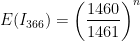
so that

To find 


so that the probability that no friend has a birthday on day

Therefore, as before,

so that

Therefore,
![+ \displaystyle (365)(364) \left[ \displaystyle \left( \frac{1453}{1461} \right)^n - \displaystyle \left( \frac{1457}{1461} \right)^{2n} \right] + 2(365) \left[ \left( \frac{1456}{1461} \right)^n - \displaystyle \left( \frac{1457}{1461} \right)^n \left( \frac{1460}{1461} \right)^n \right]](https://s0.wp.com/latex.php?latex=%2B+%5Cdisplaystyle+%28365%29%28364%29+%5Cleft%5B+%5Cdisplaystyle+%5Cleft%28+%5Cfrac%7B1453%7D%7B1461%7D+%5Cright%29%5En+-+%5Cdisplaystyle+%5Cleft%28+%5Cfrac%7B1457%7D%7B1461%7D+%5Cright%29%5E%7B2n%7D+%5Cright%5D+%2B+2%28365%29+%5Cleft%5B+%5Cleft%28+%5Cfrac%7B1456%7D%7B1461%7D+%5Cright%29%5En+-+%5Cdisplaystyle+%5Cleft%28+%5Cfrac%7B1457%7D%7B1461%7D+%5Cright%29%5En+%5Cleft%28+%5Cfrac%7B1460%7D%7B1461%7D+%5Cright%29%5En+%5Cright%5D&bg=ffffff&fg=000000&s=0&c=20201002)
and we find the standard deviation of

The graph below shows the expected value of

along with error bars representing two standard deviations.

Interestingly, the standard deviation of 


Facebook Birthday Problem: Part 4
Recently, I devised the following problem:
Suppose that you have n friends, and you always say “Happy Birthday” to each friend on his/her birthday. On how many days of the year will you not say “Happy Birthday” to one of your friends?
Until somebody tells me otherwise, I’m calling this the Facebook birthday problem in honor of Facebook’s daily alerts to say “Happy Birthday” to friends.
Here’s how I solved this problem. Let
In yesterday’s post, I began the calculation of the standard deviation of

To complete this calculation, I’ll now find the covariances. I’ll begin with 



We have calculated
so that the probability that no friend has a birthday on day
Therefore, since the expected value of an indicator random variable is the probability that the event happens, we have
for

To find 


so that the probability that no friend has a birthday on day

Therefore, as before,

so that

Since there are 

![+ \displaystyle 2 \times \displaystyle \frac{365\times 364}{2} \left[ \displaystyle \left( \frac{1453}{1461} \right)^n - \displaystyle \left( \frac{1457}{1461} \right)^{2n} \right] + 2 \sum_{k=1}^{365}\hbox{Cov}(I_k,I_{366})](https://s0.wp.com/latex.php?latex=%2B+%5Cdisplaystyle+2+%5Ctimes+%5Cdisplaystyle+%5Cfrac%7B365%5Ctimes+364%7D%7B2%7D+%5Cleft%5B+%5Cdisplaystyle+%5Cleft%28+%5Cfrac%7B1453%7D%7B1461%7D+%5Cright%29%5En+-+%5Cdisplaystyle+%5Cleft%28+%5Cfrac%7B1457%7D%7B1461%7D+%5Cright%29%5E%7B2n%7D+%5Cright%5D+%2B+2+%5Csum_%7Bk%3D1%7D%5E%7B365%7D%5Chbox%7BCov%7D%28I_k%2CI_%7B366%7D%29&bg=ffffff&fg=000000&s=0&c=20201002)
or
The calculation of
Facebook Birthday Problem: Part 3
Recently, I devised the following problem:
Suppose that you have n friends, and you always say “Happy Birthday” to each friend on his/her birthday. On how many days of the year will you not say “Happy Birthday” to one of your friends?
Until somebody tells me otherwise, I’m calling this the Facebook birthday problem in honor of Facebook’s daily alerts to say “Happy Birthday” to friends.
Here’s how I solved this problem. Let
In yesterday’s post, I showed that

The calculation of the standard deviation of

or

For the first term, we recognize that, in any four-year span, there are
Therefore, the chance that all
Using the formula 
![\hbox{Var}(I_k) = \displaystyle \left( \frac{1457}{1461} \right)^n \left[ 1 - \left( \frac{1457}{1461} \right)^n \right]](https://s0.wp.com/latex.php?latex=%5Chbox%7BVar%7D%28I_k%29+%3D+%5Cdisplaystyle+%5Cleft%28+%5Cfrac%7B1457%7D%7B1461%7D+%5Cright%29%5En+%5Cleft%5B+1+-+%5Cleft%28+%5Cfrac%7B1457%7D%7B1461%7D+%5Cright%29%5En+%5Cright%5D&bg=ffffff&fg=000000&s=0&c=20201002)
for
![\hbox{Var}(I_{366}) = \displaystyle \left( \frac{1460}{1461} \right)^n \left[ 1 - \left( \frac{1460}{1461} \right)^n \right]](https://s0.wp.com/latex.php?latex=%5Chbox%7BVar%7D%28I_%7B366%7D%29+%3D+%5Cdisplaystyle+%5Cleft%28+%5Cfrac%7B1460%7D%7B1461%7D+%5Cright%29%5En+%5Cleft%5B+1+-+%5Cleft%28+%5Cfrac%7B1460%7D%7B1461%7D+%5Cright%29%5En+%5Cright%5D&bg=ffffff&fg=000000&s=0&c=20201002)
Therefore, so far we have shown that
In tomorrow’s post, I’ll complete this calculation by finding the covariances.
Facebook Birthday Problem: Part 2
Recently, I devised the following problem:
Suppose that you have n friends, and you always say “Happy Birthday” to each friend on his/her birthday. On how many days of the year will you not say “Happy Birthday” to one of your friends?
Until somebody tells me otherwise, I’m calling this the Facebook birthday problem in honor of Facebook’s daily alerts to say “Happy Birthday” to friends.
Here’s how I solved this problem. Let
Let’s start with any of the “usual” days. In any four-year span, there are
Therefore, the chance that all
Since the expected value of an indicator random variable is the probability of the event, we see that
for
Since 


This function is represented by the red dots on the graph below.
In tomorrow’s post, I’ll calculate of the standard deviation of
Facebook Birthday Problem: Part 1
The “birthday problem” is one of the classic problems in elementary probability because of its counter-intuitive solution. From Wikipedia:
In probability theory, the birthday problem or birthday paradox concerns the probability that, in a set of n randomly chosen people, some pair of them will have the same birthday. By the pigeonhole principle, the probability reaches 100% when the number of people reaches 367 (since there are only 366 possible birthdays, including February 29). However, 99.9% probability is reached with just 70 people, and 50% probability with 23 people. These conclusions are based on the assumption that each day of the year (except February 29) is equally probable for a birthday.
Recently, I devised the following different birthday problem:
Suppose that you have n friends, and you always say “Happy Birthday” to each friend on his/her birthday. On how many days of the year will you not say “Happy Birthday” to one of your friends?
Until somebody tells me otherwise, I’m calling this the Facebook birthday problem in honor of Facebook’s daily alerts to say “Happy Birthday” to friends.
In this series, I will solve this problem. While this may ruin the suspense, here’s a graph of the solution for 
Before deriving this solution, I’ll start with a thought bubble if you’d like to take some time to think about how to do this.

 Mean Green Math