Calculator errors: When close isn’t close enough (Part 1)

Far too often, students settle for a numerical approximation of a solution that can be found exactly. To give an extreme example, I have met quite intelligent college students who were convinced that \displaystyle \frac{1}{3} was literally equal to 0.3.

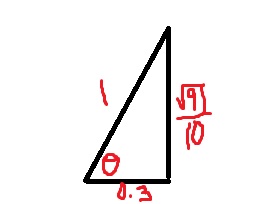
That’s an extreme example of something that nearly all students do — round off a complicated answer to a fixed number of decimal places. In trigonometry, many students will compute \sin \left( \cos^{-1} 0.3 \right) by plugging into a calculator and reporting the first three to six decimal places, like 0.95394. This is especially disappointing when there are accessible techniques for getting the exact answer (in this case, \displaystyle \frac{\sqrt{91}}{10}) without using a calculator at all.

pictsqrt9110

TIsqrt9110

Unfortunately, even maintaining eight, nine, or ten decimal places of accuracy may not be good enough, as errors tend to propagate as a calculation continues. I’m sure every math teacher has an example where the correct answer was exactly $\displaystyle\frac{3}{2}$ but students returned an answer of 1.4927 or 1.5031 because of roundoff errors.

Students may ask, “What’s the big deal if I round off to five decimal places?” Here’s a simple example — which can be quickly demonstrated in a classroom — of how such truncation errors can propagate. I’m going to generate a recursive sequence. I will start with \displaystyle \frac{1}{3}. Then I will alternate multiplying by 1000 and then subtracting 333. More mathematically,

 a_1 = \displaystyle \frac{1}{3}

a_{2n} = 1000 a_{2n-1}

a_{2n+1} = a_{2n} - 333 if n > 0

Here’s what happens exactly:

1000 \times \displaystyle \frac{1}{3} = \displaystyle \frac{1000}{3} = \displaystyle 333\frac{1}{3} = 333.\overline{3}

\displaystyle 333\frac{1}{3} - 333 = \displaystyle \frac{1}{3} = 0.\overline{3}

So, repeating these two steps, the sequence alternates between \displaystyle \frac{1}{3} and \displaystyle 333\frac{1}{3}.

But looks what happens if I calculate the first twelve terms of this sequence on a calculator.

TItrunc1

Notice that by the time I reach a_{11}, the terms of the sequence are negative, which is clearly incorrect.

So what happened?

This is a natural by-product of the finite storage of a calculator. The calculator doesn’t store infinitely many digits of $\displaystyle \frac{1}{3}$ in memory because a calculator doesn’t possess an infinite amount of memory. Instead, what gets stored is something like the terminating decimal 0.33333333333333, with about fourteen 3s. (Of course, only the first ten digits are actually displayed.)

So multiplying by 1000 and then subtracting 333 produces a new and different terminating decimal with three less 3s. Do this enough times, and you end up with negative numbers.

Local universities help train high school teachers

At UNT, we take very seriously our mission to improve both the quality and quantity of secondary teachers of science and mathematics. Part of this mission includes providing professional development for current high school teachers, including our alumni and the mentor teachers who provide the essential field experiences that form the backbone of our teacher education program. We had a nice write-up about these efforts in the local newspaper this week.

Local universities help train high school teachers,” by Jenna Duncan (Denton Record-Chronicle, July 16, 2013. Published online July 15, 2013.)

The “Don’t Suck” theory of improving graduation rates

From the Chronicle of Higher Education:

Maintaining an up-to-date list of available tutors, calculating financial aid accurately, placing students in the right classes, picking up garbage, and maintaining elevators aren’t “best” practices. They are “minimally competent” practices. Nobody is ever going to publish a research study finding a causal link between $125,000-per-photocopier contracts, Caribbean cruises, and graduation rates.

But I’m quite sure that these things are much more important to helping students graduate than the presence or absence of specific retention programs. They all go to the basic competence and quality of the institution. Well-run universities that have student-focused organizational cultures and are properly accountable to outside regulatory bodies simply don’t behave this way. Well-run universities are also much more successful in helping student earn degrees. It’s unreasonable to think that a university like Chicago State, which enrolls many part-time, low-income, and academically diverse students, will have a 100 percent graduation rate. But based on the research and examples cited in the article, it’s reasonable to expect that CSU could graduate 1 in 2 students, as opposed to 1 in 10.

Source: http://chronicle.com/blogs/brainstorm/the-dont-suck-theory-of-improving-graduation-rates/26483

What’s the State of High School Education? Bad, but Not as Bad as You Think

Taken from the Change the Equation blog, http://changetheequation.org/blog/what%E2%80%99s-state-high-school-education-bad-not-bad-you-think

Have U.S. twelfth graders made any progress in math since the 1970s? The answer is no, if we’re to believe news stories about the National Assessment of Educational Progress (NAEP), which released the results of its long-term math and science tests yesterday. Yet those news stories don’t have it quite right.

It is true that, overall, 17 year olds’ scores barely budged from 1973 to 2012. They rose a scant two points. But things look a bit different when you break down the data by racial and ethnic group. Every group made gains: black students gained 18 points, Hispanic students gained 17 points, Asian students gained six points, and white students gained four points.

The reason for this apparent impossibility? Black and Hispanic students, who unfortunately lag behind their white peers, make up a much bigger share of the population now than they did in 1973. That brings down the total score. (Jack Jennings noted this dynamic several years ago.) Yet those who imply that our students are no better served by the K-12 system than they were 40 years ago are ignoring the evidence.

So should we be popping the champagne corks? Hardly. Progress in high school has been much slower than in elementary and middle schools, where student gains have amounted to several grade levels worth of learning. In fact, high schools seem to be undoing some of the gains made by elementary and middle schools.

But gloomy fatalism and blanket indictments of K-12 won’t do us much good. One lesson NAEP teaches us  is that change is possible—we can move the needle when we set our minds to it. We’ve also got to step up our game. Students of color make up a growing share of our school enrollments. If we don’t accelerate the progress we have already made with them, we will pay a very high moral and economic price.

Beyond the Chalkboard: The Job of a Math Professor

About 15 years ago, when I was starting my career as an assistant professor, I was asked to write an article for Imagine magazine, which is targeted toward gifted students in grades 7-12, about what it’s like to be a math professor. While I would probably write something slightly different today (since my job responsibilities have shifted toward administration, academic advising, and the preparation of future secondary mathematics teachers), I think much of what I wrote still applies today.

Source: J. Quintanilla, “Beyond the Chalkboard: The Job of a Math Professor,” Imagine, Vol. 5, No. 4, p. 10 (March/April 1998).

green line

One part of my job is deceptively simple to explain: I teach math to college students. Some people think I’ve got the easiest job in the world. I teach only two classes a semester for just six hours a week, and I have a flexible schedule with summers off. How cozy!

This view of my job is, of course, misleading. The hours I spend actually lecturing are only the tip of the iceberg. Delivering lectures that make sense and maintain students’ interest for a full hour takes considerable practice and effort. Meanwhile, I am constantly fine-tuning the curriculum, writing exams, and of course grading homework assignments — tasks which keep me working late on many nights. My most time-consuming project in recent months, however, has been to write eighty–and counting–letters of recommendation for former students.

My work with students outside the classroom includes one-on-one tutoring, guiding student research projects, advising students about possible majors and careers, and sometimes just lending an ear when someone’s had a rough day. As a professor I am a public figure on campus, and my current and former students come to me for counsel on a wide range of issues, many of which are only tangentially related to mathematics. I hope that through my words and counsel I am contributing to my students’ development as people as well as scholars.

In addition to lecturing, writing recommendations and counseling, I also have to produce original research. At my university, the quality of my teaching and my research will be weighted equally when I am evaluated for tenure in five years. The relative importance of teaching and research, however, varies from college to college. In general, small liberal arts colleges tend to emphasize teaching, while major universities want their professors to be primarily researchers.

When I started graduate school, I was introduced to my current field of research: applying ideas from probability theory to study theoretical problems in materials science. I have found that my research evolves over four stages: months of frustration, several days of sheer ecstasy when I’m overflowing with ideas, weeks of double-checking that my ideas actually make sense, and finally months of writing up my results for publication in scientific journals. I purposely work on three or four research projects
simultaneously, hoping that the cycle of each is slightly out of phase with the others. Though I work on my research all year, it gets my undivided attention during the summer when I’m not teaching.

Of the many aspects of this job, teaching is for me the most satisfying. I know that most of my students will not become professional mathematicians, so I incorporate “fun lectures” into the curriculum. These lectures illustrate how the mathematics we’re studying can be applied to fields of science. In my “Hunt for Red October” lecture, for example, I talk about applying trigonometry to linguistics, opera, and submarine detection; in my “Voyager 2” lecture, I describe how conic sections are used in planetary exploration. For my favorite fun lecture, I dress up in knickers, carry my golf clubs into class, and use calculus
to analyze the trajectory of golf balls. These lectures have become quite popular with my students, and I love to watch their eyes
light up when they’re excited about learning new things, such as how mathematics can be applied to real life.

Does this career sound appealing to you? If so, heed these words of warning: To become a successful professor, you have to really, really want this career. I am not a math professor for its financial rewards; friends of mine in industry earn salaries that are triple what I make. I don’t mind, and I’m not envious of them–I get to do what I love for a living, and I’m not starving. But this job isn’t for everyone. There are innumerable distractions and frustrations along the way that will derail aspiring professors who are not entirely focused on the goal.

For example, I always thought that I would be assured a job after graduation. In 1987, the National Science Foundation projected a shortfall of 675,000 scientists and engineers over the coming two decades. I was a high school senior in 1987, so I assumed I would be able to write my own ticket after earning a doctorate.

Time would show that this NSF projection, now derisively labeled “The Myth,” was amazingly inaccurate. There is currently an overproduction of Ph.D.s in mathematics, and the job market for aspiring math professors is tight. The unemployment rate for freshly-minted Ph.D.s in mathematics has hovered around 10% throughout the 1990s. A new Ph.D. can expect a nomadic
life — bouncing all over the country from one postdoctoral appointment to another — before finally landing a tenure-track position.

Faced with such daunting employment prospects, I braced myself for an unstable life in pursuit of my dream of becoming a professor. Even so, I must admit that getting avalanched by more than a hundred rejection letters was extremely disheartening. In the end, though, I was blessed with a tenure-track position straight out of grad school.

Like many jobs, the job of a math professor is frustrating at times and can feel overwhelming. But when it does, I think about the excited, curious students at a recent fun lecture and remind myself: I love this job!

Put Understanding First

From a great article by G. Wiggins and J. McTighe, “Put Understanding First,” Reshaping High Schools, Vol. 65, No. 8, pp. 36-41 (May 2008)

Out-of-context learning of skills is arguably one of the greatest weaknesses of the secondary curriculum—the natural outgrowth of marching through the textbook instead of teaching with meaning and transfer in mind. Schools too often teach and test mathematics, writing, and world language skills in isolation rather than in the context of authentic demands requiring thoughtful application. If we don’t give students sufficient ongoing opportunities to puzzle over genuine problems, make meaning of their learning, and apply content in various contexts, then long-term retention and effective performance are unlikely, and high schools will have failed to achieve their purpose.

Description of Teach North Texas

The following article appeared in the Fall 2012 newsletter of the Forum on Education of the American Physical Society.

Recruiting and Preparing Science and Math Teachers at the University of North Texas

Mary Harris: TNT Co-Director and Professor, Department of Teacher Education and Administration

Jennifer McDonald: TNT Program Advisor

John Quintanilla: TNT Co-Director and Professor, Department of Mathematics

Cindy Woods: TNT Master Teacher

Science and mathematics are fields from which there is a high rate of teacher attrition. Demand for teachers within these high needs fields is growing, with greatest need in schools with diverse populations of low-income students. Compounding the problem, the landmark Rising Above the Gathering Storm (National Research Council, 2007) reports that “middle and high school mathematics and science teachers are more likely than not to teach outside of their own fields of study” (p. 113). The deficiencies found in teaching science and mathematics at the middle and high school levels can be attributed to three primary causes: lack of science and mathematics educator preparation programs that provide strong subject content and pedagogical knowledge for pre-service teachers, lack of support during the first years of employment, and failure of universities to recruit into science and mathematics teacher education programs (National Research Council, 2010).

In response to the state and national imperative for the United States to reemerge as world leader in science, technology, engineering, and mathematics (STEM), the University of North Texas (UNT) implemented the Teach North Texas (TNT) program, a replication of the pioneering UTeach program at the University of Texas at Austin. Combining classroom teaching experiences throughout the pedagogical course sequence, opportunities for professional development and induction, and financial support for its students, TNT has been increasingly successful in raising the quantity and quality of competent and innovative teachers within these high-need fields.

TNT now boasts almost 300 students, including 16 students seeking Physics or Physics and Mathematics secondary teaching certification. Equally impressive, TNT students are an academically talented group, with higher average GPAs and SAT Math scores than college and university averages. We expect to produce approximately 50 graduates annually in the coming years.

So, how are we doing it? Our success is an intricate interweaving of five key components: collaboration, curriculum, staffing, targeted recruiting and retention practices, and community.

Collaboration

Prior to the inception of TNT, our university of over 28,000 undergraduate students produced an annual average of only 8 secondary mathematics and science teachers combined, and a majority of these graduates considered their generalist education courses to be greatly disconnected from teaching in the STEM fields. Our university leaders saw the need for change and pledged cooperation and support for the creation of a teacher education program specifically geared toward mathematics and science.

The TNT program is firmly rooted in a collaborative vision of excellence. The College of Education (COE) and College of Arts & Sciences (CAS) worked together to implement TNT; and continued support of each college’s dean, our provost, and our president have enabled TNT to grow and sustain a remarkably successful mathematics and science teacher education program.

TNT also collaborates with five local school districts, since all field experiences require the cooperation of district officials and human resources departments. We maintain an extensive network of local Mentor Teachers who open up their classrooms to TNT students for observation and teaching practice. Without their cooperation and feedback, the extensive training we provide students would not be possible.

Curriculum

TNT’s unique curriculum instantly sets our program apart from others. It begins with an invitation for university students who have a declared interest in science or mathematics to explore teaching through a minimal-investment one-credit-hour course. Enrollment in this introductory course does not automatically require completion of the entire TNT program. However, those students who discover a passion for teaching complete a 21-credit hour minor along with their STEM content majors. These students join an educational community solely dedicated to their growth as future middle school and high school science or mathematics teachers. TNT’s dedication does not stop upon graduation; we continue to support our graduates with an induction program throughout the first and second years of their teaching careers.

The TNT minor is a sequence of courses created by COE and CAS that are specifically designed to prepare future science and mathematics teachers for the middle and high school classrooms. Throughout the program, students are trained to use the inquirybased 5E lesson plan model (engage, explore, explain, elaborate, evaluate). Inquiry-based teaching pushes TNT students toward a deeper, more thoughtful understanding of lesson planning and challenges their prior assumptions about how a class “should” be taught. Utilization of the 5E model leads to innovative and creative lessons that ensure student engagement and content understanding.

TNT stresses early and continuous field experiences both to recruit students into the program and to ensure that the teachers we produce are well qualified to teach when they enter the workforce. Few degree programs provide so many opportunities for students to interact with, learn from, and emulate practitioners in the field. TNT requires students to observe and teach at the elementary, middle school, and high school levels. As much as possible, TNT students are placed in classrooms comprised of ethnically and linguistically diverse students and in locations where a majority meet the criteria for free and reduced price lunches. This ensures that TNT students recognize and experience the cultural and emotional developmental needs of diverse populations in and out of highneed schools.

Throughout the TNT minor, students develop and practice inquirybased lessons and use results of student assessment to improve teaching. Initially, for their very first field experience, students think through the questioning strategies necessary to deliver a proven lesson effectively using a kit of materials. As TNT students gain teaching expertise, they are increasingly challenged to utilize knowledge acquired by creating original lesson plans. By the second semester of the minor course sequence, our students are developing and teaching their own lesson plans, and by the fourth semester, they are developing and teaching lessons planned for the high school level.

Furthermore, TNT students use their own teaching as the subject of action research or inquiry. They videotape and study their teaching and study the results of student pre- and post-assessments. This enables our pre-service teachers to create probing questions that link student responses directly to their understanding of the material. This type of self-critical practice characterizes excellence and innovation in mathematics and science teaching.

Staffing

As a joint program of COE and CAS, TNT is led by co-directors from both colleges, both reporting to their respective deans. TNT functions as a small department within CAS but offers a minor comprised of courses from both colleges. Both of the co-directors are released half-time by their departments to lead TNT, and they make requests for funding, development, and research support through both of their colleges.

The co-directors lead a team of seven Master Teachers, who are experienced STEM teachers who possess, at minimum, a master’s degree. Master Teachers are readily available as students prepare their lessons, and, as much as possible, they travel to schools to observe and critique TNT students as they teach. Master Teachers hold the rank of Lecturer, teach multiple TNT courses, and obtain approvals for students’ field experiences with COE and school district officials. The external relationships developed by Master Teachers help the program navigate such obstacles as processing criminal background checks, facilitating appropriate placements for apprentice (student) teaching, and communicating opportunities for employment.

TNT also employs three staff members. With a dedicated Program Advisor, we try to provide a one-stop shopping model of advising our students. Our advisor works with CAS faculty and staff advisors regarding recruiting, enrollment, and degree requirements. The advisor works with COE staff on procedures for formal admission to the teacher education program, admission into apprentice teaching, and teacher certification by the state. The Program Advisor also assists with financial aid issues and scholarship applications and directs Talon Teach, the TNT student organization. Our administrative services officer ensures our unit’s compliance with university protocols with purchasing, payroll, and other similar issues. Finally, our materials manager serves as the program’s quartermaster, tracking and maintaining our large inventory of pedagogical materials that TNT students peruse and borrow as they teach their lessons.

TNT highly depends on existing COE faculty specializing in science and mathematics education as well as CAS faculty who have a high interest in educational issues. Course teams made up of tenured/ tenure-track faculty from COE and/or CAS, Master Teachers, and graduate students meet several times each year and as often as once a week. We organize at least one annual meeting of the entire teaching faculty around program evaluation. At these meetings, data documenting student learning and other evidences of program success or need for improvement are considered, and plans are made for changes to the courses and program and for evaluation of the impact of changes.

Recruitment

In Fall 2012, TNT successfully attracted and enrolled 113 new students. TNT utilizes a combination of guerrilla and conventional marketing strategies with a primary focus on the engagement of students, faculty, and staff to increase enrollment and retention. Recruitment tools include marketing materials, electronic marketing, and word of mouth. The combination of direct recruiting efforts and the maintenance of program visibility have yielded success semester after semester.

The recruitment tactic with the greatest return is presence at all University Orientation sessions. At least one student and the Program Advisor attend all Orientation fairs and are present during one-on-one academic major advising sessions prior to new and transfer student registration. They promote TNT with short program highlights as invited by the hosting faculty advisor. TNT is advertised as a “you can do it all” degree plan. Emphasis is placed on earning a full STEM major along with teacher certification in a “two for one” slogan. Co-presentation by the Program Advisor and a current science student has led to a large increase in science (including physics) enrollment. Follow-up via e-mail reminds students of how to enroll and provides contact information in case of additional questions.

Electronic communication and marketing materials ensure program visibility and engage students, faculty, and staff. Powerful recruiting tools include targeted e-mail solicitation to science and mathematics students, strategically placed fliers with student quotes and photos, and student-produced banners outside of the TNT classrooms. Promotional items such as t-shirts, pens and pencils, notepads, key-chains, and bumper stickers, build program recognition. Faculty, staff, and students are active on the website, Facebook, and Twitter.

Word of mouth has created positive TNT program recognition across campus and within surrounding communities. TNT partners with not only campus administrators but also student advisors from other academic areas, teachers and school administrators in surrounding school districts, and UNT faculty. Consistent recognition of the efforts these partners make for TNT and its students garners continued support from these contributors. Enough cannot be said about the importance of partnerships. Numerous students are referred directly to our program not only by faculty and staff advisors, but also by community program affiliates.

Community

Students quickly learn that TNT is much more than a sequence of courses; it is a community of students, instructors, and staff with a common commitment to STEM teaching and learning. Be it through lounging in the student workroom on a beanbag chair, studying at the worktables with peers for an upcoming exam, receiving lesson-planning assistance from a Master Teacher, or cracking jokes with the Program Advisor after an advising session, our students are engulfed in a supportive environment that is dedicated not only to academic success but also to personal fulfillment. TNT has experienced success in retaining the students recruited by creating an environment in which students want to participate. This is done by using the best resource available: human interaction. TNT faculty and staff, administrators, instructors, colleagues, campus advisors, and most importantly, students all facilitate human interaction. Collaboration and communication, appreciation, and a sense of belonging come with membership in TNT. How we work with the many different people who make up TNT directly impacts the program’s success.

1. National Research Council, (2007). Rising Above the Gathering Storm: Energizing and Employing America for a Brighter Economic Future. Washington, DC: The National Academies Press.
2. National Research Council, (2010). Rising Above the Gathering Storm, Revisited: Rapidly Approaching Category 5. Washington, DC: The National Academies Press.

A rejoinder to “Is Algebra Necessary?”

From a terrific article “Reflections on Mathematics and Democracy” by Lynn Arthur Steen, a past president of the Mathematical Association of America.

So we face three distinct challenges:

– Addressing the many weaknesses evident in mathematical learning;

– Reducing the gulf between the traditional pre-calculus curriculum and the quantitative needs of life, work, and citizenship;

– Teaching mathematics in a way that encourages transfer—for citizenship, for career, and for further study.

I suggest that these three challenges are manifestations of a single problem, and that all three can be addressed in the same way:  by organizing the curriculum to pay greater attention to the goal of transferable knowledge and skills.

There are many ways to accomplish this, for example:

– by embedding mathematics in courses focused on applications of mathematics;

– by team-taught cross-disciplinary courses that blend mathematics with other subjects in which mathematical thinking arises (e.g., genetics, personal finance, medical technology);

– by project-focused curricula in which all school subjects are submerged into a class group project (e.g., design a solar powered car).

– by career-focused curricula in which a cohort of students focuses all their school work on particular career areas (e.g., technology, communications, or business).