
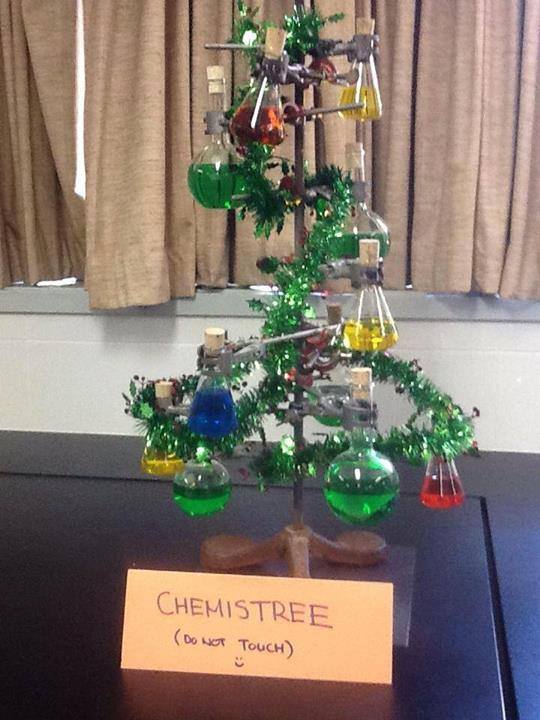
Category: Humor
World’s Most Accurate Pie Chart
 Source: Houghton College Facebook page, https://www.facebook.com/photo.php?fbid=10151682563311916&set=a.127025151915.116224.22485036915&type=1&theater
Ohm
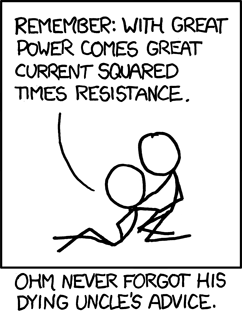 Source: http://www.xkcd.com/643/
Complex knowledge
I took a statistics course at MIT. I would go study and do problems, and have high confidence that I understood the material. Then I’d go to the lecture, and be more confused than I was when I entered the classroom. Thus, I discovered that some teachers were capable of conveying negative knowledge, so that after listening to them, I knew less than I did before.
It was also clear that knowledge varies considerably in quantity among people, and this convinced me that real knowledge varies over a very wide range.
Then I encountered people who either did not know what they were talking about, or were clearly convinced of things that were wrong, and so I learned that there was imaginary knowledge.
Once I understood that there was both real and imaginary knowledge, I concluded that knowledge is truly complex.
– Hillel J. Chiel, Case Western Reserve University
Source: American Mathematical Monthly, Vol. 120, No. 10, p. 923 (December 2013)
Correlation and causation
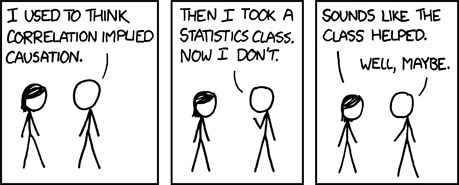
Source: http://www.xkcd.com/552/
Matrix transform

Source: http://www.xkcd.com/184/
P.S. In case you don’t get the joke… and are wondering why the answer isn’t ![[a_2, -a_1]^T](https://s0.wp.com/latex.php?latex=%5Ba_2%2C+-a_1%5D%5ET&bg=ffffff&fg=000000&s=0&c=20201002)

where 
Graphical statistics
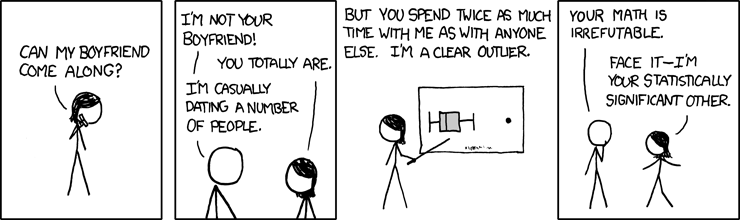
Source: http://www.xkcd.com/539/
A sampling of office hours
Yes, I definitely have had days like this. (This clip comes from the PhD Movie, from the creator of PhD Comics.)
Interdisciplinary studies (Part 4)
Shamelessly stolen from a friend:
How do you tell the difference between a plumber and a chemist?
Ask them to pronounce unionized.

 Mean Green Math