My Favorite One-Liners: Part 69

In this series, I’m compiling some of the quips and one-liners that I’ll use with my students to hopefully make my lessons more memorable for them.

This story, that I’ll share with my Precalculus students, comes from Fall 1996, my first semester as a college professor. I was teaching a Precalculus class, and the topic was vectors. I forget the exact problem (believe me, I wish I could remember it), but I was going over the solution of a problem that required finding \tan^{-1}(7). I told the class that I had worked this out ahead of time, and that the approximate answer was 82^o. Then I used that angle for whatever I needed it for and continued until obtaining the eventual solution.

(By the way, I now realize that I was hardly following best practices by computing that angle ahead of time. Knowing what I know now, I should have brought a calculator to class and computed it on the spot. But, as a young professor, I was primarily concerned with getting the answer right, and I was petrified of making a mistake that my students could repeat.)

After solving the problem, I paused to ask for questions. One student asked a good question, and then another.

Then a third student asked, “How did you know that \tan^{-1}(7) was 82^o?

Suppressing a smile, I answered, “Easy; I had that one memorized.”

The class immediately erupted… some with laughter, some with disbelief. (I had a terrific rapport with those students that semester; part of the daily atmosphere was the give-and-take with any number of exuberant students.) One guy in the front row immediately challenged me: “Oh yeah? Then what’s \tan^{-1}(9)?

I started to stammer, “Uh, um…”

“Aha!” they said. “He’s faking it.” They start pulling out their calculators.

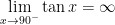
Then I thought as fast as I could. Then I realized that I knew that \tan 82^o \approx 7, thanks to my calculation prior to class. I also knew that \displaystyle \lim_{x \to 90^-} \tan x = \infty since the graph of y = \tan x has a vertical asymptote at x = \pi/2 = 90^o. So the solution to \tan x = 9 had to be somewhere between 82^o and 90^o.

So I took a total guess. “84^o,” I said, faking complete and utter confidence.

Wouldn’t you know it, I was right. (The answer is about 83.66^o.)

In stunned disbelief, the guy who asked the question asked, “How did you do that?”

I was reeling in shock that I guessed correctly. But I put on my best poker face and answered, “I told you, I had it memorized.” And then I continued with the next example. For the rest of the semester, my students really thought I had it memorized.

To this day, this is my favorite stunt that I ever pulled off in front of my students.

My Favorite One-Liners: Part 67

In this series, I’m compiling some of the quips and one-liners that I’ll use with my students to hopefully make my lessons more memorable for them.

Here are a couple of similar problems that arise in Precalculus:

  1. Convert the point (5,-5) from Cartesian coordinates into polar coordinates.
  2. Convert the complex number 5 - 5i into trigonometric form.

For both problems, a point is identified that is 5 steps to the right of the origin and then 5 steps below the x-axis (or real axis). To make this more kinesthetic, I’ll actually walk 5 paces in front of the classroom, turn right face, and then walk 5 more paces to end up at the point.

I then ask my class, “Is there a faster way to get to this point?” Naturally, they answer: Just walk straight to the point. After some work with the trigonometry, we’ll establish that

  1. (5,-5) in Cartesian coordinates is equivalent to (5\sqrt{2}, -\pi/4) in polar coordinates, or
  2. $5-5i$ can be rewritten as 5\sqrt{2} [ \cos(-\pi/4) + i \sin (-\pi/4)] in trigonometric form.

Once this is obtained, I’ll walk it out: I’ll start at the origin, turn clockwise by 45 degrees, and then take 5\sqrt{2} \approx 7 steps to end up at the same point as before.

Continuing the lesson, I’ll ask if the numbers 5\sqrt{2} and -\pi/4, or if some other angle and/or distance could have been chosen. Someone will usually suggest a different angle, like 7\pi/4 or 15\pi/4. I’ll demonstrate these by turning 315 degrees counterclockwise and walking 7 steps and then turning 675 degrees and walking 7 steps (getting myself somewhat dizzy in the process).

Finally, I’ll suggest turning only 135 degrees clockwise and then taking 7 steps backwards. Naturally, when I do this, I’ll do a poor man’s version of the moonwalk:

For more information, please see my series on complex numbers.

My Favorite One-Liners: Part 60

In this series, I’m compiling some of the quips and one-liners that I’ll use with my students to hopefully make my lessons more memorable for them.

I’m a big believer using scaffolded lesson plans, starting from elementary ideas and gradually building up to complicated ideas. For example, when teaching calculus, I’ll use the following sequence of problems to introduce students to finding the volume of a solid of revolution using disks, washers, and shells:

  • Find the volume of a cone with height h and base radius r.
  • Find the volume of the solid generated by revolving  the region bounded by y=2, y=2\sin x for 0 \le x \le \pi/2, and the y-axis about the line y=2.
  • Find the volume of the solid generated by revolving the region bounded by y=2, y=\sqrt{x}, and the y-axis about the line y=2 .
  • Find the volume of the solid generated by revolving the region bounded by y=2, y=\sqrt{x}, and the y-axis about the y-axis .
  • Find the volume of the solid generated by revolving the region bounded by x=\sqrt{2y}/(y+1), y=1, and the y-axis about the y-axis .
  • Find the volume of the solid generated by revolving  the region bounded by the parabola x=y^2+1 and the line x=3 about the line x=3.
  • Water is poured into a spherical tank of radius R to a depth h. How much water is in the tank?
  • Find the volume of the solid generated by revolving the region bounded by y= x^2, the x-axis, and x=4 about the x-axis.
  • Find the volume of the solid generated by revolving the region bounded by y= x^2, the x-axis, and x=4 about the y-axis.
  • Repeat the previous problem using cylindrical shells.

In this sequence of problems, I slowly get my students accustomed to the ideas of horizontal and vertical slices, integrating with respect to either x and y, the creation of disks and washers and (eventually) cylindrical shells.

As the problems increase in difficulty, I enjoy using the following punch line:

To quote the great philosopher Emeril Lagasse, “Let’s kick it up a notch.”

My Favorite One-Liners: Part 59

In this series, I’m compiling some of the quips and one-liners that I’ll use with my students to hopefully make my lessons more memorable for them.

Often I’ll cover a topic in class that students really should have learned in a previous class but just didn’t. For example, in my experience, a significant fraction of my senior math majors have significant gaps in their backgrounds from Precalculus:

  • About a third have no memory of ever learning the Rational Root Test.
  • About a third have no memory of ever learning synthetic division.
  • About half have no memory of ever learning Descartes’ Rule of Signs.
  • Almost none have learned the Conjugate Root Theorem.

Often, these students will feel somewhat crestfallen about these gaps in their background knowledge… they’re about to graduate from college with a degree in mathematics and are now discovering that they’re missing some pretty basic things that they really should have learned in high school. And I don’t want them to feel crestfallen. Certainly, these gaps need to be addressed, but I don’t want them to feel discouraged.

Hence one of my favorite motivational one-liners:

It’s not your fault if you don’t know what you’ve never been taught.

I think this strikes the appropriate balance between acknowledging that there’s a gap that needs to be addressed and assuring the students that I don’t think they’re stupid for having this gap.


My Favorite One-Liners: Part 57

In this series, I’m compiling some of the quips and one-liners that I’ll use with my students to hopefully make my lessons more memorable for them.

Every once in a while, students will ask my procedure for grading their exams. So I’ll tell them, tongue in cheek, that I go home so that I could have some movie playing in the background that would get in the proper mood for grading… something like Braveheart, Gladiator, or The Godfather.

For some reason, students don’t find this terribly reassuring.

My Favorite One-Liners: Part 56

In this series, I’m compiling some of the quips and one-liners that I’ll use with my students to hopefully make my lessons more memorable for them.

This really awful pun comes from a 1980s special by the comedian Gallagher; I would share a video clip here, but I couldn’t find it. I’ll tell this joke the first time that the Greek letters \alpha, \beta, \gamma, or \delta appears in a course. For the discussion below, let’s say that \alpha appears for the first time.
Where does the symbol \alpha come from?

[Students answer: “The Greek alphabet.”]

Good. Now, where did the Greeks get it from?

[Students sit in silence.]

The answer is, ancient cavemen. The sounds in the Greek alphabet correspond to the first sounds that the caveman said when he first stepped out the cave, so you can tell a lot about human psychology based on the Greek alphabet.

The caveman stepped out of the cave, saw a nice bright, sunny day, and said, “Ayyyyy!”

[Students groan.]

So, “Ahhh.” What’s the second sound?

[Students: “buh” or “bee”]

Good, the second sound is “buh.” What’s the third sound?

[Students: “guh” or “cee”]

Don’t forget, it’s the Greek alphabet. “Guh.” What’s the fourth sound?

[Students: “duh”]

Good. Now let’s put these all together to see what the caveman was saying. “Ah buh guh day.”

“Have a good day!”

[Students laugh and/or groan deeply.]

One year, when I told this story, I had a student in the front row who was carefully taking notes as I told this story; she felt very silly when I finally reached the punch line.

My Favorite One-Liners: Part 50

In this series, I’m compiling some of the quips and one-liners that I’ll use with my students to hopefully make my lessons more memorable for them.

Here’s today’s one-liner: “To prove that two things are equal, show that the difference is zero.” This principle is surprisingly handy in the secondary mathematics curriculum. For example, it is the basis for the proof of the Mean Value Theorem, one of the most important theorems in calculus that serves as the basis for curve sketching and the uniqueness of antiderivatives (up to a constant).

And I have a great story that goes along with this principle, from 30 years ago.

I forget the exact question out of Apostol’s calculus, but there was some equation that I had to prove on my weekly homework assignment that, for the life of me, I just couldn’t get. And for no good reason, I had a flash of insight: subtract the left- and right-hand sides. While it was very difficult to turn the left side into the right side, it turned out that, for this particular problem, was very easy to show that the difference was zero. (Again, I wish I could remember exactly which question this was so that I could show this technique and this particular example to my own students.)

So I finished my homework, and I went outside to a local basketball court and worked on my jump shot.

Later that week, I went to class, and there was a great buzz in the air. It took ten seconds to realize that everyone was up in arms about how to do this particular problem. Despite the intervening 30 years, I remember the scene as clear as a bell. I can still hear one of my classmates ask me, “Quintanilla, did you get that one?”

I said with great pride, “Yeah, I got it.” And I showed them my work.

And, either before then or since then, I’ve never heard the intensity of the cussing that followed.

Truth be told, probably the only reason that I remember this story from my adolescence is that I usually was the one who had to ask for help on the hardest homework problems in that Honors Calculus class. This may have been the one time in that entire two-year calculus sequence that I actually figured out a homework problem that had stumped everybody else.

My Favorite One-Liners: Part 22

In this series, I’m compiling some of the quips and one-liners that I’ll use with my students to hopefully make my lessons more memorable for them. Today’s example might be the most cringe-worthy pun that I use in any class that I teach.

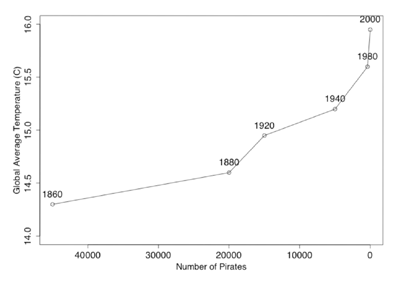
In my statistics classes, I try to emphasize to student that a high value of the correlation coefficient r is not the same thing as causation. To hopefully drive home this point, I’ll use the following picture.

piracy01

Conclusion: If we want to stop global warming, we should all become pirates.

Obviously, I tell my class, there isn’t a cause-and-effect relationship here, even though there is a strong positive correlation. So, I tell my class, in my best pirate voice, “Correlation is not the same thing as a causation, even if you get a large value of ARRRRRRR.”

Without fail, my students love this awful wisecrack.

While I’m on the topic, this is too good not to share:

For further reading, see my series on correlation and causation.


My Favorite One-Liners: Part 16

In this series, I’m compiling some of the quips and one-liners that I’ll use with my students to hopefully make my lessons more memorable for them.

One of the basic notions of functions that’s taught in Precalculus and in Discrete Mathematics is the notion of an inverse function: if f: A \to B is a one-to-one and onto function, then there is an inverse function f^{-1}: B \to A so that

f^{-1}(f(a)) = a for all a \in A and

f(f^{-1}(b)) = b for all b \in B.

If A = B = \mathbb{R}, this is commonly taught in high school as a function that satisfies the horizontal line test.

In other words, if the function f is applied to a, the result is f(a). When the inverse function is applied to that, the answer is the original number a. Therefore, I’ll tell my class, “By applying the function f^{-1}, we uh-uh-uh-uh-uh-uh-uh-undo it.”

If I have a few country music fans in the class, this always generates a bit of a laugh.

See also the amazing duet with Carrie Underwood and Steven Tyler at the 2011 ACM awards:

My Favorite One-Liners: Part 13

In this series, I’m compiling some of the quips and one-liners that I’ll use with my students to hopefully make my lessons more memorable for them.

Here’s a story that I’ll tell my students when, for the first time in a semester, I’m about to use a previous theorem to make a major step in proving a theorem. For example, I may have just finished the proof of

\hbox{Var}(X+Y) = \hbox{Var}(X) + \hbox{Var}(Y),

where X and Y are independent random variables, and I’m about to prove that

\hbox{Var}(X-Y) = \hbox{Var}(X) + \hbox{Var}(Y).

While this can be done by starting from scratch and using the definition of variance, the easiest thing to do is to write

\hbox{Var}(X-Y) = \hbox{Var}(X+[-Y]) = \hbox{Var}(X) + \hbox{Var}(-Y),

thus using the result of the first theorem to prove the next theorem.

And so I have a little story that I tell students about this principle. I think I was 13 when I first heard this one, and obviously it’s stuck with me over the years.

At MIT, there’s a two-part entrance exam to determine who will be the engineers and who will be the mathematicians. For the first part of the exam, students are led one at a time into a kitchen. There’s an empty pot on the floor, a sink, and a stove. The assignment is to boil water. Everyone does exactly the same thing: they fill the pot with water, place it on the stove, and then turn the stove on. Everyone passes.

For the second part of the exam, students are led one at a time again into the kitchen. This time, there’s a pot full of water sitting on the stove. The assignment, once again, is to boil water. Nearly everyone simply turns on the stove. These students are led off to become engineers. The mathematicians are ones who take the pot off the stove, dump the water into the sink, and place the empty pot on the floor… thereby reducing to the original problem, which had already been solved.