Every so often, I’ll publicize through this blog an interesting article that I’ve found in the mathematics or mathematics education literature that can be freely distributed to the general public. Today, I’d like to highlight “Vertically Integrating Professional Skills Throughout A Mathematics Major,” by Clarice Dziak, Brian Leventhal, Aaron Luttman, and Joseph Skufca. Here’s the abstract:
In response to a university mandate to include “professional issues” as a component of every major, we have developed a vertically integrated approach to incorporating the study of professional skills and issues into the mathematics curriculum. Beginning in the first year of study, mathematics majors take an inquiry-based course in mathematical modeling using software packages that are important in business and industry, such as Excel®, Maple®, and Matlab®. In the third year, students choose between a seminar course covering topics in teaching and another covering topics related to research and work in industry. The courses are designed to introduce students to the different cultures and issues of business, industry, and teaching. Beyond these two courses, students are required to demonstrate proficiency in three core areas through a required “professional experience,” which takes the form of an internship, undergraduate research experience, or educational outreach program.
Full reference:Clarice Dziak, Brian Leventhal, Aaron Luttman & Joseph Skufca (2014) Vertically Integrating Professional Skills Throughout A Mathematics Major, PRIMUS: Problems, Resources, and Issues in Mathematics Undergraduate Studies, 24:4,301-308, DOI:10.1080/10511970.2013.876472
March 14, 2015 has been labeled the Pi Day of the Century because of the way this day is abbreviated, at least in America: 3/14/15.
I was recently asked an interesting question: did any of our ancestors observe Pi Day about 400 years ago on 3/14/1592? The answer is, I highly doubt it.
My first thought was that may not have been known to that many decimal places in 1592. However, a quick check on Wikipedia (see also here), as well as the book “ Unleashed,” verifies that my initial thought was wrong. In China, 7 places of accuracy were obtained by the 5th century. By the 14th century, was known to 13 decimal places in India. In the 15th century, was calculated to 16 decimal places in Persia.
It’s highly doubtful that the mathematicians in these ancient cultures actually talked to each other, given the state of global communications at the time. Furthermore, I don’t think any of these cultures used either the Julian calendar or the Gregorian calendar (which is in near universal use today) in 1592. (An historical sidebar: the Gregorian calendar was first introduced in 1582, but different countries adopted it in different years or even centuries. America and England, for example, did not make the switch until the 18th century.) So in China, India, and Persia, there would have been nothing particularly special about the day that Europeans called March 14, 1592.
However, in Europe (specifically, France), Francois Viete derived an infinite product for and obtained the first 10 digits of . According to Wikipedia, Viete obtained the first 9 digits in 1579, and so Pi Day hypothetically could have been observed in 1592. (Although Unleashed says this happened in 1593, or one year too late).
There’s a second problem: the way that dates are numerically abbreviated. For example, in England, this Saturday is abbreviated as 14/3/15, which doesn’t lend itself to Pi Day. (Unfortunately, since April has only 30 days, there’s no 31/4/15 for England to mark Pi Day.) See also xkcd’s take on this. So numerologically minded people of the 16th century may not have considered anything special about March 14, 1592.
The biggest obstacle, however, may be the historical fact that the ratio of a circle’s circumference and diameter wasn’t called until the 18th century. Therefore, both serious and recreational mathematicians would not have called any day Pi Day in 1592.
Every math teacher should be familiar with this famous story concerning George B. Dantzig (1914-2005). Dantzig is universally hailed as the Father of Linear Programming for his development of the simplex method, which was named one of the top 10 algorithms of the 20th century. The following story happened while he was a graduate student at the University of California.
If you search the Web for “urban legend George Dantzig” you will probably find the first hit to be “Snopes.com, The Unsolvable Math Problem.” That site recounts the story of how George, coming in late for class, mistakenly thought two problems written on the board by Neyman were homework problems. After a few days of struggling, George turned his answers in. About six weeks later, at 8 a.m. on a Sunday morning, he and Anne were awakened by someone banging on their front door. It was Neyman who said, “I have just written an introduction to one of your papers. Read it so I can send it out right away for publication.”
George’s answers to the homework problems were proofs of then two unproven theorems in statistics. The Web site gives all the details about how George’s experiences ended up as a sermon for a Lutheran minister and the basis for the film, “Good Will Hunting.” The solution to the second homework problem became part of a joint paper with Abraham Wald who proved it in 1950, unaware that George had solved it until it was called to his attention by a journal referee. Neyman had George submit his answers to the “homework” problems as his doctoral dissertation.
True story: my own paths actually overlapped with Dantzig’s once. When I was a sophomore in college and he was a professor emeritus, we both attended the same seminar, and he was stick as sharp as a tack. However, I couldn’t build up enough courage to introduce myself to the great man.
Every so often, I’ll publicize through this blog an interesting article that I’ve found in the mathematics or mathematics education literature that can be freely distributed to the general public. Today, I’d like to highlight “Weaving History Through the Major,” by Betty Mayfield. Here’s the abstract:
The benefits of including the study of the history of mathematics in the education of mathematics majors have been discussed at length elsewhere. Many colleges and universities now offer a History of Mathematics course for mathematics majors, for mathematics education majors, or for general credit. At Hood College, we emphasize our commitment to the liberal arts by including history in many courses. We use various methods to weave the history of mathematics through all the courses in the major, culminating in our senior seminar. Other institutions looking for innovative ways to include history in their mathematics curriculum may wish to take this approach.
Full reference: Betty Mayfield (2014) Weaving History Through the Major, PRIMUS: Problems, Resources, and Issues in Mathematics Undergraduate Studies, 24:8,669-683, DOI:10.1080/10511970.2014.900158
Today I happily link to this wonderful article about how elementary school students “should” subtract two numbers, as it challenges the commonly held notion that there is only one way that subtraction should be implemented.
The common algorithm taught in schools today is the Decomposition Algorithm.
The teaching and learning of subtraction is just as important today as it was in the past. Innovations in technology and mathematics curriculum have certainly occurred since the 1700s and 1800s, but the need for the teaching and learning of subtraction has not changed. Today, in many classrooms, subtraction is often taught through student-invented algorithms. Looking to the past may give teachers insight into invented algorithms or other algorithms students may use. Additionally, many teachers who do not encourage students to invent strategies teach only the “standard subtraction algorithm” presented in nearly every textbook across the United States, the decomposition algorithm. This research and analysis provides the modern teacher with an opportunity to reflect on the algorithms being taught in his or her classroom and allows the teacher to begin to think about why decomposition became the dominant algorithm in the United States. Teachers can ask their students to reflect on whether they agree with this historical turn of events. Incorporating the history of subtraction algorithms into modern elementary school mathematics invites robust mathematical discussion of subtraction and also of how, for many mathematical operations, there isn’t just one algorithm, but rather many algorithms from which to choose.
Exploring the history of subtraction in past school mathematics may provide us with insight into students’ mathematical struggles as they attempt to conceptualize not only subtraction, but also negative numbers and other notoriously challenging mathematical concepts. As educators and researchers, we need to devote more attention to issues in mathematics education such as the development of specific algorithms in elementary mathematics.
When I teach Algebra II or Precalculus (or train my future high school teachers to teach these subjects), we eventually land on the Rational Root Test and Descartes’ Rule of Signs as an aid for finding the roots of cubic equations or higher. Before I get too deep into this subject, however, I like to give a 10-15 minute pseudohistory about the discovery of how polynomial equations can be solved. Historians of mathematics will certain take issue with some of this “history.” However, the main purpose of the story is not complete accuracy but engaging students with the history of mathematics. I think the story I tell engages students while remaining reasonably accurate… and I always refer students to various resources if they want to get the real history.
To begin, I write down the easiest two equations to solve (in all cases, :
and
These are pretty easy to solve, with solutions well known to students:
and
In other words, there are formulas that you can just stick in the coefficients and get the answer out without thinking too hard. Sure, there are alternate ways of solving for that could be easier, like factoring, but the worst-case scenario is just plugging into the formula.
These formulas were known to Babylonian mathematicians around 2000 B.C. (When I teach this in class, I write the date, and all other dates and discoverers, next to the equations for dramatic pedagogical effect.) Though not written in these modern terms, basically every ancient culture on the globe that did mathematics had some version of these formulas: for example, the ancient Egyptians, Greeks, Chinese, and Mayans.
Naturally, this leads to a simple question: is there a formula for the cubic:
Is there some formula that we can just plug , , , and to just get the answer? The answer is, Yes, there is a formula. But it’s nasty. The formula was not discovered until 1535 A.D., and it was discovered by a man named Tartaglia. During the 1500s, the study of mathematics was less about the dispassionate pursuit of truth and more about exercising machismo. One mathematician would challenge another: “Here’s my cubic equation; I bet you can’t solve it. Nyah-nyah-nyah-nyah-nyah.” Then the second mathematician would solve it and challenge the first: “Here’s my cubic equation; I bet you can’t solve it. Nyah-nyah-nyah-nyah-nyah.” And so on. Well, Tartaglia came up with a formula that would solve every cubic equation. By plugging in , , , and , you get the answer out.
Tartaglia’s discovery was arguably the first triumph of the European Renaissance. The solution of the cubic was perhaps the first thing known to European mathematicians in the Middle Ages that was unknown to the ancient Greeks.
In 1535, Tartaglia was a relatively unknown mathematician, and so he told a more famous mathematician, Cardano, about his formula. Cardano told Tartaglia, why yes, that is very interesting, and then published the formula under his own name, taking credit without mention of Tartaglia. To this day, the formula is called Cardano’s formula.
So there is a formula. But it would take an entire chalkboard to write down the formula. That’s why we typically don’t make students learn this formula in high school; it’s out there, but it’s simply too complicated to expect students to memorize and use.
This leads to the next natural question: what about quartic equations?
The solution of the quartic was discovered less than five years later by an Italian mathematician named Ferrari. Ferrari found out that there is a formula that you can just plug in , , , , and , turn the crank, and get the answers out. Writing out this formula would take two chalkboards. So there is a formula, but it’s also very, very complicated.
Of course, Ferrari had some famous descendants in the automotive industry.
So now we move onto my favorite equation, the quintic. (If you don’t understand why it’s my favorite, think about my last name.)
After solving the cubic and quartic in rapid succession, surely there should also be a formula for the quintic. So they tried, and they tried, and they tried, and they got nowhere fast. Finally, the problem was solved nearly 300 years later, in 1832 (for the sake telling a good story, I don’t mention Abel) by a French kid named Evariste Galois. Galois showed that there is no formula. That takes some real moxie. There is no formula. No matter how hard you try, you will not find a formula that can work for every quintic. Sure, there are some quintics that can be solved, like . But there is no formula that will work for every single quintic.
Galois made this discovery when he was 19 years old… in other words, approximately the same age as my students. In fact, we know when wrote down his discovery, because it happened the night before he died. You see, he was living in France in 1832. What was going on in France in 1832? I ask my class, have they seen Les Miserables?
France was torn upside-down in 1832 in the aftermath of the French Revolution, and young Galois got into a heated argument with someone over politics; Galois was a republican, while the other guy was a royalist. More importantly, both men were competing for the hand of the same young woman. So they decided to settle their differences like honorable Frenchmen, with a duel. So Galois wrote up his mathematical notes one night, and the next day, he fought the duel, he lost the duel, and he died.
Thus giving complete and total proof that tremendous mathematical genius does not prevent somebody from being a complete idiot.
For the present, there are formulas for cubic and quartic equations, but they’re long and impractical. And for quintic equations and higher, there is no formula. So that’s why we teach these indirect methods like the Rational Root Test and Descartes’ Rule of Signs, as they give tools to use to guess at the roots of higher-order polynomials without using something like the quadratic formula.
Which answer is simplified: or ? From example, here’s a simple problem from trigonometry:
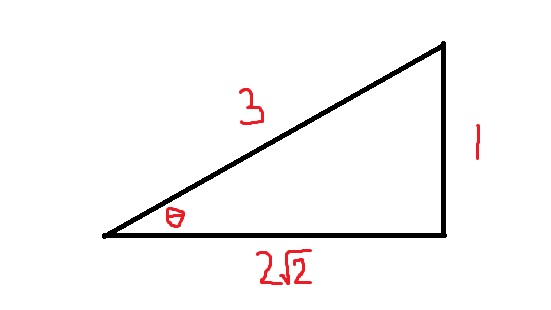
Suppose is an acute angle so that . Find .
To solve, we make a right triangle whose side opposite of has length and hypotenuse with length . The adjacent side has length . Therefore,
This is the correct answer, and it could be plugged into a calculator to obtain a decimal approximation. However, in my experience, it seems that most students are taught that this answer is not yet simplified, and that they must rationalize the denominator to get the “correct” answer:
Of course, this is equivalent to the first answer. So my question is philosophical: why are students taught that the first answer isn’t simplified but the second is? Stated another way, why is a square root in the numerator so much more preferable than a square root in the denominator?
Feel free to correct me if I’m wrong, but it seems to me that rationalizing denominators is a vestige of an era before cheap pocket calculators. Let’s go back in time to an era before pocket calculators… say, 1927, when The Jazz Singer was just released and stars of silent films, like Don Lockwood, were trying to figure out how to act in a talking movie.
Before cheap pocket calculators, how would someone find or to nine decimal places? Clearly, the first step is finding by hand, which I discussed in a previous post. So these expressions reduce to
or
Next comes the step of dividing. If you don’t have a calculator and had to use long division, which would rather do: divide by or divide by ?
Clearly, long division with is easier.
It seems to me that ease of computation was the reason that rationalizing denominators was required of students in previous generations. So I’m a little bemused why rationalizing denominators is still required of students now that cheap calculators are so prevalent.
Lest I be misunderstood, I absolutely believe that all students should be able to convert into . But I see no compelling reason why the “simplified” answer to the above trigonometry problem should be the second answer and not the first.
An 8th grade exam from Bullitt County, Kentucky. I’m not sure about the other subject areas, but it seems to me that the standards for arithmetic for those 8th grades are approximately in line with what we expect of pre-algebra students today.
Of course, the students of 1912 didn’t have access to scientific calculators.
In this post, we’ll consider the calculation of a very famous arithmetic series… not because the series is particularly important, but because it’s part of a legendary story about one of the greatest mathematicians who ever lived. My frank opinion is that every math teacher should know this story. While I’m not 100% certain about small details of the story — like whether young Gauss was 9 or 10 years old when the following event happened — I’m just going to go with the story as told by the website http://www.math.wichita.edu/history/men/gauss.html.
Carl Friedrich Gauss (1777-1855) is considered to be the greatest German mathematician of the nineteenth century. His discoveries and writings influenced and left a lasting mark in the areas of number theory, astronomy, geodesy, and physics, particularly the study of electromagnetism.
Gauss was born in Brunswick, Germany, on April 30, 1777, to poor, working-class parents. His father labored as a gardner and brick-layer and was regarded as an upright, honest man. However, he was a harsh parent who discouraged his young son from attending school, with expectations that he would follow one of the family trades. Luckily, Gauss’ mother and uncle, Friedrich, recognized Carl’s genius early on and knew that he must develop this gifted intelligence with education.
While in arithmetic class, at the age of ten, Gauss exhibited his skills as a math prodigy when the stern schoolmaster gave the following assignment: “Write down all the whole numbers from to and add up their sum.” When each student finished, he was to bring his slate forward and place it on the schoolmaster’s desk, one on top of the other. The teacher expected the beginner’s class to take a good while to finish this exercise. But in a few seconds, to his teacher’s surprise, Carl proceeded to the front of the room and placed his slate on the desk. Much later the other students handed in their slates.
At the end of the classtime, the results were examined, with most of them wrong. But when the schoolmaster looked at Carl’s slate, he was astounded to see only one number: . Carl then had to explain to his teacher that he found the result because he could see that, , , , so that he could find pairs of numbers that each add up to . Thus, times will equal .
This is the fifth in a series of posts about calculating roots without a calculator, with special consideration to how these tales can engage students more deeply with the secondary mathematics curriculum. As most students today have a hard time believing that square roots can be computed without a calculator, hopefully giving them some appreciation for their elders.
Today’s story takes us back to a time before the advent of cheap pocket calculators: 1949.
The following story comes from the chapter “Lucky Numbers” of Surely You’re Joking, Mr. Feynman!, a collection of tales by the late Nobel Prize winning physicist, Richard P. Feynman. Feynman was arguably the greatest American-born physicist — the subject of the excellent biography Genius: The Life and Science of Richard Feynman — and he had a tendency to one-up anyone who tried to one-up him. (He was also a serial philanderer, but that’s another story.) Here’s a story involving how, in the summer of 1949, he calculated without a calculator.
The first time I was in Brazil I was eating a noon meal at I don’t know what time — I was always in the restaurants at the wrong time — and I was the only customer in the place. I was eating rice with steak (which I loved), and there were about four waiters standing around.
A Japanese man came into the restaurant. I had seen him before, wandering around; he was trying to sell abacuses. (Note: At the time of this story, before the advent of pocket calculators, the abacus was arguably the world’s most powerful hand-held computational device.) He started to talk to the waiters, and challenged them: He said he could add numbers faster than any of them could do.
The waiters didn’t want to lose face, so they said, “Yeah, yeah. Why don’t you go over and challenge the customer over there?”
The man came over. I protested, “But I don’t speak Portuguese well!”
The waiters laughed. “The numbers are easy,” they said.
They brought me a paper and pencil.
The man asked a waiter to call out some numbers to add. He beat me hollow, because while I was writing the numbers down, he was already adding them as he went along.
I suggested that the waiter write down two identical lists of numbers and hand them to us at the same time. It didn’t make much difference. He still beat me by quite a bit.
However, the man got a little bit excited: he wanted to prove himself some more. “Multiplição!” he said.
Somebody wrote down a problem. He beat me again, but not by much, because I’m pretty good at products.
The man then made a mistake: he proposed we go on to division. What he didn’t realize was, the harder the problem, the better chance I had.
We both did a long division problem. It was a tie.
This bothered the hell out of the Japanese man, because he was apparently well trained on the abacus, and here he was almost beaten by this customer in a restaurant.
“Raios cubicos!” he says with a vengeance. Cube roots! He wants to do cube roots by arithmetic. It’s hard to find a more difficult fundamental problem in arithmetic. It must have been his topnotch exercise in abacus-land.
He writes down a number on some paper— any old number— and I still remember it: . He starts working on it, mumbling and grumbling: “Mmmmmmagmmmmbrrr”— he’s working like a demon! He’s poring away, doing this cube root.
Meanwhile I’m just sitting there.
One of the waiters says, “What are you doing?”.
I point to my head. “Thinking!” I say. I write down on the paper. After a little while I’ve got .
The man with the abacus wipes the sweat off his forehead: “Twelve!” he says.
“Oh, no!” I say. “More digits! More digits!” I know that in taking a cube root by arithmetic, each new digit is even more work that the one before. It’s a hard job.
He buries himself again, grunting “Rrrrgrrrrmmmmmm …,” while I add on two more digits. He finally lifts his head to say, “!”
The waiter are all excited and happy. They tell the man, “Look! He does it only by thinking, and you need an abacus! He’s got more digits!”
He was completely washed out, and left, humiliated. The waiters congratulated each other.
How did the customer beat the abacus?
The number was . I happened to know that a cubic foot contains cubic inches, so the answer is a tiny bit more than . The excess, , is only one part in nearly , and I had learned in calculus that for small fractions, the cube root’s excess is one-third of the number’s excess. So all I had to do is find the fraction , and multiply by (divide by and multiply by ). So I was able to pull out a whole lot of digits that way.
A few weeks later, the man came into the cocktail lounge of the hotel I was staying at. He recognized me and came over. “Tell me,” he said, “how were you able to do that cube-root problem so fast?”
I started to explain that it was an approximate method, and had to do with the percentage of error. “Suppose you had given me . Now the cube root of is …”
He picks up his abacus: zzzzzzzzzzzzzzz— “Oh yes,” he says.
I realized something: he doesn’t know numbers. With the abacus, you don’t have to memorize a lot of arithmetic combinations; all you have to do is to learn to push the little beads up and down. You don’t have to memorize 9+7=16; you just know that when you add 9, you push a ten’s bead up and pull a one’s bead down. So we’re slower at basic arithmetic, but we know numbers.
Furthermore, the whole idea of an approximate method was beyond him, even though a cubic root often cannot be computed exactly by any method. So I never could teach him how I did cube roots or explain how lucky I was that he happened to choose .
The key part of the story, “for small fractions, the cube root’s excess is one-third of the number’s excess,” deserves some elaboration, especially since this computational trick isn’t often taught in those terms anymore. If , then , so that . Since , the equation of the tangent line to at is
.
The key observation is that, for , the graph of will be very close indeed to the graph of . In Calculus I, this is sometimes called the linearization of at . In Calculus II, we observe that these are the first two terms in the Taylor series expansion of about .
For Feynman’s problem, , so that if $x \approx 0$. Then $\latex \sqrt[3]{1729.03}$ can be rewritten as
This last equation explains the line “all I had to do is find the fraction , and multiply by .” With enough patience, the first few digits of the correction can be mentally computed since
So Feynman could determine quickly that the answer was .
By the way,
So the linearization provides an estimate accurate to eight significant digits. Additional digits could be obtained by using the next term in the Taylor series.
I have a similar story to tell. Back in 1996 or 1997, when I first moved to Texas and was making new friends, I quickly discovered that one way to get odd facial expressions out of strangers was by mentioning that I was a math professor. Occasionally, however, someone would test me to see if I really was a math professor. One guy (who is now a good friend; later, we played in the infield together on our church-league softball team) asked me to figure out without a calculator — before someone could walk to the next room and return with the calculator. After two seconds of panic, I realized that I was really lucky that he happened to pick a number close to . Using the same logic as above,
.
Knowing that this came from a linearization and that the tangent line to lies above the curve, I knew that this estimate was too high. But I didn’t have time to work out a correction (besides, I couldn’t remember the full Taylor series off the top of my head), so I answered/guessed , hoping that I did the arithmetic correctly. You can imagine the amazement when someone punched into the calculator to get

 may not have been known to that many decimal places in 1592. However, a quick check on
  :
: and
and 
 and
and 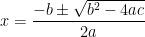
 that could be easier, like factoring, but the worst-case scenario is just plugging into the formula.
 ,
,  ,
,  , and
, and  to just get the answer? The answer is, Yes, there is a formula. But it’s nasty. The formula was not discovered until 1535 A.D., and it was discovered by a man named
 , turn the crank, and get the answers out. Writing out this formula would take two chalkboards. So there is a formula, but it’s also very, very complicated.
 . But there is no formula that will work for every single quintic.
 or
or  ? From example, here’s a simple problem from trigonometry:
 is an acute angle so that
  . Find
  .
.
 and hypotenuse with length
  . The adjacent side has length
  . Therefore,

 or
or  to nine decimal places? Clearly, the first step is finding
  by hand,
  or
or 
 or divide by
  ?
?
 and add up their sum.” When each student finished, he was to bring his slate forward and place it on the schoolmaster’s desk, one on top of the other. The teacher expected the beginner’s class to take a good while to finish this exercise. But in a few seconds, to his teacher’s surprise, Carl proceeded to the front of the room and placed his slate on the desk. Much later the other students handed in their slates.
 . Carl then had to explain to his teacher that he found the result because he could see that,
  ,
,  ,
,  , so that he could find
  pairs of numbers that each add up to
  . Thus,
 ![\sqrt[3]{1729.03}](https://s0.wp.com/latex.php?latex=%5Csqrt%5B3%5D%7B1729.03%7D&bg=ffffff&fg=000000&s=0&c=20201002) without a calculator.
without a calculator. . He starts working on it, mumbling and grumbling: “Mmmmmmagmmmmbrrr”— he’s working like a demon! He’s poring away, doing this cube root.
 on the paper. After a little while I’ve got
  .
. !”
!” cubic inches, so the answer is a tiny bit more than
  , is only one part in nearly
  , and I had learned in calculus that for small fractions, the cube root’s excess is one-third of the number’s excess. So all I had to do is find the fraction
  , and multiply by
  . Now the cube root of
  is
is  , then
  , so that
  . Since
  , the equation of the tangent line to
  at
at  is
is .
. , the graph of
  will be very close indeed to the graph of
  at
at  . In Calculus II, we observe that these are the first two terms in the
  .
. , so that
 ![\sqrt[3]{1+x} \approx 1 + \frac{1}{3} x](https://s0.wp.com/latex.php?latex=%5Csqrt%5B3%5D%7B1%2Bx%7D+%5Capprox+1+%2B+%5Cfrac%7B1%7D%7B3%7D+x&bg=ffffff&fg=000000&s=0&c=20201002) if $x \approx 0$. Then $\latex \sqrt[3]{1729.03}$ can be rewritten as
if $x \approx 0$. Then $\latex \sqrt[3]{1729.03}$ can be rewritten as![\sqrt[3]{1729.03} = \sqrt[3]{1728} \sqrt[3]{ \displaystyle \frac{1729.03}{1728} }](https://s0.wp.com/latex.php?latex=%5Csqrt%5B3%5D%7B1729.03%7D+%3D+%5Csqrt%5B3%5D%7B1728%7D+%5Csqrt%5B3%5D%7B+%5Cdisplaystyle+%5Cfrac%7B1729.03%7D%7B1728%7D+%7D&bg=ffffff&fg=000000&s=0&c=20201002)
![\sqrt[3]{1729.03} = 12 \sqrt[3]{\displaystyle 1 + \frac{1.03}{1728}}](https://s0.wp.com/latex.php?latex=%5Csqrt%5B3%5D%7B1729.03%7D+%3D+12+%5Csqrt%5B3%5D%7B%5Cdisplaystyle+1+%2B+%5Cfrac%7B1.03%7D%7B1728%7D%7D&bg=ffffff&fg=000000&s=0&c=20201002)
![\sqrt[3]{1729.03} \approx 12 \left( 1 + \displaystyle \frac{1}{3} \times \frac{1.03}{1728} \right)](https://s0.wp.com/latex.php?latex=%5Csqrt%5B3%5D%7B1729.03%7D+%5Capprox+12+%5Cleft%28+1+%2B+%5Cdisplaystyle+%5Cfrac%7B1%7D%7B3%7D+%5Ctimes+%5Cfrac%7B1.03%7D%7B1728%7D+%5Cright%29&bg=ffffff&fg=000000&s=0&c=20201002)
![\sqrt[3]{1729.03} \approx 12 + 4 \times \displaystyle \frac{1.03}{1728}](https://s0.wp.com/latex.php?latex=%5Csqrt%5B3%5D%7B1729.03%7D+%5Capprox+12+%2B+4+%5Ctimes+%5Cdisplaystyle+%5Cfrac%7B1.03%7D%7B1728%7D&bg=ffffff&fg=000000&s=0&c=20201002)



 .
.![\sqrt[3]{1729.03} \approx 12.00238378\dots](https://s0.wp.com/latex.php?latex=%5Csqrt%5B3%5D%7B1729.03%7D+%5Capprox+12.00238378%5Cdots&bg=ffffff&fg=000000&s=0&c=20201002)

 without a calculator — before someone could walk to the next room and return with the calculator. After two seconds of panic, I realized that I was really lucky that he happened to pick a number close to
  .
. lies above the curve, I knew that this estimate was too high. But I didn’t have time to work out a correction (besides, I couldn’t remember the full Taylor series off the top of my head), so I answered/guessed
  , hoping that I did the arithmetic correctly. You can imagine the amazement when someone punched into the calculator to get
 Mean Green Math