Engaging students: Completing the square

In my capstone class for future secondary math teachers, I ask my students to come up with ideas for engaging their students with different topics in the secondary mathematics curriculum. In other words, the point of the assignment was not to devise a full-blown lesson plan on this topic. Instead, I asked my students to think about three different ways of getting their students interested in the topic in the first place.

I plan to share some of the best of these ideas on this blog (after asking my students’ permission, of course).

This student submission comes from my former student Claire McMahon. Her topic, from Algebra: completing the square.

green line

There were a lot of famous mathematicians that contributed to the notion of completing the square.  The first of the mathematicians was that of the Babylonians.  This culture started the notion of not only solving the quadratics but of arithmetic itself.  The Babylonians started with the equations and then proceeded to solve them algebraically.  Back then; they used pre-calculated tables to help them with solving for the roots.  They were basically solving by the quadratic equation at this point.  The man that came along has a very hard name to not only pronounce but to spell, and I will do my best.  I will refer to him as Muhammad from here on out but his full name, or one of the common names to which he is referred is Muhammad ibn Musa al-Khwarizmi.  He developed the term algorithm, which led to an algorithm for solving quadratic equations, namely completing the square.

The notion of completing the square has gone through a series of transformations throughout the history of mathematics.  As mentioned before the Babylonians started with the notion and increased the knowledge by developing the quadratic formula to find the roots of a given quadratic equation.  This spurred the thought that I can solve any equation and find its solution and roots by completing the square.  Muhammad brought this notion to us, of which was mentioned before.  More specifically the text that he developed was “The Compendious Book of Calculations by Completion and Balancing.”  This book of course has been translated several times over but the general idea is laid out in the title.  Modern mathematicians have developed a less compendious form that is now being taught in the math classes today.  They take on many different forms and can be taught with manipulates as well.


green line

The fabulous part to the story is there are a lot of resources that help the kids of today to deal with this “trick” of the math trade.  There are numerous You Tube videos on the different methods of which show every step along the way with encouraging thoughts.  Another great online resource is any of the math websites.  I find it a little unfair that these resources were not readily available when I was struggling with such concepts.  One of my personal favorites is the PurpleMath.com website.  This website breaks everything down to basically that of a fourth grade level.  They have pictures and fun problems to work out on your own.  My favorite part is that you get your answers checked instantaneously to build the self-confidence and self-efficacy it takes to be a successful student.  These particular websites are great tools for teachers as well, as they have a lot of great examples that can be used in the classroom and different ways that a student might present and calculate a problem.

Engaging students: Measures of the angles in a triangle add to 180 degrees

In my capstone class for future secondary math teachers, I ask my students to come up with ideas for engaging their students with different topics in the secondary mathematics curriculum. In other words, the point of the assignment was not to devise a full-blown lesson plan on this topic. Instead, I asked my students to think about three different ways of getting their students interested in the topic in the first place.

I plan to share some of the best of these ideas on this blog (after asking my students’ permission, of course).

This student submission comes from my former student Claire McMahon. Her topic, from Geometry: the proof that the measures of the angles in a triangle add to 180^o.

green line

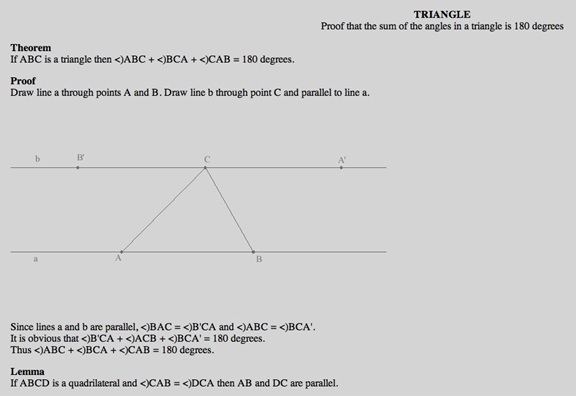
One of the hardest concepts in math is learning how to prove something that is already considered to be correct.  One of the more difficult concepts to teach could also be said on how to prove things that you had already believed and accepted in the first place.  One of these concepts happens to be that a triangle’s angles are always going to add up to 180 degrees.  Here is one of the proofs that I found that is absolutely simplistic and most kids will agree with you on it:

triangle1

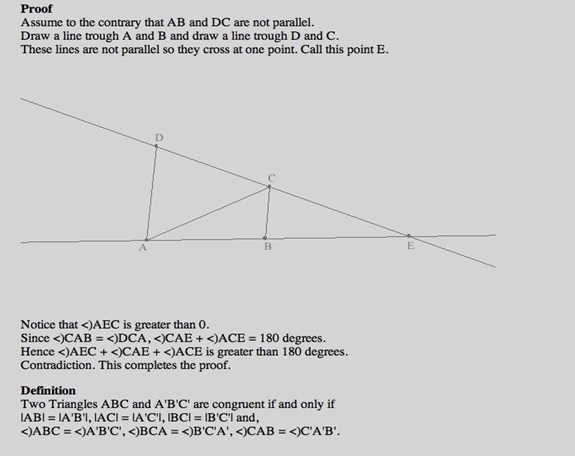
This particular proof is from the website http://www.mathisfun.com.  This is a great website to simply explain most math concepts and give exercises to practice those math facts.  For the more skeptical student, you can use a form of Euclidean and modern fact base to prove this more in depth.  I found this proof on http://www.apronus.com/geometry/triangle.htm.  Here you will see that there is no question as to why the proof above works and how it doesn’t work when you do a proof by contradiction.

triangle3 triangle2

green line

I stumbled across this awesome website that very simply put into context how easy it would be to prove that a triangle’s angles will always add up to 180 degrees.  In this activity you take the same triangle 3 times and then have them place all three of the angles on a straight line.  This proves that the angles in a triangle will always equal 180 degrees, which is a concept that should have already been taught as a straight line having an “angle” measure of 180. The website for this can be found here: http://www.regentsprep.org/Regents/math/geometry/GP5/TRTri.htm.

green line

The triangle is the basis for a lot of math.  There is one very important person that really started playing with the idea of a triangle and how 3 straight lines that close to form a figure has a certain amount of properties and similarities to parallels and other figures like it.  We base a whole unit on special right triangles in geometry in high school and never know exactly where the term right angle is derived.  This man that made the right angle so important in math is none other than Euclid himself.  While Euclid never introduced angle measures, he made it very apparent that 2 right angles are always going to be equal to the interior angles of a triangle.  Not only did Euclid prove this but he did so in a way that relates to all types of triangles and their similar counterparts using only a straight edge and a compass, pretty impressive!!

Engaging students: The field axioms

In my capstone class for future secondary math teachers, I ask my students to come up with ideas for engaging their students with different topics in the secondary mathematics curriculum. In other words, the point of the assignment was not to devise a full-blown lesson plan on this topic. Instead, I asked my students to think about three different ways of getting their students interested in the topic in the first place.

I plan to share some of the best of these ideas on this blog (after asking my students’ permission, of course).

This student submission again comes from my former student Maranda Edmonson. Her topic, from Pre-Algebra: the field axioms of arithmetic (the distributive law, the commutativity and associativity of addition and multiplication, etc.).

green line

B. Curriculum: How can this topic be used in your students’ future courses in mathematics or science?

It is safe to say that the field axioms are used in all mathematics classes once they are introduced. As students, we know them to be rules for how to simplify or expand expressions, solving equations, or just manipulating numbers and expressions. As instructors, we know them to be a solid foundation for further mathematical understanding. “In mathematics or logic, [an axiom is] an unprovable rule or first principle accepted to be true because it is self-evident or particularly useful” (Merriam-Webster.com). Is the distributive property not useful? Isn’t the associative property self-evident? We learn these axioms, master them during the first lesson we encounter them, and they stick with us. Why? Because they are obvious “rules” that we use and apply to all aspects of mathematics. They are a foundation on which we, as instructors, wish to build upon a greater mathematical understanding.

green line

B. Curriculum: How does this idea extend what your students should have learned in previous courses?

When students first begin to learn addition they are learning the associative property as well. Think about it – when kids learn about the expanded form of a number, they are already seeing that when you add more than two numbers together they equal the same thing, no matter what order they are being added in. For example:

1,458 = 1,000 + 400 + 50 + 8 = (1,000 + 400) + (50 + 8) = (1,000 + 50) + (400 + 8)

and so on. Kids tend to add numbers in the order that they are given. However, when they start learning little tricks (say, their tens facts), then they will start seeing how the numbers work together. For example: 3 + 4 + 7 soon becomes (3 + 7) + 4. Then, when students get into higher grades and begin learning multiplication, the commutative property becomes a real focus. When they are learning their multiplication facts, students are faced with $5 \times 7$ one minute, then 7 \times 5 the next. They start seeing that it does not matter what order the numbers are in, but that when two numbers are being multiplied together, they will equal the same product each time.

green line

E. Technology: How can technology be used to effectively engage students with this topic?

Math and music are always a good combination. Honestly, who doesn’t hum “Pop! Goes the Weasel” every time they need to use the quadratic formula? This YouTube video (the link is below) is of some students singing a song about the associative, commutative and distributive properties. The video is difficult to hear unless you turn the volume up, and the quality is not the greatest. However, the students in the video get the point across about what the axioms are and that they only apply to addition and multiplication.  Note that you only need to watch the first three minutes of the video. The last minute and a half or so is irrelevant to the axioms themselves.

Engaging students: Order of operations

In my capstone class for future secondary math teachers, I ask my students to come up with ideas for engaging their students with different topics in the secondary mathematics curriculum. In other words, the point of the assignment was not to devise a full-blown lesson plan on this topic. Instead, I asked my students to think about three different ways of getting their students interested in the topic in the first place.

I plan to share some of the best of these ideas on this blog (after asking my students’ permission, of course).

This student submission comes from my former student Alyssa Dalling. Her topic, from Pre-Algebra: order of operations.

green line

C. How has this topic appeared in pop culture (movies, TV, current music, video games, etc.)?

Hannah Montana is a Disney series that aired from 2006-2011. On this episode titled “Sleepwalk This Way”, Miley’s dad writes her a new song which she reads and doesn’t like. She decides to keep her dislike of the new song to herself causing her to start sleepwalking. In order to not tell her dad what she thinks of the song while sleepwalking, Miley stops sleeping which causes her many problems. One such problem occurs when Miley gets dressed in the wrong order causing her to get an unwanted result.

I would start out the class by showing the first 46 seconds of this Hannah Montana scene. (Editor’s note: Trust me, this is hilarious.) This scene is perfect for the engage because it is a way to relate the order of operations to getting dressed. After watching the scene, the teacher would explain that just like getting dressed in the proper order is important, the order of operations when doing math is as well. The students would learn PEMDAS (parenthesis, exponents, multiplication, division, addition, and subtraction) and try different problems to get them better acquainted with the concept.

green line

B. How can this topic be used in your students’ future courses in mathematics or science?

The order of operations will be used in almost every math class following Pre-Algebra. One example is in Algebra II when students start working with problems involving simplifying numbers and multiple variables. One example is

\left( \displaystyle \frac{18a^{4x} b^2}{-6 a^x b^5} \right)^3

Start out the class by asking students how the order of operations says to answer this question.  Most students will follow method two below. Upon completion of this lesson, students will learn multiple methods of problem solving which expand their previous knowledge of order of operations.

The first method students can use is to raise the numerator and denominator to the third power before simplifying. By raising each variable to the third power, no rules in the order of operations will be broken showing the student there is more than one way to use the order of operations. (Reference Method One below).

The method most students will originally think of is simplifying the fraction before raising it to the third power. The student would follow their previous knowledge of PEMDAS in order to simplify the equation to the reduced form. (Reference Method Two below). In either case, the students will see that the solution can be found by using a variety of different means that all fall under the order of operations.

Method One:

Alyssa_order1

Method Two:

Alyssa_order2

Resources: http://www.glencoe.com/sec/math/algebra/algebra2/algebra2_05/extra_examples/chapter5/lesson5_1.pdf

green line

B. How can this topic be used in your students’ future courses in mathematics or science?

An understanding of the order of operations is relied upon in Calculus as well. One application is when learning the chain rule. The following YouTube video does a fun job at explaining the chain rule by using a catchy song. The students are able to learn the rule and see examples that they can use to help them with this concept. Start it at 1:32 and end it at 2:10 (shown below).

The chain rule is used to find the derivative of the composition of two functions. So if f and g are functions, then the derivative of f(g(x)) can be found using the chain rule. Using the example F(x) = (x^3+5x)^2 , the chain rule states that the derivative will be F'(x) = f'(z) g'(x). Following this definition, the student finds the derivative to be 2(x^3+5x)(3x^2+5) . This is where the order of operations comes in. The student must use their previously acquired skills from Pre-Algebra as well as Algebra II to simplify the expression. From their previously acquired knowledge, the student would know they would have to multiply the 2 by each expression in f'(z). Also, if a question asked the student to find the derivative when x=3, the student would have to use their knowledge of the order of operations to find the solution after applying the chain rule.

Resources: http://archives.math.utk.edu/visual.calculus/2/chain_rule.4/index.html


Engaging students: Finding x- and y-intercepts

In my capstone class for future secondary math teachers, I ask my students to come up with ideas for engaging their students with different topics in the secondary mathematics curriculum. In other words, the point of the assignment was not to devise a full-blown lesson plan on this topic. Instead, I asked my students to think about three different ways of getting their students interested in the topic in the first place.

I plan to share some of the best of these ideas on this blog (after asking my students’ permission, of course).

This student submission again comes from my former student Maranda Edmonson. Her topic, from Algebra: finding x- and y-intercepts. Unlike most student submissions, Maranda’s idea answers three different questions at once.

green lineApplications: How could you as a teacher create an activity or project that involves your topic?

Culture: How has this topic appeared in pop culture (movies, TV, current music, video games, etc.)?

Technology: How can technology be used to effectively engage students with this topic?

This link is to a reflection by a mathematics teacher who used the popular TV show “The Big Bang Theory” to teach linear functions. She taught this lesson prior to teaching students about finding y-intercepts of linear functions, but it can be adapted in order to teach how to find the intercepts themselves.

ENGAGE:

One thing I would not change would be to show the students the above clip of the show where Howard and Sheldon are heatedly discussing crickets at the beginning of the activity. By showing the video at the beginning, students will be engaged and want to figure out what will be done throughout the lesson. Being a clip of a popular show that many probably watch during the week, students will be even more engaged and interested since they are able to watch something that they are already familiar with. Being something that they are already familiar with or can relate to, students have a tendency to remember the material or at least the topic longer than they would remember something that they were unfamiliar with or could not relate.

In the clip, Sheldon argues that the cricket the guys hear while eating dinner is a snowy tree cricket based on the temperature of the room and the frequency of chirps; Howard argues that it is an ordinary field cricket.  The beginning of their discussion is as follows:

Sheldon: “Based on the number of chirps per minute, and the ambient temperature in this room, it is a snowy tree cricket.”

Howard: “Oh, give me a frickin’ break. How could you possibly know that?”

Sheldon: “In 1890, Amos Dolbear determined that there was a fixed relationship between the number of chirps per minute of the snowy tree cricket and the ambient temperature – a precise relationship that is not present with ordinary field crickets.”

The whole episode revolves around the guys finding the exact genus and species of the cricket, but that is not the importance here. The importance of this clip is the linear relationship between the temperature and the number of chirps per minute of the cricket, which the activity should then be centered around.

EXPLORE:

After showing the short clip, it could be beneficial to show students the Wikipedia link that discusses Dolbear’s Law. Toward the bottom of the page, the relationship is written out in several formats, but there is a basic linear function that students could focus on for the activity.

Assuming students know how to graph linear functions (as stated above, the link is for a lesson the teacher taught before teaching students about y-intercepts), I would have students graph Dolbear’s Law on a piece of graph paper. The challenge would be for students to find out what happens when there are variations to the number of chirps of the cricket, the temperature or both to see how the graph changes – specifically where the graph crosses each axis.

 EXPLAIN/ELABORATE/EVALUATE:

At this point, students should be able to state what changes they noticed with the graph – specifically where the graph crossed the axes as changes are made to the function. After they have explained what they found, fill in any gaps and correct vocabulary as needed. Basically, teach what little there is left for the lesson. Follow-up by providing extra examples or a worksheet for students to practice before giving them a quiz or test to assess their performance.

Engaging students: Deriving the Pythagorean theorem

In my capstone class for future secondary math teachers, I ask my students to come up with ideas for engaging their students with different topics in the secondary mathematics curriculum. In other words, the point of the assignment was not to devise a full-blown lesson plan on this topic. Instead, I asked my students to think about three different ways of getting their students interested in the topic in the first place.

I plan to share some of the best of these ideas on this blog (after asking my students’ permission, of course).

This student submission again comes from my former student Maranda Edmonson. Her topic, from Geometry: deriving the Pythagorean theorem.

green line

D. History: What are the contributions of various cultures to this topic?

Legend has it that Pythagoras was so happy about the discovery of his most famous theorem that he offered a sacrifice of oxen. His theorem states that “the area of the square built upon the hypotenuse of a right triangle is equal to the sum of the areas of the squares upon the remaining sides.” It is likely, though, that the ancient Babylonians and Egyptians knew the result much earlier than Pythagoras, but it is uncertain how they originally demonstrated the proof. As for the Greeks, it is likely that methods similar to Euclid’s Elements were used. Also, though there are many proofs of the Pythagorean Theorem, one came from the contemporary Chinese civilization found in the Arithmetic Classic of the Gnoman and the Circular Paths of Heaven, a Chinese text containing formal mathematical theories.

http://jwilson.coe.uga.edu/emt669/student.folders/morris.stephanie/emt.669/essay.1/pythagorean.html

green line

E. Technology: How can technology be used to effectively engage students with this topic?

The following link is for a video that not only engages students from the very beginning by playing the Mission: Impossible theme and giving students a mission – “should they choose to accept it” – but that has great information. It begins with a short engagement, as stated before, and goes into a little bit of history about Pythagoras and the Pythagoreans. It then briefly describes what the Pythagorean Theorem is before the commentator says, “Does it have applications in our lives today?” At this point (2:43 in the video), it would be beneficial to stop the video and let students discuss where they could use the theorem. The rest of the video simply shows some examples of how the Pythagorean Theorem is used on sailboats, inclined planes, and televisions. It would be up to the teacher whether or not to show the last five minutes of the video to show students these examples, but they could take notes on these examples as they are worked out on the screen.

http://digitalstorytelling.coe.uh.edu/movie_mathematics_02.html

green line

B. Applications: How can this topic be used in your students’ future courses in mathematics or science?

After students learn the Pythagorean Theorem in their Geometry classes, they will use it throughout their mathematical careers. They will use it specifically in Pre-Calculus when they are learning about the unit circle. The theorem is fundamental to proving the basic identities in Trigonometry. It is also used in some of the trigonometric identities, aptly named the Pythagorean Identities based on the nature of their derivation.

In Physics, the kinetic energy of an object is

\displaystyle \frac{1}{2} (\hbox{mass})(\hbox{velocity})^2.

But, in terms of energy, energy at 500 mph = energy at 300 mph + energy at 400 mph. This equation means that, with the energy used to accelerate something at 500 mph, two other objects could use that same energy to be accelerated to 300 mph and 400 mph. Looks like a Pythagorean triple, right? The theorem is also used in Computer Science with processing time. Other examples are found in the link below.

http://betterexplained.com/articles/surprising-uses-of-the-pythagorean-theorem/

Engaging students: Introducing variables and expressions

In my capstone class for future secondary math teachers, I ask my students to come up with ideas for engaging their students with different topics in the secondary mathematics curriculum. In other words, the point of the assignment was not to devise a full-blown lesson plan on this topic. Instead, I asked my students to think about three different ways of getting their students interested in the topic in the first place.

I plan to share some of the best of these ideas on this blog (after asking my students’ permission, of course).

This student submission again comes from my former student Caitlin Kirk. Her topic, from Pre-Algebra: introducing variables and expressions.

green line

To keep track of some of the coldest things in the universe, scientist use the Kelvin temperature scale that begins at 0 Kelvin, or Absolute Zero. Nothing can ever be colder than Absolute Zero because at this temperature, all motion stops. The table below shows some typical temperatures of different systems in the universe.

Table of Cold Places

Temp.(K)

Location

 183

Vostok, Antarctica

160

Phobos- a moon of Mars

128

Europa in the summer

120

Moon at night

88

Miranda surface temp.

81

Enceladus in the summer

70

Mercury at night

55

Pluto in the summertime

50

Dwarf Planet Quaoar

33

Pluto in the wintertime

1

Boomerang Nebula

0

ABSOLUTE ZERO

You are probably already familiar with the Celsius (C) and Fahrenheit (F) temperature scales. The two formulas below show how to switch from degrees-C to degrees-F.

C = \frac{5}{9} (F-32)

F = \frac{9}{5} C + 32

Because the Kelvin scale is related to the Celsius scale, we can also convert from Celsius to Kelvin (K) using the equation:

K = 273 + C

Problems

Use these three equations to convert between the three temperature scales:

Problem 1: 212 F converted to K

Problem 2: 0 K converted to F

Problem 3: 100 C converted to K

Problem 4: Two scientists measure the daytime temperature of the moon using two different instruments. The first instrument gives a reading of +107 C while the second instrument gives +221 F.

a. What are the equivalent temperatures on the Kelvin scale?

b. What is the average daytime temperature on the Kelvin scale?

Problem 5: Humans can survive without protective clothing in temperatures ranging from 0 F to 130 F. In what, if any, locations from the table above can humans survive?

Solutions

Problem 1: First convert to C:  C = 5/9 (212-32) = +100 C. Then convert from C to K: K = 273 + 100 = 373 Kelvin.

Problem 2: First convert to Celsius:    0 = 273 + C so C = -273. Then convert from C to F: F = 9/5 (-273) + 32 = -459 Fahrenheit.

Problem 3: K = 273 – 100 = 173 Kelvin.

Problem 4:

a. 107 C becomes K = 273 + 107 = 380 Kelvin.  221 F becomes C = 5/9(221-32) = 105 C, and so K = 273 + 105 = 378 Kelvin.

b. (380 + 378)/2 = 379 Kelvin

Problem 5:

First convert 0 F and 130 F to Celsius so that the conversion to Kelvin is quicker. 0 F becomes C = 5/9(0-32) = -18 C (rounded to the nearest degree) and 130 F becomes C = 5/9 (130-32) = 54 C (rounded to the nearest degree).

Next, convert -18 C and 54 C to Kelvin. -18 C becomes K = 273-18 = 255 and 54 C becomes k = 273 + 54 = 327 K.

None of the locations on the table have temperatures between 255 K and 327 K, therefore humans could not survive in any of these space locations.

green line

A. How can this topic be used in your students’ future courses in mathematics or science?

This topic is one of the first experiences students have with algebra. Since algebra is the point from which students dive into more advanced mathematics, this topic will be used in many different areas of future mathematics. After mastering the use of one variable, with the basic operations of addition, subtraction, multiplication, and division, students will be introduced to the use of more than one variable. They may be asked to calculate the area of a solid whose perimeter is given and whose side lengths are unknown variables. Or in a more advanced setting, they may be asked to calculate how much money will be in a bank account after five years of interest compounded continuously. In fact, the use of variables is present and important in every mathematics class from Algebra I through Calculus and beyond. There very well may never be a day in a mathematics students’ life where they will not see a variable after variables have been introduced.

green line

B.  How does this topic extend what your students should have learned in previous courses?

 In basic arithmetic, probably in elementary or early middle school math classes, students learn how to do calculations with numbers using the four basic operations of addition, subtraction, multiplication and division. They also learn simple applications of these basic operations by calculating the area and perimeter of a rectangle, for example. Introducing variables and expressions is a continuation of those same ideas except that one or more of the numbers is now an unknown variable. Students can rely on the arithmetic skills they already possess when learning this introduction to algebra with variables and expressions.

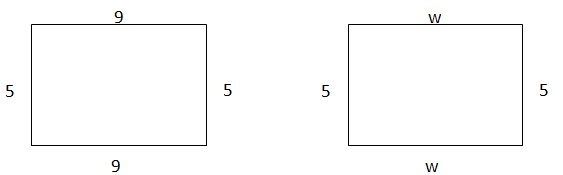
Students are familiar with calculating the area and perimeter of figures like the one on the left before they are introduced to variables. Later, they may see the same figure with the addition of a variable, as shown on the right. The addition of the variable will come with new instructions as well.

caitlin3

The difficulty of problems using variables is determined by the information given in the problems. For instance, the problem on the right can be a one step equation if an area and perimeter are given so that students only need to solve for w. The difficulty can be increased by giving only a perimeter so that students must solve for w and then for the area.

Engaging students: Computing the determinant of a matrix

In my capstone class for future secondary math teachers, I ask my students to come up with ideas for engaging their students with different topics in the secondary mathematics curriculum. In other words, the point of the assignment was not to devise a full-blown lesson plan on this topic. Instead, I asked my students to think about three different ways of getting their students interested in the topic in the first place.

I plan to share some of the best of these ideas on this blog (after asking my students’ permission, of course).

This student submission again comes from my former student Caitlin Kirk. Her topic: computing the determinant of a matrix.

green line

B. Curriculum: How does this topic extend what your students should have learned in previous courses?

 Students learn early in their mathematical careers how to calculate the area of simple polygons such as triangles and parallelograms. They learn by memorizing formulas and plugging given values into the formulas. Matrices, and more specifically the determinant of a matrix, can be used to do the same thing.

For example, consider a triangle with vertices (1,2), (3, -4), and (-2,3). The traditional method for finding the area of this circle would be to use the distance formula to find the length of each side and the height before plugging and chugging with the formula A = \frac{1}{2} bh. Matrices can be used to compute the same area in fewer steps using the fact that the area of a triangle the absolute value of one-half times the determinant of a matrix containing the vertices of the triangle as shown below.

First, put the vertices of the triangle into a matrix using the x-values as the first column and the corresponding y-values as the second column. Then fill the third column with 1’s as shown:

caitlin1

Next, compute the determinant of the matrix and multiply it by ½ (because the traditional area formula for a triangle calls for multiplying by ½ to account for the fact that a triangle is half of a rectangle, it is necessary to keep the ½ here also) as shown:

caitlin2Obviously, the area of a triangle cannot be negative. Therefore it is necessary to take the absolute value of the final answer. In this case |-8| = 8, making the area positive eight instead of negative eight.

The same idea can be applied to extend students knowledge of the area of other polygons such as a parallelogram, rectangle, or square. Determinants of matrices are a great extension of the basic mathematical concept of area that students will have learned in previous courses.

green line

D. History: What are the contributions of various cultures to this topic?

The history of matrices can be traced to four different cultures. First, Babylonians as early as 300 BC began attempting to solve simultaneous linear equations like the following:

There are two fields whose total area is eighteen hundred square yards. One produces grain at the rate of two-thirds of a bushel per square yard while the other produces grain at the rate of on-half a bushel per square yard. If the total yield is eleven hundred bushels, what is the size of each field?

While the Babylonians at this time did not actually set up matrices or calculate any determinants, they laid the framework for later cultures to do so by creating systems of linear equations.

The Chinese, between 200 BC and 100 BC, worked with similar systems and began to solve them using columns of numbers that resemble matrices. One such problem that they worked with is given below:

There are three types of corn, of which three bundles of the first, two of the second, and one of the third make 39 measures. Two of the first, three of the second and one of the third make 34 measures. And one of the first, two of the second and three of the third make 26 measures. How many measures of corn are contained of one bundle of each type?

Unlike the Babylonians, the Chinese answered this question using their version of matrices, called a counting board. The counting board functions the same way as modern matrices but is turned on its side. Modern matrices write a single equation in a row and the next equation in the next row and so forth. Chinese counting boards write the equations in columns. The counting board below corresponds to the question above:

1   2   3

2   3   2

3   1   1

26  34  39

They then used what we know as Gaussian elimination and back substitution to solve the system by performing operations on the columns until all but the bottom row contains only zeros and ones. Gaussian elimination with back substitution did not become a well known method until the early 19th century, however.

Next, in 1683, the Japanese and Europeans simultaneously saw the discovery and use of a determinant, though the Japanese published it first. Seki, in Japan, wrote Method of Solving the Dissimulated Problems which contains tables written in the same manner as the Chinese counting board. Without having a word to correspond to his calculations, Seki calculated the determinant and introduced a general method for calculating it based on examples. Using his methods, Seki was able to find the determinants of 2×2, 3×3, 4×4, and 5×5 matrices.

In the same year in Europe, Leibniz wrote that the system of equations below:

10+11x+12y=0

20+21x+22y=0

30+31x+32y=0

has a solution because

(10 \times 21 \times 32)+(11 \times 22 \times 30)+(12 \times 20 \times 31)=(10 \times 22 \times 31)+(11 \times 20 \times 32)+(12 \times 21 \times 30).

This is the exact condition under which the matrix representing the system has a determinant of zero. Leibniz was the first to apply the determinant to finding a solution to a linear system. Later, other European mathematicians such as Cramer, Bezout, Vandermond, and Maclaurin, refined the use of determinants and published rules for how and when to use them.

Source: http://www-history.mcs.st-and.ac.uk/HistTopics/Matrices_and_determinants.html

green line

B. Curriculum: How can this topic be used in you students’ future courses in mathematics or science?

Calculating the determinant is used in many lessons in future mathematics courses, mainly in algebra II and pre-calculus. The determinant is the basis for Cramer’s rule that allows a student to solve a system of linear equations. This leads to other methods of solving linear systems using matrices such as Gaussian elimination and back substitution.  It can also be used in determining the invertibility of matrices.  A matrix whose determinant is zero does not have an inverse. Invertibility of matrices determines what other properties of matrix theory a given matrix will follow. If students were to continue pursuing math after high school, understanding determinants is essential to linear algebra.

Engaging students: Distinguishing between inductive and deductive reasoning

In my capstone class for future secondary math teachers, I ask my students to come up with ideas for engaging their students with different topics in the secondary mathematics curriculum. In other words, the point of the assignment was not to devise a full-blown lesson plan on this topic. Instead, I asked my students to think about three different ways of getting their students interested in the topic in the first place.

I plan to share some of the best of these ideas on this blog (after asking my students’ permission, of course).

This student submission again comes from my former student Caitlin Kirk. Her topic, from Geometry (and proof writing): distinguishing between inductive and deductive reasoning.

green line

C. Culture: How has this topic appeared in pop culture (movies, TV, current music, video games, etc.)?

Inductive and deductive reasoning are often used on TV, radio, or in print in the form of advertising.

Deductive Reasoning

Man: What’s better, faster or slower?

All kids: Faster!

Man: And what’s fast?

Boy: My mom’s car and a cheetah.

Girl: A space ship.

Man: And what’s slow?

Boy: My grandma’s slow.

Man: Would you like her better if she was fast?

Boy: I bet she would like it if she was fast.

Man: Hmm, maybe give her some turbo boosters?

Boy: Or tape a cheetah to her back.

Man: Tape a cheetah to her back, it seems like you’ve thought about this before.

Narrator: It’s not complicated, faster is better. And iPhone 5 downloads fastest on AT&T 4G.

Deductive reasoning, which applies a general rule to specific examples, can be seen in advertisements like the AT&T commercial above. The kids establish in their conversation that faster things are better. The narrator says that iPhone 5 downloads fastest on AT&T 4G. Thus the viewer is left with the conclusion that AT&T 4G is better. This commercial’s deduction can be summed up as follows:

Faster things are better.

AT&T 4G is faster.

AT&T 4G is better. (conclusion)

Inductive Reasoning

Hotch: Sprees usually end in suicide. If he’s got nothing to live for, why wouldn’t he end it?

Reid: Because he’s not finished yet.

Reid: He’s obviously got displaced anger and took it out on his first victim.

Hotch: The stock boy represented someone. We need to know who. What about the other victims.

Reid: Defensive.

Hotch: Was he military?

Garcia: Negative.

Hotch: He’s lashing out. There’s got to be a reason. Rossi and Prentiss, dig through his house. Reid and JJ, get to the station. Morgan and I will take the crime scene. This guy’s got anger, endless targets and a gun. And from the looks of it, he just got started.

Inductive reasoning, which uses specific examples to make a general rule, can be seen frequently in episodes of TV shows or movies that involve crime scene investigation. The show Criminal Minds features a special unit of the FBI that profiles criminals. They do this by interviewing criminals who have already been caught and then inducing general rules about all criminals in order to catch the one they are looking for. Conversations among the profilers, like the one above, lead to inductive reasoning that can be summed up as follows:

He has nothing to live for.

He doesn’t want to commit suicide.

He wasn’t in the military.

He has displaced anger.

He has endless targets.

He has a gun.

He is a dangerous man who will hurt more people. (conclusion)

green line

C. Culture: How has this topic appeared in high culture (art, classical music, theatre, etc.)?

 When in the Course of human events, it becomes necessary for one people to dissolve the political bands which have connected them with another, and to assume among the powers of the earth, the separate and equal station to which the Laws of Nature and of Nature’s God entitle them, a decent respect to the opinions of mankind requires that they should declare the causes which impel them to the separation.

 We hold these truths to be self-evident, that all men are created equal, that they are endowed by their Creator with certain unalienable rights, that among these are Life, Liberty, and the pursuit of Happiness. That to secure these rights, Governments are instituted among Men, deriving their just powers from the consent of the governed. That whenever any Form of Government becomes destructive of these ends, it is the Right of the People to alter or to abolish it, and to institute new Government, laying its foundation on such principles and organizing its powers in such form, as to them shall seem most likely to effect their Safety and Happiness.

-The Declaration of Independence

July, 4, 1776

The Declaration of Independence was drafted as a deductive argument as to why the United States can and should be a country independent of Great Britain. Thomas Jefferson drafted the declaration with a series of premises leading to four different conclusions.

  1. George III is a tyrant
  2. The colonies have a right to be free and independent states
  3. All political connections between Britain and the colonies should be dissolved
  4. The “united states” have the right to do all things that free nations do

These four conclusions then serve as premises for the final conclusion that the United States is now an independent country. The declaration is a great example of deductive reasoning because it takes specific examples, such as the 27 grievances against the monarch, and makes logical conclusions, such as “George III is a tyrant,” from the examples. Its deduction can be plainly seen.

The Declaration of Independence is a great example of high culture to use in the classroom because every student who is educated in the United States will have some knowledge of this document. Therefore learning to analyze it “mathematically” in terms of deductive versus inductive reasoning, is a great engagement tool.

green line

E. Technology: How can technology be used to effectively engage students with this topic?

Crime Scene Games & Deductive Reasoning: https://sites.google.com/a/wcsga.net/mock-trial/crime-scene-games-deductive-reasoning

This website contains links to several crime scene investigation games. Several of the games require students to collect clues, compare evidence, and then determine who is responsible for committing a given crime. These games are great for having students use their deductive skills. A couple of the other games require students to review given qualities of a criminal and inductively decide who the criminal in a scenario is based on these broad statements.

This website could be used to engage students easily. Having students play a game, especially one like these where they cannot pick out the mathematical skill they are using, is a great way to get students to abandon their potential distaste for a topic and be involved. After the students have completed a game and solved their crime, the teacher can smoothly transition into a geometrical lesson on inductive and deductive reasoning. The teacher will have activated the students’ knowledge of reasoning through a fun game. They will then be in a better position to learn a new, mathematical application of the reasoning they just used.

Engaging students: Finding the area of a square or rectangle

In my capstone class for future secondary math teachers, I ask my students to come up with ideas for engaging their students with different topics in the secondary mathematics curriculum. In other words, the point of the assignment was not to devise a full-blown lesson plan on this topic. Instead, I asked my students to think about three different ways of getting their students interested in the topic in the first place.

I plan to share some of the best of these ideas on this blog (after asking my students’ permission, of course).

This student submission comes from my former student Alyssa Dalling. Her topic, from Geometry: finding the area of a square or rectangle.

green line

D. How have different cultures throughout time used this topic in their society?

Giza

  • For three thousand years, the Great Pyramid of Giza was the world’s tallest man-made structure. It is also the oldest structure of the Seven Wonders of the Ancient World. It was built by cutting huge stones into rectangles then placing each stone into place to create the base. It is believed by many that the pharaoh Khufu had his vizier Hemon create the design for the great Pyramids. What is amazing about the design of the Pyramid of Giza is that each of the four sides of the base has an average error of only 58 millimeters in length. Meaning the base is almost a perfect square!
  • It would be fun to start the engage with introducing the Pyramid of Giza and explaining the facts above. Then students would be given the dimensions of other pyramids where they would have to find the area of the base to see whether they created a square or rectangular pyramid. This would get them excited about this topic because students would be exploring math that has actually been used in real life.

Castillo

  • The Mesoamericans also built pyramids with square and rectangular bases. The picture above is in a city known as Chechen Itza which is located in the Mexican state of Yucatan. It is called El Castillo, and also known as the Temple of Kukulkan. Unlike the Egyptian pyramids though, the Mayan pyramids were usually meant as steps to get to a temple on top. The pyramids consisted of several square bases stacked onto each other with steps up each side. El Castillo consists of nine square terraces each about 8.4 feet tall. The main base of the pyramid is approximately 55.3 meters (181 feet).
  • What would be fun to do is have students find the area of each level and compare it to all the levels on the pyramid. I feel students would have fun seeing just how big this type of structure is and understanding the planning it took to create the different levels in this pyramid.

Sources: http://en.wikipedia.org/wiki/Great_Pyramid_of_Giza and http://en.wikipedia.org/wiki/Pyramids#Nigeria

green line

B. How can this topic be used in your students’ future courses in mathematics or science?

  • Finding the area of squares and rectangles will be used a lot in Algebra and Algebra II. One example in Algebra is when students start solving for unknown variables. A student would be asked to find the area of a square when they have two unknown sides.
  • The following is an example engage problem students would use the finding the area of a square or rectangle to solve.

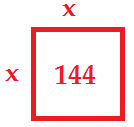
Principal Smith has decided the school needs a new practice basketball court. The current practice court is a square with an area of 144 square feet. She wants the new court to be a rectangle twice as long as it is wide. Find the length of all the sides of both the old court and the new court and find the area of the new court.

rect1rect2

x^2 = 144

So x = 12

Then x(2x) = 2x^2 = 2(12)^2 = 288

The square court has sides of 12.

The rectangular court has sides of 12×24 and an area of 288 square feet.