Engaging students: Finding the area of a square or rectangle

In my capstone class for future secondary math teachers, I ask my students to come up with ideas for engaging their students with different topics in the secondary mathematics curriculum. In other words, the point of the assignment was not to devise a full-blown lesson plan on this topic. Instead, I asked my students to think about three different ways of getting their students interested in the topic in the first place.

I plan to share some of the best of these ideas on this blog (after asking my students’ permission, of course).

This student submission comes from my former student Kayla (Koenig) Lambert. Her topic, from Geometry: finding the area of a square or rectangle.

green line

B) Curriculum: How can this topic be used in student’s future courses in math or science?

 Finding the area of a square or rectangle can be applied in many other subjects throughout a student’s school career. This topic is learned around 4th or 5th grade, and around this time students will just be using the formulas to find the areas. In middle school, they might be finding the areas by way of more difficult problems, like word problems. The real fun for this subject, in my opinion, doesn’t start until high school. In high school you can use the area of squares and rectangles to find the solutions to many problems. In high school geometry, the Pythagorean Theorem is taught. The area of squares is related to this depending on how the teacher presents this to the student. The Pythagorean Theorem states that “in any right triangle, the area of the square whose side is the hypotenuse is equal to the sum of the areas of the squares whose sides are the two legs of the right triangle” (Square-geometry).

In college, possibly high school calculus, students will learn to approximate the total area under a curve (or integral) using the Riemann Sum. To approximate the integral, you find the area of each rectangle, and all of the rectangles areas added together give you the approximated integral. The area of rectangles is also used in Statistics. When creating a histogram, you multiply the height (density) and width of the bars (rectangles).  Then adding the areas (relative frequencies) of all of the bars should be equal to one. Students will also need to use the area of squares and rectangles on college placement exams and standardized testing.


green line

C) Culture: How has this topic appeared in high culture (art, classical music, theatre, etc.)?

 In my opinion, anything and everything is a form of art, so the area of squares and rectangles can appear in an infinite amount of high culture. M.C. Escher has used squares and rectangles to create tessellations and “portrayed mathematical relationships among shapes, figures and space” (MC Escher). The area of a rectangle was used to Polykeitos the Elder who was a Greek sculptor. He used the area of a rectangle to create the perfect ratio for the human body. Painters also needed to figure out how to depict 3D scenes onto 2D canvas during the Renaissance (Mathematics and Art).

However, one of the more well-known applications of mathematics in art is the Golden Rectangle, which just so happens to involve the area of squares and rectangles. The Golden Rectangle is the area of the original rectangle to the area of the square, which is also the Golden Ratio. In other words, the Golden Rectangle is a rectangle wherein the ratio of its length to its width is the Golden Ratio (Golden Rectangle). Many ancient art and architecture have incorporated the Golden Rectangle into designs. The Golden Rectangle was used in the floor plans and design of the exterior of The Parthenon, which was a Greek temple dedicated to goddess Athena in 5th century BC (Mathematics and Art). Leonardo DaVinci also used the Golden Rectangle in his work. When painting the Mona Lisa, he used this to “draw attention to the face of the woman in the portrait” (Mathematics and Art). DaVinci also used the Golden Rectangle in the Last Supper using it to create a “perfect harmonic balance between placement of characters in the background” and also used it to arrange the characters around the table (Mathematics and Art).


green line

D) History: Who were some of the people who contributed to the development of this topic?

 Finding the area of squares and rectangles didn’t just come out of the blue; we can thank geometry and ancient mathematics for the development of this topic. One person in particular who contributed to the development of this topic was Euclid, or Euclid of Alexandria, who was a Greek mathematician and known as the “Father of Geometry” (Euclid). He was said to revolutionize geometry and his book The Elements is considered the most influential textbook of all time (History of Mathematics). The collection of his books, all thirteen of them, contain all traditional school geometry (Solomon).

However, Euler wasn’t the only one to contribute to this topic. Pythagoras and his students discovered most of what high school students learn in geometry today (History of Mathematics). In the classical period, Aryabhata wrote a treatise including the computation of areas. From the kingdom of Cao Wei, Liu Hui edited and commented on The Nine Chapters of Mathematics Art in 179 AD (History of Mathematics). There are so many people who contributed to this topic, and people are still contributing and developing to the area of squares and rectangles today!


Works Cited

“Euclid – Wikipedia, the free encyclopedia.” Wikipedia, the free encyclopedia.  20 Feb. 2012. http://en.wikipedia.org/wiki/Euclid.

“Golden Rectangle.” Logicville : Puzzles and Brainteasers.  20 Feb. 2012. http://www.logicville.com/sel26.htm.

“M. C. Escher – Wikipedia, the free encyclopedia.” Wikipedia, the free encyclopedia. 20 Feb. 2012. http://en.wikipedia.org/wiki/M._C._Escher.

“Mathematics and art – Wikipedia, the free encyclopedia.” Wikipedia, the free encyclopedia.  20 Feb. 2012. http://www.en.wikipedia.org/wiki/Mathematics_and_art.

Solomon, Robert. The Little Book Of Mathematical Principals, Theories and Things. New York: Metro Books, 2008.

“Square (geometry) – Wikipedia, the free encyclopedia.” Wikipedia, the free encyclopedia. 20 Feb. 2012. http://en.wikipedia.org/wiki/Square_(geometry).

“History of mathematics – Wikipedia, the free encyclopedia.” Wikipedia, the free encyclopedia. 20 Feb. 2012. http://en.wikipedia.org/wiki/History_of_mathematics.


Engaging students: Solving proportions

In my capstone class for future secondary math teachers, I ask my students to come up with ideas for engaging their students with different topics in the secondary mathematics curriculum. In other words, the point of the assignment was not to devise a full-blown lesson plan on this topic. Instead, I asked my students to think about three different ways of getting their students interested in the topic in the first place.

I plan to share some of the best of these ideas on this blog (after asking my students’ permission, of course).

This student submission comes from my former student Kayla (Koenig) Lambert. Her topic, from Pre-Algebra: solving proportions.

green line

C. Culture: How has this topic appeared in the news?

Solving proportions, or the idea of a proportion being solved, appears in the news more often than not. One specific example that can be used is the effect of the economy on real estate companies. Say we are given 25% of 16 real estate companies that have closed their businesses due to poor economy. We can use proportions to determine the number of real estate companies that closed. We know that the percent is 25 and that the whole is 16. Therefore 25/100 = x/16 which gives us 4 real estate companies that closed (Review of Proportions). Proportions can also be used to determine how many miles we can drive on a certain amount of gas, and gas prices are constantly on the news. Also, this will be relevant to high school students who drive and need to find how much money they need to buy gas for the week, etc.

We can also use proportions to find the unit price of an item at a grocery store, or if an item costs a certain amount, you can find out how many of those items you can buy with a fixed amount of money you have. Buying items and saving money are also all over the news. If you find the unit price you can compare items therefore saving money by buying the item that you get the most out of your money.  Another way solving proportions can appear on the news is by the stock market. You can use proportions to find out how much the stock market will rise in a given amount of days given the current amount of points it has raised in a certain amount of days. Making a proportion problem for students to solve is relatively easy and can be related to anything that is on the news. We can use this to our advantage to get the students to be a little more interested in proportions (and mathematics) so they can see different ways it is related to real life.


green line

D. History: How was this topic adopted by the mathematical community?

The idea of proportions was adopted and used by many in the mathematical community. Proportions were used by Greek writers, including one named Nicomachus, who include proportions and ratios in arithmetic (Math Forum). Proportions were also adopted by Exodus who used them in geometry and by Theon of Smyrna who used proportions in music (Math Forum). In 2000 B.C., the Babylonians adopted proportions to represent place value notation (Pythagoras – Geometrical Algebra). Using proportions was accepted by mathematicians and was used to solve so many different equations used for so many different ideas, and is still used today. Early proportions were adopted by the Egyptians and were used to calculate fractions and measurement of farmland (Mathematics History). Later, proportions were adopted by so many more in the mathematical community like in Greece, China, India, and Babylonia in order to learn geometry. Greeks, like Plato, adopted proportions in order to study them with the Egyptians. I think that proportions were well liked by mathematicians and were adopted by many because you can use proportions to solve so many things.


green line

D. History: How did people’s conception of proportions change over time?

From the beginning, people have used proportions. Early humans used proportions to see if one tribe was twice as large as another or if one leather strap is only half as long as another (Math Forum). It is obvious that the idea solving proportions hasn’t really changed that much, but what we can use proportions to solve has changed. In 2000 B.C. Babylonians used proportions to evolve place value notation by allowing arbitrarily large numbers and fractions to be represented (An Overview of Egyptian Mathematics). Around 1600 B.C. in Egypt, proportions were used to calculate the fraction and superficial measure of farmland (Mathematics History). Egyptians then used proportions to find volumes of cylinders and areas of triangles.

Vitruvius thought of proportions in terms of unit fractions for their architecture calculations (Proportion (architecture)). Also, scribes used “unit fractions” for their calculations in Egypt and Mesopotamia. Egyptians based proportions on parts of their body and their symmetrical relation to each other; like fingers, palms, hands, etc. Multiples of body proportions would be found in the arrangement of fields and buildings people lived in (Proportion (architecture)) and from here, proportions evolved. In 600 B.C., the idea of using proportions evolved and was then used for geometry (Mathematics History). Proportions are still used in geometry, like in architecture and land, like it was 3000 years ago. When you think about it, proportions have evolved, but the use of proportions has evolved even greater. There are so many topics we can now solve using proportions!

Works Cited

“Math Forum – Ask Dr. Math.” The Math Forum @ Drexel University. 7 Mar. 2012. <http://www.mathforum.org/library/drmath/view/64539.html&gt;.

“Mathematics History.” ThinkQuest : Library. 7 Mar. 2012. <http://library.thinkquest.org/22584/&gt;.

“Proportion (architecture).” Wikipedia, the free encyclopedia. 7 Mar. 2012. <http://en.wikipedia.org/wiki/Proportion_%28architecture%29&gt;.

“Review of Proportions.” Self Instructional Mathematics Tutorials. 7 Mar. 2012. <http://www.cstl.syr.edu/fipse/decunit/ratios/revprop.htm&gt;.

“An Overview of Egyptian Mathematics.”  7 Mar. 2012. < http://www-groups.dcs.st-and.ac.uk/~history/HistTopics/Egyptian_mathematics.html >


Engaging students: Adding and subtracting decimals

In my capstone class for future secondary math teachers, I ask my students to come up with ideas for engaging their students with different topics in the secondary mathematics curriculum. In other words, the point of the assignment was not to devise a full-blown lesson plan on this topic. Instead, I asked my students to think about three different ways of getting their students interested in the topic in the first place.

I plan to share some of the best of these ideas on this blog (after asking my students’ permission, of course).

This student submission comes from my former student Elizabeth (Markham) Atkins. Her topic, from Pre-Algebra: adding and subtracting decimals.

green line

Applications

Adding and subtracting decimals is a fun subject to learn about. Decimals are everywhere in the world! Sports use decimals when timing people. Let’s try this problem: “Billy Joe ran a lap in 61.7 seconds the first time and 59.3 seconds the second time. How long did both laps take Billy Joe?” We use decimals to measure rainfall. “On Monday it rained a total of 1.27 inches, measured in a rain gauge. By Tuesday .23 inches had evaporated. Tuesday night’s big storm gave us another 3.58 inches. How much rain was in the rain gauge after Tuesday’s big storm?” We also use decimals with money! “Let’s say you found a lost cat. You return it to its owner for a reward of $50.00.Then you receive your allowance of $50.00. You then get your pay check from work which states you earned $108.75 for a week after taxes were taken out. It’s been a good week! You decide to spend a little money. You put $10.03 of gas in your car. You then by three items: Shoes ($51.99), jeans ($71.27) and gun ($0.97). How much do you have left?”


green line

Technology

 Technology is an awesome tool that we have to use to engage your students. On YouTube there is a song called the decimal song about how to add, subtract, multiply, and divide decimals. There is also a website where you can buy mathematical songs like his YouTube hit the Rappin’ Mathematician Decimals. He has a catchy way to grab student’s attention and they still learn. Technology can be used to enhance a lesson, an anchor video for example. Many website provide games. Mathgamesfun.net is a good example. Calculators are not a good enhancement tool because students can simply have the calculator do all the work for them. Calculators are a good technology to use to check a student’s work! Math.harvard.edu provides examples of math in movies. This way a student can see how math is used in the world. Learnalberta.ca/content/mesg.html/math6web/index.html?page=lessons&lesson=m6lessonshell01.swf is a website devoted to fractions. Another good technology for the teacher’s advantage is kaganonline.com. It is a website of different tools to use when teaching mathematics!


green line

Curriculum

Decimals, along with fractions, numbers, and other basics, are a key foundational mathematical stepping stone to schooling and in life. Students will use math every day of their lives. In their science classes students will use decimals in measurement, weights, and time. Also when the student learns about scientific notation, they will use decimals. Students will use decimals to answer half-life questions. Decimals are used in economy. All of economy deals with money. Money deals with decimals. When learning about the stock market they use decimals. When looking at the mileage on their car, they use decimals. Students will have to learn decimals to help with percentages, sales, interest, sales tax, loans, and any sort of measurements in everyday life. Percentages are just decimals with a fancy symbol. If the students want to save money they need to know how to add and subtract decimals. Decimals are all around us we just have to teach the students how to see and use them!

Engaging students: Solving quadratic equations

In my capstone class for future secondary math teachers, I ask my students to come up with ideas for engaging their students with different topics in the secondary mathematics curriculum. In other words, the point of the assignment was not to devise a full-blown lesson plan on this topic. Instead, I asked my students to think about three different ways of getting their students interested in the topic in the first place.

I plan to share some of the best of these ideas on this blog (after asking my students’ permission, of course).

This student submission comes from my former student Elizabeth (Markham) Atkins. Her topic, from Algebra II: solving quadratic equations.

green line

D. History: Who were some of the people who contributed to the discovery of this topic?

Factoring quadratic polynomials is a useful trick in mathematics. Mathematics started long ago. http://www.ucs.louisiana.edu/~sxw8045/history.htm stated that the Babylonians “had a general procedure equivalent to solving quadratic equations”. They taught only through examples and did not explain the process or steps to the students. http://www.mytutoronline.com/history-of-quadratic-equation states that the Babylonians solved the quadratic equations on clay tablets. Baudhayana, an Indian mathematician, began by using the equation ax^2+bx=c. He provided ways to solve the equations. Both the Babylonians and Chinese were the first to use completing the square method which states you take the equation ax^2+bx+c. You take b and divide it by two. After you divide by two you square that number and add it to ax^2+bx and subtract it from c.  Even doing it this way the Babylonians and Chinese only found positive roots. Brahmadupta, another Indian mathematician, was the first to find negative solutions. Finally after all these mathematicians found ways of solving quadratic equations Shridhara, an Indian mathematician, wrote a general rule for solving a quadratic equation.

green line

C. Culture: How has this topic appeared in the news?

USA today (http://www.usatoday.com/news/education/2007-03-04-teacher-parabola-side_N.htm) had a news article that talks about students who used quadratic equations to cook marshmallows. A teacher had students in teams choose a quadratic equation. The teams then used the quadratic equation choosen to build a device to “harness solar heat and cook marshmallows”. http://www.kveo.com/news/quadratic-equations-no-problem talks about a 6 year old who learned to solve quadratic equations. Borland Educational News (http://benewsviews.blogspot.com/2007/03/memorize-quadratic-formula-in-seconds_3620.html) talks about someone who came up with a song for the quadratic formula, which is a way to solve a quadratic equation. They sing the following words to the tune of Pop Goes the Weasel: “X is equal to negative B plus or minus the square root of B squared minus 4AC All over 2A.” It may be an elementary way to solve the equation, but it sure does work. Mathematics is all around us. It is in our everyday lives. We use it without even knowing it sometimes!

green line

A. Applications: How could you as a teacher create an activity or project that involves your topic?

Lesson Corner (http://www.lessoncorner.com/Math/Algebra/Quadratic_Equations) is an excellent resource for finding lesson plans and activities for quadratic equations. One lesson (http://distance-ed.math.tamu.edu/peic/lesson_plans/factoring_quadratics.pdf) talking about engaging the students with a game called “Guess the Numbers”. The students are given two columns, a sum column and a product column. They are then to guess the two numbers that will add to get the sum and multiply to get the product. This is an excellent game because it gets the students going and it is like a puzzle to solve. Learn (http://www.learnnc.org/lp/pages/2981) has a lesson plan for a review of quadratic equations.  The students are engaged by playing “Chutes and Ladders”. The teacher transformed it. The procedures are as follows:

  1. Draw a card.
  2. Roll the dice.
  3. If you roll a 1 or a 6, then solve your quadratic equation by completing the square.
  4. If you roll a 2 or 5, then solve your quadratic equation by using the quadratic formula.
  5. If you roll a 3, then solve your quadratic equation by graphing.
  6. If you roll a 4, then solve your quadratic equation by factoring if possible. If not, then solve it another way.
  7. If you solve your equation correctly, then you may move on the board the number of spaces that corresponds to your roll of the die.
  8. If you answer the question incorrectly, then the person to your left has the opportunity to answer your question and move your roll of the die.
  9. The first person to reach the end of the board first wins the game!
  10. Good luck!!

I think this is an excellent idea because it brings back a little of the students’ childhood!

Engaging students: Truth tables

In my capstone class for future secondary math teachers, I ask my students to come up with ideas for engaging their students with different topics in the secondary mathematics curriculum. In other words, the point of the assignment was not to devise a full-blown lesson plan on this topic. Instead, I asked my students to think about three different ways of getting their students interested in the topic in the first place.

I plan to share some of the best of these ideas on this blog (after asking my students’ permission, of course).

This student submission comes from my former student Elizabeth (Markham) Atkins. Her topic, from Geometry: truth tables.

green line

D. History: Who were some of the people who contributed to the development of this topic?

In “Peirce’s Truth-Functional Analysis and the Origin of Truth Tables” it is said that Charles Peirce was the first to start studying truth tables or rather developing the idea. He created the truth table in 1893. Peirce stated “the purpose of reasoning is to establish the truth or falsity of our beliefs, and the relationship between truth and falsity”. Nineteen years later, two mathematicians developed the truth table as we know it today. Ludwig Wittgenstein and Bertrand Russell both knew of truth tables but formalized them into the form we know today. In “The Genesis of the Truth-Table Device” it is said that George Berry stated “Peirce developed the technique, but not the device”. Wittgenstein developed the terminology that we today associate with truth tables. All in all it is the work of many people that finally developed the truth tables that we know today.


green line

APPLICATIONS: What interesting word problems using this topic can your students do now?

Truth tables state that if P is true and Q is true then both P and Q are true. If either P or Q or both are false then P and Q are false. So I could have the students construct many truth tables to demonstrate their knowledge of the subject or I could come up with some interesting word problems. Word problems such as “True or false: If Billy Joe graduated and Shawn graduated then both Billy Joe and Shawn graduated.” There are not many word problems you could create that would deal with truth tables. You can have the students begin to think logically. You could give them a statement to complete such as, “Good apples are red. Granny Smith apples are green. Thus ____” This enables the teacher to get the students in the logical process of thinking in order for them to correctly understand truth tables.

green line

B. CURRICULUM: How can this topic be used in your students’ future courses in mathematics or science?

By teaching my students truth tables and how to use them correctly it prepares them for future classes and for everyday life. In high schools now the students are learning twenty first century skills. To learn truth tables it will help with the twenty first century skills. When you learn truth tables you learn to think logically. The students need to learn logical thinking for science and economics. In Science, they need to learn logical thinking for when they do experiments. It will allow them to process, “well if I do this then this might happen.” In economics students need logical thinking so that when they learn to invest money they can weigh their options. In everyday life students make decisions that they need to think about. Teenagers in the modern day are moving so fast that they often do and say things without thinking. If they learn to think logically then they might be able to think, “If I say or do this then this might happen.”

Irving H. Anelli’s


Engaging students: Solving exponential equations

In my capstone class for future secondary math teachers, I ask my students to come up with ideas for engaging their students with different topics in the secondary mathematics curriculum. In other words, the point of the assignment was not to devise a full-blown lesson plan on this topic. Instead, I asked my students to think about three different ways of getting their students interested in the topic in the first place.

I plan to share some of the best of these ideas on this blog (after asking my students’ permission, of course).

This student submission comes from my former student Elizabeth (Markham) Atkins. Her topic, from Precalculus: solving exponential equations.

green line

A.   APPLICATIONS: What interesting (i.e., uncontrived) word problems using this topic can your students do now?

Exponential equations can be different topics. You can use exponential equations for bacterial growth or decay, population growth or decay, or even a child eating their Halloween candy. Another example would be minimum wage.  A good word problem would be at one point minimum wage was $1.50 an hour. Use A=1.6 e^{rt} to figure out when minimum wage will reach $10.25 an hour. Another good word problem would be Billy Joe gets a dollar on his first day of work. Every day he works his salary for that day doubles. How much money does he have at the end of 30 days? A good money example would also be banking. “Use the equation A=Pe^{rt}. Shawn put $100 in a savings account, which has a rate of 5% per year. How long will it take for his savings to grow to $1000? There are many ways to show exponential growth and decay.

green line

B. CURRICULUM: How can this topic be used in your students’ future courses in mathematics or science?

Exponential equations can be used in science and life for many years from now.  Students will see exponential equations when they begin to study bacteria. They will have to find the decay of growth. Students will also have to see population growth and decay throughout history. They may be asked to find out what the population will be in twenty years. When students take economics, or do their own banking, they will need to calculate interest and principal. Students will also need to do the stock market which uses exponential equations. If students go into field where they are concerned with the population of species that may be becoming extinct then the student would predict when the species would become distinct by using an exponential formula. They could also calculate how long until a certain species may take over the world, such as tree frogs or rabbits. Exponential equations are everywhere in the world and in other subjects, besides mathematics.

green line

E. TECHNOLOGY: How can technology (YouTube, Khan Academy [khanacademy.org], Geometers Sketchpad, graphing calculators, etc.) be used to effectively engage students with this topic?

Exponential equations are used with technology everyday and every which way. Khan Academy has a few examples of exponential growth and exponential decay. Youtube has many great examples of exponential equations. Crewcalc’s exponential rap is an excellent example. They are very creative high school who found a way to express a mathematical concept through music.

Zombie Growth shows another interesting way to portray the mathematical concept of exponential equations. They use the phenomenon of zombies to demonstrate how exponential equations work.

Math project on Youtube showed another way to demonstrate how exponential equations work. They posed a problem and then stated the steps to solve the problem. Students need to use graphing calculators to check whether or not they have the right graph based on information given. They also need calculators to calculate equations and check their equations.

Engaging students: Finding points in the coordinate plane

In my capstone class for future secondary math teachers, I ask my students to come up with ideas for engaging their students with different topics in the secondary mathematics curriculum. In other words, the point of the assignment was not to devise a full-blown lesson plan on this topic. Instead, I asked my students to think about three different ways of getting their students interested in the topic in the first place.

I plan to share some of the best of these ideas on this blog (after asking my students’ permission, of course).

This student submission comes from my former student Derek Skipworth. His topic, from Pre-Algebra: finding points in the coordinate plane.

green line

A. Applications – How could you as a teacher create an activity or project that involves your topic?

When I think of the coordinate plane, one of the first things that come to mind is mapping.  When I think of my teenage years, I think of how I always wanted more money.  By using these two ideas together, an activity could easily be created to get the students involved in the lesson: a treasure map!

The first part of the activity would be providing the students with a larger grid.  Then provide them with a list of landmarks/items at different locations (i.e. skull cave at (3,2)) that would then be mapped onto the grid.  By starting out with one landmark, you could also build off previously identified landmarks, such as “move 3 units East and 4 units North to find the shipwreck.  The shipwreck is located at what coordinates?”   These steps could also be based off generic formulas with solutions for x and y.  After all landmarks were identified, there would be a guide below that would trace out a path to find the treasure, which is only discovered after the full path is completed.

treasuremapCourtesy of paleochick.blogspot.com

green line

B. Curriculum: How can this topic be used in your students’ future courses in mathematics or science?

One of the good things about the exercise above is that it integrates several different ideas into one. A big one that stands out to me is following procedures.  This is vital once you get into high school sciences.  By building the map step-by-step, which each one building off the previous step, you cannot find the treasure without replicating the map exactly if you miss/misinterpret a step along the way.

As far as the coordinate plane, finding locations on the plane is important when graphing functions.  Being able to find the intercepts and any asymptotes gives you starting points to work with.  From there you generally only need a few more points to create a line of the function based off plotted points.  This also has applications in science/math when creating bar graphs/line graphs and similar graphs.

green line

D.  How was this topic adopted by the mathematical community?

As discussed in my Geometry class this semester (Krueger), the Cartesian plane opened up a lot of doors in the world of Geometry.  Euclid had already established a great working knowledge of a vast amount of Geometric ideas and figures.  One thing he did not establish was length.  In his teachings, there were relative terms such as “smaller than” or “larger than”.  No values were ever assigned to his figures though.  By introducing the Cartesian plane (and in effect, being able to plot points on said plane), we were able to actually assign values to these figures and advance our mathematical knowledge.  The Cartesian plane acts as a bridge between Algebra and Geometry that did not exist before.  Because of this, we can know solve problems based in Geometry without ever even needing to draw the figure in the first place (example: Pythagorean Theorem).

Engaging students: Solving linear systems of equations with matrices

In my capstone class for future secondary math teachers, I ask my students to come up with ideas for engaging their students with different topics in the secondary mathematics curriculum. In other words, the point of the assignment was not to devise a full-blown lesson plan on this topic. Instead, I asked my students to think about three different ways of getting their students interested in the topic in the first place.

I plan to share some of the best of these ideas on this blog (after asking my students’ permission, of course).

This student submission comes from my former student Alyssa Dalling. Her topic, from Algebra II: finding the area of a square or rectangle.

green line

A. What interesting (i.e., uncontrived) word problems using this topic can your students do now?

A fun way to engage students on the topic of solving systems of equations using matrices is by using real world problems they can actually understand. Below are some such problems that students can relate to and understand a purpose in finding the result.

  • The owner of Campbell Florist is assembling flower arrangements for Valentine’s Day. This morning, she assembled one large flower arrangement and found it took her 8 minutes. After lunch, she arranged 2 small arrangements and 15 large arrangements which took 130 minutes. She wants to know how long it takes her to complete each type of arrangement.

(Idea and solution on http://www.ixl.com/math/algebra-1/solve-a-system-of-equations-using-augmented-matrices-word-problems )

  • The Lakers scored a total of 80 points in a basketball game against the Bulls. The Lakers made a total of 37 two-point  and three-point baskets. How many two-point shots did the Lakers make? How many three-point shots did the Lakers make?

(Idea and solution on http://www.algebra-class.com/system-of-equations-word-problems.html )

green line

A. How could you as a teacher create an activity or project that involves your topic?

  • For this topic, creating a fun activity would be one of the best ways to help students learn and explore solving systems of equations using matrices. One way in which this could be done is by creating a fun engaging activity that allows the students to use matrices while completing a fun task. The type of activity I would create would be a sort of “treasure hunt.” Students would have a question they are trying to find the solution for using matrices. They would solve the system of equations and use that solution to count to the letter in the alphabet that corresponds to the number they found. In the end, the solution would create different blocks of letters that the student would have to unscramble.

For Example: The top of the page would start a joke such as “What did the Zero say to the Eight?…

Solve x+y=26 and 4x+12y=90 using matrices.

To solve this, the student would put this information into a matrix and find the solution came out to be x=12 and y=14. They would count in the alphabet and see that the 12th letter was L and the 14th letter was N. Then at the bottom of their page, they would find where it said to write the letters for x and y such as below-
N  __  __  __     __  __    L  __! (Nice Belt!)

x     a    c    z       d    z     y    w

green line

E. How can technology be used to effectively engage students with this topic?

This activity would be used after students have learned the basics of putting a matrix into their calculator to solve. The class would be separated into small groups (>5 or more if possible with 2-3 kids per group) The rules are as follows: a group can work together to set up the equation, but each individual in the group had to come up to the board and write out their groups matrices and solution. The teacher would hand out a paper of 8-12 problems and tell the students they can begin. The first group to finish all the problems correctly on the board wins. There would be problems ranging from 2 variables to 4.

Ex: One of the problems could be  and . The groups would have to first solve this on their paper using their calculator then the first person would come up to the board to write how they solved it-

Written on the board:

Alyssa_system

The technology of calculators allows this to be a fun and fast paced game. It will allow students to understand how to use their calculator better while allowing them to have fun while learning.

Engaging students: Dividing fractions

In my capstone class for future secondary math teachers, I ask my students to come up with ideas for engaging their students with different topics in the secondary mathematics curriculum. In other words, the point of the assignment was not to devise a full-blown lesson plan on this topic. Instead, I asked my students to think about three different ways of getting their students interested in the topic in the first place.

I plan to share some of the best of these ideas on this blog (after asking my students’ permission, of course).

This student submission comes from my former student Dale Montgomery. His topic, from Pre-Algebra: dividing fractions.

green line

Applications

A Short Play On Numbers

By: Dale Montgomery

You see two brothers talking in the playground.

Timmy: (little brother) Gee Jonny, it sure was a good idea to sell Joe our old Pokémon deck. Now he finally has some cards to play with and we have some money to buy some new cards.

Jonny: (older brother) Yeah, I am glad we could help him get started. He has been wanting some cards for so long. Ok, you have the money so give me half.

Timmy: Ummm… (puzzling) Jonny I don’t know how to make half of 6 dollars and fifty cents, can you help?

Jonny: Of course Timmy, I learned how to divide fractions last week… lets see. (Jonny writes on the board 6 and ½ divided by 1/2 and does the division)

Timmy: How is half more than what we started with?

Jonny: I don’t know, this is the way my teacher taught me to do it. I guess you just have to find 13 dollars to give me so I can have half.

End Scene

Teacher: So class, what did Jonny do?

I came up with this idea thinking about the student asked question regarding dividing pie in half. I feel this could be a common misconception that would be addressed if we could teach students to think about math in context, rather than just a process. Dividing fractions is not the easiest thing to conceive. This short skit could be presented in any number of formats. I like the idea of having some sort of recorded show, just because it would make the intro to class go much faster. This skit introduces a situation that is very similar to word problems that children do. Also, the content can easily be modified to fit the majority class interest. For example it could have been an old Nintendo DS game that the brothers no longer play. This puts a problem that could be very real for the students right in front of them to figure out the correct process. It could lead to good discussion and make for a good lesson on dividing fractions.


green line

Manipulative

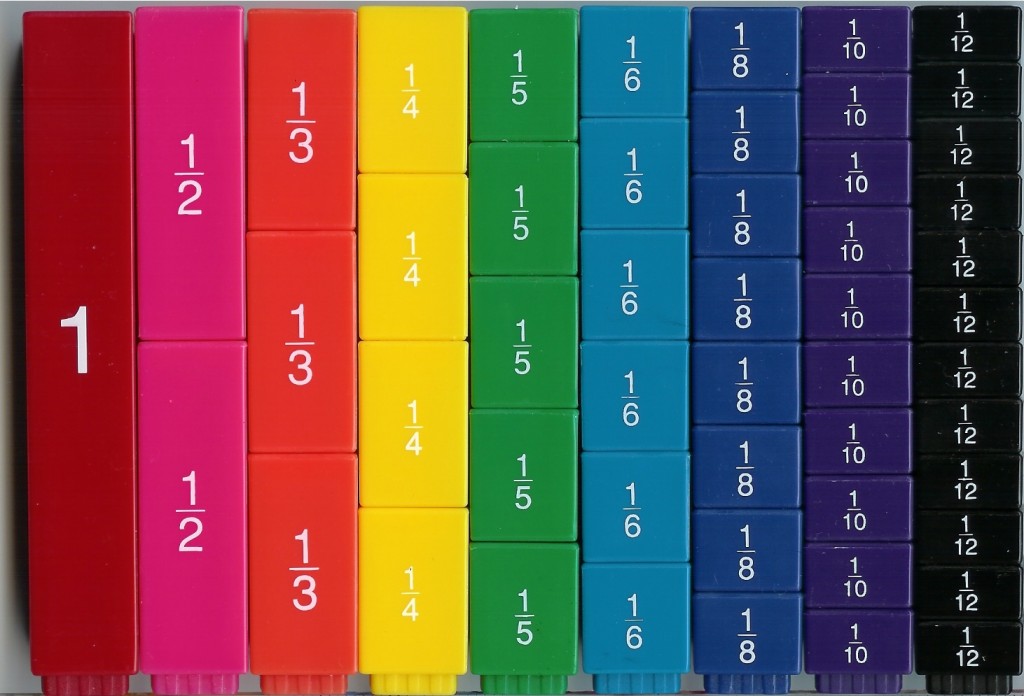
Fraction bars are great tools to help students visualize dividing fractions. For example, if you wanted to divide 2/3 by 1/6 you would line up two of the third bars alongside one of the sixth bar and find out how many times that fraction goes into 2 thirds. In this case it would be four. Fractions themselves are extremely difficult to visualize, and dividing by fractions seems conceptually ridiculous.  It can be difficult to adjust student’s thinking to this area. A manipulative like fraction bars are a good starting point in helping kids understand just how fractions work.

FractionBars


green line

Curriculum, future uses

The topic of dividing fractions has many uses in future courses. Primarily these will be in algebra 1 and 2 for most students. Having a good conceptual knowledge of fractions will help students tremendously in these courses. As an algebra student you would be required to use your knowledge of fractions on an almost daily basis. Being introduced to the concept of multiple variables and canceling them out as you divide polynomials is a very complicated process that gets even more complicated if you do not understand fractions. Laying this conceptual framework is important when you consider all that students must use these concepts for at the higher level math classes. As you consider this in the lessons don’t forget the previous concepts held here such as grouping into equal parts and counting by intervals (3,6,9).


Engaging students: Mathematical induction

In my capstone class for future secondary math teachers, I ask my students to come up with ideas for engaging their students with different topics in the secondary mathematics curriculum. In other words, the point of the assignment was not to devise a full-blown lesson plan on this topic. Instead, I asked my students to think about three different ways of getting their students interested in the topic in the first place.

I plan to share some of the best of these ideas on this blog (after asking my students’ permission, of course).

This student submission comes from my former student Dale Montgomery. His topic, from Precalculus: mathematical induction.

green line

Technology

https://www.khanacademy.org/math/trigonometry/seq_induction/proof_by_induction/v/proof-by-induction

Looking at Khanacademy’s video on mathematical induction, I feel like he has one of the better explanations of mathematical induction that I have heard. This lends itself well to starting class off with a video to engage, and then moving on to an explore where the students test what can or can’t be proved by induction. This quick explanation by Khan gives a good starting point, and the fact that his videos are interesting should be sufficient enough to engage the students. Another possibility is to have the students watch this at home, that way you have more time during class do work on learning how to use the principle of induction.

green line

Application

This problem, and proof (taken from Wikipedia) has flawed logic. In it, it uses the principle of mathematical induction. This would be a good engage because it has supposedly sound logic but it says something that is obviously not true. This will engage the students by showing them something that doesn’t make sense. This will cause a imbalance in their thinking, and make them want to make sense of the situation. I would probably present it as a bell ringer or similar problem, after induction has been introduced.

All horses are the same color

The argument is proof by induction. First we establish a base case for one horse (n = 1). We then prove that if n horses have the same color, then n+1  horses must also have the same color.

Base case: One horse

The case with just one horse is trivial. If there is only one horse in the “group”, then clearly all horses in that group have the same color.

Inductive step

Assume that n  horses always are the same color. Let us consider a group consisting of n+1 horses.

First, exclude the last horse and look only at the first  horses; all these are the same color since  horses always are the same color. Likewise, exclude the first horse and look only at the last  horses. These too, must also be of the same color. Therefore, the first horse in the group is of the same color as the horses in the middle, who in turn are of the same color as the last horse. Hence the first horse, middle horses, and last horse are all of the same color, and we have proven that:

  • If n horses have the same color, then n+1  horses will also have the same color.

We already saw in the base case that the rule (“all horses have the same color”) was valid for n=1 . The inductive step showed that since the rule is valid for n=1 , it must also be valid for n=2 , which in turn implies that the rule is valid for n=3 and so on.

Thus in any group of horses, all horses must be the same color.

(taken from http://en.wikipedia.org/wiki/All_horses_are_the_same_color )

The explanation relies on the fact that a set of a single element cannot have 2 different sets with the same element. Because this assumption cannot be made, the case of n=2 falls apart and tears the argument apart.


green line

Application

Dominoes have been talked about as a way to explain mathematical induction. The idea that if you can prove that the first one falls, and you can prove that in general if a domino falls, the one after it will fall, you can prove that the entire row of dominoes would fall. I think it would be fun to students to actually demonstrate this idea. It would even be fun to illustrate what would happen if you cannot prove that the first one falls by gluing the dominoes to whatever surface that you are using (not the table).

The idea would be to have it set up as the students walked in and ask them what would happen if you pushed over the first domino. After that test the hypothesis with one row (you should probably have multiple rows set up for this). Then introduce the concepts of base case and induction step using the dominos. Then you can ask well what if we cannot push the first domino over, does that mean we cannot show that all of the dominos will fall? After this you can start taking the concept of dominos and applying it to Mathematical induction.

dominoes