Engaging students: Mathematical induction

In my capstone class for future secondary math teachers, I ask my students to come up with ideas for engaging their students with different topics in the secondary mathematics curriculum. In other words, the point of the assignment was not to devise a full-blown lesson plan on this topic. Instead, I asked my students to think about three different ways of getting their students interested in the topic in the first place.

I plan to share some of the best of these ideas on this blog (after asking my students’ permission, of course).

This student submission comes from my former student Emily Bruce. Her topic, from Precalculus: mathematical induction.

green line

How could you as a teacher create an activity or project that involves your topic?

In order to help students understand how induction works, I would either use the domino example or the idea behind an assembly line. Using dominos, students would make a domino train by standing them on their ends close to each other. Students should be able to see that we only have to knock down the first one in order to guarantee that all of them fall over because we know that any one tile falling over will knock over the next one. The assembly line analogy uses the idea that as long as an object begins down the assembly line and each person does their job and passes it on, the object will be made correctly. Like induction, these examples only require us to have the first step succeed and guarantee that it passes from one step to the next, in order to guarantee that it will work for every step.


green line

How can this topic be used in your students’ future courses in mathematics or science?

Induction is a basic proof method that is very useful when proving statements that involve all natural numbers. It is used in pre-calculus, as well as more advanced calculus courses and other upper level college courses. It is an extremely helpful tool when dealing with the natural numbers. Using induction, we can prove conjectures about different series or summations. Knowing and understanding different patterns of with the natural numbers is particularly important in later calculus classes when they focus on the possible convergence of different series and summations.


green line

How has this topic appeared in pop culture?

The movie Titanic is a classic movie about a sinking cruise ship. The question to be posed is “How did they know the whole ship would sink from one hole?” The answer involves induction. The captain would have known that the bulkhead that had a hole would flood completely from the hole. He also would have known that as soon as any one bulkhead was full, another adjacent bulkhead would begin filling up. This is the concept of induction. Using just those two pieces of information, the captain was able to induce that the boat would continue to fill with water until it sank. This is why the captain immediately began evacuating the boat. It was only a matter of time before the ship went down, with everything in it. He knew all of this just form knowing that the first bulkhead would fill and once any one was full, the next would begin to fill as well. The knowledge and quick thinking of the captain saved many lives from the Titanic.


Received from:

http://math.stackexchange.com/questions/423513/how-to-teach-mathematical-induction

Engaging students: Graphing an ellipse

In my capstone class for future secondary math teachers, I ask my students to come up with ideas for engaging their students with different topics in the secondary mathematics curriculum. In other words, the point of the assignment was not to devise a full-blown lesson plan on this topic. Instead, I asked my students to think about three different ways of getting their students interested in the topic in the first place.

I plan to share some of the best of these ideas on this blog (after asking my students’ permission, of course).

This student submission comes from my former student Donna House. Her topic, from Precalculus: graphing an ellipse.

green line

How could you as a teacher create an activity or project that involves your topic?

A great hands-on activity for learning about an ellipse is created with some cardboard, a string, some tape, a yarn needle (or something to make a hole in the cardboard), and a marker.

To create the “ellipse boards,” take a piece of cardboard about one foot by one foot. You do not have to use a square piece and it can be larger or smaller. Just make certain the cardboard is large enough for the graph to be clearly seen. (I prefer white cardboard because it is easier to see the marks, but regular cardboard will also work if you use dark markers.)

Next, using the marker, make two marks for the foci. Thread the string (or yarn) through the yarn needle and poke a hole through one of the foci, pulling the string to the back side of the cardboard. Tie a knot in the string and tape it to the back of the board.

Now, thread the other end of the string through the yarn needle and poke a hole through the other focus. Decide how long the string needs to be to create a nice ellipse. (Remember the string must be 2a long – whatever length that is. Unless you really want the ellipse to be a certain size, the length of the string can vary. The farther apart the foci are, the more elongated the ellipse will be. This can also lead to a discussion about what happens to the shape of the ellipse as the foci get very close to each other!) Make certain the drawing will not fall off the edge of the board. Then tie a knot in this end of the string and tape it down. Each ellipse board will have a different sized ellipse unless you VERY carefully measure the foci and the string. I think having different sizes is better (and much easier to do) and shows the students that the formula for an ellipse works. Now the boards are ready for the students! (The students can put together their ellipse boards in class or you can have them pre-made to save time.)

The fun part is the actual drawing of the ellipse. This, however, is not as easy as it looks! To draw the ellipse, use the marker to stretch the string taut and let the string guide your drawing. Be sure to draw one before class so you will be able to give the students suggestions as they draw their own ellipses.

On their boards, the students can find the center, draw the major and minor axes, can find the vertices, and can easily see that the foci are on the major axis. Using the string, you can prove that the sum of the distances from any point on the ellipse to each of the foci is always 2a, and, using the Pythagorean Theorem, the students can see how to find the foci.

ellipse1

green line

How could you as a teacher create an activity or project that involves your topic?

            Since an ellipse is created when a cylinder is cut at an angle, ellipses are commonly encountered in construction. An example is creating a right angle while joining two pipes to build the corner of a fence. One joining method is to cut each pipe at a 45° angle then weld them together. Students could be asked to determine the length of the major and minor axes of the resulting ellipse when a 2” diameter pipe is cut at a 45° angle.

This same idea is used to make holes in walls or tile for some light fixtures, plumbing fixtures (like shower heads), vent pipes, etc.

I also found the following class project. This could be done in small groups by giving each group the main problem and letting them brainstorm to come up with the solution. I think this would be wonderful to stimulate creativity in the classroom.

http://www.pleacher.com/mp/mlessons/calculus/appellip.html
green line

How can technology be used to effectively engage students with this topic?

To engage the students, begin by showing the first 3 1/2 minutes or so of this video from YouTube:

https://www.youtube.com/watch?v=Yl8Qy79aLk0

Note that the doctor actually touches the peppermint while the sound waves are on!

But what does this have to do with an ellipse?

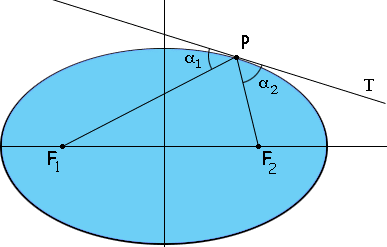
A unique characteristic of the ellipse is that shockwaves emitted from one focus will
reflect off the ellipse and go through the other focus. Using this characteristic, medical engineers have created a device called a lithotripter (as shown in the video) which can break up kidney and gall stones with minimal damage to the surrounding tissue. This eliminates the need for traditional surgery. Mathematics continues to make life easier!

ellipse2

As illustrated in the diagram above, when an energy ray reflects off a surface, the angle of incidence is equal to the angle of reflection.

Here is a short article explaining how the medical device works. (The above illustration comes from this article.) Using the computer, project the article onto the screen to show to the class.

http://mathcentral.uregina.ca/beyond/articles/Lithotripsy/lithotripsy1.html

This not only shows how technology can be used to engage students, it also shows how this topic is used in technology!

Engaging students: Computing trigonometric functions using a unit circle

In my capstone class for future secondary math teachers, I ask my students to come up with ideas for engaging their students with different topics in the secondary mathematics curriculum. In other words, the point of the assignment was not to devise a full-blown lesson plan on this topic. Instead, I asked my students to think about three different ways of getting their students interested in the topic in the first place.

I plan to share some of the best of these ideas on this blog (after asking my students’ permission, of course).

This student submission comes from my former student Delaina Bazaldua. Her topic, from Precalculus: computing trigonometric functions using a unit circle.

green line

How could you as a teacher create an activity or project that involves your topic?

When I first picked my topic, I was searching through topics that I could choose while playing the game Headbandz with my coworkers. That is when my idea hit me: Trigonometry Headbandz. Instead of asking the traditional questions like: “Am I an animal?” “Do I move?” “Am I famous?” or whatnot, the person guessing would have either a degree value, radian value, or the x-y coordinate on their headband and would ask questions like: “Is my measure in radians?” “Is my measure in quadrant I?” “Does my measure have a radical in it?” For the first few minutes, students would be allowed to use a premade unit circle to help them in guessing. However, after that they would need to guess solely based on memorization of the circle. I think this is a good engage because it is a familiar game that students will enjoy and it’s also educational in that they are subconsciously memorizing the unit circle that will carry them through the remaining months of high school, college, and perhaps, everyday life.


green line

How does this topic extend what your students should have learned in previous courses?

When I was in EDSE 3500 with Dr. Pratt, I truly learned how the unit circle worked for the first time in my life. In high school, it was more taught as: “learn this so you can use it for a really long, hard word that is supposedly math (trigonometry.)” In Dr. Pratt’s class, she gave every student the two special right triangles (30-60-90 and (45-45-90) and an empty circle that had the x-y coordinate plane on it. She asked us to recall what we learned in geometry in high school so that we can figure out the side lengths of the triangle. After that, we formed the unit circle using the two right triangles that she gave us by using the degree measure and the side lengths. It was so neat and so surprising that I have never learned how the unit circle is formed—especially as a math major. I definitely want to implement this in my teaching because it forces students to recall what they used in geometry and it also teaches where the unit circle comes from. In addition, it will also be easier for them to construct it in the future if they were to ever forget it.


green line

How could you as a teacher create an activity or project that involves your topic?

I just love this topic and activities that go hand-in-hand with it, so I decided to do it again. I was in the mood to procrastinate, so naturally I log onto Pinterest. I came across a board game dealing with the unit circle: http://cheesemonkeysf.blogspot.com/2014/07/life-on-unit-circle-board-game-for-trig.html?spref=pi. It is based on the game Life on a Number Line. It caught my attention because it tests the students’ knowledge of the unit circle in a fun way. The game involves game pieces, 3 die (a standard one and two positive-negative dice), a semi-blank unit circle, and flash cards of the trigonometric functions. When a student lands on the radian, they are to name the sine and cosine measurement in order to get credit. This game can also be played on a much larger scale with the entire class competing for extra credit. The whole point of the game is to, as the blog says, “used to living on the unit circle” in a fun and educational way. Like the first activity, Trigonometry Headbandz, it inevitably forces students to learn the unit circle. This way, it’s much more engaging and fun than staring at a piece of paper in hopes of memorizing it.

References:

http://cheesemonkeysf.blogspot.com/2014/07/life-on-unit-circle-board-game-for-trig.html?spref=pi

Dr. Pratt EDSE 3500 class


Engaging students: Exponential Growth and Decay

In my capstone class for future secondary math teachers, I ask my students to come up with ideas for engaging their students with different topics in the secondary mathematics curriculum. In other words, the point of the assignment was not to devise a full-blown lesson plan on this topic. Instead, I asked my students to think about three different ways of getting their students interested in the topic in the first place.

I plan to share some of the best of these ideas on this blog (after asking my students’ permission, of course).

This student submission comes from my former student Chais Price. His topic, from Precalculus: exponential growth and decay.

green line

How does this topic extend what your students should have learned in previous courses?

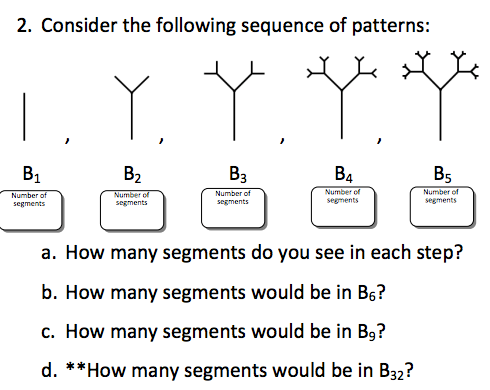
Every year in elementary through high school it seemed like I had some form of standardized test. These test typically consist of various problems, which include patterns and sequences of patters style of problems. I always found it more helpful when being introduced to more complex and intimidating concepts, to relate the general idea to something much more simplistic. When teaching a lesson on exponential growth and/or decay I plan on starting off the lesson with problems like:

exponential1 exponential2

These two patterns are pretty basic and finding the next one in the sequence shouldn’t be to difficult. This begs the question what if I wanted to find some enormous value for n. For questions d, a student can answer the question by drawing or counting but it will take some time. Or the student could find an equation that models the sequence of patterns. The equation would obviously be an exponential. From this point the teacher could discuss how these functions appear on the graph by simply observing what is happening in the sequence. In the first picture alone with the triangles, we only have 4 triangles shown and the first triangle is solid black. If we continue on, the next one in the sequence would represent basically our x values on a graph and the amount of triangles growing exponentially represents the y values. By using this previous knowledge the teacher was capable of relating a new concept with a much simpler approach.

green line

How could you as a teacher create an activity or project that involves your topic?

Has anyone ever asked you if you would rather have a million dollars, or a penny that doubles everyday for an entire month? I heard this question probably when I was in high school. I am pretty sure that I picked a penny that doubled everyday for a month only because it was the least obvious and it seemed like a trick question. However this is an example of how only 31 days explode into a fortune. After the first week of doubling you only have a little over a dollar. In fact you really don’t start making any real money until about the middle of the 3rd week if you chose to have a penny double everyday for a month. It turns out that by the last day of the month you end up with over 21 million dollars. This is once again because the function is growing exponentially. The link at the bottom of the page has a story that uses this same idea about a raja from India who made a young girls request to have a grain of rice double everyday for a month. This story can be fun to read and engaging for the students as well. After the story is read, there is a calendar where the students will fill in each day the amount of rice given to Rani, the young girl in the story. This calendar has a few random days filled in so the students know if they are on the right track. This activity serves as an engage/ explore for more of an introduction to exponential growth. The students could graph this function of type some points into the calculator to see the function explode. Let x represent days and y represent the grain of rice each day.


green line

How can technology be used to effectively engage students with this topic?

Dan Myers is a teacher who developed a style of teaching called the 3 act lessons, which incorporates multiple technology applications such as video recording, as well as imaging and photo editing. Each act is designed to teach a lesson like a movie divided up into parts. I came across this lesson of his which I think is awesome. In act 1, there is a 24 second video with these words at the beginning: “ a smaller domino can topple a domino that is up to 1.5 times larger in every dimension. “ The guy on the video explains that the smallest domino is 5 mm high and 1mm thick. This is all you are given. Then the teacher asks something to the class along the lines of “ If you wanted to topple over a domino the size of a sky scraper, how many dominoes would you need? “ This opens the door for students to both question and reason. Make a prediction and write it down. Have the students write down an answer they know is too high and one they know is too low. That is the end of act one. As we get into act to we need more information just like in a movie. Act 2 answers the question how many dominoes are present in the video. It also provides a data sheet that has the heights f several sky scrappers. This is a very discussion style lesson so in act 2 we would continue to promote discussion and questions. Then finally in act three we come to the conclusion. The man in the video had 13 dominoes and the biggest one was barely up to his waste. It turns out that if we were to keep adding dominoes that grew 1.5 times more than the previous one, the 29th domino would be as tall as the Empire State Building. That is exponential growth at its finest.


Engaging students: Parabolas

In my capstone class for future secondary math teachers, I ask my students to come up with ideas for engaging their students with different topics in the secondary mathematics curriculum. In other words, the point of the assignment was not to devise a full-blown lesson plan on this topic. Instead, I asked my students to think about three different ways of getting their students interested in the topic in the first place.

I plan to share some of the best of these ideas on this blog (after asking my students’ permission, of course).

This student submission comes from my former student Banner Tuerck. His topic, from Precalculus: finding the equation of a parabola from the focus and directrix.

green line

An interesting way to present the mathematics behind parabolas and their focus points is through the applications it has in science present in our everyday lives. http://spacemath.gsfc.nasa.gov/IRAD/IRAD-4.pdf

The above link includes a great engagement activity for students to do as a group activity. The first exercise presented involves the students in the design of a parabolic dish after observing the properties of a satellite dish with a radio receiver (located at the focus). Once the students have completed the design of the parabolic dish the instructor could then use the second half of the pdf from the link as an elaboration activity. The instructor could either keep the students in the groups or have them work the problems individually. Nevertheless, the second activity would be for the students to work problems one and two, which deal with aiding a bird watcher and a hobbiest in determining the focus points in order to design their parabolically shaped tools. The last problems are excellent real world examples of why one would need to know and apply the mathematics for parabolas. This will encourage students to view everyday objects with a more mathematical respect.


green line

The understanding of the relationship between the focus point and the directrix of a standard parabola is fundamental when students extend their mathematical and science education in post-secondary courses. For example, when students reach multivariable calculus they will graph and study the properties of conic sections on a three dimensional scale. With respect to this topic the students can apply their preexisting knowledge of two-dimensional parabolas to the paraboloids presented in this course. Furthermore, if students from a pre-calculus high school course were to not keep with the theoretical study of mathematics they could benefit greatly from this topic in careers such as architecture, art, or graphic design.


green line

As an instructor of a pre-calculus course one has many technological resources to use in order to construct an elaborate lesson on the directrix and focus of a parabola. For example, modern graphing calculators allow instructors to link their calculator to a projector and show the entire class various parabolas in order to further visualize the changing distances to these specific points. Furthermore, I believe a unique homework assignment would be for students to graph given quadratic equations with an online resource such as http://www.wolframalpha.com/. This assignment would also be a great review of how to apply the distance formula. I recommend having the students check that the points on the parabola are equidistant apart from the focus and the directrix they have already found after graphing and computing. Another idea is requesting (for full credit of the assignment) the students use the following link: https://www.khanacademy.org/math/algebra2/conics_precalc/parabolas_precalc/v/parabola-focus-and-directrix-1

to facilitate their understanding of the definition of a parabola as well as the importance of the focus point and directrix line. This is a way to involve technology while simultaneously ensuring that students review key aspects of the lesson after it was given by the instructor during class time.

References

http://spacemath.gsfc.nasa.gov/IRAD/IRAD-4.pdf

http://www.wolframalpha.com/.

https://www.khanacademy.org/math/algebra2/conics_precalc/parabolas_precalc/v/parabola-focus-and-directrix-1


Engaging students: Compound interest

In my capstone class for future secondary math teachers, I ask my students to come up with ideas for engaging their students with different topics in the secondary mathematics curriculum. In other words, the point of the assignment was not to devise a full-blown lesson plan on this topic. Instead, I asked my students to think about three different ways of getting their students interested in the topic in the first place.

I plan to share some of the best of these ideas on this blog (after asking my students’ permission, of course).

This student submission comes from my former student Andy Nabors. His topic, from Precalculus: compound interest.

green line

What interesting (i.e., uncontrived) word problems using this topic can your students do now?

I would give the students a problem to find out where they should invest their money. They would be given several options with pros and cons and need to choose the best option for them and explain their reasoning. The problem would go something like this:

You are looking to put your graduation money, a total of $2,498, into a savings account. You have gone to several banks and found the interest rates and start-up fees for making an account there. Which bank is offering you the best deal? Which would you choose and why?

Bank Interest Rate Compounded Start-Up Fee
Bank of America 2.5% daily $65
CitiBank 5% monthly $100
Comerica 3% weekly $50
JP Morgan 1.7% continuously $50
Wells Fargo 3.3% bi-annually $0


This material is Pre-Cal, so I assume the students are either juniors or seniors, so they may be looking at having to open a bank account of their own in their near future. Then this would be a relevant question for them to look into and figure out what exactly gives them the best option.


green line

How could you as a teacher create an activity or project that involves your topic?

This activity would be similar to one we did in 4050. At the time of this activity, they would not know the formula for compound interest. I would put the students in pairs and pose the question “Suppose you have $1000 that earns 8% interest. How much would you have at the end of 2 years if the interest was compounded: a.)annually b.) biannually c.)quarterly d.)daily”. Then the students would work in pairs to figure out the answers and I would instruct the students to find a pattern as they worked to make it easier. The students would eventually discover the formula for compound interest compounded for any number. They would then be asked how many times the money would have to be compounded to put out the highest total. The students would discover that the higher number, the more total, but as the compounded numbers increased, the difference between the outputs would decrease. So we could then say that there is a limit to how much the output could be, and that limit would be compounded infinitely. Then we could take the limit and find out what the formula is for finding compound interest compounded continuously.


green line

How can technology be used to effectively engage students with this topic?

Students need to know how to do their own research in their future for things like buying a house or car, choosing whether or not to rent or buy, or other things where they are having to find the best deal and fit for them. This activity would have students researching different banks. They would be asked to find out the details on certain banks’ interest rates. They would need to find out about fees and how many times the interest is compounded. They would need information about at least three banks, and then would need to research on independent sites which bank would be the best to start an account with from the banks they chose. Then they would choose a bank for them based on their own findings and calculations, and would choose a bank based on what an online article said. This would let students form their own opinions based on data they found, and weigh that data against the opinions of others. Their findings and opinions may not match up, and that’s why this activity would benefit them. It’s important that students learn to not take the opinions of others as fact, but do their own research to find the best deal.


Helping Mathematics Students Survive the Post-Calculus Transition

Every so often, I’ll publicize through this blog an interesting article that I’ve found in the mathematics or mathematics education literature that can be freely distributed to the general public. Today, I’d like to highlight Michael J. Cullinane (2011) Helping Mathematics Students Survive the Post-Calculus Transition, PRIMUS: Problems, Resources, and Issues in Mathematics Undergraduate Studies, 21:8, 669-684, DOI:10.1080/10511971003692830

Here’s the abstract:

Many mathematics students have difficulty making the transition from procedurally oriented courses such as calculus to the more conceptually oriented courses in which they subsequently enroll. What are some of the key “stumbling blocks” for students as they attempt to make this transition? How do differences in faculty expectations for students and student expectations for themselves contribute to the “transition dilemma?” What might faculty incorporate into students’ learning experiences during the transition to help students better navigate the shift from procedural to conceptual, from concrete to abstract? This article offers some lessons learned in connection with these questions.

The full article can be found here: http://dx.doi.org/10.1080/10511971003692830

Square any number up to 1000 without a calculator

The Mathematical Association of America has an excellent series of 10-minute lectures on various topics in mathematics that are nevertheless accessible to the general public, including gifted elementary school students.  From the YouTube description:

Mathemagician Art Benjamin [professor of mathematics at Harvey Mudd College] demonstrates and explains the mathematics underlying a mental arithmetic technique for quickly squaring numbers.

Vertically Integrating Professional Skills Throughout A Mathematics Major

Every so often, I’ll publicize through this blog an interesting article that I’ve found in the mathematics or mathematics education literature that can be freely distributed to the general public. Today, I’d like to highlight “Vertically Integrating Professional Skills Throughout A Mathematics Major,” by Clarice Dziak, Brian Leventhal, Aaron Luttman, and Joseph Skufca. Here’s the abstract:

In response to a university mandate to include “professional issues” as a component of every major, we have developed a vertically integrated approach to incorporating the study of professional skills and issues into the mathematics curriculum. Beginning in the first year of study, mathematics majors take an inquiry-based course in mathematical modeling using software packages that are important in business and industry, such as Excel®, Maple®, and Matlab®. In the third year, students choose between a seminar course covering topics in teaching and another covering topics related to research and work in industry. The courses are designed to introduce students to the different cultures and issues of business, industry, and teaching. Beyond these two courses, students are required to demonstrate proficiency in three core areas through a required “professional experience,” which takes the form of an internship, undergraduate research experience, or educational outreach program.

The full article can be found here: http://dx.doi.org/10.1080/10511970.2013.876472

Full reference:Clarice Dziak, Brian Leventhal, Aaron Luttman & Joseph Skufca (2014) Vertically Integrating Professional Skills Throughout A Mathematics Major, PRIMUS: Problems, Resources, and Issues in Mathematics Undergraduate Studies, 24:4,301-308, DOI:10.1080/10511970.2013.876472

Engaging students: Using Straightedge and Compass to Find the Incenter of a Triangle

In my capstone class for future secondary math teachers, I ask my students to come up with ideas for engaging their students with different topics in the secondary mathematics curriculum. In other words, the point of the assignment was not to devise a full-blown lesson plan on this topic. Instead, I asked my students to think about three different ways of getting their students interested in the topic in the first place.

I plan to share some of the best of these ideas on this blog (after asking my students’ permission, of course).

This student submission comes from my former student Nada Al-Ghussain. Her topic, from Geometry: using a straightedge and compass to find the incenter of a triangle.

green line

What interesting things can you say about the people who contributed to the discovery and/or the development of this topic?

Sitting down one day pondering, Greco-Roman mathematician Euclid had a light-bulb moment and Eureka, the Elements was created! Right? Well not quite. Back in the day, 440B.C to be exact, a merchant named Hippocrates of Chios, chased after pirates to Athens to recover his stolen property. Unsuccessful, he attended math lectures and compiled the first known work of elements in geometry. Later on, around 350 B.C in the Academy, mathematician Theudius’s textbook was used by non- other than Aristotle. Then came our man Euclid in 300 BC and presented to us the pivotal textbooks, the Elements, which was used in universities until the 20th century. Euclid had compiled previous mathematical work into his Elements although he alone contrived the design and construction of different parts. Euclid’s Elements consisted of 13 books that covered Euclidean geometry, elementary number theory, and etc. For example, in book 4 (IV) Proposition 4, Euclid gives directions to inscribe a circle in a given triangle using a straightedge and compass.


http://www.britannica.com/EBchecked/topic/194880/Euclid

http://aleph0.clarku.edu/~djoyce/java/elements/bookIV/propIV4.html


green line

How could you as a teacher create an activity or project that involves your topic?


I would set up a Founding Geometry explore activity before telling students anything over Euclidean geometry. In this activity I would want individual work but allow students to discuss in groups. Each person would get an equilateral triangle image, a compass, and a straightedge, not a ruler! First I would instruct the students to find the incenter, middle point of the triangle using only those two tools. This would get the students to think and go through trial and error as they work individually and together. Next I would ask them to write down their steps and discuss with each other. Then I would open class discussion asking the students the steps they took to get the incenter. I would ask thee students if they see anything else with all the lines they drew. Hoping they would describe the angle bisectors. Then I would ask the class if all triangle incenter’s could be found the same way. I would give each student a different shaped and sized triangle and give them time to discover the answer on their own. Once students finished, I would discuss the class the key steps and definitions learned. I would then tell me that they all are founders of Geometry, and tell them about Euclid’s role in geometry. This activity could be easily changed to any parts like how to construct a triangle or even to help prove and understand the Pythagorean theorem.


green line

How can technology be used to effectively engage students with this topic?


When constructing geometry, trial and error tends to occur. Whether it is an instructor or a student. Graphical Ruler and Compass Editor, GRACE is a great site that allows the user to construct using only a straightedge and compass. By simply producing points and picking from Line, Line Segment, Ray, Circle, Perpendicular Bisector, and Intersection. This could be given to students as they work in class or at home as to not waste paper. It has special features that allow you to zoom in and out doing multiple constructions on one page. It also allows you to create and test axioms. This is tool is great for middle school all the way to university level students. It’s a quick visual that can be manipulated easily. From experience, many times when constructing certain propositions from Euclid’s Elements, I tended to waste time erasing so much and making perfect circles. Plus hand drawings can be tedious for some students. This is easier to use and engage all students including some special education students.


http://www.cs.rice.edu/~jwarren/grace/