Engaging students: Reducing fractions to lowest terms

In my capstone class for future secondary math teachers, I ask my students to come up with ideas for engaging their students with different topics in the secondary mathematics curriculum. In other words, the point of the assignment was not to devise a full-blown lesson plan on this topic. Instead, I asked my students to think about three different ways of getting their students interested in the topic in the first place.

I plan to share some of the best of these ideas on this blog (after asking my students’ permission, of course).

This student submission comes from my former student Madison duPont. Her topic, from Pre-Algebra: reducing fractions to lowest terms.

green line

How can this topic be used in your students’ future courses in mathematics or science?

Reducing fractions to lowest terms can be applied to future mathematics topics such as ratios and proportions, and scientific topics such as chemistry or physics. Ratios can be represented as fractions and are not typically reduced to lowest terms because they represent relationships of two subjects using numbers. Being able to reduce these ratios can help students better identify the underlying relationship and apply this relationship to other aspects of the math problem, such as problems using unit price or map scales. Proportions relate to the concept of reducing fractions to lowest terms when using cross-multiplication. Having both sides of the proportion reduced to lowest terms makes the cross-multiplication much easier to compute and derive a final reduced answer. Chemistry uses fractions reduced to lowest terms with topics, like stoichiometry, that use potentially small and large numbers in several ratios that are multiplied together to obtain a final converted and reduced answer. Physics often uses ratio-like formulas and problems that are applied to real-world scenarios, which typically require fractions reduced to lowest terms because answers like miles per one hour are the goal. All of these topics use concepts of reducing fractions to lowest terms to more easily accomplish problems using a series of fractional computations, or to get an answer that is in terms of a single unit or most reduced so that it makes sense to real-world application.


green line

How does this topic extend what your students should have learned in previous courses?

This topic extends previously learned topics such as concepts of unique prime factorizations, greatest common divisor, manipulating fractions, and multiplication facts. The concept of unique prime factorizations greatly aids students in finding the greatest common divisor, which is used to find the greatest factor of the value of both the numerator and denominator. Next, manipulation of fractions is used to properly divide the numerator and denominator by the greatest common divisor. This process of dividing both parts of the fraction utilizes multiplication facts as well to determine what the answer to the division problem on both the top and bottom of the fraction would be. These previously learned concepts are all subtle and important applications when reducing fractions to lowest terms.


green line

How can technology (YouTube, Khan Academy [khanacademy.org], Vi Hart, Geometers Sketchpad, graphing calculators, etc.) be used to effectively engage students with this topic? Note: It’s not enough to say “such-and-such is a great website”; you need to explain in some detail why it’s a great website.


This video reminded me of many students that I have tutored or encountered in classrooms that were determined that a calculator was all they needed when doing math. Applied to reducing fractions to lowest terms, this video is extremely relevant in displaying that technology cannot be the only source of intelligence when thinking mathematically. Reducing fractions with extremely large numbers or numbers that do not have well-known factors can seem exhausting or impossible. Punching several factors of the numerator and denominator into a calculator attempting to reduce numbers with each common factor, and then not being sure of whether the fraction appearing on their screen is truly in the most reduced form surely indicates the technology is not the only way of solving the problem. Many students hop on a procedural escalator when beginning varying types of problems (in addition to reducing fractions to lowest terms) using memorized steps, punching calculator buttons, feeling comfortable, until suddenly—there is a horribly unattractive fraction halting their progress. This is when using mathematical problem solving skills such as reducing the numerator and denominator by the greatest common divisor or checking to see that the numerator and denominator are relatively prime becomes pertinent. Using these conceptual skills can save someone that is stuck waiting for a calculator to do the work for them, or that has given up on finishing a problem because it seems impossible or difficult, from thinking they are incapable of working out a problem efficiently and successfully. This video highlights the importance of being capable of knowing when it is time to take the effort to climb the stairs to reach your destination.


References:

“Stuck on an Escalator” Video link:

https://www.youtube.com/watch?v=VrSUe_m19FY

found via Google video search



Engaging students: Standard Deviation

In my capstone class for future secondary math teachers, I ask my students to come up with ideas for engaging their students with different topics in the secondary mathematics curriculum. In other words, the point of the assignment was not to devise a full-blown lesson plan on this topic. Instead, I asked my students to think about three different ways of getting their students interested in the topic in the first place.

I plan to share some of the best of these ideas on this blog (after asking my students’ permission, of course).

This student submission comes from my former student Jillian Greene. Her topic, from statistics: standard deviations.

green line

How could you as a teacher create an activity or project that involves your topic?


An activity that I’ve seen presented to introduce the idea of standard deviation requires students to explore the information given to them before actually being taught the math behind standard deviation. As the students settle into their seats, prompt them to work with their shoulder partner and help to measure the width of their left thumbnail (or length of their pointer finger, width of their hand, etc.) and write it on a sticky note. Once the data is collected, the students will calculate the mean of all of the measurements. The mean is then written on the board in the center, and the students are asked to go and stack their post-it notes in either the center if they are perfectly the mean, or on the right or left if it’s bigger or smaller, respectively. Have them find the mean of the distances of each measurement from the mean. When they discover this should be zero, have them discuss with each other and then in the big group what that means. If time provides, it might even be fun to ask deeper understanding questions like what would happen if everyone last half of their thumbnail, or what if just Student A’s thumbnail tripled in size. This will provide a meaningful sequitur into the sometimes confusing world of standard deviation and distances from the mean.


green line

How has this topic appeared in pop culture (movies, TV, current music, video games, etc.)?

http://www.dailymotion.com/video/x3lc0rx

This is a full episode of Everybody Loves Raymond but the clip in reference starts at about 8:45 and lasts a minute or so.


This clip shows a scenario where the couple, Ray and Deborah, is comparing their scores on an IQ test (a very common use for standard deviation). Deborah comments on how her score is very close to Ray’s, being only 15 points higher. The brother that proctored the exam corrected her by saying that 15 points is a standard deviation higher and puts her in a “whole new class” of genius. Have students discuss and explain what it means for Deborah to be one standard deviation higher. Use the information given in the episode (100 is average, 115 is one standard deviation higher) to construct the bell curve for IQ scores. Then use the bell curve to introduce percentiles. Since Ray is the average, center-of-the-bell score, then he is in the 50th percentile. The students can then attempt to discover on their own (or with a group) what percentile Deborah’s score puts her in.


green line

How can this topic be used in your students’ future courses in mathematics or science?


Standard deviation is a topic that pervades almost all sciences. In biology classes, students are asked to student the weather and climate of various habitats. In differentiating between the two, one must look at the overall picture. If the student is presented with the information that place A and place B both have average temperatures of 60 degrees, this information might not be good to take as face value. Place A might have a range from 40 to 80 degrees throughout the year while place B might range from 0 to 100 and then have one or two extremely hot outliers that even the average out to 60. Looking at not only the skew of the bell curve, but also what the standard deviation is for each place, might save a student from forgetting to bring a fan to hypothetical place B, or writing that that the climate of that place is cool year round.  In addition to biology, standard deviation is a very necessary operation in psychology, which is a very statistics-based science. This can easily be seen in representing IQ scores how we found earlier!


Engaging students: Square roots

In my capstone class for future secondary math teachers, I ask my students to come up with ideas for engaging their students with different topics in the secondary mathematics curriculum. In other words, the point of the assignment was not to devise a full-blown lesson plan on this topic. Instead, I asked my students to think about three different ways of getting their students interested in the topic in the first place.

I plan to share some of the best of these ideas on this blog (after asking my students’ permission, of course).

This student submission again comes from my former student Jessica Martinez. Her topic, from Algebra: square roots.

green line

How has this topic appeared in the news?

There is a (sort of) holiday for square root days; sort of because square root days only come 9 time every century and this year we celebrated 4/4/16. Since it’s not as frequent as Pi Day, it’s a lesser known “holiday”, but even then, it still pops up in the news. I found this online article for a UK news site that described other square root-related fun facts in history. It also included a post from Good Morning America with the hashtag #squarerootday, which gave me this idea: I would like to encourage my students to participate in all of the fun square root-related activities that celebrate this day (if there was one that school year). The founder of square root day has suggestions that include but are not limited to: square dancing, drinking root beer out of square glasses, or even taking a drive on route 66. In the days leading up to this fantastic math-related day, I would consider giving my kids an extra credit point for posting a picture of themselves doing something square root related on the class twitter with the tag #squarerootday (or a post on some other class social media). If there wasn’t a square root day during that academic year, I still think it would be fun to tell my students about this holiday.


green line

How does this topic extend what your students should have learned in previous courses?

My students should have already learned about perfect squares and their multiplication tables up to 12 or 13, at least. For a simple refresher, I could have my students color/highlight perfect squares on multiplication tables. Then taking the square root of something is the inverse of creating perfect squares, unless what’s under the square root sign isn’t a perfect square. Then what’s under the radical is something that they need to divide into its prime factors so that they can simplify. My students should have also at least learned about prime numbers, if not prime factoring. A way to solve square roots would be pairing up the prime factors under the square root so that you can “take it out” from under the radical; for my students, I could have them think of the square root sign as a jail cell, and the only way that the numbers could “get out” of the cell is if they had a “prime partner” to escape with (i.e. a pair of 2s, a pair of 3s etc.).


green line

What interesting things can you say about the people who contributed to the discovery and/or the development of this topic?

So one of the oldest records of square roots in history would be The Old Babylonian tablet YBC 7289, which dates back anywhere from 2000-1600 BC. It depicts a square with two diagonals drawn and on the diagonals are numbers; when they are calculated, you get a very close approximation of the square root of 2 for the diagonal. Their value for the square root of two was about 1.41421297; I could have my students quickly calculate the square root of two (about 1.41421356) and mention to my students that this is pretty impressive for a civilization without modern day technology. The fact that they used clay tablets for math calculations shows how little they had to work with. Yet Babylon was also one of the most famous ancient cities in Mesopotamia; it’s mentioned multiple times in the bible and they were pretty advanced in mathematics for their area, despite the lack of resources we have today. They used a sexagesimal number system, which is base 60; they could solve algebra problems and work with what we now call Pythagorean triples; they could also solve equations with cubes.


References

A Visual Approach to Simplifying Radicals (A Get Out of Jail Free Card). (2012, January 15). Retrieved September 09, 2016, from https://reflectionsinthewhy.wordpress.com/2012/01/15/a-visual-approach-to-simplifying-radicals-a-get-out-of-jail-free-card/

Babylon and the Square Root of 2. (2016). Retrieved September 09, 2016, from https://johncarlosbaez.wordpress.com/2011/12/02/babylon-and-the-square-root-of-2/

Buncombe, A. (16, April 4). Square Root Day: There are only nine days this century like this. Retrieved September 09, 2016, from http://www.independent.co.uk/news/world/americas/square-root-day-there-are-only-nine-days-this-century-like-this-a6967991.html

Fowler, D., & Robson, E. (n.d.). Square Root Approximations in Old Babylonian Mathematics: YBC 7289 in Context. Historical Mathematica, 366-378. Retrieved September 9, 2016, from https://math.berkeley.edu/~lpachter/128a/Babylonian_sqrt2.pdf.

Mark, J. J. (2011, April 28). Babylon. Retrieved September 09, 2016, from http://www.ancient.eu/babylon/


Engaging students: Introducing proportions

In my capstone class for future secondary math teachers, I ask my students to come up with ideas for engaging their students with different topics in the secondary mathematics curriculum. In other words, the point of the assignment was not to devise a full-blown lesson plan on this topic. Instead, I asked my students to think about three different ways of getting their students interested in the topic in the first place.

I plan to share some of the best of these ideas on this blog (after asking my students’ permission, of course).

This student submission again comes from my former student Deborah Duddy. Her topic, from Pre-Algebra: introducing proportions.

green line

How can this topic be used in your students’ future courses in mathematics or science?


Proportions, in the form a/b = c/d, is a middle school math topic. The introduction of proportions builds upon the students’ understanding of fractions and ability to solve simple equations. This topic is used in the students’ future Geometry and Statistics courses. The use of proportions is used in Geometry to identify similar polygons which are defined as having congruent corresponding angles and proportional corresponding sides. The use of similar triangles and proportions are used to perform indirect measurements. In Statistics, proportions are used throughout measures of central tendency. Additionally, statistics uses sampling proportions including the proportion of successes.


The ability to use proportions for indirect measurements is also included in the study of Physics, Chemistry and Biology.  Chemistry uses proportions to determine based upon the chemical structure of a compound, the number of atoms pertaining to each element of the compound.  The study of Anatomy also uses many proportions including leg length/stature or the sitting height ratio (sitting heigh/stature x 100).


green line

How has this topic appeared in high culture (art, classical music, theatre, etc.)?


In art, proportions are expressed in terms of scale and proportion.  Scale is the proportion of 2 different size objects and proportion is the relative size of parts within the whole.  An example of proportion is Michelangelo’s David.  The proportions within the body are based on an ancient Greek mathematical system which is meant to define perfection in the human body.  Da Vinci’s  Vitruvian Man is also an example of art based upon proportions or constant rates of fractal expansion.  The music of Debussy has been studied to show that several piano pieces are built precisely and intricately around proportions and the two ratios of Golden Section and bisection so that the music is organized in various geometrical patterns which contribute substantially to its expansive and dramatic impact.

The use of proportions is also a constant within Greek and Roman classical architecture.  Many classical architecture buildings such as the Parthenon illustrate the use of proportions through the building.  Additionally, classical architecture uses specific proportions to determine roof height and length plus the placement of columns.


green line

How has this topic appeared in the news?

Proportions are constantly in the news even though they may not be presented in a/b=c/d format.  However, the concept of proportion is used throughout news reporting and even advertising.  The current news topic is the upcoming Presidential election.  Daily, we are provided with new and different poll results.  These results are derived via a proportion.  For example, 100 people are polled, these results are then derived via proportional concepts to provide a percentage voting for each candidate.  Percentage is a specific type of the  a/b = c/d proportion.  Daily news uses proportions when reporting growth trends for national debt, crime and even new housing starts in DFW.   Today, proportions were used when discussing the new Samsung Note7 and its ability to explode.  During the winter, proportions are used to tell us how many inches of rain would result from 2 inches of snow. Sports broadcasters also use proportions when discussing the potential of athletes.  If the athlete can hit 10 homeruns in 20 games, then he will potentially hit 50 homeruns in 100 games.  Proportions even appear in advertising for new medicines detailing the data associated with the medicine trial.


References:

Debussy in Proportion: A Musical Analysis, Dr Roy Howat


Michelangelo’s David


Click to access MOEFranklin.pdf


http://www.brightstorm.com


Engaging students: Combinations

In my capstone class for future secondary math teachers, I ask my students to come up with ideas for engaging their students with different topics in the secondary mathematics curriculum. In other words, the point of the assignment was not to devise a full-blown lesson plan on this topic. Instead, I asked my students to think about three different ways of getting their students interested in the topic in the first place.

I plan to share some of the best of these ideas on this blog (after asking my students’ permission, of course).

This student submission again comes from my former student Heidee Nicoll. Her topic, from probability: combinations.

green line

How could you as a teacher create an activity or project that involves your topic?

As a teacher, I would give my students an activity where, with a partner, they would be in charge of creating an ice cream shop.  Each ice cream shop has large cones, which can hold two scoops of ice cream, and six different flavors of ice cream.  Each shop would be required to make a list of all the different cone options available.  (Note: cones with two scoops of the same flavor are not allowed.)  The groups would calculate the total number of combinations, and try to find any patterns in their work.  I would ask them how to calculate the number of options for 7 flavors of ice cream, and then ask them to find a general rule or pattern for calculating the total for n flavors, and have them try their formula a few times to see if it gives them the correct answer.  As a bonus, I would also ask them how many flavors of ice cream they would need to be able to advertise at least 100 different cone combinations.


green line

What interesting things can you say about the people who contributed to the discovery and/or the development of this topic?

Historia Mathematica, a scientific journal, has an article called “The roots of combinatorics,” which describes records of ancient civilizations’ work in combinations and permutations.  I would share with my students the first part of this description of the medical treatise of Susruta, without reading the last sentence that gives the answers:

“It seems that, from a very early time, the Hindus became accustomed to considering questions involving permutations and combinations. A typical example occurs in the medical treatise of Susruta, which may be as old as the 6th century B.C., although it is difficult to date with any certainty. In Chapter LX111 of an English translation [Bishnagratna 19631] we find a discussion of the various kinds of taste which can be made by combining six basic qualities: sweet, acid, saline, pungent, bitter, and astringent. There is a systematic list of combinations: six taken separately, fifteen in twos, twenty in threes, fifteen in fours, six in fives, and one taken all together” (Biggs 114).

I would ask them to estimate the number of combinations of any size group within those “six basic qualities” without doing any actual calculations.  Once they had all made their estimates, as a class we would do the calculations and comment on the accuracy of our earlier estimates.


green line

How has this topic appeared in pop culture (movies, TV, current music, video games, etc.)?

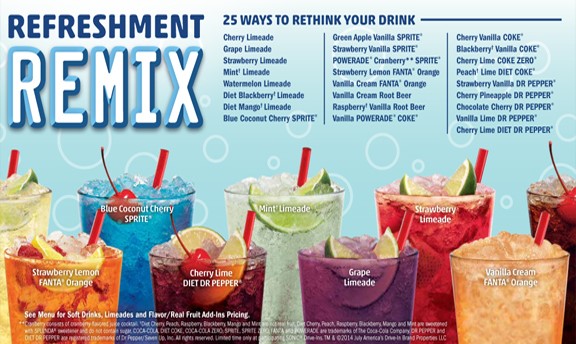
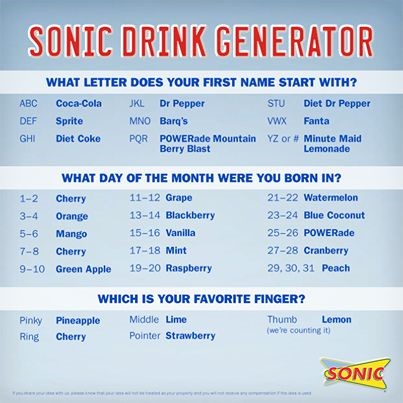
Sonic commercials boast that their fast food restaurant offers more than 168,000 drink combinations.  This commercial shows a man trying to calculate the total number of options after buying a drink:

I would show my students the commercial, as well as images of Sonic menus and advertisements for their drinks, such as the following:

sonic1

sonic2

sonic3

sonic4

The Wall Street Journal also has an article about the accuracy of the company’s claim to 168,000 drink options, found at http://blogs.wsj.com/numbers/counting-the-drink-combos-at-a-sonic-drive-in-230/.    The author talks about the number of base soft drinks and additional flavorings available, and says that according to the math, Sonic’s number should be well over 168,000 and closer to 700,000.  He describes the claim of a publicist who works for Sonic that 168,000 was the number of options available for no more than 6 add-ins, which the company deemed a reasonable number.  The article also notes the difference between reasonable combinations and literally all combinations, which could spur a good discussion in the classroom about context and its importance in real world problems.


References


Biggs, N.l. “The Roots of Combinatorics.” Historia Mathematica 6.2 (1979): 109-36. Web. 08 Sept. 2016.


Carl Bialik. “Counting the Drink Combos at a Sonic Drive-In.” The Wall Street Journal. N.p., 27 Nov. 2007. Web. 08 Sept. 2016.


http://www.youtube.com/channel/UC9fSZEMOuJjptiXVsYf8SqA. “TV Commercial Spot – Sonic Drive In Sonic Splash Sodas – Calculator Phone – This Is How You Sonic.” YouTube. YouTube, 29 Oct. 2014. Web. 08 Sept. 2016.

Engaging students: Adding and subtracting decimals

In my capstone class for future secondary math teachers, I ask my students to come up with ideas for engaging their students with different topics in the secondary mathematics curriculum. In other words, the point of the assignment was not to devise a full-blown lesson plan on this topic. Instead, I asked my students to think about three different ways of getting their students interested in the topic in the first place.

I plan to share some of the best of these ideas on this blog (after asking my students’ permission, of course).

This student submission comes from my former student Daniel Herfeldt. His topic, from Pre-Algebra: adding and subtracting decimals.

green line

How could you as a teacher create an activity or project that involves your topic?

A great engage activity that I have thought about as a teacher would be to have the students add and subtract money. For this activity I would provide the students with play money (dollar bills, quarters, dimes, nickels, and pennies) needed to proceed. I would then ask the students to show me what 65 cents looks like. Most outcomes will probably look similar with two quarters, a dime, and a nickel while in fact there are many ways to show what 65 cents looks like. Some students might come up with a quarter and four dimes, or 13 nickels. After the students finish with their first example, I would ask them if they could find another way to add up the coins to get 65 cents. This is a very simple activity that refreshes the students’ knowledge on how to add decimals. The activity also shows the teacher which students have a harder time with the topic.


green line

How was this topic appeared in pop culture?

The concept of adding and subtracting decimals is all over the world. It is used for everyday things, such as sports. One of the most watched things on television is the summer or winter Olympics. People from all over the world compete in several events and get scores. For example, gymnasts compete for the highest score in the specific event they are doing and then add it to their total score to be declared the winner. After the first event, one gymnast may have the highest score of 16.543 while the person below her has a score of 15.785. Then in the second event, the person that previously had a higher score only scored 12.400, while the person that was behind her scored a 15.115. To declare the winner of the two, you would have to sum up both scores and see which of the two competitors had the higher score. You would get the total of 28.943 for the first gymnast, and 30.900 for the second. From here the winner would be the second gymnast.


green line

How can technology be used to effectively engage students with this topic?

http://www.coolmath.com/prealgebra/02-decimals/decimals-cruncher/addition

This game would be a great tool to refresh a students’ memory on how to add decimals if you are planning to have a test. To start, you would hand out every student their own small whiteboard and marker. You would then put the game on the projector screen so that all of the students can see it. Start out with clicking the easy button so that you don’t start with a difficult problem. Ex: 31 + .4. This should be a problem that all students can answer. Have all the students write down on their own white board what they think the answer would be. After the students finish, ask them to put their white board face down. Once all of the students finish, have everyone raise up their answers. Afterwards plug in the answer that is most common amongst the students to see if the majority was correct. If most are correct, proceed to the next difficulty, which is medium, and repeat the steps that you did for the easy problem. If the majority of the class gets it right, then go to the final and hardest difficulty and repeat the steps one more time. If the majority of the students get the answer wrong for any difficulty, do the problem on the board to show the steps and try another problem of the same difficulty. The students will then remember the steps and have a higher chance of being correct. When the students get the hard problems correct, keep doing the hard problems until you feel the students have grasped the concept.


Engaging students: Rational and Irrational Numbers

In my capstone class for future secondary math teachers, I ask my students to come up with ideas for engaging their students with different topics in the secondary mathematics curriculum. In other words, the point of the assignment was not to devise a full-blown lesson plan on this topic. Instead, I asked my students to think about three different ways of getting their students interested in the topic in the first place.

I plan to share some of the best of these ideas on this blog (after asking my students’ permission, of course).

This student submission again comes from my former student Daniel Adkins. His topic, from Pre-Algebra: rational and irrational numbers.

green line

What interesting (i.e., uncontrived) word problems using this topic can your students do now? (You may find resources such as http://www.spacemath.nasa.gov to be very helpful in this regard; feel free to suggest others.)

The largest hurdle to overcome in mathematics, is the introduction to foreign, and new concepts. Quite often, individuals are stuck with their “old math”. When a new object appears before them, they won’t play with it, or recognize that even though it’s new, it still works with what we already know. This is especially true when it comes to introducing concepts of new sets of numbers, such as the imaginary numbers, or irrational numbers. More often than not, when it comes to irrational numbers, students freeze up. I believe that the best way to prevent this, is to show that students already know a lot about this set. By taking it step by step and reminding students what they already know about rational numbers, you can show them they have known about irrational numbers in some form or fashion for quite some time.

A simple two step project would be to first introduce the concept of an irrational number, then the instructor can draw a circle with a marked radius, and say, this is my pizza pie. Now I want a piece of pizza pie, but when it comes to pieces of pizza pie, I’m particular. I want to proficiently partake of my pizza pie by partitioning it perfectly, to where each piece is equally cut. If all I know is the radius though, how can I know where to cut it? Eventually students will point out that by finding the circumference, and then dividing the circumference by how many pieces you want, you can make sure they’re all equal. At this point, point out that you have a ratio of pieces to circumference, but how did the students get to the circumference in the first place? 2*pi*r so that means the radius of a circle is in a ratio to its circumference right? So we can right pi as some sort of fraction correct?  If the students are aware that this isn’t possible, then the digging isn’t necessary, but if they aren’t ask them to try and write it as a fraction.

The second part of this exercise would be to emphasize nested sets. Divide the students up into 2-4 groups, and have a several Natural, whole, integer, rational, and irrational numbers written on pieces of colored paper (with each team having 1 color). Students will line up in front of “nestable” baskets spread out in front of them labeled by the different sets of numbers as listed above, and will one at a time aim for the smallest set that their number can fall in. After all the papers have been thrown, the papers will be collected and compared as a class, and each paper made in the correct basket will count as a point for that team. At the end of it all, put the numbers back in their baskets and show how the baskets can all fit inside of each other, except that the irrational and rational baskets are the same size, and so they can’t nest inside of each other. This can be emphasized by drawing it on the board. This exercise reminds students of what it means for sets to share qualities, and that irrational numbers don’t have the same qualities that rational numbers do.


green line

What interesting things can you say about the people who contributed to the discovery and/or the development of this topic?


Throughout my high school career, it was never brought to my attention that there were conflicts within the history of math, or in fact that there even was a history of math. In fact, it wasn’t till my collegiate years that my classmates and I came to learn such things were at one point a problem, that math could have different viewpoints.

The individual who is credited with discovering irrational numbers is Hipassus of Metapontum. He was a philosopher who studied Pythagorean based concepts, and while trying to use the Pythagorean Theorem to solve for a ratio between a unit square’s side length and its diagonal, he learned that there wasn’t such a thing. At the time, the other Pythagorean philosophers believed that only positive rational numbers existed. So when Hipassus introduced his discovery to them, they weren’t exactly happy. The story varies, and no one may ever know what truly happened to him, but some of the more versed stories range from the other Pythagoreans simply killing him, to Pythagoras himself ostracized him, and upon the Gods discovering the abomination he discovered, they had him drowned by the sea to hide it away.

Regardless of the validity of these stories, it shows how discoveries like these can often cause turmoil in time periods.


green line

How was this topic adopted by the mathematical community?

Hipassus’s discovery caused such a drastic response because of two reasons; first off, it contradicted the core belief of Pythagoreans that Mathematics and geometry were indefinitely correlated, as in they were completely inseparable. But it also raised another problem that would eventually be brought up by another philosopher named Zeno. The problem was in the discrete vs. continuous argument, and how geometry couldn’t solve it. All in all, when Hipassus introduced this concept, it was met with malice. Many individuals would write this off as simply how things were “back then”, but a closer examination at something like imaginary numbers will reveal a similar pattern. It wasn’t until the Middle Ages when Middle Eastern mathematicians introduced concepts of algebra that irrational numbers became fully accepted within the mathematical community.

All in all, the stories behind things like irrational and imaginary numbers should be shared within schools much more often. Not only is it extremely interesting, and can convince students to do their own research, but it also shows that people were afraid to learn new thing, that these foreign concepts that are terrifying now, were terrifying to the people who discovered them too. It teaches students that instead of ostracizing others for bizarre concept, but instead to analyze them themselves. Because those bizarre concepts, may become commonplace. It shows students that Hipassus was on the right side of history, even though he was alone for quite a while.


References:

https://brilliant.org/wiki/history-of-irrational-numbers/

http://www-history.mcs.st-andrews.ac.uk/HistTopics/Arabic_mathematics.html

https://www.algebra.com/algebra/homework/Problems-with-consecutive-odd-even-integers/Problems-with-consecutive-odd-even-integers.faq.question.580533.html

http://tulyn.com/8th-grade-math/irrational-numbers/wordproblems


Engaging students: Absolute value

In my capstone class for future secondary math teachers, I ask my students to come up with ideas for engaging their students with different topics in the secondary mathematics curriculum. In other words, the point of the assignment was not to devise a full-blown lesson plan on this topic. Instead, I asked my students to think about three different ways of getting their students interested in the topic in the first place.

I plan to share some of the best of these ideas on this blog (after asking my students’ permission, of course).

This student submission again comes from my former student Dalia Rodriguez. Her topic, from Pre-Algebra: absolute value.

green line

A2. How could you as a teacher create an activity or project that involves your topic?

Get a deck of cards and take the Ace cards out, as students walk through the door give them a card. The red cards will represent a negative number, the black will represent a positive number, Jacks will represent the number 11, Queen will represent the number 12, and King will represent the number 13. From the student roster call out two students at a time and ask them their number, the two students will then decide which card has the highest value, do this until all students are called. Then ask the students, “What if I told you that the red cards represented a negative number?” This will engage the student because they will feel confident about their answer until they hear that the red cards represented a negative integer. Then the student will start thinking and coming up with conceptions on how a negative number affects which integer is higher. The teacher can then ask another pair of students what their numbers are, and follow up by asking which integer is higher. The students will most likely answer incorrectly so this would be a time to ask other students what their thoughts are. All the students will be participating and thinking. The last question the teacher would ask before beginning the lesson would be, “What if I told you that the color of your card does not matter, or affect the number on the car?” Allowing all the students to participate by calling on them, at the beginning, will break at least a small barrier and open the doors for them to share their opinion. Also, asking scaffolding question to let the students start thinking about properties of absolute value will let the students remember the activity and acknowledge that even thought the number is negative or positive absolute values is the distance away from zero and it will always be positive.


green line

In Finding Dory, her parents laid out sea shells on the ocean floor that lead to her parents. The sea shells were spread out in lines going around the house, the distance from the beginning shell to the house is always positive, even though they are in the left side (negative side). The teacher can tell the student that each sea shell represents 1 unit, as they see the length of the sea shells lines the students will think of these lines as positive numbers, no matter what direction the sea shells are coming from.


green line

Students should have already learned about positive, negative integers, and distances. You can engage your student by asking them question and having a class discussion. Questions like:


“What is a positive integer?”


“What is a negative integer?”


“How do you measure distance?”


“Can distance be negative?”


These types of questions will scaffold student to get a base line idea of what absolute value is, but also allow them to remember what they already have learned. Allowing students to realize that their connections from past knowledge to new knowledge will let them better understand what they are learning. Having a class discussion on their previous knowledge will allow a teacher to see where there might be misconceptions and also see a base line where the students are at, or what they might need help at. A small review lesson from the teacher, after a discussion, will then clear up any final misconceptions and allow the class to move forward from the same starting position.

Engaging students: Solving one-step algebra problems

In my capstone class for future secondary math teachers, I ask my students to come up with ideas for engaging their students with different topics in the secondary mathematics curriculum. In other words, the point of the assignment was not to devise a full-blown lesson plan on this topic. Instead, I asked my students to think about three different ways of getting their students interested in the topic in the first place.

I plan to share some of the best of these ideas on this blog (after asking my students’ permission, of course).

This student submission again comes from my former student Anna Park. Her topic, from Algebra: solving one-step algebra problems.

green line

How could you as a teacher create an activity or project that involves your topic?

Bingo game:

The teacher will create a bingo sheet with a free space in the middle, and integers in the other spaces. These integers represent the answers to the word problems that the teacher will be putting on the board or projector screen. Each word problem will either be a one-step equation or a two-step equation. A one step equation involves only one step to solve for the variable, this means only one operation will be done on the equation. The goal is to have the variable by itself on the left side of the equal sign and the numbers on the right side of the equal sign. A two-step equation is similar to a one step equation. A two-step equation is where it takes only two steps to solve for the variable in the equation that has more than one operation. The goal is the same as a one-step equation.
green line

How can this topic be used in your students’ future courses in mathematics or science?

  1. In future courses students will need to know how to isolate a variable in an equation to receive its value. They will need to know how to graph equations and inequalities in future mathematics courses. From Algebra and on students will need to know how to solve for the value of a variable.
  2. Students will also need to know how to create an equation given to them in word problems. Some of the classes that this will be needed for is Physics, geometry, algebra II, Pre-Calculus, Calculus, college courses..etc. Algebra is a tool for problem solving, and critical thinking. Word problems give real life examples of algebra and students will be able to apply this knowledge to real life situations and understand the problems given to them in future classes.


green line

How can technology (YouTube, Khan Academy [khanacademy.org], Vi Hart, Geometers Sketchpad, graphing calculators, etc.) be used to effectively engage students with this topic?

  1. Kolumath is a great youtube math channel that explains how to do certain math operations with great visual examples and clear explanations. The speaker talks clearly and is easy to understand, and the examples he uses ties in information the students have learned in previous courses. His visual examples allow students who struggle with picturing math functions to connect to the lesson.
  2. This channel also gives definitions over the topic and any definition relatable to the operations done in the video.
  3. Listed below are examples he uses on how to solve one-step and two-step equations. (References)

Solving one step equations:  https://www.youtube.com/watch?v=Ot-KSERw8Gc

Solving two step equations: https://www.youtube.com/watch?v=m7acIUcQ-7E


Engaging students: Venn diagrams

In my capstone class for future secondary math teachers, I ask my students to come up with ideas for engaging their students with different topics in the secondary mathematics curriculum. In other words, the point of the assignment was not to devise a full-blown lesson plan on this topic. Instead, I asked my students to think about three different ways of getting their students interested in the topic in the first place.

I plan to share some of the best of these ideas on this blog (after asking my students’ permission, of course).

This student submission comes from my former student Amber Northcott. Her topic, from Probability: Venn diagrams.

green line

How could you as a teacher create an activity or project that involves your topic?

There are a few activities you can do with Venn diagrams. One idea is for the first day of class you can put up a big poster with a Venn diagram on it or you can draw one on the board. One circle can be ‘loves math’, while the other is ‘do not like math’. Then of course the center where the two circles intertwine will be the students who love math, but yet don’t like it. When your students come into the room you can have them put their name where it seems fit. This way you can get to better know your students on the topic of math. Another idea is that when you get to a topic, for instance arithmetic and geometric sequences, you can create a giant poster Venn diagram or draw it on the board. Then you can have your students write one thing that either arithmetic has or geometric has or both of them have. Once each student has put up just one thing on the Venn diagram, you can start a class discussion on the Venn diagram. While the discussion goes on you may fix a couple things here and there or even add to it. At the end each student will have their own Venn diagram to fil out, so they can have it in their notes.


green line

How can this topic be used in your students’ future courses in mathematics or science?


Venn diagrams are an easier way to compare and contrast two topics. It can help differentiate between the two topics. For example, how are geometric and arithmetic sequences different? Do they have anything in common? What do they have in common? This helps students identify the topics more thoroughly and helps them get a better understanding about each topic.


green line

How has this topic appeared in the news.


Not too long ago Hillary Clinton posted a Venn diagram about gun control on twitter. In response she was getting mocked and criticized. A short article on thehill.com goes into the mockery by showing pictures of people’s tweets to Hillary Clinton. Some had two circles separate from each other with one stating people who know how to make Venn diagrams and the other one stating Hillary’s graphic design staff. The other article from the Washington Post actually goes through her Venn diagram and fixes errors. These errors include the data in the Venn diagram.

Letting students see this, would definitely cause a discussion. I think we can turn the discussion into whether or not we think the Venn diagram was wrong. By having this discussion, we can learn more about what the students know about Venn diagrams and shed more light on how we can use the Venn diagrams in many different ways for many different topics.


References

https://www.washingtonpost.com/news/the-fix/wp/2016/05/20/we-fixed-hillary-clintons-terrible-venn-diagram-on-gun-control/

http://thehill.com/blogs/ballot-box/presidential-races/280706-clinton-mocked-for-misuse-of-venn-diagram