Engaging students: Defining the terms perpendicular and parallel

In my capstone class for future secondary math teachers, I ask my students to come up with ideas for engaging their students with different topics in the secondary mathematics curriculum. In other words, the point of the assignment was not to devise a full-blown lesson plan on this topic. Instead, I asked my students to think about three different ways of getting their students interested in the topic in the first place.

I plan to share some of the best of these ideas on this blog (after asking my students’ permission, of course).

This student submission again comes from my former student Allison Metlzer. Her topic, from Geometry: defining the terms perpendicular and parallel.

green line

B1. How can this topic be used in your students’ future courses in mathematics or science?

The concepts of perpendicular and parallel will be implemented in many of my students’ future mathematics courses not only in high school, but also in college. In algebra, the students are asked to find the slope or the rate of change. In looking at the slope, students are asked to find if it’s parallel or perpendicular to another function’s slope.

In geometry, many shapes have properties that define them as having parallel or perpendicular sides (i.e. squares, rectangles, parallelograms, etc.). Also, in order to decide if triangles are similar, their corresponding sides must be parallel. In order to use the Pythagorean Theorem, the triangle must be right angled or have the two legs perpendicular to one another.

In calculus, students are asked to find orthogonal vectors which are also defined as perpendicular vectors. Also, calculus incorporates concepts from algebra and geometry which in turn, include parallel and perpendicular lines.

Therefore, many, if not all of my students’ future math courses will use the topics parallel and perpendicular. Thus, it would be important for me to teach them the two concepts correctly now so that there wouldn’t be any misconceptions in the future.


green line

C3. How has this topic appeared in the news?

One big thing the news talks about every two years is the Olympics. Using the concept of parallel and perpendicular, the constructions are made for all of the different events. Apparent examples of events incorporating parallel lines are track, speed skating, and swimming. The one I will focus on is swimming, namely because it is a very popular Olympic event and one of my favorites. Pictured below is an Olympic swimming pool of 8 lanes. Do the lanes appear to be parallel? Two things that are parallel are defined as never intersecting while also being continuously equidistant apart. One can clearly see the lanes of the pool never intersect. If they did, then the contestants could interfere with one another. Also, because the Olympics is a fair competition, the lanes are equidistant in order to give each contestant a fair and equal amount of room.

Because the Olympics is a well-known event featured in newspapers, articles, and on TV, the students will be able to understand this real world application of parallel and perpendicular.

pool

green line

E1. How can technology (YouTube, Khan Academy [khanacademy.org], Vi Hart, Geometers Sketchpad, graphing calculators, etc.) be used to effectively engage students with this topic?

Before I would play the video, https://www.youtube.com/watch?v=vnnwfcDcNlY, I would first ask the students to think of as many examples they can of parallel and perpendicular in the real world. After about a couple of minutes, I would tell them to keep those in mind and see if the video included any they didn’t think of. I would play the video from 1:25 to 3:05 which is the portion that displays all of the examples. It has clear pictures of recognizable objects which incorporate parallel or perpendicular lines. Also, the video has labels on the pictures to even more clearly describe where the components of parallel and perpendicular lines are. I believe that the initial brainstorm along with this video would get the students thinking about the importance of parallel and perpendicular lines. Also, I would make the connection that those examples would not be considered parallel or perpendicular unless they met the following definitions. Then I could explicitly define both parallel and perpendicular.

Thinking of real world examples, and seeing pictures of them will help the students understand what parallel and perpendicular lines should look like. After they have this initial understanding, they then could get a better grasp of the definitions. Also, they would recognize the importance of following the definitions to correctly construct objects involving parallel and perpendicular lines.

References:

Detwiler, dir. Intro to Parallel and Perpendicular Line. YouTube, 2010. Web. <https://www.youtube.com/watch?v=vnnwfcDcNlY >.

Engaging students: The area of a circle

In my capstone class for future secondary math teachers, I ask my students to come up with ideas for engaging their students with different topics in the secondary mathematics curriculum. In other words, the point of the assignment was not to devise a full-blown lesson plan on this topic. Instead, I asked my students to think about three different ways of getting their students interested in the topic in the first place.

I plan to share some of the best of these ideas on this blog (after asking my students’ permission, of course).

This student submission comes from my former student Dale Montgomery. His topic, from Geometry: the area of a circle.

green line

History

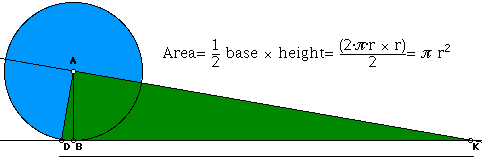
Archimedes was the mathematician who we attribute with finding the area of a circle to be  Where r is the radius and π is the ratio of circumference to diameter of a circle. (Note that Archimedes was not the first to find the area of a circle, but was the first to find π). I would really like to start the class with something along the lines of introducing Archimedes supposed final words “Do not disturb my circles.” And then go into the death of Archimedes and the mystery surrounding his tomb, such as the account of Cicero and the fact that no one knows where the tomb is now. Cicero said that his tomb had a sphere inscribed in a cylinder, which Archimedes considered to be his greatest mathematical proof. From there, the class should have great interest in what is going on. And we can talk about the fact that the area of a circle is the same as the area a triangle with the same base as the circumference and the same height as the radius. ArchimedesCircle

Rorres, Chris. “Tomb of Archimedes – Illustrations”. Courant Institute of Mathematical Sciences. Retrieved 2011-03-15.

green line

Culture

http://newsfeed.time.com/2013/02/02/are-crop-circles-more-than-just-modern-pranks/

I would show this article in class, most likely passing it out to read. I would ask if they thought it was a prank, and then give them a similar picture as presented in the article but mapped out with radiuses. Then I would say that the average person could do so many square feet of crop’s per hour. If it gets dark at 9 pm and the sun comes up at 6 am, could a person pull a prank like this?

After we discussed how to find the area of a circle I would have found one that it was impossible for one person to do. Then I would display this youtube video.

Seeing that there were 2 people working on it could display that it is possible for it to be a hoax. I like this because it gives the students a way to analyze information that they are given. Does it make sense for these things to be aliens? Not really, so let’s find other explanations. It both introduces the concept and teaches some critical thinking skills.

green lineApplications

You could apply the area of a circle to the diameter of a pizza. When you order pizza you order things like an 8 or a 12 inch. These are diameters and do not give the best idea of how much pizza you are actually getting. You can even include this lesson with a pizza party or something similar. This would easily get kids excited since it is something that most kids like, and they would have the possibility of getting pizza afterwards.

pizza

Two-Column Proofs that Two-Column Proofs are Terrible

I’m not entirely sure that I completely agree with the author of this post (http://mathwithbaddrawings.com/2013/10/16/two-column-proofs-that-two-column-proofs-are-terrible/), but he certainly provides food for thought and so I’m happy to link to it. Among the most provocative quotes from this post:

In a good proof, each individual step is obvious, but the conclusion is surprising.  In many two-column proofs—especially those taught earliest in a geometry course—each individual step is mystifying, while the conclusion is obvious.

Engaging students: Central and inscribed angles

In my capstone class for future secondary math teachers, I ask my students to come up with ideas for engaging their students with different topics in the secondary mathematics curriculum. In other words, the point of the assignment was not to devise a full-blown lesson plan on this topic. Instead, I asked my students to think about three different ways of getting their students interested in the topic in the first place.

I plan to share some of the best of these ideas on this blog (after asking my students’ permission, of course).

This student submission comes from my former student Theresa (Tress) Kringen. Her topic, from Geometry: central and inscribed angles.

green line

What interesting word problems using this topic can students do now?

After defining the terms central angle and inscribed angle, students can use a central angles to draw a pie graph or pie chart. They can depict the data using a visual. Based in the percentage of any part of a whole, they will crate a fraction of the whole circle by dividing 360 degrees by that percentage to give the piece of the pie in which they needed to find.

Say a student is given the data below and asked to graph the data into a pie chart:

Students’ favorite colors:

Blue                10

Yellow             3

Red                 7

Orange            3

Green              10

Purple             6

Pink                 9

Other              2

Students would be required to give percentages based on the 50 students with the percentages listed as: Blue 20%, Yellow 6%, Red 14%, Orange 6%, Green 20%, Purple 12%, Pink 18%, other 4%. This would correspond to the percentage of the 360 degree central angle.

To tie in inscribe angles, I would have to students explain why a pie chart would not work with inscribed angles.

green line

How does this topic appear in high culture?

In order to engage students I could help them understand inscribed angles by relating it to the camera angle in their video games. Describing an inscribed angle as a camera angle on their video game would help them understand it better. As they move throughout the game, their camera angle changes. Based on the camera’s location, you are able to see a certain portion of the screen. If there isn’t much of an angle, the range of view is small or zoomed in. This could be explained as the radius of the circle. The smaller the radius, the less view there is. Thus, the opposite is true. If the radius is large, the camera has a larger view of the object. If the camera has a larger angle of view, more is visible in the camera. I would then relate this to the arc length that the angle creates. I would explain that if the angle of the camera is small, the area of the arc length, or view of the camera would also be small. If the angle of the camera is larger, the arc length or view of the camera is much larger.

green line

How can technology be used to effectively engage students with this topic?

Once students are given the application problem listed above, I could then engage them further by asking them to use word or excel to graph the information given into a document. They would be required to make a chart of the data with the listed percentages of each parameter along with the degree of the angle that the parameter requires to make the pie graph. I would require this since the technology would calculate this on its own without the student having to put in the effort. To make it fun, I would give the students a few extra minutes to make their pie graph their own by customizing it to reflect their personality and style.

To further engage them, I could also ask that each student create a questionnaire that asked each student what their favorite choice of any given set of choices were. They would be required to have at least 7 responses as to make a 7 piece pie chart, but they would be able to choose the topic, and find the information for their parameters on their own. Once they did this, they would be required to make an additional pie chart with their results to present to the class.


Engaging students: Finding the area of a square or rectangle

In my capstone class for future secondary math teachers, I ask my students to come up with ideas for engaging their students with different topics in the secondary mathematics curriculum. In other words, the point of the assignment was not to devise a full-blown lesson plan on this topic. Instead, I asked my students to think about three different ways of getting their students interested in the topic in the first place.

I plan to share some of the best of these ideas on this blog (after asking my students’ permission, of course).

This student submission comes from my former student Kayla (Koenig) Lambert. Her topic, from Geometry: finding the area of a square or rectangle.

green line

B) Curriculum: How can this topic be used in student’s future courses in math or science?

 Finding the area of a square or rectangle can be applied in many other subjects throughout a student’s school career. This topic is learned around 4th or 5th grade, and around this time students will just be using the formulas to find the areas. In middle school, they might be finding the areas by way of more difficult problems, like word problems. The real fun for this subject, in my opinion, doesn’t start until high school. In high school you can use the area of squares and rectangles to find the solutions to many problems. In high school geometry, the Pythagorean Theorem is taught. The area of squares is related to this depending on how the teacher presents this to the student. The Pythagorean Theorem states that “in any right triangle, the area of the square whose side is the hypotenuse is equal to the sum of the areas of the squares whose sides are the two legs of the right triangle” (Square-geometry).

In college, possibly high school calculus, students will learn to approximate the total area under a curve (or integral) using the Riemann Sum. To approximate the integral, you find the area of each rectangle, and all of the rectangles areas added together give you the approximated integral. The area of rectangles is also used in Statistics. When creating a histogram, you multiply the height (density) and width of the bars (rectangles).  Then adding the areas (relative frequencies) of all of the bars should be equal to one. Students will also need to use the area of squares and rectangles on college placement exams and standardized testing.


green line

C) Culture: How has this topic appeared in high culture (art, classical music, theatre, etc.)?

 In my opinion, anything and everything is a form of art, so the area of squares and rectangles can appear in an infinite amount of high culture. M.C. Escher has used squares and rectangles to create tessellations and “portrayed mathematical relationships among shapes, figures and space” (MC Escher). The area of a rectangle was used to Polykeitos the Elder who was a Greek sculptor. He used the area of a rectangle to create the perfect ratio for the human body. Painters also needed to figure out how to depict 3D scenes onto 2D canvas during the Renaissance (Mathematics and Art).

However, one of the more well-known applications of mathematics in art is the Golden Rectangle, which just so happens to involve the area of squares and rectangles. The Golden Rectangle is the area of the original rectangle to the area of the square, which is also the Golden Ratio. In other words, the Golden Rectangle is a rectangle wherein the ratio of its length to its width is the Golden Ratio (Golden Rectangle). Many ancient art and architecture have incorporated the Golden Rectangle into designs. The Golden Rectangle was used in the floor plans and design of the exterior of The Parthenon, which was a Greek temple dedicated to goddess Athena in 5th century BC (Mathematics and Art). Leonardo DaVinci also used the Golden Rectangle in his work. When painting the Mona Lisa, he used this to “draw attention to the face of the woman in the portrait” (Mathematics and Art). DaVinci also used the Golden Rectangle in the Last Supper using it to create a “perfect harmonic balance between placement of characters in the background” and also used it to arrange the characters around the table (Mathematics and Art).


green line

D) History: Who were some of the people who contributed to the development of this topic?

 Finding the area of squares and rectangles didn’t just come out of the blue; we can thank geometry and ancient mathematics for the development of this topic. One person in particular who contributed to the development of this topic was Euclid, or Euclid of Alexandria, who was a Greek mathematician and known as the “Father of Geometry” (Euclid). He was said to revolutionize geometry and his book The Elements is considered the most influential textbook of all time (History of Mathematics). The collection of his books, all thirteen of them, contain all traditional school geometry (Solomon).

However, Euler wasn’t the only one to contribute to this topic. Pythagoras and his students discovered most of what high school students learn in geometry today (History of Mathematics). In the classical period, Aryabhata wrote a treatise including the computation of areas. From the kingdom of Cao Wei, Liu Hui edited and commented on The Nine Chapters of Mathematics Art in 179 AD (History of Mathematics). There are so many people who contributed to this topic, and people are still contributing and developing to the area of squares and rectangles today!


Works Cited

“Euclid – Wikipedia, the free encyclopedia.” Wikipedia, the free encyclopedia.  20 Feb. 2012. http://en.wikipedia.org/wiki/Euclid.

“Golden Rectangle.” Logicville : Puzzles and Brainteasers.  20 Feb. 2012. http://www.logicville.com/sel26.htm.

“M. C. Escher – Wikipedia, the free encyclopedia.” Wikipedia, the free encyclopedia. 20 Feb. 2012. http://en.wikipedia.org/wiki/M._C._Escher.

“Mathematics and art – Wikipedia, the free encyclopedia.” Wikipedia, the free encyclopedia.  20 Feb. 2012. http://www.en.wikipedia.org/wiki/Mathematics_and_art.

Solomon, Robert. The Little Book Of Mathematical Principals, Theories and Things. New York: Metro Books, 2008.

“Square (geometry) – Wikipedia, the free encyclopedia.” Wikipedia, the free encyclopedia. 20 Feb. 2012. http://en.wikipedia.org/wiki/Square_(geometry).

“History of mathematics – Wikipedia, the free encyclopedia.” Wikipedia, the free encyclopedia. 20 Feb. 2012. http://en.wikipedia.org/wiki/History_of_mathematics.


Engaging students: Truth tables

In my capstone class for future secondary math teachers, I ask my students to come up with ideas for engaging their students with different topics in the secondary mathematics curriculum. In other words, the point of the assignment was not to devise a full-blown lesson plan on this topic. Instead, I asked my students to think about three different ways of getting their students interested in the topic in the first place.

I plan to share some of the best of these ideas on this blog (after asking my students’ permission, of course).

This student submission comes from my former student Elizabeth (Markham) Atkins. Her topic, from Geometry: truth tables.

green line

D. History: Who were some of the people who contributed to the development of this topic?

In “Peirce’s Truth-Functional Analysis and the Origin of Truth Tables” it is said that Charles Peirce was the first to start studying truth tables or rather developing the idea. He created the truth table in 1893. Peirce stated “the purpose of reasoning is to establish the truth or falsity of our beliefs, and the relationship between truth and falsity”. Nineteen years later, two mathematicians developed the truth table as we know it today. Ludwig Wittgenstein and Bertrand Russell both knew of truth tables but formalized them into the form we know today. In “The Genesis of the Truth-Table Device” it is said that George Berry stated “Peirce developed the technique, but not the device”. Wittgenstein developed the terminology that we today associate with truth tables. All in all it is the work of many people that finally developed the truth tables that we know today.


green line

APPLICATIONS: What interesting word problems using this topic can your students do now?

Truth tables state that if P is true and Q is true then both P and Q are true. If either P or Q or both are false then P and Q are false. So I could have the students construct many truth tables to demonstrate their knowledge of the subject or I could come up with some interesting word problems. Word problems such as “True or false: If Billy Joe graduated and Shawn graduated then both Billy Joe and Shawn graduated.” There are not many word problems you could create that would deal with truth tables. You can have the students begin to think logically. You could give them a statement to complete such as, “Good apples are red. Granny Smith apples are green. Thus ____” This enables the teacher to get the students in the logical process of thinking in order for them to correctly understand truth tables.

green line

B. CURRICULUM: How can this topic be used in your students’ future courses in mathematics or science?

By teaching my students truth tables and how to use them correctly it prepares them for future classes and for everyday life. In high schools now the students are learning twenty first century skills. To learn truth tables it will help with the twenty first century skills. When you learn truth tables you learn to think logically. The students need to learn logical thinking for science and economics. In Science, they need to learn logical thinking for when they do experiments. It will allow them to process, “well if I do this then this might happen.” In economics students need logical thinking so that when they learn to invest money they can weigh their options. In everyday life students make decisions that they need to think about. Teenagers in the modern day are moving so fast that they often do and say things without thinking. If they learn to think logically then they might be able to think, “If I say or do this then this might happen.”

Irving H. Anelli’s