In this series of posts, I consider how algebra can be used to answer a question about the 2048 game: From looking at a screenshot of the final board, can I figure out how many moves were needed to reach the final board? Can I calculate how many new 2-tiles and 4-tiles were introduced to the board throughout the course of this game? In this post, we consider the event horizon of 2048, which I reached after about four weeks of intermittent doodling:
In yesterday’s post, we developed a system of two equations in two unknowns to solve for and , the number of 2-tiles and 4-tiles (respectively) that appeared throughout the course of the game:
.
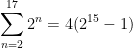
In this post and tomorrow’s post, I consider how the two sums in the above equations can be obtained without directly adding the terms.
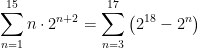
In this post, I perform this calculation again, except symbolically and more compactly. The key initial steps are writing the series as a double sum and then interchanging the order of summation (much like reversing the order of integration in a double integral). This is a trick that I’ve used again and again in my own research efforts, but it seems that the students that I teach have never learned this trick. Here we go:
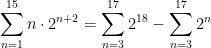
The inner sum is a finite geometric series with terms, common ratio of 2, and initial term . Therefore,
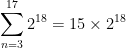
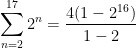
The first sum is merely the sum of a constant. The second sum is another finite geometric series with 15 terms, common ratio of 2, and initial term . So
In this series of posts, I consider how algebra can be used to answer a question about the 2048 game: From looking at a screenshot of the final board, can I figure out how many moves were needed to reach the final board? Can I calculate how many new 2-tiles and 4-tiles were introduced to the board throughout the course of this game? In this post, we consider the event horizon of 2048, which I reached after about four weeks of intermittent doodling:
In yesterday’s post, we developed a system of two equations in two unknowns to solve for and , the number of 2-tiles and 4-tiles (respectively) that appeared throughout the course of the game:
.
In this post and tomorrow’s post, I consider how the two sums in the above equations can be obtained without directly adding the terms.
In yesterday’s post, we showed that the formula for the sum of a finite geometric series can be used to calculate the first sum:
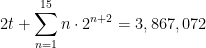
Let’s now consider the second (and more complicated) sum, which can be written as
For reasons that will become clear shortly, this sum can be written in expanded form as
Let’s now rearrange the terms of this sum. We will do this by adding along the diagonals instead of along the rows. In this way, the above sum can be rearranged as
Each of these new rows (or the original diagonals) is a geometric series and can be calculated using the formula:
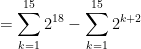
So, thus far in the calculation, we have established that
.
Simplifying,
The first sum on the right is the sum of a constant being added to itself 15 times:
The second sum on the right is yet another geometric series. Indeed, it’s the same geometric series from the first diagonal above:
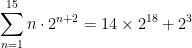
Therefore,
Not surprisingly, this matches the sum that was found via direct addition.
In this series of posts, I consider how algebra can be used to answer a question about the 2048 game: From looking at a screenshot of the final board, can I figure out how many moves were needed to reach the final board? Can I calculate how many new 2-tiles and 4-tiles were introduced to the board throughout the course of this game? In this post, we consider the event horizon of 2048, which I reached after about four weeks of intermittent doodling:
In yesterday’s post, we developed a system of two equations in two unknowns to solve for and , the number of 2-tiles and 4-tiles (respectively) that appeared throughout the course of the game:
.
In this post and tomorrow’s post, I consider how the two sums in the above equations can be obtained without directly adding the terms.
In this series of posts, I consider how algebra can be used to answer a question about the 2048 game: From looking at a screenshot of the final board, can I figure out how many moves were needed to reach the final board? Can I calculate how many new 2-tiles and 4-tiles were introduced to the board throughout the course of this game? In this post, we consider the event horizon of 2048, which I reached after about four weeks of intermittent doodling:
In the previous posts, we have developed a system of two equations in two unknowns to solve for and , the number of 2-tiles and 4-tiles (respectively) that appeared throughout the course of the game.
The first equation,
,
says that the sum of the tiles that were introduced has to be equal to the sum of the tiles that appear on the final board. Directly adding the sixteen tiles above yields
.
This sum can also be calculated using a trick to be discussed in tomorrow’s post.
The second equation,
,
says that the total number of points may be divided into the contributions provided by the tiles on the final board. For example, the 16-tile was formed by joining two 8-tiles for 16 points. Each of those 8-tiles were formed by joining two 4-tiles for another points. Added together, the 16-tiles results in points. This analysis does not account for any 4-tiles that were created by adding two 2-tiles. The number of such 2-tiles is , where is the number of 2-tiles that appear on the final board (in this case, ). These additions result in 2-tiles worth points.
For the board above, this equation becomes
and (for this particular board) the sum can be written more simply as
Directly adding the sum — and being very careful to double-check the arithmetic — yields the second equation
This sum can also be calculated using a trick to be discussed in a future post.
Solving, we find
Substituting into the first equation:
So we conclude that 98,524 2-tiles and 16,273 4-tiles were introduced to the board. Stated another way, about 85.8% of the new tiles were 2-tiles, while about 14.2% of the new tiles were 4-tiles. Also, since two tiles were on the board before any moves were made, a total of moves were needed to reach the above board.
In this series of posts, I consider how algebra can be used to answer a question about the 2048 game: From looking at a screenshot of the final board, can I figure out how many moves were needed to reach the final board? Can I calculate how many new 2-tiles and 4-tiles were introduced to the board throughout the course of this game?
(The above board is the only picture I currently have of reaching 4096 without using an undo — the version of the game that I had at the time permitted two undos per game. I have also reached 8192 in game mode — I was really lucky that day — but I sadly don’t have a screenshot to memorialize the occasion.)
In the previous post, I used two insights to develop of a system of two equations in two unknowns. Let and denote the number of 2-tiles and 4-tiles, respectively, that were introduced by the game. The sum of the tiles on the final board must also be the sum of the 2-tiles and 4-tiles that were introduced during the course of the game. Therefore,
Next, we consider how the total of 44,148 points was reached by looking at the final tiles.
Each 8-tile was formed by joining two 4-tiles (for 8 points). Some of those 4-tiles were added by the computer; others were formed by joining two 2-tiles (for 4 points each). So each 8-tile is worth points, plus 4 times some undetermined number.
Each 16-tile was formed by joining two 8-tiles (for 16 points). Each of those two 8-tiles was formed by joining two 4-tiles (for 8 points for each 8-tile, or more points). Again, some of those 4-tiles were added by the computer; others were formed by joining two 2-tiles (for 4 points each). So each 16-tile is worth points, plus 4 times some undetermined number.
There are no 32-tiles on this board. However, to continue the pattern, any 32-tiles are formed by joining two 16-tiles (for 32 points). Each of those two 16-tiles was formed by joining two 8-tiles (for 16 points for each 16-tile, or more points). Each of those four 8-tiles was formed by joining two 4-tiles (for 8 points for each 8-tile, or more points). Again, some of those 4-tiles were added by the computer; others were formed by joining two 2-tiles (for 4 points each). So each 16-tile is worth points, plus 4 times some undetermined number.
By now, the pattern should be clear. Any 64-tile on the board would contribute points, plus 4 times some undetermined number (as a reminder, the number of 4-tiles formed by adding in the course of making the 64-tile).
Any 128-tile on the board would contribute points, plus 4 times some undetermined number.
And, in general, a -tile would contribute points, plus 4 times some undetermined number.
In particular, when , a 4096-tile would contribute points, plus 4 times some undetermined number.
In summary, for the above board, there are:
Three 4-tiles (for 4 times some undetermined number),
Two 8-tiles (for points plus 4 times some undetermined number),
One 16-tile (for points plus 4 times some undetermined number), and
One 4096-tile (for points plus 4 times some undetermined number).
Adding, this board will have , plus 4 times some undetermined number.
What is this undetermined number? It is the number of 4-tiles that are formed by combined two 2-tiles throughout the course of the game thus far. Since is the number of 2-tiles that have appeared and there are three 2-tiles on the board above, we conclude that 2-tiles have been combined into 4-tiles throughout the course of the game, resulting in points. Therefore, we have the second equation
Let’s start solving:
Substituting into the first equation:
So we conclude that 1573 2-tiles and 250 4-tiles were introduced to the board. Stated another way, about 86.3% of the new tiles were 2-tiles, while about 13.7% of the new tiles were 4-tiles. Also, since two tiles were on the board before any moves were made, a total of moves were needed to reach the above board.
In this series of posts, I consider how algebra can be used to answer a question about the 2048 game: From looking at a screenshot of the final board, can I figure out how many moves were needed to reach the final board? Can I calculate how many new 2-tiles and 4-tiles were introduced to the board throughout the course of this game?
In the previous two posts, we developed two key insights (which will be used to develop of system of two equations in two unknowns):
1. Likewise, the 16-tile on the board was formed by adding two 8-tiles (16 points). Each of those 8-tiles was formed by adding two 4-tiles (, or another 16 points). And those 4-tiles, as well as the final 4-tile on the board, could have been (a) newly introduced by the game or else (b) formed by adding to 2-tiles (thus adding 4 points to the score for each of those 4-tiles).
Let and denote the number of 2-tiles and 4-tiles, respectively, that were introduced by the game. Since there are three 2-tiles on this final board, we conclude that 2-tiles were combined to make 4-tiles. Since each of these 4-tiles adds 4 points, we conclude that the final score of 44 points was obtained as follows:
2. The sum of the tiles on the final board is . This also must be the sum of the 2-tiles and 4-tiles that were introduced during the course of the game. This gives us a second equation:
.
So we have a system of two equations in the two unknowns and . This is actually a simple system of equations to solve. Starting with the first equation:
Substituting into the second equation:
This indeed matches what happened: nine 2-tiles and two 4-tiles were introduced to the board. Furthermore, since two of these tiles were on the initial board, we can conclude that it took nine moves to reach the final board.
In this series of posts, I consider how algebra can be used to answer a question about the 2048 game: From looking at a screenshot of the final board, can I figure out how many moves were needed to reach the final board? Can I calculate how many new 2-tiles and 4-tiles were introduced to the board throughout the course of this game?
To study this question, here’s a graphic showing the first nine moves in a typical game of 2048. I’ve included black circles to highlight the new 2-tiles and 4-tiles that are placed with each successive move, and I’ve added dark red ovals to indicate when two tiles are about to be combined in the next move.
In yesterday’s post, I raised one key insight about this game: we can calculate how many points were added for making each tile on the final board.
In today’s post, I raise a second insight. The final board has three 2-tiles, one 4-tile, and one 16-tile. So the sum of the tiles is 6 + 4 + 16, or 26. Also, during the course of the game, nine 2-tiles and two 4-tiles were introduced by the game. The sum of these tiles is 18 + 8, which is also 26. In other words, the sum of the tiles on the final board must equal the sum of the tiles that are introduced during the successive moves of the game.
With these two insights, we will (in tomorrow’s post) set up a system of two equations in two unknowns that will allow us to solve for the number of 2-tiles and 4-tiles that were introduced during the game using only the information on the final board.
In this series of posts, I consider how algebra can be used to answer a question about the 2048 game: From looking at a screenshot of the final board, can I figure out how many moves were needed to reach the final board? Can I calculate how many new 2-tiles and 4-tiles were introduced to the board throughout the course of this game?
To study this question, here’s a graphic showing the first nine moves in a typical game of 2048. I’ve included black circles to highlight the new 2-tiles and 4-tiles that are placed with each successive move, and I’ve added dark red ovals to indicate when two tiles are about to be combined in the next move.
Clearly, for these 9 moves, the computer introduced nine 2-tiles and two 4-tiles (including the two tiles that began the game in the initial position.) So here’s the question: is there a way, from looking only at the final board (with three 2-tiles, one 4-tile, and one 16-tile) and without looking at any of the prior history of the game, to calculate the number of 2-tiles and 4-tiles that were introduced?
In this post, I introduce the first of two insights that will allow us to answer these questions using algebra. (The second insight will be discussed in tomorrow’s post.) To study this question, let’s begin with the final board (with a score of 44 points) and look at how the tiles on the final board were formed.
Clearly, the three 2-tiles do not contribute anything to the final score. Net contribution: 0 points.
The one 4-tile on the final board (marked with a green circle) hypothetically could have either been a new tile that was introduced by the computer or else formed by combining two 2-tiles. In this case, we see that this particular 4-tile was indeed formed by adding two 2-tiles on Move 8. Net contribution: 4 points.
Handling the one 16-tile on the final board is a little more interesting. To begin, this 16-tile was formed from adding two 8-tiles on Move 8. Net contribution: 16 points.
Each of these 8-tiles were formed by adding two 4-tiles (one on Step 4, the other on Step 7). Net contribution: , or another 16 points.
Two of the four tiles were formed by adding two 2-tiles (on steps 3 and 6). The other two four tiles were introduced by the computer (on steps 0 and 3) and were moved around the board prior to combining with another 4-tile. Net contribution: , or 8 points.
So the total score is 4 points from making 4-tile on the final board and 16+16+8 = 40 points from making the 16-tile on the final board, for a total of 44 points.
This way of thinking about the game… how many points were added for making each tile on the final board… is one of two insights necessary to use algebra to solve for the prior history of the game. After discussing the second insight tomorrow, we’ll be ready to discuss the algebra of 2048.
In July and early August of this year, I finally defeated the wildly addicting 2048 game. That’s not to say that I reached the 2048-tile. No, I really defeated the game by reaching the event horizon that literally cannot be surpassed. (This is the usual way I overcome video-game addiction… play the game so much that I get sick of it.)
Over the four weeks or so that it took me to reach the event horizon, I thought of some interesting questions: From looking at only the above screenshot, can I figure out how many moves were needed to reach the final board? Can I calculate how many new 2-tiles and 4-tiles were introduced to the board throughout the course of this game?
It turns out that these questions can be solved with simple algebra. Indeed, if posed in the correct fashion, these questions can be answered using only elementary-school arithmetic. I will discuss the answers to these questions in this series of posts.
It should be noted that the above game board was accomplished in practice mode, and I needed perhaps a couple thousand undos to offset the bad luck of a tile randomly appearing in an unneeded place. I estimate the odds of a skilled player reaching the event horizon in game mode to be about to one. Later in this series, I’ll give my rationale for this estimate.
For what it’s worth, my personal best in game mode was reaching the 8192-tile. I’m convinced that, even with the random placements of the new 2-tiles and 4-tiles, the skilled player can reach the 2048-tile nearly every time and should reach the 4096-tile most of the time. However, reaching the 8192-tile requires more luck than skill, and reaching the 16384-tile requires an extraordinary amount of luck.
In my capstone class for future secondary math teachers, I ask my students to come up with ideas for engaging their students with different topics in the secondary mathematics curriculum. In other words, the point of the assignment was not to devise a full-blown lesson plan on this topic. Instead, I asked my students to think about three different ways of getting their students interested in the topic in the first place.
I plan to share some of the best of these ideas on this blog (after asking my students’ permission, of course).
This student submission comes from my former student Samantha Smith. Her topic, from Precalculus: graphing an ellipse.
How has this topic appeared in pop culture?
Football is America’s favorite sport. There is practically a holiday for it: Super Bowl Sunday. I do not think students realize how much math is actually involved in the game of football, from statistics, to yards, the stadium and even the football itself. The video link below explores the shape of the football and of what importance the shape is. As you can see in the picture below, a 2D look of the football shows us that it is in the shape of an ellipse.
The video further explains how the 3D shape (Prolate Spheroid) spins in the air and is aerodynamic. Also, since it is not spherical, it is very unpredictable when it hits the ground. The football can easily change directions at a moments notice. This video is a really cool introduction to graphing an ellipse; it shows what the shape does in the real world. Students could even figure out a graph to represent a football. Overall, this is just a way to engage students in something that they are interested in.
D. History: What interesting things can you say about the people who contributed to the discovery and/or development of this topic?
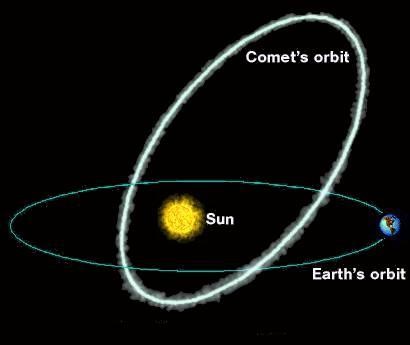
Halley’s Comet has been observed since at least 240 B.C. It could be labeled as the most well-known comet. The comet is named after one of Isaac Newton’ friends, Edmond Halley. Halley worked closely with Newton and used Newton’s laws to calculate how gravitational fields effected comets. Up until this point in history, it was believed that comets traveled in a straight path, passing the Earth only once. Halley discovered that a comet observed in 1682 followed the same path as a comet observed in 1607 and 1531. He predicted the comet would return in 76 years, and it did. Halley’s Comet was last seen in 1986 so, according to Halley’s calculations, it will reappear in 2061.
Halley’s Comet has an elliptical orbit around the sun. It gets as close to the sun as the Earth and as far away from the sun as Pluto. This is an example of how ellipses appear in nature. We could also look at the elliptical orbits of the different planets around the sun. Students have grown up hearing about Newton’s Laws, but this is an actual event that supported and developed those laws in relation to ellipses.
Through my research on ellipses, the coolest application I found is Statuary Hall (the Whispering Gallery) in our nation’s capital. The Hall was constructed in the shape of an ellipse. It is said that if you stand at one focal point of the ellipse, you can hear someone whispering across the room at the other focal point because of the acoustical properties of the elliptical shape. The YouTube video below illustrates this phenomena. The gallery used to be a meeting place of the House of Representatives. According to legend, it was John Quincy Adams that discovered the room’s sound properties. He placed his desk at a focus so he could easily hear conversations across the room.
The first link below is a problem students can work out after transitioning from the story of the hall. Given the dimensions of the room, students find the equation of the ellipse that models the room, the foci of the ellipse, and the area of the ellipse. This one topic can cover multiple applications of the elliptical form of Statuary Hall.



















 .
.



 ,
,

 ,
, that appear on the final board. Directly adding the sixteen tiles above yields
 .
. ,
, may be divided into the contributions provided by the tiles on the final board. For example, the 16-tile was formed by joining two 8-tiles for 16 points. Each of those 8-tiles were formed by joining two 4-tiles for another
  points. Added together, the 16-tiles results in
  points. This analysis does not account for any 4-tiles that were created by adding two 2-tiles. The number of such 2-tiles is
  , where
  is the number of 2-tiles that appear on the final board (in this case,
  ). These additions result in
  2-tiles worth
  points.
 — and being very careful to double-check the arithmetic — yields the second equation





 moves were needed to reach the above board.


 points, plus 4 times some undetermined number.
 points, plus 4 times some undetermined number.
 more points). Each of those four 8-tiles was formed by joining two 4-tiles (for 8 points for each 8-tile, or
  more points). Again, some of those 4-tiles were added by the computer; others were formed by joining two 2-tiles (for 4 points each). So each 16-tile is worth
  points, plus 4 times some undetermined number.
 points, plus 4 times some undetermined number (as a reminder, the number of 4-tiles formed by adding in the course of making the 64-tile).
 points, plus 4 times some undetermined number.
 -tile would contribute
  points, plus 4 times some undetermined number.
 , a 4096-tile would contribute
  points, plus 4 times some undetermined number.
 points plus 4 times some undetermined number), and
 points plus 4 times some undetermined number).
 , plus 4 times some undetermined number.
 2-tiles have been combined into
  4-tiles throughout the course of the game, resulting in
  points. Therefore, we have the second equation





 moves were needed to reach the above board.
 , or another 16 points). And those 4-tiles, as well as the final 4-tile on the board, could have been (a) newly introduced by the game or else (b) formed by adding to 2-tiles (thus adding 4 points to the score for each of those 4-tiles).


 . This also must be the sum of the 2-tiles and 4-tiles that were introduced during the course of the game. This gives us a second equation:
 .
.


 , or 8 points.
 to one. Later in this series, I’ll give my rationale for this estimate.