Engaging students: Defining the terms complementary angles, supplementary angles, and vertical angles

In my capstone class for future secondary math teachers, I ask my students to come up with ideas for engaging their students with different topics in the secondary mathematics curriculum. In other words, the point of the assignment was not to devise a full-blown lesson plan on this topic. Instead, I asked my students to think about three different ways of getting their students interested in the topic in the first place.

I plan to share some of the best of these ideas on this blog (after asking my students’ permission, of course).

This student submission comes from my former student Brittany Tripp. Her topic, from Geometry: defining the terms complementary angles, supplementary angles, and vertical angles

green line

How could you as a teacher create an activity or project that involves your topic?

I really enjoy getting the students up, out of their seats, moving around, and engaging with one another. One way that you could do this, that would fit for this topic, would be to create different matching cards. You could makes cards that have the names: complementary angles, supplementary angles, and vertical angles. Then to go along with those you could have different cards that have the definitions of the different types of angles and other characteristics about them. You would give each student a card and then turn on some music and have them dance around the room looking for the people that pair with them. I love the idea of music because it gets the students more engaged than just lazily walking around the room. In my opinion, music and dancing your awakens senses and increases student engagement in a way that just walking around doesn’t. After everyone finds the people they pair with you could have each group read off their cards so that everyone else has to opportunity to gain all the information on all of the cards. You could take this one step further and get different angles and measurements and cards ask the students to first find their complementary angle, then supplementary. This would give them the opportunity to actually practice the different types of angles and put definitions to actually problems.


green line

What interesting things can you say about the people who contributed to the discovery and/or development of this topic?

A variety of people have contributed to the discovery and development of this topic, for instance: Proclus, Eudemus, Euclid, and that is just to name a few. They all have varying definitions of what an angle itself is and while none of them use the terms complementary, supplementary, or vertical angles, they state things that we now know to be those things. Proclus, or Proclus of Athens, is known to have been “the most authoritative philosopher of late antiquity.” “[He] was eager to demonstrate the harmony of the ancient religious revelations and to integrate them in the philosophical tradition of Pythagoras and Plato.” He also wrote commentaries on a variety of other philosophers and mathematicians works including, but not limited to, Euclid, Aristotle, and Plato. In a commentary of Euclid’s first book of elements, Proclus’s idea, of what an angle is, is presented.

There are also two corollaries given by Proclus in association with Book I Proposition 32 of Euclid’s Elements which discusses the three angles of a triangle. Eudemus, or Eudemus of Rhodes, was a Greek philosopher very present before 300 B.C. He worked closely with Aristotle and Theophrastus. “[Eudemus’s] history of geometry, arithmetic, and astronomy completed the Doctrines of the Natural Scientists of Theophrastus.” There are three known works on the history of Mathematics that were contributed by Eudemus, those, as stated in the previous quote, being: History of Arithmetic, History of Geometry, and History of Astronomy. Eudemus’s idea of what an angle is, is also presented in the commentary of Euclid’s first book of elements.

Of course, considering Eudemus is known for one of his works History of Geometry, I think it is safe to say he contributed much more to Geometry than this simply idea of an angle. Now on to maybe one of the most well known mathematicians, who contributed to the understanding and development of angles, Euclid. There is not very much that anyone knows about Euclid besides when and where he was born. He is mostly known for this contribution to geometry in the Elements. In Euclid’s book, Euclid’s Elements, there are propositions outlining a variety of different types of angles such as supplementary angles and vertical angles. For instance, Book I Proposition 13 of Euclid’s Elements is about supplementary angles and Book I Proposition 15 is about vertical angles.


green line

How can technology be used to effectively engage students with this topic?

There is a website that I have used before with students that I have tutored and I have really enjoyed using it and see how much the students enjoy using it! The website is IXL Learning (https://www.ixl.com/). I love this website because it has a huge variety of different mathematics topics ranging from grades Pre-K, counting objects, to Twelfth grade, Pre-Calculus and Calculus. The website alone is super appealing because it is very colorful which instantly helps to catch the attention of whomever is using it. All of the grades levels are presented on the homepage so it makes finding the grade you are looking for extremely easy. When you click on the grade level it takes you to a screen that is broken up into categories and within each category there are subcategories. These make it even easier to find/access the specific topic you are looking for. For instance when looking for complementary, supplementary, and vertical angles you can click on tenth grade geometry. The page it takes you to contains a category called Angles. Under the angles category there are subcategories that include angle vocabulary, angle measures, identify different types of angles, as well as other things.



Engaging students: Classifying polygons

In my capstone class for future secondary math teachers, I ask my students to come up with ideas for engaging their students with different topics in the secondary mathematics curriculum. In other words, the point of the assignment was not to devise a full-blown lesson plan on this topic. Instead, I asked my students to think about three different ways of getting their students interested in the topic in the first place.

I plan to share some of the best of these ideas on this blog (after asking my students’ permission, of course).

This student submission again comes from my former student Brianna Horwedel. Her topic, from Geometry: classifying polygons.

green line

How could you as a teacher create an activity or project that involves your topic?

A great activity for classifying polygons would be a card sort. Give students index cards with different ways to describe polygons on them. For example, the cards could say “has three sides”, “has five sides”, “has 4 equal sides”, “has four sides”, “triangle”, “quadrilateral”, “square”, “pentagon”. Also include cards with a pictorial representation of the polygons that you want them to identify. Have the students work in groups of three or four to match all of the cards. For example, “has three sides”, “triangle”, and the picture of a triangle would all be matched together. After about five to ten minutes of the students working in their groups, I would have a larger set of the index cards (probably on standard printer paper) that one person from each group would come up and place in the correct category/group.


green line

How can technology be used to effectively engage students with this topic?

There are tons of great polygon sorting games online. At the beginning of the unit I would have the students play Polygon Shape Game (http://www.sheppardsoftware.com/mathgames/geometry/shapeshoot/PolygonShapesShoot.htm). It is a great introductory game. It really helps the students understand what it means to be a polygon. The students have to pick out all of the shapes that are polygons on one round; on the next round, they have to pick out all of the shapes that aren’t polygons. Once students have a better understanding of what defines a polygon and different types of polygons, I would have them play Half a Min: Polygon (http://www.math-play.com/types-of-poligons.html). This game makes the students type in a type of polygon based on the hint given. This game is definitely harder than the first one; I would save it for maybe a review before a test.


green line

How has this topic appeared in high culture (art, classical music, theatre, etc.)?

Polygons occur frequently in abstract art, particularly the movement called De Stijl. It was inspired in part by the chaos of war. Dutch artists in 1917 wanted to contrast the messiness of war with art that consisted of balance, harmony, and the absence of individual expression. Piet Mondrian is one of the most famous artists to come from this particular movement. His work is created using grids, which creates various rectangles, and primary colors. Here is one of his paintings titles Broadway Boogie Woogie:

It would be really fun for the students to then create their own artwork in the De Stijl style using only polygons that we have previously discussed.

References:

http://visionandverse.blogspot.com/2014/08/the-art-of-piet-mondrian.html

http://www.abstract-art-framed.com/mondrian.html

http://www.math-play.com/types-of-poligons.html

http://www.sheppardsoftware.com/mathgames/geometry/shapeshoot/PolygonShapesShoot.htm


Engaging students: Truth tables

In my capstone class for future secondary math teachers, I ask my students to come up with ideas for engaging their students with different topics in the secondary mathematics curriculum. In other words, the point of the assignment was not to devise a full-blown lesson plan on this topic. Instead, I asked my students to think about three different ways of getting their students interested in the topic in the first place.

I plan to share some of the best of these ideas on this blog (after asking my students’ permission, of course).

This student submission comes from my former student Anna Park. Her topic, from Geometry: truth tables.

green line

How could you as a teacher create an activity or project that involves your topic?


The student’s will each be given half a sentence. The student’s have to walk around and talk to everyone in the class and compare their slivers of paper. They have to logically match up with someone in order to finish their statement. For example, one student will have “If I have a flat tire,” and another student will have,” then I will have to change the tire” then they would be matched together. Once all of the students find their match the student’s will stand up with their partner and present their sentence and explain why it logically works.


green line

How can this topic be used in your students’ future courses in mathematics or science?


Truth tables will be used in geometry and in nearly every math class that follows. In college, truth tables are used in discrete mathematics, real analysis, and any proof based class. Truth tables help develop logical thinking, which is needed when one writes a mathematical proof. Many students understand the idea of cause and effect, but they do not logically think out their actions before they do them. Truth tables allow you to think deeper in cause and effect. Which, they will need later in life when making big decisions. For instance, in college there are many things to juggle. For example; assignments, sleep, physical activity, social life, and work. I have to consider all of my options logically in order to get everything done. I think about how many hours I have left in the day after I have class and work, then I look at my assignments and their due dates and see which ones I can complete given the time I have. Then I plan my workout to go with the exact amount of time left over, and still manage to get around seven hours of sleep. I have to think to my self, “ If I get this assignment done today, then I can do my other assignment tomorrow.” Students will need to learn cause and effect and truth tables is a good place to start.


green line

How can technology (YouTube, Khan Academy [khanacademy.org], Vi Hart, Geometers Sketchpad, graphing calculators, etc.) be used to effectively engage students with this topic?


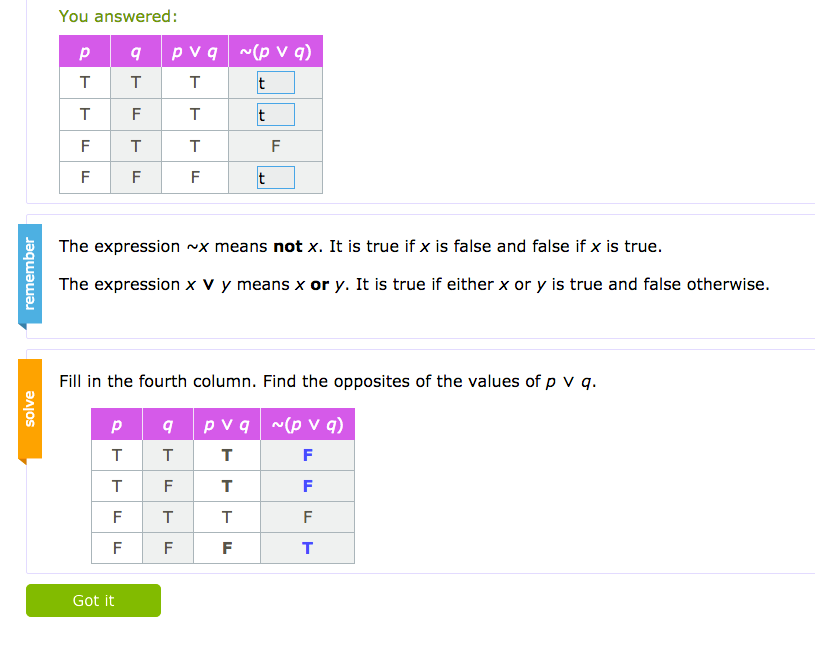
There are many youtube videos that show you how to do truth tables, which is great for when you are learning. But there is a website where students can practice writing truth tables and get immediate feedback if they are right or wrong. The students’ can practice for as long as they want, and it is great repetition for the student to remember how truth tables work and the rules they must follow. With the website when the students get it wrong it will explain why the student was wrong and why the table should be what it is. Below is an example of what the website does when the answer is incorrect.

https://www.ixl.com/math/geometry/truth-tables


Engaging students: Deriving the proportions of a 45-45-90 right triangle

In my capstone class for future secondary math teachers, I ask my students to come up with ideas for engaging their students with different topics in the secondary mathematics curriculum. In other words, the point of the assignment was not to devise a full-blown lesson plan on this topic. Instead, I asked my students to think about three different ways of getting their students interested in the topic in the first place.

I plan to share some of the best of these ideas on this blog (after asking my students’ permission, of course).

This student submission comes from my former student Amber Northcott. Her topic, from Geometry: deriving the proportions of a 45-45-90 right triangle.

green line

How could you as a teacher create an activity or project that involves your topic?

There are ways to make the 45-45-90 right triangle not only interesting, but make it fun. A project or activity that I made up involves architecture using the special right triangle 45-45-90. In the project the students become architects. Their job is to create their own architecture, whether it is a bridge or house, etc. by using 45-45-90 right triangles. They must use a three to ten 45-45-90 right triangles. Once the students figured out how many they will use, they are going to draw their architecture. Then the students will label the sides and angles of what they drew. At the end of the activity or project they will solve the 45-45-90 triangles they used. An option for a long project is to actually build the architecture using measurable materials. The project will allow them to be creative and connect real life to the 45-45-90 right triangle. The students will also present their projects.

Another way to do the activity or project is make it a group activity and give the students some word problems dealing with architecture and have them choose one of those word problems. The students will then take the word problem and create the architecture in the word problem. They can draw it or create it, but it has to be measured and labeled along with finding the missing piece. Then they can present their findings, which includes how they came up with their measurements of sides and angles.

All the ways to do the activity or project will still need the student to be able to answer any questions that their peers or myself may ask. Also, at the end their will be a reflection on the project and their interpretation of how to solve the 45-45-90 right triangle.


green line

How has this topic appeared in high culture (art, classical music, theatre, etc.)?

Triangles can be seen everywhere. For example, they can be seen on bridges and buildings. The website geometrinarchitecture.weebly.com has a section talking about the special right triangles, which includes the 45-45-90 right triangle. On the bottom of the page the website shares pictures of windows, roofs, and even a front door is seen within a triangle. The webpage also gives examples of how the special triangles can be used in architecture.

green line

How can technology (YouTube, Khan Academy [khanacademy.org], Vi Hart, Geometers Sketchpad, graphing calculators, etc.) be used to effectively engage students with this topic? Note: It’s not enough to say “such-and-such is a great website”; you need to explain in some detail why it’s a great website.

The dynamicgeometry.com website talks about the Geometers Sketchpad. After checking it out, I find that the program can be useful. The students can create their own 45-45-90 right triangles and explore the idea of 45-45-90 right triangles on their own after instructions on how to use the program. This engages them because the student will be able to think, how can I create a 45-45-90 right triangle? What is a 45-45-90 right triangle?  The students will have these questions and more, but those questions will soon be answered throughout the lesson itself.

References

http://geometrinarchitecture.weebly.com/special-triangles.html

http://www.dynamicgeometry.com/index.html


Engaging students: Solving two-step algebra problems

In my capstone class for future secondary math teachers, I ask my students to come up with ideas for engaging their students with different topics in the secondary mathematics curriculum. In other words, the point of the assignment was not to devise a full-blown lesson plan on this topic. Instead, I asked my students to think about three different ways of getting their students interested in the topic in the first place.

I plan to share some of the best of these ideas on this blog (after asking my students’ permission, of course).

This student submission again comes from my former student Jessica Bonney. Her topic, from Pre-Algebra: solving two-step algebra problems.

green line

How could you as a teacher create an activity or project that involves your topic?

A great activity to use in the classroom with students for this topic would have to be algebra tiles. The tiles are a good manipulative that can be used to improve the students’ understanding and offer contact to representative manipulation for students that are more kinesthetic learners. The algebra tiles can be used to help justify and explain the process of solving two-step equations. They were developed on the basis of two ideas: (1) we can isolate variables by using “zero pairs” and (2) equations don’t change when equal amounts of tiles are used on both sides of the equation. Algebra tiles come in different colors and sizes, which can be used to represent different parts of an equation that can help students solve two-step algebra problems.  I think this would be a fun and interactive activity to help students learn and understand how to go about solving these types of problems.


green line

How can this topic be used in your students’ future courses in mathematics or science?

Once a student gets to a certain grade level, they constantly start building upon what they learn. This material can be carried into high school and even college level courses.  Before a student learns two-step equations, they must master one-step equations, and even before that they need to understand basic arithmetical operations. Once mastery has been achieved, students will move onto solving larger polynomials, which can later be used in future algebra, geometry, and calculus courses. Another interesting use for two-step algebra problems is for future science and even computer science courses. In science, let’s say physics or chemistry, the students can use the two-step method for solving how fast a ball fell from a rooftop or for solving how fast a chemical evaporated at a certain temperature. Now in computer science students can learn how to develop algebraic functions in a computerized setting.


green line

What interesting things can you say about the people who contributed to the discovery and/or the development of this topic?

Rene’ Descartes, born in March of 1596, was a French mathematician, philosopher, and scientist. He is widely known for the statement, “I think, therefore I am,” deriving it from the foundation of intuition that, when he thinks, he exists. After obtaining a degree in law, his father wanted him to join Parliament, but sadly he was only 20 and the minimum age to join was 27. In turn, he moved to the Netherlands where he was influenced to study science and mathematics. During this time he formulated a common method of logical reasoning, centered on mathematics, which can be related to all sciences. This method is discussed in Discourse on Method, and is comprised of four rules: “(1) accept nothing as true that is not self-evident, (2) divide problems into their simplest parts, (3) solve problems by proceeding from simple to complex, and (4) recheck the reasoning.” We use these rules everyday when directly apply them to mathematical procedures.


References:

“Rene Descartes”. Encyclopædia Britannica. Encyclopædia Britannica Online. Encyclopædia

Britannica Inc., 2016. Web. 07 Sep. 2016 <https://www.britannica.com/biography/Rene-

Descartes>.


My Favorite One-Liners: Part 106

In this series, I’m compiling some of the quips and one-liners that I’ll use with my students to hopefully make my lessons more memorable for them.

Years ago, when I first taught Precalculus at the college level, I was starting a section on trigonometry by reminding my students of the acronym SOHCAHTOA for keeping the trig functions straight:

\sin \theta = \displaystyle \frac{\hbox{Opposite}}{\hbox{Hypotenuse}},

\cos \theta = \displaystyle \frac{\hbox{Adjacent}}{\hbox{Hypotenuse}},

\tan \theta = \displaystyle \frac{\hbox{Opposite}}{\hbox{Adjacent}}.

At this point, one of my students volunteered that a previous math teacher had taught her an acrostic to keep these straight: Some Old Hippie Caught Another Hippie Tripping On Acid.

Needless to say, I’ve been passing this pearl of wisdom on to my students ever since.

My Favorite One-Liners: Part 74

In this series, I’m compiling some of the quips and one-liners that I’ll use with my students to hopefully make my lessons more memorable for them.

After presenting the Fundamental Theorem of Calculus to my calculus students, I make a point of doing the following example in class:

\displaystyle \int_0^4 \frac{1}{4} x^2 \, dx

Hopefully my students are able to produce the correct answer:

\displaystyle \int_0^4 \frac{1}{4} x^2 \, dx = \displaystyle \left[ \frac{x^3}{12} \right]^4_0

= \displaystyle \frac{(4)^3}{12} - \frac{(0)^3}{12}

= \displaystyle \frac{64}{12}

= \displaystyle \frac{16}{3}

Then I tell my students that they’ve probably known the solution of this one since they were kids… and I show them the classic video “Unpack Your Adjectives” from Schoolhouse Rock. They’ll watch this video with no small amount of confusion (“How is this possibly connected to calculus?”)… until I reach the 1:15 mark of the video below, when I’ll pause and discuss this children’s cartoon. This never fails to get an enthusiastic response from my students.

If you have no idea what I’m talking about, be sure to watch the first 75 seconds of the video below. I think you’ll be amused.

Predicate Logic and Popular Culture (Part 123): Willie Nelson

Let M(t) be the proposition “You were on my mind at time t.” Translate the logical statement

\forall t < 0 (M(t)).

Naturally, this matches the classic song by Willie Nelson (though Elvis did record it before him).

green line

Context: This semester, I taught discrete mathematics for the first time. Part of the discrete mathematics course includes an introduction to predicate and propositional logic for our math majors. As you can probably guess from their names, students tend to think these concepts are dry and uninteresting even though they’re very important for their development as math majors.

In an effort to making these topics more appealing, I spent a few days mining the depths of popular culture in a (likely futile) attempt to make these ideas more interesting to my students. In this series, I’d like to share what I found. Naturally, the sources that I found have varying levels of complexity, which is appropriate for students who are first learning prepositional and predicate logic.

When I actually presented these in class, I either presented the logical statement and had my class guess the statement in actual English, or I gave my students the famous quote and them translate it into predicate logic. However, for the purposes of this series, I’ll just present the statement in predicate logic first.

Predicate Logic and Popular Culture (Part 122): Queen

Let p be the proposition “I cross a million rivers,” let q be the proposition “I rode a million miles,” and let r be the proposition “I still am where I started.” Translate the logical statement

(p \land q) \Rightarrow r.

This matches a line from this classic by Queen.

green line

Context: This semester, I taught discrete mathematics for the first time. Part of the discrete mathematics course includes an introduction to predicate and propositional logic for our math majors. As you can probably guess from their names, students tend to think these concepts are dry and uninteresting even though they’re very important for their development as math majors.

In an effort to making these topics more appealing, I spent a few days mining the depths of popular culture in a (likely futile) attempt to make these ideas more interesting to my students. In this series, I’d like to share what I found. Naturally, the sources that I found have varying levels of complexity, which is appropriate for students who are first learning prepositional and predicate logic.

When I actually presented these in class, I either presented the logical statement and had my class guess the statement in actual English, or I gave my students the famous quote and them translate it into predicate logic. However, for the purposes of this series, I’ll just present the statement in predicate logic first.

Predicate Logic and Popular Culture (Part 121): OneRepublic

Let F(x) be the proposition “x is a right friend,” let P(y) be the proposition “y is a right place,” let I(x,y) be the proposition “x is located at place y,” and let H(x,y) be the proposition “They have x at place y,” and let $p$ be the proposition “We’re going down.” Translate the logical statement

\forall x \forall y(F(x) \land P(y) \land I(x,y) \Rightarrow H(x,y)) \land p.

This matches the chorus of this song by OneRepublic.

green line

Context: This semester, I taught discrete mathematics for the first time. Part of the discrete mathematics course includes an introduction to predicate and propositional logic for our math majors. As you can probably guess from their names, students tend to think these concepts are dry and uninteresting even though they’re very important for their development as math majors.

In an effort to making these topics more appealing, I spent a few days mining the depths of popular culture in a (likely futile) attempt to make these ideas more interesting to my students. In this series, I’d like to share what I found. Naturally, the sources that I found have varying levels of complexity, which is appropriate for students who are first learning prepositional and predicate logic.

When I actually presented these in class, I either presented the logical statement and had my class guess the statement in actual English, or I gave my students the famous quote and them translate it into predicate logic. However, for the purposes of this series, I’ll just present the statement in predicate logic first.