Engaging students: Multiplying fractions

In my capstone class for future secondary math teachers, I ask my students to come up with ideas for engaging their students with different topics in the secondary mathematics curriculum. In other words, the point of the assignment was not to devise a full-blown lesson plan on this topic. Instead, I asked my students to think about three different ways of getting their students interested in the topic in the first place.

I plan to share some of the best of these ideas on this blog (after asking my students’ permission, of course).

This student submission again comes from my former student Saundra Francis. Her topic, from Pre-Algebra: multiplying fractions.

green line

How could you as a teacher create an activity or project that involves your topic?


This multiplying fractions project found on Teachers Pay Teachers by Mix and Match gets students interested in the topic through creating a dog house. For the project students have to use the size of their chosen dog to discover the dimensions of the doghouse. The students will then scale down their doghouse by multiplying fractions to create a model doghouse. Once the students have discovered the dimensions of the model they can build the model doghouse. There are worksheets provided on the website that will guide the students through this process, the also have word problems related to the doghouse for extra multiplying fractions practice. This project would engage students because they will be able to create their own doghouse and they will be given an opportunity to build it. It also will help students understand how to multiply fractions through working out how it relates to scaling items.


green line

How does this topic extend what your students should have learned in previous courses?


In previous math course students should have learned how to multiply, reduce fractions to the simplest form, and how to covert mixed numbers to improper fractions. Using these concepts students will be able to multiply fractions based on previous understanding of fractions and multiplication. A YouTube video titled Review of Fraction Concepts created by mathtutordvd (https://www.youtube.com/watch?v=7Wrde6iFVcA) reminds students what a fraction is and what it represents. It also reviews term such as numerator and denominator, which are important terms for students to know when they learn how to multiply fractions. This will engage students’ prior knowledge by giving them a refresher and will prepare them for learning how to multiply fractions. It also might help students that were previously having a hard time understanding the concept of fractions once they watch the video. It also discusses the important of fractions, which will help students realize how it can apply to their daily lives.

green line

How can technology (YouTube, Khan Academy [khanacademy.org], Vi Hart, Geometers Sketchpad, graphing calculators, etc.) be used to effectively engage students with this topic?

The Multiplying Fractions Song by NUMBERROCK (https://www.youtube.com/watch?v=CcDGRLosAf0) is an excellent video to engage students and help them understand how to multiply fractions.. This video goes through two examples of multiplying fractions while rapping. The examples used about finding treasure and digging for dinosaur bones will catch students’ attention. The video not only gives student procedural knowledge, the steps to multiply fractions, but explains why we are able to multiply fractions through the images. They sing “multiply the numerator, then multiply the denominator” which students can repeat when they are working on problems later in the lesson. In the video, models are displayed that show students how to multiply using a model, which is part of the TEKS. The diagrams also show students why multiplication of fractions works and gives them a better understanding of the concept. The rap song and cartoon visuals draws students attention and help them remember the topic being learned.

References:

https://www.teacherspayteachers.com/Product/Multiplying-Fractions-Project-2351217

https://www.youtube.com/watch?v=7Wrde6iFVcA

https://www.youtube.com/watch?v=CcDGRLosAf0

Engaging students: Permutations

In my capstone class for future secondary math teachers, I ask my students to come up with ideas for engaging their students with different topics in the secondary mathematics curriculum. In other words, the point of the assignment was not to devise a full-blown lesson plan on this topic. Instead, I asked my students to think about three different ways of getting their students interested in the topic in the first place.

I plan to share some of the best of these ideas on this blog (after asking my students’ permission, of course).

This student submission again comes from my former student Sarah McCall. Her topic, from probability: permutations.

green line

What interesting (i.e., uncontrived) word problems using this topic can your students do now?

In high school math, word problems are essentially unavoidable. They can be a pain, but they do help students to be able to see applications of what they are learning as well as good problem solving skills. So, if we must make use of word problems, we might as well make them as engaging/fun as possible. Some examples of ones that I found and would use in my classroom:

  1. Permutation Peter went to the grocery store yesterday and met a super cute girl. He was able to get her phone number (written on the back of his receipt), but today when he went to call her he couldn’t find it anywhere! He knows that it consisted of 7 digits between 0 and 9. Help Permutation Peter by figuring out how many combinations of phone numbers there are.
  2. Every McDonald’s Big Mac consists of 10 layers: 2 patties, 3 buns, lettuce, cheese, onions, special sauce, and pickles. How many different ways are there to arrange a Big Mac?


green line

How has this topic appeared in pop culture?

Many students are easily confused when they first learn the difference between permutations and combinations, because for most permutations is an unfamiliar concept. One way to show students that they have actually seen permutations before in everyday life is with a Rubik’s cube. To use this in class, I would have students pass around a Rubik’s cube, while I explained that each of the possible arrangements of the Rubik’s cube is a permutation. I would also present to them (and explain) the equation that allows you to find the total number of possibilities (linked below) which yields approximately 43 quintillion permutations. This means it would be virtually impossible for someone to solve it just by randomly turning the faces. Who says you won’t use math in the real world!

green line


How can technology be used to effectively engage students with this topic?
In a day and age where a majority of our population is absorbed in technology, I believe that one of the most effective ways to reach high school students is to encourage the constructive use of technology in the classroom instead of fighting it. Khan academy is one of the best resources out there for confusing mathematics topics, because it engages students in a format that is familiar to them (YouTube); not to mention it may be effective for students’ learning to hear a different voice explaining topics other than their normal teacher. In my classroom, I would have my students use their phones, laptops, or tablets to work through khan academy’s permutation videos, examples, and practice problems (link listed below).

References

https://www.quora.com/How-are-permutations-applied-in-real-life

https://prezi.com/q3aaem0k2xie/permutations-in-the-real-world

https://ruwix.com/the-rubiks-cube/mathematics-of-the-rubiks-cube-permutation-group

https://www.khanacademy.org/math/precalculus/prob-comb/combinatorics-precalc/v/permutation-formula

Engaging students: Expressing a rate of change as a percentage

In my capstone class for future secondary math teachers, I ask my students to come up with ideas for engaging their students with different topics in the secondary mathematics curriculum. In other words, the point of the assignment was not to devise a full-blown lesson plan on this topic. Instead, I asked my students to think about three different ways of getting their students interested in the topic in the first place.

I plan to share some of the best of these ideas on this blog (after asking my students’ permission, of course).

This student submission again comes from my former student Peter Buhler. His topic, from Pre-Algebra: expressing a rate of change as a percentage.

green line

How could you as a teacher create an activity or project that involves your topic?

As a teacher, one activity that could be used to engage students would be to use a real world application. This topic is unique, as it can be applied directly to shopping at a store. This activity could include having students bring in a catalog of a sale (either from a grocery store or department store) to the classroom to use. Then students would be encouraged to calculate percent discounts based on markdowns, or they could use a fixed percent discount (ex: 30% off everything) and calculate the new prices of various items from the store.

This activity is not only effective for teaching the topic, but also engages students since this is a topic that everyone deals with on a regular basis. Also, allowing students to bring in catalogs gives the students the freedom to operate within the classroom, as opposed to being given a generic worksheet and asked to solve those problems. An extension of this could be to introduce exponential growth (which is still rate of change and uses percentages) and can be applied to banking, credit, mortgages, and other applications that students may know little about.


green line

How can this topic be used in your students’ future courses in mathematics or science?

Although the rate of change and percentages may be introduced at the junior high level, students will continue to use various aspects of these topics even into college level math courses. Derivatives are a huge part of calculus, and it is a known fact that derivatives are simply the rate of change of the original function. On the other hand, percentages can also lead to discussions around probability, chemical compositions within a compound, or even calculating grades for a certain class. All of these deal with using rate of change or percentages in classes outside of pre-algebra.

One application of this could be to introduce derivatives in a class outside of calculus and in a way that students would easily understand. If a student is able to understand the idea behind the rate of change, then they can understand a derivative. Likewise, the teacher can introduce certain applications of percentages outside of mathematics in order to tie in other topics.


green line

How can technology be used to effectively engage students with this topic?

As mentioned previously, one method to engage students is through real world applications. Both rate of change and percentages can be found in compound interest. There is a link to a video on YouTube which illustrates how powerful compound interest really can be. The use of graphics and other visuals within the video would allow for student to grasp how large the rate of change is, even after starting with small numbers.

Another useful tool that could be used in the classroom is an online calculator to observe the rate of change. If students have the ability to access the internet, then they could access the URL listed below. The website allows for students to put in different dollar amounts to observe the rate of change in regards to investment. While there is certainly a time to teach students how to calculate this without the website, this could be something that the students use to gain insight into how quickly compound interest can occur. It also gives students the opportunity to observe how different values change the final total and therefore make observations about how compound interest works. The link is: https://www.calculatestuff.com/financial/compound-interest-calculator.


References:

https://www.youtube.com/watch?v=immQX0RKFY0

https://www.calculatestuff.com/financial/compound-interest-calculator


Engaging students: Solving two-step algebra problems

In my capstone class for future secondary math teachers, I ask my students to come up with ideas for engaging their students with different topics in the secondary mathematics curriculum. In other words, the point of the assignment was not to devise a full-blown lesson plan on this topic. Instead, I asked my students to think about three different ways of getting their students interested in the topic in the first place.

I plan to share some of the best of these ideas on this blog (after asking my students’ permission, of course).

This student submission comes from my former student Jessica Williams. Her topic, from Pre-Algebra: solving two-step algebra problems.

green lineHow could you as a teacher create an activity or project that involves your topic?

Learning two-step algebra problems can difficult for students at first glance of the equation; therefore I believe using a hands on manipulative to demonstrate is a big help, especially for your visual/kinesthetic learners. I’ve recently helped demonstrate this lesson I’ve seen online to my sister, who is in 7th grade. It worked marvelously with her; therefore I would definitely do it in my actual classroom. To teach this lesson, I would bring in cups and colored chips for each student to use to demonstrate the equation given. For starters, present the students with an equation to solve. (2x+3=9) Next, present the students of the guide lines/rules of the cups and chips. Let them know that if the variable is a positive number, to place the cup facing upwards. Similarly, if the variable is a negative number, tell them to place the cup facing down. Let the students know that the coefficient of the variable is what lets you know how many cups to use. Next, you would guide the students with questioning but asking them to display what 2x is using their cups. They should each have two cups facing upwards. Next, they will place 3 chips next to their cups to represent the +3 and have an equal sign with 9 chips on the other side. This would lead into asking the students what they could do to get rid of the 3 chips on one side, which results in having to get rid of 3 on the side with 9 as well. This will lead the students to 2x=6, and you can ask the students if 2 cups equals 6 chips, then how many does only one cup equal. They should get to x=3, with enough scaffold questioning. Then the teacher could provide multiple more examples to do on their own with the objects in front of them. This allows for the students to visual see why solving the two-step equations work the way they do. It shows students how you have to “do to one side what you do to another.”


green lineHow does this topic extend what your students should have learned in previous courses?


Prior to learning about two-step equations the students will have worked with one step equations. They are used to seeing simple equations, such as x-2=6 or 2x=10, where they only have to complete one step. Before teaching the students two-step equations, the teacher should allow a couple practice problems to access the student’s prior knowledge. The two-step algebra problems are only a slight extension to what they have practiced. It also extends on basic addition, subtraction, multiplication, and division. They know how to do all of these things; however adding a variable to the mix is quite an extension in the perspective of the students. They have to be taught the meaning and definition of a variable and how it has a specific value that needs to be solved for in order for the equation to be correct. Learning this topic will also help prepare the students for more difficult math such as solving quadratic equations, word problems, etc.


green line

How can technology (YouTube, Khan Academy [khanacademy.org], Vi Hart, Geometers Sketchpad, graphing calculators, etc.) be used to effectively engage students with this topic?

Technology can always be made fun for the kids, however it can be very good for extra practice as well. For example, http://www.math-play.com/Two-Step-Equations-Game.html is an amazing way to practice and have fun at the same time. The game requires player one and player two to go against each other. Each player has to answer a two-step equation correctly in order to shoot his or her ball at the basketball hoop. The player at the end with the most points wins the game! This game is extremely engaging for the students because it involves competition. What does every student love to do? WIN! It boosts their confidence. If the student would rather work alone, that’s fine as well. It still benefits every student why keeping their mind in the game and focusing on answering correctly. The students can also answer question on Khan academy or watch videos for refreshment before the next class. There are so many ways technology can be beneficial. In previous lessons, I have used Kahoot and plickerz. Both require 100% engagement from each student and they both require individual accountability.


References:


http://www.math-play.com/Two-Step-Equations-Game.html


Annenberg Learner: https://www.learner.org/workshops/algebra/workshop1/lessonplan2.html


Engaging students: Expressing probability as a fraction and as a percentage

In my capstone class for future secondary math teachers, I ask my students to come up with ideas for engaging their students with different topics in the secondary mathematics curriculum. In other words, the point of the assignment was not to devise a full-blown lesson plan on this topic. Instead, I asked my students to think about three different ways of getting their students interested in the topic in the first place.

I plan to share some of the best of these ideas on this blog (after asking my students’ permission, of course).

This student submission again comes from my former student Jenna Sieling. Her topic, from probability: expressing a probability as a fraction and as a percentage.

green line

How could you as a teacher create an activity or project that involves your topic?


This topic is something that can really be applied in many places. Especially in sports, weather, and economics, probabilities as fractions and percentages are used daily. This can become very relatable to high school students no matter what they are interested in or plan to study in college. An activity that can be used in the classroom is starting a fake fantasy football league. Although I have never played in a fantasy football league, I know that to win in your group you need to look at the statistics of each player doing well. Given a class of hopefully around 30 students, we can start a week long activity of our own fantasy football league in the classroom and the students can be given different statistics each day to calculate the probability of their players being a good advantage for their team. This is just one activity that could catch the interest of students who may not usually be interested in probabilities.

green line

How can this topic be used in your students’ future courses in mathematics or science?


            One of the most popular majors for young students to fall into is business and probabilities become an important concept to understand if you plan to work in the business world. By making this point to a class, I feel the students will take the importance of this subject to heart. Business is not the only future path that would be using probabilities in the form of fractions or percentages. Fields like meteorology, economics, and even education majors would use the concept of probabilities to help teach elementary school students the basics to help them further on. If a student goes on to study history, at one point he or she will have to look at the economic history and understand the probability of these events happening and the probability of them happening again. The student would need to know how to multiply integers by fractions or percentages to gain conceptual knowledge of probability and its use.


green line

How can technology (YouTube, Khan Academy [khanacademy.org], Vi Hart, Geometers Sketchpad, graphing calculators, etc.) be used to effectively engage students with this topic?


I googled different online games to use for probability games and the most useful games, I found from Mathwire.com. Most games on this website were dice-based probability games but I think these are fun, easy games that could be assigned as homework. One game on the website was a game named SKUNK. The aim of the game is to guess the probability that a pair a dice will give you the highest amount of points. Each letter in the name SKUNK counts as one round and at the end of all the rounds, the person with the highest amount of points wins. Each player has to roll the dice once within one round and calculate the probability of getting the highest amount on each round. After looking at this game and others on this website, I realized that I could also explain the probability you need to understand to play poker if it was a popular game between friends and family. I could easily find a website to create a mock poker game and show students the idea of probability within poker.


Engaging students: Order of operations

In my capstone class for future secondary math teachers, I ask my students to come up with ideas for engaging their students with different topics in the secondary mathematics curriculum. In other words, the point of the assignment was not to devise a full-blown lesson plan on this topic. Instead, I asked my students to think about three different ways of getting their students interested in the topic in the first place.

I plan to share some of the best of these ideas on this blog (after asking my students’ permission, of course).

This student submission comes from my former student Megan Termini. Her topic, from Pre-Algebra: order of operations.

green line

How has this topic appeared in pop culture (movies, TV, current music, video games, etc.)?


The order of operations appears in pop culture in many different ways. An example is the song “Cupid Shuffle” by Cupid. There are certain steps that you do in a specific order. If you do not follow the order, then it is no longer the cupid shuffle. An activity would be incorporating the order of operations into the “Cupid Shuffle”. For example, the chorus is,

“Parentheses, Parentheses, Parentheses, Parentheses,

Exponents, Exponents, Exponents, Exponents,

Now Mult. or Div., Now Mult. or Div.

Now Add or Subtract, Now Add or Subtract.”

There are certain dance moves to go along with each step in the song. Here is a video of some students doing the song and dance (Reference A). This is a very effective way of teaching the students the order of operations(PEMDAS) because many students love music and dancing, and they are more likely to remember the song and dance moves than just memorizing the order itself.


green line

How could you as a teacher create an activity or project that involves your topic?


There are tons of activities that you could do that involve the order of operations. As the teacher, you would want to create an activity that is fun and engaging for the students. Something that involves everyone in the class and not just a few students. One activity that would-be fun is Order of Operations War. Many students love playing the card game war. Now it is the same game just involving the order of operations. Each student will get a deck of cards and evenly deal them. Then they will get note cards with each of the operations on it. They will each flip 3 cards, arrange them with the operations and try to get as close to the target number as they can. The person who gets the closest is the winner of the round. This game would be a great way of getting all the students involved and a good way of learning the order of operations. (Reference B)

green line

How can this topic be used in your students’ future courses in mathematics or science?


Learning the order of operations is very important for the students to learn, especially for their future courses in mathematics or science. The order of operations is used is almost every mathematics course from then on and most of the science courses. That is why is it very important to understand how it works. You know that you will use them in math and science course, but also you will use the idea of order of operations in computer sciences courses. When programming, the code has to be in a specific order to work. Just like a math problem, if you don’t apply the operations in the correct order, then you won’t get the correct answer.

References:

A. (2014, March 11). Retrieved September 01, 2017, from https://www.youtube.com/watch?v=EfgtWthLvk4

B. Order of Operations War With Just A Deck of Cards. (n.d.). Retrieved September 01, 2017, from http://us9.campaign-archive2.com/?u=3c5f5b9960a466398eccb35f8&id=cf58289e69&e=c87fd3cb28


Engaging students: Laws of Exponents

In my capstone class for future secondary math teachers, I ask my students to come up with ideas for engaging their students with different topics in the secondary mathematics curriculum. In other words, the point of the assignment was not to devise a full-blown lesson plan on this topic. Instead, I asked my students to think about three different ways of getting their students interested in the topic in the first place.

I plan to share some of the best of these ideas on this blog (after asking my students’ permission, of course).

This student submission comes from my former student Lyndi Mays. Her topic, from Pre-Algebra: the Laws of Exponents (with integer exponents) green lineWhile thinking about different activities that I could do with Laws of Exponents I decided to try making a bingo card. I like this idea because it’s a way for students practice on different problems while playing a game. The way I have it set up to use in a classroom, I have questions that I would ask. One example is . I would put this up on the board and the student has to solve it and see if they have the answer on their card. I would tell the students what the answers were until after we were done with the activity so that they’re not just waiting to hear the answer instead of doing the work. If a student got a “bingo” then I would check their answers and if they got them all right then I would have an incentive like 5 extra points on a homework assignment of their choice or something along those lines.

So, if I wrote on the board the equations x^4(x), x^0 y^5, (2x^2-3y^5)^0, and x^5 y^{-2} . If a student received this card, then on these questions they would get a “bingo” on the descending diagonal from left to right. You’ll also notice that I included some wrong answers in a few of the spots. Hopefully the students would notice they were not all the way simplified and would know they couldn’t use those.

green line

Students can use Laws of Exponents to help them understand Laws of Logarithms. They will use the Laws of Exponents throughout Calculus courses when taking the derivatives or integrals of different problems. It’s important for students to understand these laws so that they can simplify problems and use them to their advantage. One example is when the student is asked to solve \int x^{-4} \, dx. If the student has a good understanding of the Laws of Exponents, then their first reaction will be to change it to \int dx/x^4 = -1/3 x^3 + C. Having this understanding is necessary for this problem and helps when students already know the Laws of Exponents so that they’re not having to learn extra material basically.

green line

Archimedes is the one that discovered the Laws of Exponents. He did this by breaking everything down as much as possible. To show an example,

3^4 \times 3^2 = (3×3×3×3) (3×3)  We can do this just by know the definition of exponents

= 3×3×3×3×3×3     Once we remove the parentheses we see we’re just multiplying 3 together 6 times.

= 3^6                         This is just the definition of exponents again

Teaching the students the Laws of Exponents this way can show them how a mathematician discovers all these rules that we follow and gives them a better understanding of the laws. Opening up this interest might help the students become more interested in math. Another example that I would show students would be y^5/y^3. From here I would show the students that we could break it down to (y \times y \times y \times y \times y)/(y \times y \times y). Hopefully, then the students would see that you could divide and get rid of the denominator, y×y=y^2, and this is why it is ok to subtract when a term with an exponent is being divided by something with the same base. This is also a really good way to show students why they can NOT use these laws when they’re working with terms with different bases.

References:

Exponentiation. (2017, September 1). In Wikipedia, The Free Encyclopedia. Retrieved

23:05, September 1, 2017, from https://en.wikipedia.org/w/index.php?title=Exponentiation&oldid=798388543

Engaging students: Ratios and rates of change

In my capstone class for future secondary math teachers, I ask my students to come up with ideas for engaging their students with different topics in the secondary mathematics curriculum. In other words, the point of the assignment was not to devise a full-blown lesson plan on this topic. Instead, I asked my students to think about three different ways of getting their students interested in the topic in the first place.

I plan to share some of the best of these ideas on this blog (after asking my students’ permission, of course).

This student submission again comes from my former student Kelly Bui. Her topic, from Algebra: ratios and rates of change.

green line

How could you as a teacher create an activity or project that involves your topic?

The activity I created would involve having the entire class make Rice Krispies treats as either groups or partners. The recipe I linked below calls for 6 cups of Rice Krispies, but for the sake of the activity, each table will receive 1 ½ cups of the cereal. Every table will receive the original recipe and determine how many large marshmallows they will need and how many tablespoons of butter they will need for the recipe to be modified to using only 1 ½ cups of cereal. This activity will allow students to use the ratios to convert measurements, such as 40 marshmallows / 6 cups of Rice Krispies. After a group finishes their calculations and finds the ratio of each ingredient in respect to the amount of cereal, they can begin making their Rice Krispies treats. To extend this to a project, the Rice Krispies Treats activity can be done in class and students will be assigned to find a recipe which involves either using the ratio to create a smaller or larger serving of the recipe.


green line

How can this topic be used in your students’ future courses in mathematics or sciences?

Ratios are introduced in middle school when we compare a part to another other part or part to whole. Students also begin to grasp that 12 inches / 1 foot is a relationship between two quantities because there are 12 inches per foot. We also see the use of ratios in high school chemistry when converting units. A simple ratio we first learn is that density is the ratio of mass to volume. This can then be extended, for example, when students begin to solve for the number of moles of an element given its mass in grams. Before teaching a chemistry class that 1 mole = 6.022×10^23, instructors could begin with simple conversions of the length of a state in miles and converting that length into inches. Once students understand the process and the concept that we are taking one unit and converting it to another unit, it will be easier to apply it to more complex situations in chemistry.

As a class, to get into the process of using ratios to convert units, the students can make their own conversion ratios with different objects to model this relationship. For instance, 4 fire extinguishers are the length 1 lab table and 8 lab tables are the length 1 school bus, and based on these ratios, students must find the length of a school bus in terms of fire extinguishers. This activity will allow the students to use objects they see every day and create a relationship among them.


green line

How has this topic appeared in pop culture (movies, TV, current music, video games, etc.)?

Shark Tank is a show which involves 5 or 6 sharks (investors) and entrepreneurs that go into the “shark tank” to pitch their ideas seeking one or more partners who will invest in their business. Most entrepreneurs seek a money amount for an amount of stake in their company or business. If the entrepreneurs are lucky, they will get a deal with one or more of the sharks. In the video below, Aaron Krause pitches his product, the “Scrub Daddy” in which he asks for a $100,000 investment for a 10% equity in his company. We see the topic of ratios appear in this business-related show because 10% equity of $100,000 means he values his company at $1 million, in other words our ratio is 10% / $100,000. This ratio can be used to find the value of the company at 100%. In addition, the sharks also like to know the breakdown of the cost per unit. In this video, Mr. Krause states that it takes $1.00 to create a scrub daddy and he sells it for $2.80 wholesale. This gives the sharks the knowledge of how much they would earn for 1 Scrub Daddy. Given the sharks are willing to negotiate, like in the video, Lori gets 20% equity of the company. For each $2.80 / 1 Scrub Daddy, she will earn $0.56.


Engaging students: Adding a mixture of positive and negative numbers

In my capstone class for future secondary math teachers, I ask my students to come up with ideas for engaging their students with different topics in the secondary mathematics curriculum. In other words, the point of the assignment was not to devise a full-blown lesson plan on this topic. Instead, I asked my students to think about three different ways of getting their students interested in the topic in the first place.

I plan to share some of the best of these ideas on this blog (after asking my students’ permission, of course).

This student submission comes from my former student Rachel Delflache. Her topic, from Pre-Algebra: adding a mixture of positive and negative numbers.

green line

How could you as a teacher create an activity or project that involves your topic?

An activity that could be helpful for engaging students in engaging in addition and subtraction would be Snakes and Humans. The activity is done using red and black counting tiles—the red representing humans (positive integers) and the black representing snakes (negative Integers). The activity begins by letting the students know that whenever one snake meets one human they leave together (i.e. cancel each other out). After the introduction is given, a series of addition problems can be given. After the student are comfortable with the addition problems, more challenging problems can be given such as 5- (-3) or 5 humans minus 3 snakes. From this point, the students have to figure out how to take away three snakes when they are only given 5 humans to begin with. The trick is that they have to add three human/snake pairs to the original group of humans before they can take away the three snakes, which results in them ending with 8 humans. This activity is beneficial in engaging students because it allows them to explore addition and subtraction of negative and positive integers without the anxiety that seeing traditional math problems may cause students.


green line

How does this topic extend what your students should have learned in previous courses?

This topic builds on students prior understanding of addition and subtraction of positive integers. Adding a negative integer can be introduced as subtracting a positive integer, which is something students should already be comfortable with. By equating it to something the students already know, it allows the students to have more confidence in their abilities going into the lesson After the students have mastered adding a negative number, the lesson would be able to move onto subtracting a negative number, a more unfamiliar topic to the students. For this part of the lesson, an activity like the one above could be use to allow the students to discover that subtracting a negative integer is the same as adding a positive integer and why. The benefit to building on a procedure that the students are already comfortable with is that it allows the students to be more comfortable going into the lesson.


green line

How can technology be used to engage students with this topic?

One website that can be used to help engage students is http://www.coolmath-games.com/. While this website does not have instructional aspects, it does have games that are centered around math. One such game was Sum Points, in which the player tries to make the total points on the board equal to zero by adding and subtracting different numbers. The benefit of this website is that it allows students to sharpen their abilities in adding and subtracting integers without feeling like they are doing math. Students tend to enjoy using computers, and playing games on the computer tends to be a favorite for students. This tool gives them the pleasure of playing on the internet, while also allowing them to stay on task with learning.


Engaging students: Solving one-step algebra problems

In my capstone class for future secondary math teachers, I ask my students to come up with ideas for engaging their students with different topics in the secondary mathematics curriculum. In other words, the point of the assignment was not to devise a full-blown lesson plan on this topic. Instead, I asked my students to think about three different ways of getting their students interested in the topic in the first place.

I plan to share some of the best of these ideas on this blog (after asking my students’ permission, of course).

This student submission again comes from my former student Deetria Bowser. Her topic, from Algebra: solving one-step algebra problems.

green line

What interesting (i.e., uncontrived) word problems using this topic can your students do now? (You may find resources such as http://www.spacemath.nasa.gov to be very helpful in this regard; feel free to suggest others.)

To create a successful word problem that would both interest, and engage students, the teacher must “know his class.” Knowing one’s class involves knowing the many different students your students have. For example, if one knows that there are a lot of baseball players in the classroom, then creating word problems that involve baseball would be engaging for these students.

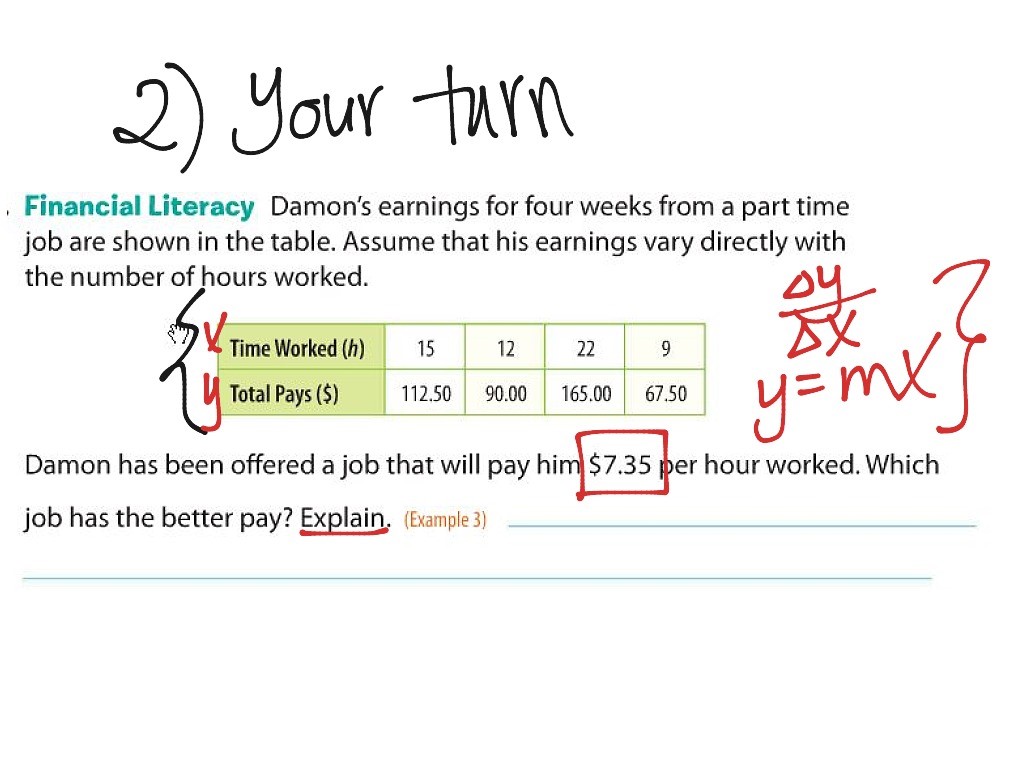
Additionally, to benefit all students you could do problems that involve finances. Including more “finance problems” will help students realize the importance of math, and how they can apply it in everyday life. An example of such problem would be “Damon’s earnings for four weeks from a part time are shown in the table. Assume his earnings vary directly with the number of hours worked. Damon has been offered a job that will pay him $7.35 per hour worked. Which job is better pay (Tucker, A.)? Including word problems that students can relate to now or in the future can help students stay engaged while learning, and answer the question that is most commonly asked by students: “When will I ever use this in real life?”

green line

How could you as a teacher create an activity or project that involves your topic?

As a teacher, creating engaging activities and/or projects can prove to be quite difficult for word problems that are one- or two-step algebra problems, due to the fact that most students completely shut down once a word problem is presented to them. To combat this I have found that making it into a cooperative game can help soothe the anxiety caused by word problems. One game that is great to play with one or two step algebra problems is called rally coach. In this game, students are paired off. Student A is expected to work on solving the problem, while Student B is expected to watch, listen, check, and praise just as a coach would. Once the students think they have the correct answer, they will raise their hand so that the teacher may check it. If they get the answer correct, then the teacher will give them another problem (this time Student A and Student B switch roles). If the answer is incorrect, they must continue working on the problem. The end goal of the game is to answer as many questions as possible before time runs out. By playing this game students are able to help each other solve one or two step word problems.


green line

How can this topic be used in your students’ future courses in mathematics or science?

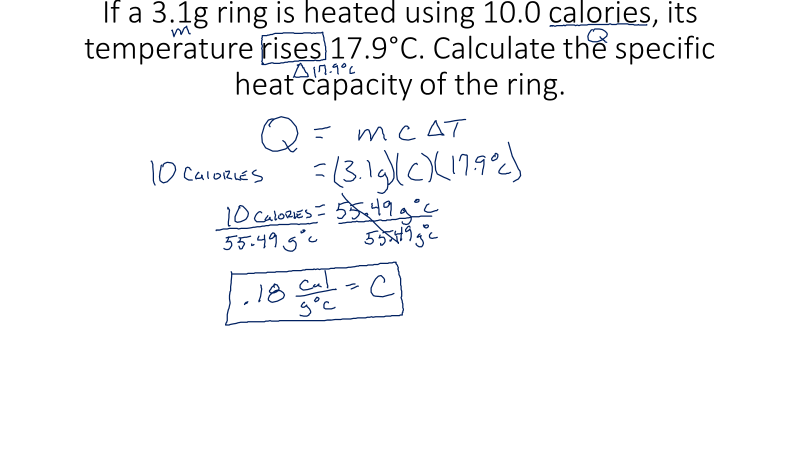
In future courses many problems will involve one or two step algebra problems. For instance, in science courses like chemistry and physics, one will need to know how to solve for different variables of equations. For example, if one is in a chemistry course and is given a word problem (i.e If a 3.1g ring is heated using 10.0 calories, its temperature rises 17.9°C. Calculate the specific heat capacity of the ring) that provides heat energy (Q) mass of a substance (m) and change in temperature (deltaT), but is asked to solve for the specific heat, students will need to know how to solve for the specific heat either by isolating the variable in the beginning (Cp=Q/mdeltaT) or plugging in the givens and isolating the variable (Daniell, B).

References

Daniell, B. (n.d.). Energy Slides 3 [Powerpoint that contains Specific Heat problem].

Tucker, A. (2016). Direct Variation. Retrieved September 01, 2017, from

http://www.showme.com/sh/?h=PQvPbm4