Engaging students: Introducing the parallel postulate

In my capstone class for future secondary math teachers, I ask my students to come up with ideas for engaging their students with different topics in the secondary mathematics curriculum. In other words, the point of the assignment was not to devise a full-blown lesson plan on this topic. Instead, I asked my students to think about three different ways of getting their students interested in the topic in the first place.

I plan to share some of the best of these ideas on this blog (after asking my students’ permission, of course).

This student submission comes from my former student Enrique Alegria. His topic, from Geometry: introducing the parallel postulate.

green line

What interesting things can you say about the people who contributed to the discovery and/or the development of this topic?

The parallel postulate dates back to a man named Pythagoras of Samos. Pythagoras was a Greek philosopher that created a mysterious cult, the Pythagoreans. The purpose of the cult was to seek out a universal truth about numbers and shapes and became the foundation for Geometry. “The Pythagoreans concluded that the one universal quality of all things in the universe, the one thing that everything had in common, was that it was numerable and could be counted.” (Bryan 2014). Improving the work of Pythagoras and other mathematician predecessors was a man named Euclid who originated from ancient Greece. It was through Pythagoras’s key teachings, such as the Pythagorean Theorem, that began the fundamentals of Geometry.

Euclid wrote thirteen books named the Elements. These books were the entirety of Geometry. The Elements starts with a few simple definitions and postulates that were to be built off of each other to prove propositions. Through that work, Euclid changed the world. A masterpiece of logical thought and deductive reasoning.

Euclid caused controversy for years and years to come due to a specific part from the Elements. The parallel postulate which states, “That, if a straight line falling on two straight lines makes the interior angles on the same side less than two right angles, the two straight lines, if produced indefinitely, meet on that side on which are the angles less than the two right angles.” Because this postulate makes drastic assumptions it is almost impossible to be proven. For that reason, the parallel postulate has caused so much controversy over the years. Euclid tried to prove all that he could without the parallel postulate and reached Proposition 29 of Book I. This topic further developed as mathematicians believed that the statement could not hold true. From there, several mathematicians are to follow on proving the Parallel Postulate.

green line

How did people’s conception of this topic change over time?

Over time the conception of the parallel postulate changed as many mathematicians tried to prove the postulate. Mathematicians wanted to prove that the postulate was not so much a postulate but a theorem. Several proofs were created, but none had succeeded in proving the postulate from the plane in Euclidean Geometry. As no mathematicians were able to do so they moved towards other dimensions or geometries.

The beginning of Non-Euclidean Geometries. Using the first four postulates of Euclid but create a new definition for the parallel postulate. For example, Nikolay Ivanovich Lobachevsky and János Bolyai were two mathematicians that held all postulates true but the parallel postulate true when discovering Hyperbolic Geometry. The parallel postulate has been modified as such, “For any infinite straight line  and any point  not on it, there are many other infinitely extending straight lines that pass through  and which do not intersect .” (Weisstein) This also led French mathematician Henri Poincaré to show the Hyperbolic Geometry was consistent through the half-plane model.

Many more geometries were able to follow a similar format of creating a parallel postulate equivalent to Euclid’s parallel postulate. “The parallel postulate is equivalent to the equidistance postulatePlayfair’s axiomProclus’ axiom, the triangle postulate, and the Pythagorean theorem.” (Szudzik). Despite the many trial and errors of trying to prove the parallel postulate, peoples’ conception of the topic was able to transform and discover new geometries where the respective parallel postulate can hold to be true.

green line

How can technology be used to effectively engage students with this topic?

Technology can be used to effectively engage students with the parallel postulate through a short series of YouTube videos by the channel Extra Credits. The five-part video series is called “Extra History: History of Non-Euclidean Geometry” with short seven to eight-minute videos which goes through the history of the parallel postulate. The video not only explicitly states what the parallel postulate is, but it goes through the history of how peoples’ conception has changed over time and how it has applied to today’s world and expands into physics.

The video series is produced with high-quality animation and narration. An engaging visual representation of the history of geometry that mathematicians have gone through to prove Euclid’s parallel postulate. Engaging in the countless trials and the amount of time that it has taken to go through this proof. Showcasing other discoveries that Euclidean Geometry has led to being Non-Euclidean Geometry. Lastly, the discoveries that Non-Euclidean Geometries will further lead to. Allowing students to join in on the questioning of the world as we know it.

Citations

Bryan, V., 2014. The Cult Of Pythagoras. [online] Classical Wisdom Weekly. https://classicalwisdom.com/philosophy/cult-of-pythagoras/

Szudzik, Matthew and Weisstein, Eric W. “Parallel Postulate.” From MathWorld–A Wolfram Web Resource. https://mathworld.wolfram.com/ParallelPostulate.html

Weisstein, Eric W. “Non-Euclidean Geometry.” From MathWorld–A Wolfram Web Resource. https://mathworld.wolfram.com/Non-EuclideanGeometry.html

https://mathcs.clarku.edu/~djoyce/java/elements/bookI/post5.html

https://www.youtube.com/watch?v=nkvVR-sKJT8&list=PLhyKYa0YJ_5Dj3ZG-Qk9VfaCfo-Nh9S-2

Predicate Logic and Popular Culture (Part 225): George Jones

Let D(t) be the statement “I am dead at time t,” let L(t) be the statement “I love you at time t,” and let T be the set of all times. Translate the logical statement

\forall t \in T(\lnot D(t) \Rightarrow L(t)).

This matches the opening line of arguably the greatest country song ever, “He Stopped Loving Her Today” by George Jones.

Context: Part of the discrete mathematics course includes an introduction to predicate and propositional logic for our math majors. As you can probably guess from their names, students tend to think these concepts are dry and uninteresting even though they’re very important for their development as math majors.

In an effort to making these topics more appealing, I spent a few days mining the depths of popular culture in a (likely futile) attempt to make these ideas more interesting to my students. In this series, I’d like to share what I found. Naturally, the sources that I found have varying levels of complexity, which is appropriate for students who are first learning prepositional and predicate logic.

When I actually presented these in class, I either presented the logical statement and had my class guess the statement in actual English, or I gave my students the famous quote and them translate it into predicate logic. However, for the purposes of this series, I’ll just present the statement in predicate logic first.

Predicate Logic and Popular Culture (Part 224): Robert Frost

Let G(x) be the statement “x is gold,” let S(x) be the statement “x can stay,” and let H be the set of all things. Translate the logical statement

\forall x \in H(G(x) \Rightarrow \lnot S(x)).

This matches the title of a Robert Frost poem, shown below recited in the movie “The Outsiders.”

Context: Part of the discrete mathematics course includes an introduction to predicate and propositional logic for our math majors. As you can probably guess from their names, students tend to think these concepts are dry and uninteresting even though they’re very important for their development as math majors.

In an effort to making these topics more appealing, I spent a few days mining the depths of popular culture in a (likely futile) attempt to make these ideas more interesting to my students. In this series, I’d like to share what I found. Naturally, the sources that I found have varying levels of complexity, which is appropriate for students who are first learning prepositional and predicate logic.

When I actually presented these in class, I either presented the logical statement and had my class guess the statement in actual English, or I gave my students the famous quote and them translate it into predicate logic. However, for the purposes of this series, I’ll just present the statement in predicate logic first.

Predicate Logic and Popular Culture (Part 223): Daniel Caesar

Let N(x) be the statement “You need x,” let G(x) be the statement “I will give you x,” and let H be the set of all things. Translate the logical statement

\forall x \in H(N(x) \Rightarrow G(x)).

This matches a line from the song “Too Deep to Turn Back” by Daniel Caesar.

Context: Part of the discrete mathematics course includes an introduction to predicate and propositional logic for our math majors. As you can probably guess from their names, students tend to think these concepts are dry and uninteresting even though they’re very important for their development as math majors.

In an effort to making these topics more appealing, I spent a few days mining the depths of popular culture in a (likely futile) attempt to make these ideas more interesting to my students. In this series, I’d like to share what I found. Naturally, the sources that I found have varying levels of complexity, which is appropriate for students who are first learning prepositional and predicate logic.

When I actually presented these in class, I either presented the logical statement and had my class guess the statement in actual English, or I gave my students the famous quote and them translate it into predicate logic. However, for the purposes of this series, I’ll just present the statement in predicate logic first.

Engaging students: Finding the area of a square or rectangle

In my capstone class for future secondary math teachers, I ask my students to come up with ideas for engaging their students with different topics in the secondary mathematics curriculum. In other words, the point of the assignment was not to devise a full-blown lesson plan on this topic. Instead, I asked my students to think about three different ways of getting their students interested in the topic in the first place.

I plan to share some of the best of these ideas on this blog (after asking my students’ permission, of course).

This student submission comes from my former student Austin Stone. His topic, from Geometry: finding the area of a square or rectangle.

green line

How could you as a teacher create an activity or project that involves your topic?

There are many applications to the real world that involves geometry and specifically area of squares and rectangles. Students could use this topic to find the cheapest cost of tiling the floor of a bathroom. Giving them the dimensions of the different tiles and the cost of each tile, students would have to find the area of the bathroom floor and then be able to pick the set of tiles that would be the most efficient and cheapest. This gives students a real world application to what they are learning while also giving them practice in finding the area given dimensions of a square and/or rectangle. This project also calls back to prior knowledge such as perimeter of rectangles and multiplying cost of one tile with the number of tiles used to get to total price. This project could also be a small part of a bigger PBL using area and perimeter of multiple polygons.

green line

How does this topic extend what your students should have learned in previous courses?

The obvious prior knowledge to finding the area of a square of rectangle is being able multiply two numbers which is learned back in grade school. If the students are given the area of the square or rectangle and labeling the sides with a variable, the students would have to be able to solve for the variable. By doing this they would have to be able to multiply binomials (or polynomials if you want students to have more of a challenge). Once they multiply the two binomials and set the equation equal to the area given, they would then have to use the quadratic formula or factor which is learned in Algebra I. If students are given one side and the area, then they would have to solve for a variable with degree one which is used continually in all math classes. Depending on what information is given in the area problem, students will have to use prior knowledge to determine the answer.

green line

How have different cultures throughout time used this topic in their society?

In East Asian mathematics during the 1st-7th centuries, a book called The Nine Chapters gives formulas for solid figures including squares and rectangles. The formulas are given as series of operations to get the result, called algorithms. Instead of variable and symbols, the formulas are given in sentences as in, “multiply the length of the rectangle by the width.” This puts the regular A=lw into words so that if someone who had no idea how to compute the area, they would be able to understand by the sentence given. This undoubtably was much more difficult to follow and became too long of descriptions for more complex figures, as this way of mathematics ended in Eastern Asian in the 7th century. That does not mean that this way of math was not important. This put words into formulas instead of symbols which made it easier to understand for those that are learning it for the first time.

References

https://www.britannica.com/science/East-Asian-mathematics/The-great-early-period-1st-7th-centuries

Predicate Logic and Popular Culture (Part 222): The Notebook

Let B(x) be the statement “x is a bird.” Translate the logical statement

B(you) \Rightarrow B(I).

This matches a line from the movie “The Notebook.”

Context: Part of the discrete mathematics course includes an introduction to predicate and propositional logic for our math majors. As you can probably guess from their names, students tend to think these concepts are dry and uninteresting even though they’re very important for their development as math majors.

In an effort to making these topics more appealing, I spent a few days mining the depths of popular culture in a (likely futile) attempt to make these ideas more interesting to my students. In this series, I’d like to share what I found. Naturally, the sources that I found have varying levels of complexity, which is appropriate for students who are first learning prepositional and predicate logic.

When I actually presented these in class, I either presented the logical statement and had my class guess the statement in actual English, or I gave my students the famous quote and them translate it into predicate logic. However, for the purposes of this series, I’ll just present the statement in predicate logic first.

Engaging students: Finding the volume and surface area of prisms and cylinders

In my capstone class for future secondary math teachers, I ask my students to come up with ideas for engaging their students with different topics in the secondary mathematics curriculum. In other words, the point of the assignment was not to devise a full-blown lesson plan on this topic. Instead, I asked my students to think about three different ways of getting their students interested in the topic in the first place.

I plan to share some of the best of these ideas on this blog (after asking my students’ permission, of course).

This student submission again comes from my former student Angelica Albarracin. Her topic, from Geometry: finding the volume and surface area of prisms and cylinders.

green line

How could you as a teacher create an activity or project that involves your topic?

For finding the surface area of prisms and cylinders, I as the teacher would create an activity centered around using the nets of these figures to better visualize this concept. In my experience, many students do not struggle with the computational aspect of finding the surface area of prisms and cylinders, but rather, they tend to forget to calculate the area of all the faces of such figures. When a student views these three-dimensional figures on paper, it can be easy to forget some faces as not all of them can be illustrated, requiring the student to have an accurate depiction of the figure already in mind. By having students work with nets, they will have some guidance in calculating the surface area of prisms and cylinders. Additionally, having the students construct each intended figure with the net can also help students develop a better understanding of the composition of prisms and cylinders.

A project I could use as a teacher in order to help students understand volume of prisms and cylinders would be to have the students create their own drink company. I could provide the students with several models of different styles of cans they could use and have them find the volume of their selected can as a requirement. I think this would be a fun way to not only allow to students some creative freedom but also provide practice calculating the volumes of various prisms and cylinders. Students would have to consider aspects such as how much liquid one container holds over another, how portable the shape is, and how will others drink from it. Students could also find the surface area of their drink cans in order to see how much material would be needed to print a label that would fit around each can.

green line

How can this topic be used in your students’ future courses in mathematics or science?

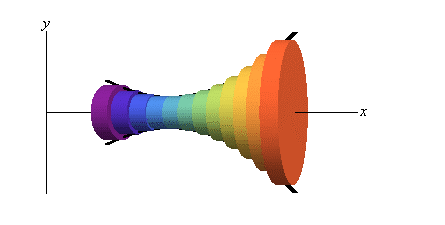
Finding the volume and surface area of prisms and cylinders provides a basic background for students to start exploring more complex shapes such as spheres, cones, and pyramids. However, in Calculus I, this topic is taken further with the introduction of integrals and the concept of finding the area under irregular curves. Later down the line, students will also learn about volumes of solids of revolution. For rounded curves, an approximation for such solids is comprised of taking the sum of the volume of many cylinders; the more cylinders there are, the closer the approximation will be to the true volume. An image of this is shown below:

This image has an empty alt attribute; its file name is cylinder1.png

Continuing with the theme of solids of revolutions, Calculus II is when students must find the surface area of these solids. To approximate the surface area, we take the surface area of frustums that can be formed under the curve. Frustums are similar to cones as they both have circular bases, but instead of coming to a point, a frustum also has a circular top. As before, the greater the amount of frustums used in the approximation, the closer the calculated value is to the true surface area. The formula for the surface area of a frustum is A = 2\pi r h A = where r =(r_1+r_2)/2. Frustums are unique in that both circular bases are different. In the case that the bases are the same, the formula for r becomes r =(2r_1)/2 = r_1,  in which case the formula for surface area becomes A = 2\pi r h  which is exactly the formula for the surface area of a cylinder. Below is an image of the surface area approximation of a solid formed by revolution:
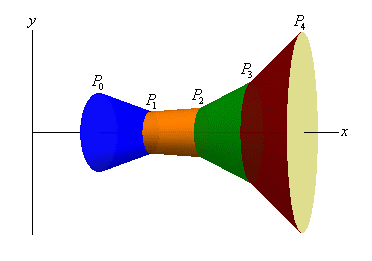
This image has an empty alt attribute; its file name is cylinder2.png

green line

What interesting things can you say about the people who contributed to the discovery and/or the development of this topic? (You might want to consult Math Through The Ages.)

The ancient Greeks are responsible for naming many of the figures and solids we commonly see in Geometry. For example, the word “prism” comes from the Greek word meaning “to saw”, which comes from the fact the cross sections (or cuts) of a prism are congruent. The word “cylinder” also comes from Greek, specifically from the word that means “to roll”. In addition, the Greeks were also “the first to systematically investigate the areas and volumes of plan figures and solids”. One of the most famous of these Greeks is the mathematician Archimedes who is directly responsible for the approximation of the area of a circle, the approximation of pi, the formulas for the volume and surface area of a sphere, and a technique called the “method of exhaustion”, which was used to find areas and volumes of figures in a manner similar to that of modern calculus. Archimedes viewed his discovery of the formula for the surface area of a sphere as his greatest mathematical achievement and even instructed that it be remembered on his gravestone as a sphere within a cylinder.

Another mathematician who developed techniques that bore similarities to modern calculus was Italian mathematician Bonaventura Francesco Cavalieri. While his discoveries pertained to finding the volume of objects, he was able to use are of cross sections to show that “two objects have the same volume if the areas of their corresponding cross-sections are equal in all cases”. This came to be known as Cavalieri’s Principle, but it is important to note that Chinese mathematician Zu Gengzhi had previously discovered this principle hundreds of years before Cavalieri. The next biggest advancement in this topic is attributed to integrals and making sense of the idea of finding the area under a curve. An approximate method for finding the area of a figure with an irregular boundary was developed known as Simpson’s Rule which had previously been known by Cavalieri but was rediscovered in the 1600s.

References:

https://amsi.org.au/teacher_modules/area_volume_surface_area.html

https://www.famousscientists.org/archimedes-makes-his-greatest-discovery/#:~:text=Archimedes%20also%20proved%20that%20the,a%20sphere%20within%20a%20cylinder.&text=The%20sphere%20within%20the%20cylinder.

https://study.com/academy/lesson/how-to-find-the-volume-of-a-cylinder-lesson-for-kids.html

https://tutorial.math.lamar.edu/classes/calci/Area_Volume_Formulas.aspx

https://tutorial.math.lamar.edu/classes/calcii/surfacearea.aspx

https://en.wikipedia.org/wiki/Surface_area

Predicate Logic and Popular Culture (Part 221): Monk

Let A(x,y,z) be the statement “x accuses y of z,” let P be the set of all people, and let H be the set of all things. Translate the logical statement

\forall x \in P(\lnot \exists y \in P \exists z \in H (A(x,y,z))).

This matches a line from the TV series “Monk.”

Context: Part of the discrete mathematics course includes an introduction to predicate and propositional logic for our math majors. As you can probably guess from their names, students tend to think these concepts are dry and uninteresting even though they’re very important for their development as math majors.

In an effort to making these topics more appealing, I spent a few days mining the depths of popular culture in a (likely futile) attempt to make these ideas more interesting to my students. In this series, I’d like to share what I found. Naturally, the sources that I found have varying levels of complexity, which is appropriate for students who are first learning prepositional and predicate logic.

When I actually presented these in class, I either presented the logical statement and had my class guess the statement in actual English, or I gave my students the famous quote and them translate it into predicate logic. However, for the purposes of this series, I’ll just present the statement in predicate logic first.

Engaging students: Finding the slope of a line

In my capstone class for future secondary math teachers, I ask my students to come up with ideas for engaging their students with different topics in the secondary mathematics curriculum. In other words, the point of the assignment was not to devise a full-blown lesson plan on this topic. Instead, I asked my students to think about three different ways of getting their students interested in the topic in the first place.

I plan to share some of the best of these ideas on this blog (after asking my students’ permission, of course).

This student submission again comes from my former student Austin Stone. His topic, from Algebra: finding the slope of a line.

green line

How could you as a teacher create an activity or project that involves your topic?

Using “pull back” toy cars, you can create a fun little activity that students can compete in to see who wins. Students can be put into groups or do it individually depending on how many cars you have available. The idea of the activity would have students pull back the cars a small amount and record how far they took it back and how far the car went. After doing this from three or four different distances, the students would then graph their data with x=how far they took it back and y=how far the car went. Then the teacher would tell the students to find how far back they would need to pull for the car to go a specified distance by finding the slope of their line (or rate of change in this example). After students have done their calculations, they would then pull back their cars however far they calculated and the closest team to the distance gets a prize.

green line

How can this topic be used in your students’ future courses in mathematics or science?

Students will continually use slope throughout their future math and science classes. In math courses, slope is used to graph data and predict what will happen if certain numbers are used. It is also used to notice observations about the graph such as steepness (how quickly it changes) and if the rate of change is increasing or decreasing. It is also used in science for very similar reasons. In physics, slope is used commonly to calculate velocity and force. In chemistry labs, slope is used to predict how much of a certain substance needs to be added to find observational differences. In calculus, when taking the first derivative of a function, if the slope is negative, then the function is decreasing during that interval and vice versa if it is positive. Slope is also widely used in Algebra II, so learning how to find the slope is very important for future math and science classes whether it be in high school or college.

green line

How does this topic extend what your students should have learned in previous courses?

Students should have already learned how to graph points on the coordinate plane. They can take this knowledge and now not only plot seemingly random points, but now see the relationship between these points. Plotting points is a skill usually learned around 6th grade and is used regularly after that. Also, finding the x and y axis can be used when finding the slope of a line. If you have a function with no points, finding the x and y axis can let you find the slope. Finding the x and y axis is learned in Algebra I so this would be fresh on students’ minds. Finding the slope of a line can be scaffolded with finding the x and y axis in lectures or in PBL experience. Also refreshing students on how to graph not only in the first quadrant, but in all four quadrants could be a quick little activity at the beginning of the PBL experience.

Reference:

http://www.andrewbusch.us/home/racing-day-algebra-2

Predicate Logic and Popular Culture (Part 220): Cash Cash

Let H(x,t) be the statement “I had x at time t,” let P be the set of all people, and let T be the set of all times. Translate the logical statement

\forall t < 0 (\lnot \exists x \in P(H(x,t))).

This matches a line from “How to Love” by Cash Cash featuring Sofia Reyes.

Context: Part of the discrete mathematics course includes an introduction to predicate and propositional logic for our math majors. As you can probably guess from their names, students tend to think these concepts are dry and uninteresting even though they’re very important for their development as math majors.

In an effort to making these topics more appealing, I spent a few days mining the depths of popular culture in a (likely futile) attempt to make these ideas more interesting to my students. In this series, I’d like to share what I found. Naturally, the sources that I found have varying levels of complexity, which is appropriate for students who are first learning prepositional and predicate logic.

When I actually presented these in class, I either presented the logical statement and had my class guess the statement in actual English, or I gave my students the famous quote and them translate it into predicate logic. However, for the purposes of this series, I’ll just present the statement in predicate logic first.