
I love this: http://www.thepostgame.com/blog/dish/201501/second-grade-teacher-uses-nba-games-teach-basic-math-students
Category: Elementary
A defense of the Common Core
I read the following defense of the pedagogical strategies behind the Common Core: http://www.vox.com/2014/4/20/5625086/the-common-core-makes-simple-math-more-complicated-heres-why
I really have no issue with the article itself. Sadly, the article does not address the two great deficiencies in the implementation of the Common Core: (1) homework problems and other assessments to gauge the depth of a student’s conceptual understanding of mathematics in ways that are age-appropriate, and (2) the direct tying of high-stakes tests based on the Common Core standards to the assessment of teachers.
I don’t feel like replicating my previous posts on this topic, so I’ll refer to my past posts here: https://meangreenmath.wordpress.com/2014/12/18/common-core-subtraction-and-the-open-number-line-index/
Square any number up to 1000 without a calculator
The Mathematical Association of America has an excellent series of 10-minute lectures on various topics in mathematics that are nevertheless accessible to the general public, including gifted elementary school students. From the YouTube description:
Mathemagician Art Benjamin [professor of mathematics at Harvey Mudd College] demonstrates and explains the mathematics underlying a mental arithmetic technique for quickly squaring numbers.
Arithmetic with big numbers: Index
I’m doing something that I should have done a long time ago: collect past series of posts into a single, easy-to-reference post. The following posts formed my series on doing basic arithmetic with very large numbers that exceed the character displays of most calculators.
Part 1: Addition
Part 2: Multiplication
Part 3: Division
The New York Knicks and perfect squares
Funny but true: as the disaster of the 2014-15 season for the New York Knicks progressed, they had a record of:
- 1-1 after 2 games
- 2-4 after 6 games
- 3-9 after 12 games
- 4-16 after 20 games
- 5-25 after 30 games, and
- 6-36 after 42 games.
http://www.sbnation.com/nba/2014/12/21/7431765/the-knicks-love-math-as-much-as-they-love-losing
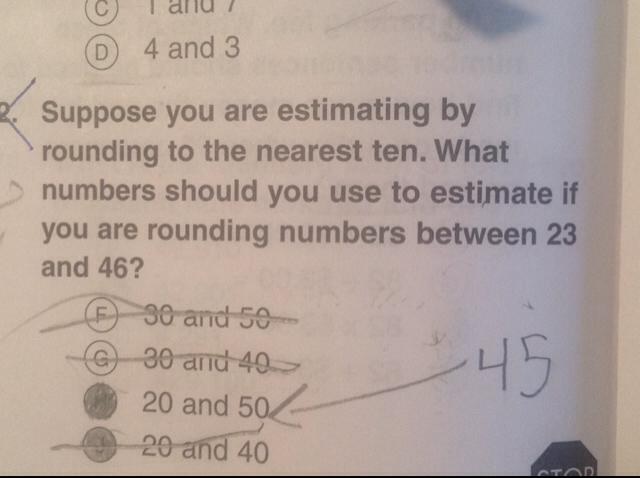
Another poorly written word problem
Textbooks have included the occasional awful problem ever since Pebbles Flintstone and Bamm-Bamm Rubble chiseled their homework on slate tablets while attending Bedrock Elementary. But even with the understanding that there have been children have been doing awful homework problems since the dawn of time (and long before the advent of the Common Core), this one is a doozy.
There’s no sense having a debate about standards for elementary mathematics if textbook publishers can’t construct sentences that can be understood by elementary students (or their parents).
Too many significant digits (Part 2)
In yesterday’s post, I had a little fun with this claim that the Nike app could measure distance to the nearest trillionth of a mile. The more likely scenario is that the app just reported all of the digits of a double-precision floating point number, whether or not they were significant.
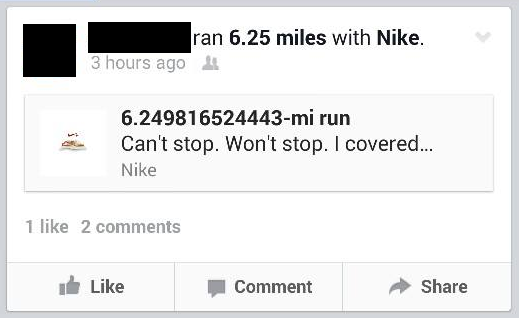
In real life, I’d expect that the first three decimal places are accurate, at most. According to Wikipedia, the official length of a marathon is 42.195 kilometers, but any particular marathon may be off by as many as 42 meters (0.1% of the total distance) to account for slight measurement errors when figuring out a course of that length.
A history about the Jones-Oerth Counter, the devise used to measure the distance of road running courses, can be found at the USA Track and Field website. And my friends who are serious runner swear that the Jones-Oerth Counter is much more accurate than GPS.

The same story often appears in students’ homework. For example:
If a living room is 17 feet long and 14 feet wide, how long is the diagonal distance across the room?
Using the Pythagorean theorem, students will find that the answer is 
This answer, of course, is ridiculous because a standard ruler cannot possibly measure a distance that precisely. The answer follows from the false premise that the numbers 17 and 14 are somehow exact, without absolutely no measurement error. My guess is that at most two decimal places are significant (i.e., the numbers 17 and 14 can be measured accurately to within one-hundredth of a foot, or about one-eighth of an inch).
My experience is that no many students are comfortable with the concept of significant digits (or significant figures), even though this is a standard topic in introductory courses in chemistry and physics. An excellent write-up of the issues can be found here: http://www.angelfire.com/oh/cmulliss/
Other resources:
http://mathworld.wolfram.com/SignificantDigits.html
http://en.wikipedia.org/wiki/Significant_figures
http://en.wikipedia.org/wiki/Significance_arithmetic
Too many significant digits (Part 1)
The following appeared on my Facebook feed a while back:
Just look at that: the Nike app claimed to measure the length of my friend’s run with twelve decimal places of accuracy.
Let’s have some fun with this. Just suppose that the app was able to measure distance to the nearest trillionth of a mile. One trillionth of a mile is…
5.28 billionths of a foot,
or about 63.4 billionths of an inch,
or about 161 billionths of a centimeter,
or about 1.61 billionths of a meter,
or about 1.61 nanometers.
By way of comparison, the fingernails on the average adult grow about 3 millimeters a month. A world-class runner could run 6.25 miles in about 30 minutes; in those 30 minutes, his/her fingernails would grow about 2 microns, or about 2000 nanometers. (Of course, they’ll grow longer for less athletic runners covering the same distance at a slower speed.)
So if the Nike app can measure my distance to the nearest trillionth of a mile, it would have absolutely no difficulty measuring how much my fingernails grew while running.
Or, it could be that the Nike app really isn’t measuring the distance all that precisely. Probably the app used double-precision arithmetic, and whoever programmed the app didn’t tell it to truncate after a reasonable number of digits.
Lychrel Numbers
A friend of mine posted the following on Facebook (with names redacted):
So [my daughter] comes home with this assignment:
For each number from 10 – 99, carry out the following process.
- If the number is a palindrome (e.g., 77), stop.
- Else reverse the number and add that to the original. E.g.: 45+54 = 99.
- If the result is not a palindrome, repeat step (2) with the result.
- Record the final palindromic result and the number of steps taken.
Most are simple.
- 56 + 65 = 110
- 110 + 011 = 121
- Stop. 2 steps taken.
The numbers 89 and 98 were given for extra credit, and they mysteriously explode, taking 24 steps. It made [my daughter] cry.
She wanted me to check her work, so I decided it was a good time to teach the wonders of Python, and we very quickly had a couple of simple functions to do the trick.
Well, you saw where this was going. How many steps does 887 take?
We’re up to 104000 steps so far, and Python is crying.
True or false: For a given n, the above algorithm completes in finite time?
I guess I’ve been living under a rock for the past 20 years, because I had never heard of this problem before. It turns out that numbers not known to lead to a palindrome are called Lychrel numbers. However, no number in base-10 has been proven to be a Lychrel number. The first few candidate Lychrel numbers (i.e., numbers that have not been proven to not be Lychrel numbers) are 196, 295, 394, 493, 592, 689, 691, 788, 790, 879, 887, 978, 986, 1495, 1497, 1585, 1587, 1675, 1677, 1765, 1767, 1855, 1857, 1945, 1947, 1997, 2494, 2496, 2584, 2586, 2674, 2676, 2764, 2766, 2854, 2856, 2944, 2946, 2996, 3493, 3495, 3583, 3585, 3673, 3675…
The above algorithm is called the 196-algorithm, after the smallest suspected Lychrel number.
For further reading, I suggest the following links and the references therein:
http://mathworld.wolfram.com/196-Algorithm.html
http://mathworld.wolfram.com/LychrelNumber.html
http://www.mathpages.com/home/kmath004/kmath004.htm (which contains a proof that 10110 is a Lychrel number in binary and that Lychrel numbers always exist in base 
Math Coach’s Corner
I found the following blogpost very intriguing. This sounds like an engaging way of teaching children how to multiply, whether or not the Common Core was the educational fashion of the day: http://mathcoachscorner.blogspot.com/2014/08/a-peek-inside-theres-nothing-alien.html.

