Let be the proposition “I’d trade for ,” let be the proposition “x was looking for this,” and let be the proposition “ is now in my way.” Translate the logical statement
.
This matches some of the opening lines from the summer hit of 2012.
And I can’t resist also sharing this incredible mashup:
Context: This semester, I taught discrete mathematics for the first time. Part of the discrete mathematics course includes an introduction to predicate and propositional logic for our math majors. As you can probably guess from their names, students tend to think these concepts are dry and uninteresting even though they’re very important for their development as math majors.
In an effort to making these topics more appealing, I spent a few days mining the depths of popular culture in a (likely futile) attempt to make these ideas more interesting to my students. In this series, I’d like to share what I found. Naturally, the sources that I found have varying levels of complexity, which is appropriate for students who are first learning prepositional and predicate logic.
When I actually presented these in class, I either presented the logical statement and had my class guess the statement in actual English, or I gave my students the famous quote and them translate it into predicate logic. However, for the purposes of this series, I’ll just present the statement in predicate logic first.
Let be the proposition “I am looking for ,” and let be the proposition “I have found .” Translate the logical statement
.
This is a wonderful song by U2.
Context: This semester, I taught discrete mathematics for the first time. Part of the discrete mathematics course includes an introduction to predicate and propositional logic for our math majors. As you can probably guess from their names, students tend to think these concepts are dry and uninteresting even though they’re very important for their development as math majors.
In an effort to making these topics more appealing, I spent a few days mining the depths of popular culture in a (likely futile) attempt to make these ideas more interesting to my students. In this series, I’d like to share what I found. Naturally, the sources that I found have varying levels of complexity, which is appropriate for students who are first learning prepositional and predicate logic.
When I actually presented these in class, I either presented the logical statement and had my class guess the statement in actual English, or I gave my students the famous quote and them translate it into predicate logic. However, for the purposes of this series, I’ll just present the statement in predicate logic first.
Let be the proposition “ knows the way I feel tonight,” let be the proposition “ is lonely.” Translate the logical statement
.
This matches the opening line from this classic from 1960.
Context: This semester, I taught discrete mathematics for the first time. Part of the discrete mathematics course includes an introduction to predicate and propositional logic for our math majors. As you can probably guess from their names, students tend to think these concepts are dry and uninteresting even though they’re very important for their development as math majors.
In an effort to making these topics more appealing, I spent a few days mining the depths of popular culture in a (likely futile) attempt to make these ideas more interesting to my students. In this series, I’d like to share what I found. Naturally, the sources that I found have varying levels of complexity, which is appropriate for students who are first learning prepositional and predicate logic.
When I actually presented these in class, I either presented the logical statement and had my class guess the statement in actual English, or I gave my students the famous quote and them translate it into predicate logic. However, for the purposes of this series, I’ll just present the statement in predicate logic first.
Let be the proposition “You take a breath at time ,” let be the proposition “You make a move at time ,” let be the proposition “You break a bond at time ,” let be the proposition “You take a step at time ,” and let be the proposition “I watch you at time .” Translate the logical statement
.
This matches the opening lines of this iconic song by The Police.
Context: This semester, I taught discrete mathematics for the first time. Part of the discrete mathematics course includes an introduction to predicate and propositional logic for our math majors. As you can probably guess from their names, students tend to think these concepts are dry and uninteresting even though they’re very important for their development as math majors.
In an effort to making these topics more appealing, I spent a few days mining the depths of popular culture in a (likely futile) attempt to make these ideas more interesting to my students. In this series, I’d like to share what I found. Naturally, the sources that I found have varying levels of complexity, which is appropriate for students who are first learning prepositional and predicate logic.
When I actually presented these in class, I either presented the logical statement and had my class guess the statement in actual English, or I gave my students the famous quote and them translate it into predicate logic. However, for the purposes of this series, I’ll just present the statement in predicate logic first.
Let $p$ be the proposition “I am around you,” and let be the proposition “ will harm you.” Translate the logical statement
.
This matches the opening lines of this wonderful song from the musical Sweeney Todd.
Context: This semester, I taught discrete mathematics for the first time. Part of the discrete mathematics course includes an introduction to predicate and propositional logic for our math majors. As you can probably guess from their names, students tend to think these concepts are dry and uninteresting even though they’re very important for their development as math majors.
In an effort to making these topics more appealing, I spent a few days mining the depths of popular culture in a (likely futile) attempt to make these ideas more interesting to my students. In this series, I’d like to share what I found. Naturally, the sources that I found have varying levels of complexity, which is appropriate for students who are first learning prepositional and predicate logic.
When I actually presented these in class, I either presented the logical statement and had my class guess the statement in actual English, or I gave my students the famous quote and them translate it into predicate logic. However, for the purposes of this series, I’ll just present the statement in predicate logic first.
Let be the proposition “ is a business,” and let be the proposition “ is like .” Translate the logical statement
.
This matches the showstopper from Annie Get Your Gun:
Context: This semester, I taught discrete mathematics for the first time. Part of the discrete mathematics course includes an introduction to predicate and propositional logic for our math majors. As you can probably guess from their names, students tend to think these concepts are dry and uninteresting even though they’re very important for their development as math majors.
In an effort to making these topics more appealing, I spent a few days mining the depths of popular culture in a (likely futile) attempt to make these ideas more interesting to my students. In this series, I’d like to share what I found. Naturally, the sources that I found have varying levels of complexity, which is appropriate for students who are first learning prepositional and predicate logic.
When I actually presented these in class, I either presented the logical statement and had my class guess the statement in actual English, or I gave my students the famous quote and them translate it into predicate logic. However, for the purposes of this series, I’ll just present the statement in predicate logic first.
In my capstone class for future secondary math teachers, I ask my students to come up with ideas for engaging their students with different topics in the secondary mathematics curriculum. In other words, the point of the assignment was not to devise a full-blown lesson plan on this topic. Instead, I asked my students to think about three different ways of getting their students interested in the topic in the first place.
I plan to share some of the best of these ideas on this blog (after asking my students’ permission, of course).
This student submission again comes from my former student Heidee Nicoll. Her topic, from probability: combinations.
How could you as a teacher create an activity or project that involves your topic?
As a teacher, I would give my students an activity where, with a partner, they would be in charge of creating an ice cream shop. Each ice cream shop has large cones, which can hold two scoops of ice cream, and six different flavors of ice cream. Each shop would be required to make a list of all the different cone options available. (Note: cones with two scoops of the same flavor are not allowed.) The groups would calculate the total number of combinations, and try to find any patterns in their work. I would ask them how to calculate the number of options for 7 flavors of ice cream, and then ask them to find a general rule or pattern for calculating the total for n flavors, and have them try their formula a few times to see if it gives them the correct answer. As a bonus, I would also ask them how many flavors of ice cream they would need to be able to advertise at least 100 different cone combinations.
What interesting things can you say about the people who contributed to the discovery and/or the development of this topic?
Historia Mathematica, a scientific journal, has an article called “The roots of combinatorics,” which describes records of ancient civilizations’ work in combinations and permutations. I would share with my students the first part of this description of the medical treatise of Susruta, without reading the last sentence that gives the answers:
“It seems that, from a very early time, the Hindus became accustomed to considering questions involving permutations and combinations. A typical example occurs in the medical treatise of Susruta, which may be as old as the 6th century B.C., although it is difficult to date with any certainty. In Chapter LX111 of an English translation [Bishnagratna 19631] we find a discussion of the various kinds of taste which can be made by combining six basic qualities: sweet, acid, saline, pungent, bitter, and astringent. There is a systematic list of combinations: six taken separately, fifteen in twos, twenty in threes, fifteen in fours, six in fives, and one taken all together” (Biggs 114).
I would ask them to estimate the number of combinations of any size group within those “six basic qualities” without doing any actual calculations. Once they had all made their estimates, as a class we would do the calculations and comment on the accuracy of our earlier estimates.
How has this topic appeared in pop culture (movies, TV, current music, video games, etc.)?
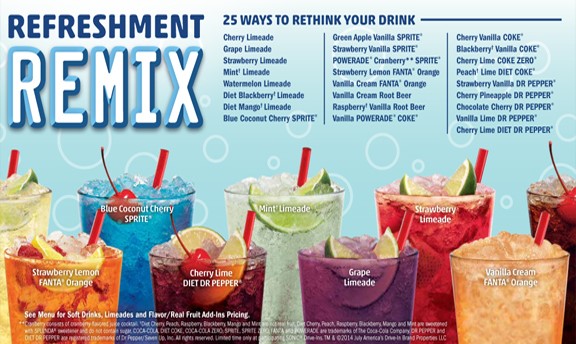
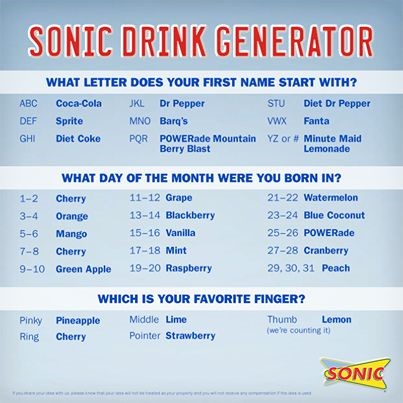
Sonic commercials boast that their fast food restaurant offers more than 168,000 drink combinations. This commercial shows a man trying to calculate the total number of options after buying a drink:
I would show my students the commercial, as well as images of Sonic menus and advertisements for their drinks, such as the following:
The Wall Street Journal also has an article about the accuracy of the company’s claim to 168,000 drink options, found at http://blogs.wsj.com/numbers/counting-the-drink-combos-at-a-sonic-drive-in-230/. The author talks about the number of base soft drinks and additional flavorings available, and says that according to the math, Sonic’s number should be well over 168,000 and closer to 700,000. He describes the claim of a publicist who works for Sonic that 168,000 was the number of options available for no more than 6 add-ins, which the company deemed a reasonable number. The article also notes the difference between reasonable combinations and literally all combinations, which could spur a good discussion in the classroom about context and its importance in real world problems.
References
Biggs, N.l. “The Roots of Combinatorics.” Historia Mathematica 6.2 (1979): 109-36. Web. 08 Sept. 2016.
Carl Bialik. “Counting the Drink Combos at a Sonic Drive-In.” The Wall Street Journal. N.p., 27 Nov. 2007. Web. 08 Sept. 2016.
I’m doing something that I should have done a long time ago: collecting a series of posts into one single post. The following links comprised my series on an advertisement that I saw in Jason’s Deli.
Part 1: The advertisement for the Jason’s Deli salad bar.
Part 2: Correct calculation of the number of salad bar combinations.
Part 3: Incorrect calculation of how long it would take to eat this many combinations.

be the proposition “I’d trade
for
,” let
be the proposition “x was looking for this,” and let
be the proposition “
.

 be the proposition “I have found
  .
. be the proposition “
 .
. be the proposition “You take a breath at time
  ,” let
  be the proposition “You make a move at time
  be the proposition “You break a bond at time
  be the proposition “You take a step at time
  be the proposition “I watch you at time
  .
. be the proposition “
 .
. be the proposition “
 be the proposition “
 .
.