
I enjoyed this reflective piece from Math with Bad Drawings about determining whether 


Short story: 

I enjoyed this reflective piece from Math with Bad Drawings about determining whether
Short story:
A lot more Matrix jokes can be found at https://mathwithbaddrawings.com/2018/03/07/matrix-jokes/

In my capstone class for future secondary math teachers, I ask my students to come up with ideas for engaging their students with different topics in the secondary mathematics curriculum. In other words, the point of the assignment was not to devise a full-blown lesson plan on this topic. Instead, I asked my students to think about three different ways of getting their students interested in the topic in the first place.
I plan to share some of the best of these ideas on this blog (after asking my students’ permission, of course).
This student submission again comes from my former student Alexandria Johnson. Her topic, from Algebra II/Precalculus: computing the composition of two functions.

The following link is to a worksheet over composition of functions. The worksheet allows students to explore composition of functions without outright telling them what composition of functions is. Instead, the students are working on real world problems about shopping in a store that is having a 20% sale with mystery coupons. In the worksheet, students explore whether or not it matters which discount is applied first and the equations that go along with each scenario. This worksheet is interesting because it approaches composition of functions in an explorative way and it is using a real-world situation students in high school may find relatable, which can help hook students that are math-phobic.
https://betterlesson.com/community/document/1326462/going-shopping-student-materials-docx
Computing the composition of two functions requires prior knowledge of basic operations and combining like terms. This topic will expand upon their knowledge of basic operations by applying them to functions. Students will be able to add, subtract, multiply, and divide functions. Students should be able to use the distribution property; this is important when students are writing (fog)(x) and (gof)(x). During this topic, students should be able to expand upon their knowledge of creating functions from real world problems, which can be seen in the worksheet from the link above.
Musical composition is a way this topic can appear in high culture. Musical composition is the process of combining notes, chords, and melodies in a particular way. Arranging the notes, chords, or melodies in different ways can change the composition. Function composition is the combining of different functions f(x) and g(x) in different ways like addition, subtraction, multiplication, and division. Order usually matters in function composition just like in musical composition. If you have several band students, or musically inclined students, this would be a good hook to grab students interest.
Work cited
https://betterlesson.com/community/document/1326462/going-shopping-student-materials-docx
In my capstone class for future secondary math teachers, I ask my students to come up with ideas for engaging their students with different topics in the secondary mathematics curriculum. In other words, the point of the assignment was not to devise a full-blown lesson plan on this topic. Instead, I asked my students to think about three different ways of getting their students interested in the topic in the first place.
I plan to share some of the best of these ideas on this blog (after asking my students’ permission, of course).
This student submission comes from my former student Austin DeLoach. His topic, from Precalculus: using a recursively defined sequence.
How could you as a teacher create an activity or project that involves your topic?
One activity that would be interesting to introduce recursion would be Fibonacci’s rabbit problem. In his book, Liber Abaci, Fibonacci introduced a problem where you start with one young pair of rabbits and try to find out how many rabbits you would have after a year. Every month, a grown pair of rabbits can give birth to a new pair, and it only takes one month for a young pair to grow up and be able to reproduce on their own, and the rabbits also never die. This is one of the most popular recursive sequences (the Fibonacci sequence), and, by itself, can be solved without a prior knowledge of recursion, but is a very good way to introduce the idea once the students begin to analyze the pattern of how many pairs of rabbits there are after each month. This problem is laid out in this video, https://youtu.be/sjQlW6cH3Ko but it is not necessary to show the video to introduce the problem.
How can this topic be used in your students’ future courses in mathematics or science?
One major place that a solid grasp of recursion can be used is in computer programming courses. Although not everyone takes these, they are becoming increasingly popular and the field is not likely to shrink any time soon. In programming, there are certain things that can either only be written recursively (as opposed to explicitly) or at least ones that are simpler to write and understand with recursion than with an explicit algorithm. There are also times, depending on the language and content, that a recursive function can be more efficient. Because of this, an understanding of recursion is becoming increasingly important for more people, and the ability to write and understand how it works is practically becoming necessary. So, even though not every student will go on to take computer science, many will, and the basic idea is still important to understand.
How can technology be used to effectively engage students with this topic?
There is a series of Khan Academy videos on recursively defined sequences online. The first one is https://youtu.be/lBtb30SjU2Q and it shows how to read and understand what the basic frame for recursion is. Although Khan Academy videos are not always the most engaging for all students, they do work for many because of their consistent structure. This video in particular is about recursive formulas for arithmetic sequences. Without mentioning the vocabulary yet, the video does introduce the idea of a base case and the method for finding subsequent values. The video both shows how to look at a list of values and determine the recursive definition, as well as how to understand the recursive definition if that is what you are given. For a three minute video, it does a very good job of introducing important topics for recursive series and explaining the basic ideas so that students have a framework to build on later when more complex recursively defined sequences are introduced.
References:
1. https://youtu.be/sjQlW6cH3Ko
2. https://youtu.be/lBtb30SjU2Q
3. https://plato.stanford.edu/entries/recursive-functions/
This was another T-shirt that I found in my search for the perfect ugly mathematical Christmas sweater: https://www.amazon.com/Pascals-Triangle-Math-Christmas-shirt/dp/B07KJS5SM2/ I love the artistry of this shirt; the “ornaments” at the corners of the hexagons and the presents under the tree are nice touches.
There’s only one small problem:

Oops.
In my capstone class for future secondary math teachers, I ask my students to come up with ideas for engaging their students with different topics in the secondary mathematics curriculum. In other words, the point of the assignment was not to devise a full-blown lesson plan on this topic. Instead, I asked my students to think about three different ways of getting their students interested in the topic in the first place.
I plan to share some of the best of these ideas on this blog (after asking my students’ permission, of course).
This student submission comes from my former student Rachel Delflache. Her topic, from Precalculus: using Pascal’s triangle.
How does this topic expand what your students would have learned in previous courses?
In previous courses students have learned how to expand binomials, however after 



In this expansion it can be seen that in the first term of the expansion the first monomial is raised to the original power, and in each term the power of the first monomial decreases by one. Conversely, the second monomial is raised to the power of 0 in the first term of the expansion, and increases by a power of 1 for each subsequent term in the expansion until it is equal to the original power of the binomial.
Sierpinski’s Triangle is triangle that was characterized by Wacław Sieriński in 1915. Sierpinski’s triangle is a fractal of an equilateral triangle which is subdivided recursively. A fractal is a design that is geometrically constructed so that it is similar to itself at different angles. In this particular construction, the original shape is an equilateral triangle which is subdivided into four smaller triangles. Then the middle triangle is whited out. Each black triangle is then subdivided again, and the patter continues as illustrated below.

Sierpinski’s triangle can be created using Pascal’s triangle by shading in the odd numbers and leaving the even numbers white. The following video shows this creation in practice.
What are the contributions of various cultures to this topic?
The pattern of Pascal’s triangle can be seen as far back as the 11th century. In the 11th century Pascal’s triangle was studied in both Persia and China by Oman Khayyam and Jia Xian, respectively. While Xian did not study Pascal’s triangle exactly, he did study a triangular representation of coefficients. Xian’s triangle was further studied in 13th century China by Yang Hui, who made it more widely known, which is why Pascal’s triangle is commonly called the Yanghui triangle in China. Pascal’s triangle was later studies in the 17th century by Blaise Pascal, for whom it was named for. While Pascal did not discover the number patter, he did discover many new uses for the pattern which were published in his book Traité du Triangle Arithméthique. It is due to the discovery of these uses that the triangle was named for Pascal.
Reference:
• https://en.wikipedia.org/wiki/Pascal%27s_triangle
• http://mathforum.org/workshops/usi/pascal/images/fill.comb.gif
• https://www.britannica.com/biography/Blaise-Pascal#toc445406main
• https://en.wikipedia.org/wiki/Sierpinski_triangle
Today is 11/23, and 1, 1, 2, 3 are the first four terms of the Fibonacci sequence.

While some common (i.e., base-10) logarithms work out evenly, like 

In today’s post, I’ll summarize the past few posts to describe how talented Algebra II students, who have just been introduced to logarithms, can develop proficiency with the Laws of Logarithms while also understanding that the above answer is not just a meaningless jumble of digits. The only tools students will need are
To estimate 

One way to do this is to use Wolfram Alpha to find the convergents of
Convergents[Log[10,5.1264],15]
A little explanation is in order:
 should be used for natural logarithms instead of
  , as base-10 logarithms are next to useless for mathematical researchers. That said, I freely concede that this convention is confusing to students who grew up thinking that should be used for base-10 logarithms and for natural logarithms. (See also my standard joke about using natural logarithms.) Naturally, the can be changed for other logarithms.. In most cases, that’s enough terms to provide a convergent whose denominator is at least six digits long. In the rare instance when this doesn’t happen, a number larger than 15 can be entered.
From Wolfram Alpha, I see that 
for an easy approximation on a scientific calculation will be  . In this context, “best” means something that’s close to a power of 10 but less than
  . Students entering into a calculator will find
In other words, the denominator of the convergent
A quick check with a calculator shows that this approximation is accurate to three decimal places. This alone should convince many students that the above apparently random jumble of digits is not so random after all.
While the above discussion should be enough for many students, some students may want to know how to find the rest of the decimal places with this technique. To answer this question, we again turn to the convergents of 
Option #1. Ask the student to use Wolfram Alpha to raise 

which matches the output of the calculator.
Option #2. Ask the student to “trick” a hand-held calculator into finding 
 . (This is a rare case where there happens to be no remainder.) Next, the student uses a hand-held calculate to compute
In this example, the 


which may be rearranged as
after using the Laws of Exponents. From this point, the derivation follows the steps in Option #1.
While some common (i.e., base-10) logarithms work out evenly, like
To a student first learning logarithms, the answer is just an apparently random jumble of digits; indeed, it can proven that the answer is irrational. With a little prompting, a teacher can get his/her students wondering about how people 50 years ago could have figured this out without a calculator. This leads to a natural pedagogical question:
Can good Algebra II students, using only the tools at their disposal, understand how decimal expansions of base-10 logarithms could have been found before computers were invented?
Here’s a trial-and-error technique — an exploration activity — that is within the grasp of Algebra II students. It’s simple to understand; it’s just a lot of work. The only tools that are needed are
by itself repeatedly in a quest to find integer powers of that are close to powers of  .
.
In the previous post in this series, we found that
and

Using the Laws of Logarithms on the latter provides an approximation of 

Compare with:
Since hand-held calculators will generate identical outputs for these two expressions (up to the display capabilities of the calculator), this may lead to the misconception that the irrational number 
We now turn to a question that was deferred in the previous post.
Student: How did you know to raise 3 to the 323,641st power?
Teacher: I just multiplied 3 by itself a few hundred thousand times.
Student: C’mon, really. How did you know?
While I don’t doubt that some of our ancestors used this technique to find logarithms — at least before the discovery of calculus — today’s students are not going to be that patient. Instead, to find suitable powers quickly, we will use ideas from the mathematical theory of continued fractions: see Wikipedia, Mathworld, or this excellent self-contained book for more details.
To approximate 


or, equivalently,

In other words, we’re looking for rational numbers that are reasonable close to
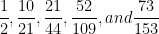
A larger convergent is 
As more terms are taken, these convergents get closer and closer to
using a denominator that’s less than the denominator of the next convergent. For example, the second convergent  is the closest rational number to that has a denominator less than
  , the denominator of the third convergent. and slightly less than .
 is guaranteed to be within
  of . (In fact, if and
  are consecutive convergents, then is guaranteed to be within
  of .) is at least six digits long (that is, greater than
  ), then must be within
  of … and it’ll probably be significantly closer than that.
So convergents provide a way for teachers to maintain the illusion that they found a power like 
While some common (i.e., base-10) logarithms work out evenly, like
To a student first learning logarithms, the answer is just an apparently random jumble of digits; indeed, it can proven that the answer is irrational. With a little prompting, a teacher can get his/her students wondering about how people 50 years ago could have figured this out without a calculator. This leads to a natural pedagogical question:
Can good Algebra II students, using only the tools at their disposal, understand how decimal expansions of base-10 logarithms could have been found before computers were invented?
Here’s a trial-and-error technique — an exploration activity — that is within the grasp of Algebra II students. It’s simple to understand; it’s just a lot of work.
To approximate
In the previous post in this series, we essentially used trial and error to find such powers of 3. We found

from which we can conclude

This approximation is accurate to five decimal places.
By now, I’d imagine that our student would be convinced that logarithms aren’t just a random jumble of digits… there’s a process (albeit a complicated process) for obtaining these decimal expansions. Of course, this process isn’t the best process, but it works and it only uses techniques at the level of an Algebra II student who’s learning about logarithms for the first time.
If nothing else, hopefully this lesson will give students a little more appreciation for their ancestors who had to perform these kinds of calculations without the benefit of modern computing.
We also saw in the previous post that larger powers can result in better and better approximation. Finding suitable powers gets harder and harder as the exponent gets larger. However, when a better approximation is found, the improvement can be dramatic. Indeed, the decimal expansion of a logarithm can be obtained up to the accuracy of a hand-held calculator with a little patience. For example, let’s compute
Predictably, the complaint will arise: “How did you know to try 
I’ll give the real answer that question later in this series.
Postponing the answer to that question for now, there are a couple ways for students to compute this using readily available technology. Perhaps the most user-friendly is the free resource Wolfram Alpha:

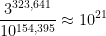
That said, students can also perform this computation by creatively using their handheld calculators. Most calculators will return an overflow error if a direct computation of 


In particular, let’s divide
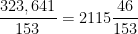
or

This suggests that we try to compute

and a hand-held calculator can be used to show that this expression is approximately equal to 
By the Laws of Exponents, we see that
Whichever technique is used, we can now use the Laws of Logarithms to approximate
This approximation matches the decimal expansion of
Since hand-held calculators will generate identical outputs for these two expressions (up to the display capabilities of the calculator), this may lead to the misconception that the irrational number
Summarizing, Algebra II students can find the decimal expansion of
by itself repeatedly in a quest to find integer powers of that are close to powers of .While I don’t have a specific reference, I’d be stunned if none of our ancestors tried something along these lines in the years between the discovery of logarithms (1614) and calculus (1666 or 1684).
















 Mean Green Math
