In this series, I’m compiling some of the quips and one-liners that I’ll use with my students to hopefully make my lessons more memorable for them.
Here’s an anecdote that I’ll share when teaching students about factorials:
The obvious observation is that the factorials get big very, very quickly.
Here’s my anecdote:
Many years ago, I was writing lesson plans while the TV show “Wheel of Fortune” was on in the background. And the contestant solved the puzzle at the end, and Pat Sajak declared, “You have just won $40,320 in cash in prizes.
So I immediately thought to myself, “Ah, 8 factorial.”
Then I thought, ugh [while slapping myself in the forehead, grimacing, and shaking my head, pretending that I can’t believe that that was the first thought that immediately came to mind].
[Finishing the story:] Not surprisingly, I was still single when this happened.
In this series, I’m compiling some of the quips and one-liners that I’ll use with my students to hopefully make my lessons more memorable for them. This is a quip that I’ll use when a theoretical calculation can be easily confirmed with a calculator. Today’s post is less of a one-liner than a story.
When I teach Algebra II or Precalculus (or train my future high school teachers to teach these subjects), we eventually land on the Rational Root Test and Descartes’ Rule of Signs as an aid for finding the roots of cubic equations or higher. Before I get too deep into this subject, however, I like to give a 10-15 minute pseudohistory about the discovery of how polynomial equations can be solved. Historians of mathematics will certain take issue with some of this “history.” However, the main purpose of the story is not complete accuracy but engaging students with the history of mathematics. I think the story I tell engages students while remaining reasonably accurate… and I always refer students to various resources if they want to get the real history.
To begin, I write down the easiest two equations to solve (in all cases, :
and
These are pretty easy to solve, with solutions well known to students:
and
In other words, there are formulas that you can just stick in the coefficients and get the answer out without thinking too hard. Sure, there are alternate ways of solving for that could be easier, like factoring, but the worst-case scenario is just plugging into the formula.
These formulas were known to Babylonian mathematicians around 2000 B.C. (When I teach this in class, I write the date, and all other dates and discoverers, next to the equations for dramatic pedagogical effect.) Though not written in these modern terms, basically every ancient culture on the globe that did mathematics had some version of these formulas: for example, the ancient Egyptians, Greeks, Chinese, and Mayans.
Naturally, this leads to a simple question: is there a formula for the cubic:
Is there some formula that we can just plug , , , and to just get the answer? The answer is, Yes, there is a formula. But it’s nasty. The formula was not discovered until 1535 A.D., and it was discovered by a man named Tartaglia. During the 1500s, the study of mathematics was less about the dispassionate pursuit of truth and more about exercising machismo. One mathematician would challenge another: “Here’s my cubic equation; I bet you can’t solve it. Nyah-nyah-nyah-nyah-nyah.” Then the second mathematician would solve it and challenge the first: “Here’s my cubic equation; I bet you can’t solve it. Nyah-nyah-nyah-nyah-nyah.” And so on. Well, Tartaglia came up with a formula that would solve every cubic equation. By plugging in , , , and , you get the answer out.
Tartaglia’s discovery was arguably the first triumph of the European Renaissance. The solution of the cubic was perhaps the first thing known to European mathematicians in the Middle Ages that was unknown to the ancient Greeks.
In 1535, Tartaglia was a relatively unknown mathematician, and so he told a more famous mathematician, Cardano, about his formula. Cardano told Tartaglia, why yes, that is very interesting, and then published the formula under his own name, taking credit without mention of Tartaglia. To this day, the formula is called Cardano’s formula.
So there is a formula. But it would take an entire chalkboard to write down the formula. That’s why we typically don’t make students learn this formula in high school; it’s out there, but it’s simply too complicated to expect students to memorize and use.
This leads to the next natural question: what about quartic equations?
The solution of the quartic was discovered less than five years later by an Italian mathematician named Ferrari. Ferrari found out that there is a formula that you can just plug in , , , , and , turn the crank, and get the answers out. Writing out this formula would take two chalkboards. So there is a formula, but it’s also very, very complicated.
Of course, Ferrari had some famous descendants in the automotive industry.
So now we move onto my favorite equation, the quintic. (If you don’t understand why it’s my favorite, think about my last name.)
After solving the cubic and quartic in rapid succession, surely there should also be a formula for the quintic. So they tried, and they tried, and they tried, and they got nowhere fast. Finally, the problem was solved nearly 300 years later, in 1832 (for the sake telling a good story, I don’t mention Abel) by a French kid named Evariste Galois. Galois showed that there is no formula. That takes some real moxie. There is no formula. No matter how hard you try, you will not find a formula that can work for every quintic. Sure, there are some quintics that can be solved, like . But there is no formula that will work for every single quintic.
Galois made this discovery when he was 19 years old… in other words, approximately the same age as my students. In fact, we know when wrote down his discovery, because it happened the night before he died. You see, he was living in France in 1832. What was going on in France in 1832? I ask my class, have they seen Les Miserables?
France was torn upside-down in 1832 in the aftermath of the French Revolution, and young Galois got into a heated argument with someone over politics; Galois was a republican, while the other guy was a royalist. More importantly, both men were competing for the hand of the same young woman. So they decided to settle their differences like honorable Frenchmen, with a duel. So Galois wrote up his mathematical notes one night, and the next day, he fought the duel, he lost the duel, and he died.
Which bring me to the conclusion of this story: we have complete and total proof that tremendous mathematical genius does not prevent somebody from being a complete idiot.
For the present, there are formulas for cubic and quartic equations, but they’re long and impractical. And for quintic equations and higher, there is no formula. So that’s why we teach these indirect methods like the Rational Root Test and Descartes’ Rule of Signs, as they give tools to use to guess at the roots of higher-order polynomials without using something like the quadratic formula.
In this series, I’m compiling some of the quips and one-liners that I’ll use with my students to hopefully make my lessons more memorable for them.
Sometimes it’s pretty easy for students to push through a proof from beginning to end. For example, in my experience, math majors have little trouble with each step of the proof of the following theorem.
Theorem. If , then .
Proof. Let , where , and let , where . Then
For other theorems, it’s not so easy for students to start with the left-hand side and end with the right-hand side. For example:
Theorem. If , then .
Proof. Let , where , and let , where . Then
.
A sharp math major can then provide the next few steps of the proof from here; however, it’s not uncommon for a student new to proofs to get stuck at this point. Inevitably, somebody asks if we can do the same thing to the right-hand side to get the same thing. I’ll say, “Sure, let’s try it”:
.
I call working with both the left and right sides to end up at the same spot the Diamond Rio approach to proofs: “I’ll start walking your way; you start walking mine; we meet in the middle ‘neath that old Georgia pine.” Not surprisingly, labeling this with a catchy country song helps the idea stick in my students’ heads.
Though not the most elegant presentation, this is logically correct because the steps for the right-hand side can be reversed and appended to the steps for the left-hand side:
Proof (more elegant). Let , where , and let , where . Then
In this series, I’m compiling some of the quips and one-liners that I’ll use with my students to hopefully make my lessons more memorable for them.
While I can’t take credit for today’s one-liner, I’m more than happy to share it.
A colleague was explaining his expectations for simplifying expressions such as
Of course, this isn’t yet simplified, but his students were balking about doing the required work. So, on the spur of the moment, he laid down a simple rule:
Not simplifying a fraction in a fraction is an infraction.
In this series, I’m compiling some of the quips and one-liners that I’ll use with my students to hopefully make my lessons more memorable for them.
At many layers of the mathematics curriculum, students learn about that various functions can essentially commute with each other. In other words, the order in which the operations is performed doesn’t affect the final answer. Here’s a partial list off the top of my head:
Arithmetic/Algebra: . This of course is commonly called the distributive property (and not the commutative property), but the essential idea is that the same answer is obtained whether the multiplications are performed first or if the addition is performed first.
Algebra: If , then .
Algebra: If and is any real number, then .
Precalculus: .
Precalculus: .
Calculus: If is continuous at an interior point , then .
Calculus: If and are differentiable, then .
Calculus: If is differentiable and is a constant, then .
Calculus: If and are integrable, then .
Calculus: If is integrable and is a constant, then .
Calculus: If is integrable, .
Calculus: For most differentiable function that arise in practice, .
Probability: If and are random variables, then .
Probability: If is a random variable and is a constant, then .
Probability: If and are independent random variables, then .
Probability: If and are independent random variables, then .
Set theory: If , , and are sets, then .
Set theory: If , , and are sets, then .
However, there are plenty of instances when two functions do not commute. Most of these, of course, are common mistakes that students make when they first encounter these concepts. Here’s a partial list off the top of my head. (For all of these, the inequality sign means that the two sides do not have to be equal… though there may be special cases when equality happens to happen.)
Algebra: if . Important special cases are , , and .
Probability: If and are dependent random variables, then .
Probability: If and are dependent random variables, then .
All this to say, it’s a big deal when two functions commute, because this doesn’t happen all the time.
I wish I could remember the speaker’s name, but I heard the following one-liner at a state mathematics conference many years ago, and I’ve used it to great effect in my classes ever since. Whenever I present a property where two functions commute, I’ll say, “In other words, the order of operations does not matter. This is a big deal, because, in real life, the order of operations usually is important. For example, this morning, you probably got dressed and then went outside. The order was important.”
In this series, I’m compiling some of the quips and one-liners that I’ll use with my students to hopefully make my lessons more memorable for them.
One of the most common student mistakes with logarithms is thinking that
.
Whenever students make this mistake, I call it the Third Classic Blunder. The first classic blunder, of course, is getting into a major land war in Asia. The second classic blunder is getting into a battle of wits with a Sicilian when death is on the line. And the third classic blunder is thinking that somehow simplfies as .
Sadly, as the years pass, fewer and fewer students immediately get the cultural reference. On the bright side, it’s also an opportunity to introduce a new generation to one of the great cinematic masterpieces of all time.
One of my colleagues calls this mistake the Universal Distributive Law, where the distributes just as if was being multiplied by a constant. Other mistakes in this vein include and .
Along the same lines, other classic blunders are thinking that
simplifies as
and that
simplifies as .
I’m continually amazed at the number of good students who intellectually know that the above equations are false but panic and use them when solving a problem.
In my capstone class for future secondary math teachers, I ask my students to come up with ideas for engaging their students with different topics in the secondary mathematics curriculum. In other words, the point of the assignment was not to devise a full-blown lesson plan on this topic. Instead, I asked my students to think about three different ways of getting their students interested in the topic in the first place.
I plan to share some of the best of these ideas on this blog (after asking my students’ permission, of course).
This student submission again comes from my former student Storm Boykin. Her topic, from Algebra II: the quadratic formula.
How could you as a teacher create an activity or project that involves your topic?
Learning the Quadratic Formula can be quite a tedious process for students. They have to learn the why and how, but still need to be able to recall the Quadratic Formula fairly quickly. Students cannot use it as a tool to solve quadratic equations if they cannot remember it. The chart below is to be a card sort from a mnemonic device that was passed down by a former teacher. The idea is that the students will have these cards mixed up, and then they will have to match the story with its’ mathematical counterpart. Then, using the mnemonic device, the student can put the story in order, and will have the quadratic formula before their eyes.
The negative boy
-b
couldn’t decide
±
if he wanted to go to the radical party
√
but the boy was square
b^2
and missed out on four awesome chicks
-4ac
it was all over by two am
/2a
What interesting things can you say about the people who contributed to the discovery and/or the development of this topic?
Quadratics began to come about around 2000 BCE because mathematicians needed a way to make “architectural floor and wall plans.” Quadratics have been worked on by various cultures since then. While working on quadratics, Pythagorus found that the square root of a number did not have to be an integer. However, he didn’t believe that imaginary numbers existed, and had one of his associates killed for even suggesting to the public that “non- integers” existed. They idea of a quadratic formula was touched on by hindu and islamic mathematicians, but did not come into form as our modern day formula until 1637, when Rene Descartes published it in his geometric works.
How can this topic be used in your students’ future courses in mathematics or science?
All algebra and calculus courses will have quadratic equations in them. Students will have a much easier Physics experience if they have the equation at their disposal. Quadratics are used to calculate velocity and height of objects in the air. Real world examples involving velocity and height are the perfect blend of physics and science! Students will also need the quadratic formula for the SAT and PSAT.
In my capstone class for future secondary math teachers, I ask my students to come up with ideas for engaging their students with different topics in the secondary mathematics curriculum. In other words, the point of the assignment was not to devise a full-blown lesson plan on this topic. Instead, I asked my students to think about three different ways of getting their students interested in the topic in the first place.
I plan to share some of the best of these ideas on this blog (after asking my students’ permission, of course).
This student submission again comes from my former student Sarah Asmar. Her topic, from Algebra/Precalculus: dividing polynomials.
How could you as a teacher create an activity or project that involves your topic?
Many high school students are introduced to Polynomials in Algebra I. They are taught how to factor and to even graph Polynomials. In Algebra II, students are asked to add, subtract, multiply and divide Polynomials. Dividing Polynomials is challenging for many students because they are not only dividing numbers, but now they have added letters to the mix. There are two ways to divide Polynomials: Long Division and Synthetic Division. Since this is a topic that most students find difficult to grasp, I would split the students into groups of about 3 or 4 and provide each group with Algebra tiles. I would then provide each group with an index card with a specific Polynomial for them to divide. The index card will have a dividend and divisor for the students to use in order for them to create find the answer using the Algebra tiles. First, they will need to create a frame. Then, the dividend should be formed inside the frame while the divisor is formed on the left hand side outside of the frame. The answer will be shown with the tiles on the top line outside the frame. I will do an example with them first and then have them do the problem provided on their index card with their group. This activity will provide the students with a visual representation on how dividing polynomials would look like in order for it to be easier for them on paper.
How can this topic be used in your students’ future courses in mathematics or science?
Students are introduced to dividing Polynomials in Algebra II. Most would never like to see this topic again, but unfortunately that is not the case. Dividing Polynomials is revisited in a Pre-Calculus class. However, it is taught at a much deeper level. Students are required to divide using long and synthetic division. Synthetic division is taught as a short cut for dividing Polynomials, but it doesn’t always work and students would have to divide using long division. Synthetic substitution is taught as well to find the solution of the Polynomial given. Synthetic substitution is as easy as just plugging in the given number for the variable provided in the Polynomial. Dividing Polynomials is also used in Binomial Expansion in Pre-Calculus. Along with all of these topics in Pre-Calculus, dividing Polynomials appears in all future basic Math courses such as Calculus. A real life example that uses Polynomials is aerospace science. These equations are used for object in motion, projectiles and air resistance.
How can technology be used to effectively engage students with this topic?
I was searching the Internet and I came across this video. I thought that this video would be an amazing tool to help the students understand how to divide polynomials without me just lecturing to them. It is sung to the tune of “We Are Young” which is a very popular song in the pop music culture. Using something like this would show a visual representation, but it will also drill the steps in their head. Our brains can easily remember songs even after listening to a song just once. The fact that dividing polynomials is put into a song makes it more likely for a student to remember the steps they need to take in order to perform the indicated operation.
In my capstone class for future secondary math teachers, I ask my students to come up with ideas for engaging their students with different topics in the secondary mathematics curriculum. In other words, the point of the assignment was not to devise a full-blown lesson plan on this topic. Instead, I asked my students to think about three different ways of getting their students interested in the topic in the first place.
I plan to share some of the best of these ideas on this blog (after asking my students’ permission, of course).
This student submission again comes from my former student Perla Perez. Her topic, from Algebra: adding, subtracting, and multiplying matrices.
How could you as a teacher create an activity or project that involves your topic?
“Cryptography is the study of encoding and decoding messages. Cryptography was first developed to send secret messages in written form.” Cryptography also uses matrices to code and decode these messages by multiplication and the inverse of them. This, however, can be done by using any operations. By using the worksheet below as a foundation for an activity, teachers can have students act like hackers to engage students in computing different operations with matrices. In this activity, prepare the classroom by dividing it into four sections each with one of the phrases separated on the worksheet. Display the message (numerically) that is to be coded. Display the alphabet with corresponding number somewhere visible for students to have references throughout the activity. The instructions given are:
Students are to get into four groups (more groups can be added for larger classrooms by making the phrase longer).
Students are given an index card with the matrix [2, 7; 13, 5]
Students are to add the matrix on each station to the the matrix on the card.
When completed students must go change the message on the broad with the code.
When the students finish coding the message they can continue developing their skills by having them do this in the beginning of class throughout the lesson plan period. As the lesson progresses the teacher can change the phrase and require different operations to be made to either code or decode or even come up with their own message. With this activity the teacher gets the opportunity to see how the students choose to add the matrices together.
How can technology (YouTube, Khan Academy [khanacademy.org], Vi Hart, Geometers Sketchpad, graphing calculators, etc.) be used to effectively engage students with this topic? Note: It’s not enough to say “such-and-such is a great website”; you need to explain in some detail why it’s a great website.
In today’s society we have access to a plethora of technology that can aid us in our everyday lives. There are so many ways one can learn something with different methods and from different people. The best part about the technology that we have access to is we can be manipulative to fit the needs of our students. When students get to the topic of adding, subtracting and soon multiplying matrices, they should be familiar with what a matrix is, the dimensions of one, and how to solve linear system with them. At this point it is a good a time to bring in a game into play like this one:
In this game the player chooses an operation such as adding, subtracting, multiplying by another matrix or scaler, and its dimensions. When a certain operation is chosen such as multiplication, it only allows the player to choose any size matrix but then spits out one with specific number of rows to multiply it with. The teacher can play this game with their students in any way they sit. The purpose is to get students thinking why and how the operations are working. From there the teacher can introduce the new topic.
How has this topic appeared in high culture (art, classical music, theatre, etc.)?
So many times students don’t understand that what they learn in class is used in everyday life, but teachers can give students the resources and knowledge to see applications of their work. In the video below, it shows different ways matrices can be applied. For instances the operations of matrices are used in a wide variety of way in our culture.
The main one can be in computer programming and computer coding, but they are also seen in another places such as dance and architecture. “In contra dancing, the dancers form groups of four (two couples), and these groups of four line up to produce a long, two-person-wide column” and where each square that is created is a formed by two pairs. Like the video had said, matrices can be used to analyze contra dancing. This can be done by having squares and multiplying them creating different types of configurations. By creating different groups and formations, essentially it is using different operations to create different matrices to.
In my capstone class for future secondary math teachers, I ask my students to come up with ideas for engaging their students with different topics in the secondary mathematics curriculum. In other words, the point of the assignment was not to devise a full-blown lesson plan on this topic. Instead, I asked my students to think about three different ways of getting their students interested in the topic in the first place.
I plan to share some of the best of these ideas on this blog (after asking my students’ permission, of course).
This student submission again comes from my former student Daniel Adkins. His topic, from Algebra: adding, subtracting, multiplying, and dividing complex numbers.
How has this topic appeared in pop culture?
Robot chicken aired a television episode in which students were being taught about the imaginary number. Upon the instructor’s completion of his definition of the imaginary number, one student, who understands the definition, immediately has his head explode. One student turns to him and says, “I don’t get it. No wait now I-“, and then his head also explodes.
This video can be used as a humorous introduction that only takes a few seconds. It conveys that these concepts can be difficult in a more light-hearted sense. At the same time it satirically exaggerates the difficulty, and therefore might challenge the students. All the while the video provides the definition as well.
How did people’s conception of this topic change over time?
The first point of contact with imaginary numbers is attributed to Heron of Alexandria around the year 50 A.D. He was attempting to solve the section of a pyramid. The equation he eventually deemed impossible was the sqrt(81-114). Attempts to find a solution for a negative square root wouldn’t reignite till the discovery of negative numbers, and even this would lead to the belief that it was impossible. In the early fifteenth century speculations would rise again as higher degree polynomial equations were being worked out, but for the most part negative square roots would just be avoided. In 1545 Girolamo Cardono writes a book titled Ars Magna. He solves an equation with an imaginary number, but he says, “[imaginary numbers] are as subtle as they would be useless.” About them, and most others agreed with him until 1637. Rene Descartes set a standard form for complex numbers, but he still wasn’t too fond of them. He assumed, “that if they were involved, you couldn’t solve the problem.” And individuals like Isaac Newton agreed with him.
Rafael Bombelli strongly supported the concept of complex numbers, but since he wasn’t able to supply them with a purpose, he went mostly unheard. That is until he came up with the concept of using complex numbers to find real solutions. Over the years, individuals eventually began to hear him out.
One of the major ways that helped aid with people eventually come to terms with imaginary numbers was the concept of placing them on a Cartesian graph as the Y-axis. This concept was first introduced in 1685 by John Wallis, but he was largely ignored. A century later, Caspar Wessel published a paper over the concept, but was also ignored. Euler himself labeled the square root of negative 1 as i, which did help in modernizing the concept. Throughout the 19th century, countless mathematicians aided to the growing concept of complex numbers, until Augustin Louis Cauchy and Niels Henrik Able make a general theory of complex numbers.
This is relevant to students because it shows that mathematicians once found these things impossible, then they found them unbelievable, then they found them trivial, until finally, they found a purpose. It encourages students to work hard even if there doesn’t seem to be a reason behind it just yet, and even if it seems like your head is about to blow.
How has this topic appeared in high culture?
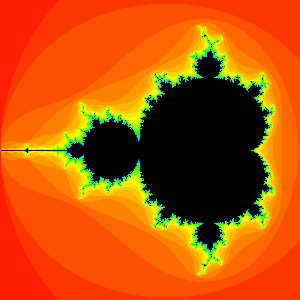
The Mandelbrot set is a beautiful fractal set with highly complex math hidden behind it. However it is extremely complicated, and as Otto von Bismarck put it, “laws are like sausages. Better not to see them being made.”
Like most fractals, the Mandelbrot set begins with a seed to start an iteration. In this case we begin with x2 + c, where c is some real number. This creates an eccentric pattern that grows and grows.
For students, this can show how mathematics can create beautiful patterns that would interest their more artistic senses. Not only would this generate interest in complex numbers, but it might convince students to investigate recurring patterns.





 :
: and
and 
 and
and 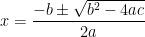
 that could be easier, like factoring, but the worst-case scenario is just plugging into the formula.
 ,
,  ,
,  , and
, and  to just get the answer? The answer is, Yes, there is a formula. But it’s nasty. The formula was not discovered until 1535 A.D., and it was discovered by a man named
 , turn the crank, and get the answers out. Writing out this formula would take two chalkboards. So there is a formula, but it’s also very, very complicated.
 . But there is no formula that will work for every single quintic.
 , then
  .
. , where
  , and let
  , where
  . Then


 .
.



 .
.



 .
.
 . This of course is commonly called the distributive property (and not the commutative property), but the essential idea is that the same answer is obtained whether the multiplications are performed first or if the addition is performed first.
 , then
  .
. .
. .
. .
. is continuous at an interior point
  .
. are differentiable, then
  .
. .
. .
. .
. is integrable,
  .
. .
. and
and  are random variables, then
  .
. .
. .
. .
. ,
,  , and
, and  are sets, then
  .
. .
. if
if  . Important special cases are
  ,
,  , and
, and  .
. . I call this the
  .
. ,
,  , etc.
 .
. .
.
 .
. .
. .
. somehow simplfies as
  .
. distributes just as if
  was being multiplied by a constant. Other mistakes in this vein include
  and
and  .
. simplifies as
 simplifies as
  .
.
 Mean Green Math