Engaging students: Venn diagrams

In my capstone class for future secondary math teachers, I ask my students to come up with ideas for engaging their students with different topics in the secondary mathematics curriculum. In other words, the point of the assignment was not to devise a full-blown lesson plan on this topic. Instead, I asked my students to think about three different ways of getting their students interested in the topic in the first place.

I plan to share some of the best of these ideas on this blog (after asking my students’ permission, of course).

This student submission comes from my former student Michelle McKay. Her topic, from Probability: Venn diagrams.

green line

A. What interesting word problems using this topic can your students do now?

In my opinion, you can create a word problem with Venn diagrams on just about anything. To make a word problem more interesting, you can relate the problem to an upcoming event or holiday, make a cultural reference, or even discuss students’ hobbies (i.e. video games, books, etc.).

On Valentine’s Day, a survey of what gifts a women received from their significant other yielded surprising results.

76% of the women surveyed received a card.

72% received chocolate.

49% received flowers.

21% received chocolate and a card.

5% received a card and flowers.

7% received chocolate and flowers.

33% received chocolate, a card, and flowers.

If a woman from the survey was selected at random, what would the probability of her having not received a Valentine’s Day gift be? What is the probability that she received any combination of two gifts? What is the probability that she received a card and flowers, but not chocolate?

green line

B.     How can this topic be used in your students’ future courses in mathematics or science?

Venn diagrams are an excellent way to organize information. They can organize and be a visual representation of gathered statistics (like in the above section). They can also organize general ideas and concepts, distinguishing them as unique or shared amongst other ideas/concepts. A student can use Venn diagrams in either of these manners for both math and science classes of any difficulty.


green line

B. How does this topic extend what your students should have learned in previous courses?

When using Venn diagrams to represent statistics, it reinforces the idea that parts cannot be larger than the whole. We know when using Venn diagrams for statistical data that the decimals must add up to 1 to represent 100%. Students should realize that adding the decimals and getting a number that is larger than or smaller than 1 means they miscalculated or there is “missing” data. By “missing” data, I mean to say that they did not enter in all the given information correctly.


Engaging students: Multiplying binomials

In my capstone class for future secondary math teachers, I ask my students to come up with ideas for engaging their students with different topics in the secondary mathematics curriculum. In other words, the point of the assignment was not to devise a full-blown lesson plan on this topic. Instead, I asked my students to think about three different ways of getting their students interested in the topic in the first place.

I plan to share some of the best of these ideas on this blog (after asking my students’ permission, of course).

This student submission comes from my former student Claire McMahon. Her topic, from Algebra I: multiplying binomials like (a+b)(c+d).

green line

I personally have had the pleasure of teaching this part of Algebra 1 to a freshman high school class.  The greatest part about the lesson was how the students were able to work together to really figure all of them out and better yet, they knew why!  You can use several different versions of BINGO for practically anything in math.  And who doesn’t love to win prizes.  This website in particular has led me to some really great lesson plans and I credit a lot of this blog to a lot of the lesson plans I have personally implemented.  Almost every one of them worked with almost little to no tweaking.  I’m not exactly a huge fan of the FOIL concept so I used BINO instead of Bingo!!  Just like singing the song and insert joke here.  So here is the lesson on Distributive Bingo and how it works.  The basic rundown is you give the students either the polynomial or the already factored binomials and have them solve it one way or the other.  For example, if you are trying to focus more on the factoring and zeros making them go from a polynomial to factoring is good practice.  The other really great thing is you can build scaffolds into the game itself by passing out hint cards or key concepts to help them figure out what they are looking for, similar to a formula sheet.

green line

One of the great things about the Internet is there is so much information constantly flowing in and out at all times.  YouTube is a great asset when trying to reinforce good study habits and good metacognition.  Most students are very visual and it gives step-by-step instructions on how to do almost anything.  The other key thing is they can pause rewind and replay if necessary.  If you prefer to have a safer environment for your students to browse then you can lean them toward teacher tube, which has all the same resources without the junk videos.  Here is one of the many multiplying videos that show a method similar to a Punnet Square, which is in line with learning genetics and heredity.  They might have already learned this in biology but if not then it’s a great visual representation of a multiplication table and they will learn it again in science.  It’s easy for the students to check their work and for you to see where any misconceptions can arise.

green line

Algebra tiles are an amazing tool for teaching area models and multiplying binomials.  There are virtual algebra tiles found on the Internet and also many different websites that you can buy a classroom set.   I recommend your students to get used to because they show the value of negative and positive and how multiplying, adding, subtracting or dividing positive and negative integers affects the outcome.  This concept is very important when you are learning to multiply binomials and is often lost or was never present in many student’s previous studies.  You need to make sure that these basic skill benchmarks are met before embarking on an algebra tiles journey.  If you teach the basic rules to play with algebra tiles then you will be set in teaching them multiplication and factoring of binomials and polynomials.  We all love a journey of understanding and this is one of the most awesome tools that students can use to “do math.”

Engaging students: Completing the square

In my capstone class for future secondary math teachers, I ask my students to come up with ideas for engaging their students with different topics in the secondary mathematics curriculum. In other words, the point of the assignment was not to devise a full-blown lesson plan on this topic. Instead, I asked my students to think about three different ways of getting their students interested in the topic in the first place.

I plan to share some of the best of these ideas on this blog (after asking my students’ permission, of course).

This student submission comes from my former student Claire McMahon. Her topic, from Algebra: completing the square.

green line

There were a lot of famous mathematicians that contributed to the notion of completing the square.  The first of the mathematicians was that of the Babylonians.  This culture started the notion of not only solving the quadratics but of arithmetic itself.  The Babylonians started with the equations and then proceeded to solve them algebraically.  Back then; they used pre-calculated tables to help them with solving for the roots.  They were basically solving by the quadratic equation at this point.  The man that came along has a very hard name to not only pronounce but to spell, and I will do my best.  I will refer to him as Muhammad from here on out but his full name, or one of the common names to which he is referred is Muhammad ibn Musa al-Khwarizmi.  He developed the term algorithm, which led to an algorithm for solving quadratic equations, namely completing the square.

The notion of completing the square has gone through a series of transformations throughout the history of mathematics.  As mentioned before the Babylonians started with the notion and increased the knowledge by developing the quadratic formula to find the roots of a given quadratic equation.  This spurred the thought that I can solve any equation and find its solution and roots by completing the square.  Muhammad brought this notion to us, of which was mentioned before.  More specifically the text that he developed was “The Compendious Book of Calculations by Completion and Balancing.”  This book of course has been translated several times over but the general idea is laid out in the title.  Modern mathematicians have developed a less compendious form that is now being taught in the math classes today.  They take on many different forms and can be taught with manipulates as well.


green line

The fabulous part to the story is there are a lot of resources that help the kids of today to deal with this “trick” of the math trade.  There are numerous You Tube videos on the different methods of which show every step along the way with encouraging thoughts.  Another great online resource is any of the math websites.  I find it a little unfair that these resources were not readily available when I was struggling with such concepts.  One of my personal favorites is the PurpleMath.com website.  This website breaks everything down to basically that of a fourth grade level.  They have pictures and fun problems to work out on your own.  My favorite part is that you get your answers checked instantaneously to build the self-confidence and self-efficacy it takes to be a successful student.  These particular websites are great tools for teachers as well, as they have a lot of great examples that can be used in the classroom and different ways that a student might present and calculate a problem.

Engaging students: Order of operations

In my capstone class for future secondary math teachers, I ask my students to come up with ideas for engaging their students with different topics in the secondary mathematics curriculum. In other words, the point of the assignment was not to devise a full-blown lesson plan on this topic. Instead, I asked my students to think about three different ways of getting their students interested in the topic in the first place.

I plan to share some of the best of these ideas on this blog (after asking my students’ permission, of course).

This student submission comes from my former student Alyssa Dalling. Her topic, from Pre-Algebra: order of operations.

green line

C. How has this topic appeared in pop culture (movies, TV, current music, video games, etc.)?

Hannah Montana is a Disney series that aired from 2006-2011. On this episode titled “Sleepwalk This Way”, Miley’s dad writes her a new song which she reads and doesn’t like. She decides to keep her dislike of the new song to herself causing her to start sleepwalking. In order to not tell her dad what she thinks of the song while sleepwalking, Miley stops sleeping which causes her many problems. One such problem occurs when Miley gets dressed in the wrong order causing her to get an unwanted result.

I would start out the class by showing the first 46 seconds of this Hannah Montana scene. (Editor’s note: Trust me, this is hilarious.) This scene is perfect for the engage because it is a way to relate the order of operations to getting dressed. After watching the scene, the teacher would explain that just like getting dressed in the proper order is important, the order of operations when doing math is as well. The students would learn PEMDAS (parenthesis, exponents, multiplication, division, addition, and subtraction) and try different problems to get them better acquainted with the concept.

green line

B. How can this topic be used in your students’ future courses in mathematics or science?

The order of operations will be used in almost every math class following Pre-Algebra. One example is in Algebra II when students start working with problems involving simplifying numbers and multiple variables. One example is

\left( \displaystyle \frac{18a^{4x} b^2}{-6 a^x b^5} \right)^3

Start out the class by asking students how the order of operations says to answer this question.  Most students will follow method two below. Upon completion of this lesson, students will learn multiple methods of problem solving which expand their previous knowledge of order of operations.

The first method students can use is to raise the numerator and denominator to the third power before simplifying. By raising each variable to the third power, no rules in the order of operations will be broken showing the student there is more than one way to use the order of operations. (Reference Method One below).

The method most students will originally think of is simplifying the fraction before raising it to the third power. The student would follow their previous knowledge of PEMDAS in order to simplify the equation to the reduced form. (Reference Method Two below). In either case, the students will see that the solution can be found by using a variety of different means that all fall under the order of operations.

Method One:

Alyssa_order1

Method Two:

Alyssa_order2

Resources: http://www.glencoe.com/sec/math/algebra/algebra2/algebra2_05/extra_examples/chapter5/lesson5_1.pdf

green line

B. How can this topic be used in your students’ future courses in mathematics or science?

An understanding of the order of operations is relied upon in Calculus as well. One application is when learning the chain rule. The following YouTube video does a fun job at explaining the chain rule by using a catchy song. The students are able to learn the rule and see examples that they can use to help them with this concept. Start it at 1:32 and end it at 2:10 (shown below).

The chain rule is used to find the derivative of the composition of two functions. So if f and g are functions, then the derivative of f(g(x)) can be found using the chain rule. Using the example F(x) = (x^3+5x)^2 , the chain rule states that the derivative will be F'(x) = f'(z) g'(x). Following this definition, the student finds the derivative to be 2(x^3+5x)(3x^2+5) . This is where the order of operations comes in. The student must use their previously acquired skills from Pre-Algebra as well as Algebra II to simplify the expression. From their previously acquired knowledge, the student would know they would have to multiply the 2 by each expression in f'(z). Also, if a question asked the student to find the derivative when x=3, the student would have to use their knowledge of the order of operations to find the solution after applying the chain rule.

Resources: http://archives.math.utk.edu/visual.calculus/2/chain_rule.4/index.html


Engaging students: Finding x- and y-intercepts

In my capstone class for future secondary math teachers, I ask my students to come up with ideas for engaging their students with different topics in the secondary mathematics curriculum. In other words, the point of the assignment was not to devise a full-blown lesson plan on this topic. Instead, I asked my students to think about three different ways of getting their students interested in the topic in the first place.

I plan to share some of the best of these ideas on this blog (after asking my students’ permission, of course).

This student submission again comes from my former student Maranda Edmonson. Her topic, from Algebra: finding x- and y-intercepts. Unlike most student submissions, Maranda’s idea answers three different questions at once.

green lineApplications: How could you as a teacher create an activity or project that involves your topic?

Culture: How has this topic appeared in pop culture (movies, TV, current music, video games, etc.)?

Technology: How can technology be used to effectively engage students with this topic?

This link is to a reflection by a mathematics teacher who used the popular TV show “The Big Bang Theory” to teach linear functions. She taught this lesson prior to teaching students about finding y-intercepts of linear functions, but it can be adapted in order to teach how to find the intercepts themselves.

ENGAGE:

One thing I would not change would be to show the students the above clip of the show where Howard and Sheldon are heatedly discussing crickets at the beginning of the activity. By showing the video at the beginning, students will be engaged and want to figure out what will be done throughout the lesson. Being a clip of a popular show that many probably watch during the week, students will be even more engaged and interested since they are able to watch something that they are already familiar with. Being something that they are already familiar with or can relate to, students have a tendency to remember the material or at least the topic longer than they would remember something that they were unfamiliar with or could not relate.

In the clip, Sheldon argues that the cricket the guys hear while eating dinner is a snowy tree cricket based on the temperature of the room and the frequency of chirps; Howard argues that it is an ordinary field cricket.  The beginning of their discussion is as follows:

Sheldon: “Based on the number of chirps per minute, and the ambient temperature in this room, it is a snowy tree cricket.”

Howard: “Oh, give me a frickin’ break. How could you possibly know that?”

Sheldon: “In 1890, Amos Dolbear determined that there was a fixed relationship between the number of chirps per minute of the snowy tree cricket and the ambient temperature – a precise relationship that is not present with ordinary field crickets.”

The whole episode revolves around the guys finding the exact genus and species of the cricket, but that is not the importance here. The importance of this clip is the linear relationship between the temperature and the number of chirps per minute of the cricket, which the activity should then be centered around.

EXPLORE:

After showing the short clip, it could be beneficial to show students the Wikipedia link that discusses Dolbear’s Law. Toward the bottom of the page, the relationship is written out in several formats, but there is a basic linear function that students could focus on for the activity.

Assuming students know how to graph linear functions (as stated above, the link is for a lesson the teacher taught before teaching students about y-intercepts), I would have students graph Dolbear’s Law on a piece of graph paper. The challenge would be for students to find out what happens when there are variations to the number of chirps of the cricket, the temperature or both to see how the graph changes – specifically where the graph crosses each axis.

 EXPLAIN/ELABORATE/EVALUATE:

At this point, students should be able to state what changes they noticed with the graph – specifically where the graph crossed the axes as changes are made to the function. After they have explained what they found, fill in any gaps and correct vocabulary as needed. Basically, teach what little there is left for the lesson. Follow-up by providing extra examples or a worksheet for students to practice before giving them a quiz or test to assess their performance.

Why does 0.999… = 1? (Part 5)

Here’s one more way of convincing students that 0.\overline{9} = 1. Here’s the idea: how far apart are the two numbers?

First off, since 1 \ge 0.\overline{9}, we know that 1 - \overline{9} \ge 0.

Of course, we know that 1-0.9 = 0.1. Since 0.\overline{9} must lie between 0.9 and 1, we know that 1 - 0.\overline{9} must be less than 0.1.

Second, we know that 1-0.99 = 0.01. Since 0.\overline{9} must lie between 0.99 and 1, we know that 1 - 0.\overline{9} must be less than 0.01.

Third, we know that 1-0.999 = 0.001. Since 0.\overline{9} must lie between 0.999 and 1, we know that 1 - 0.\overline{9} must be less than 0.001.

By the same reasoning, we conclude that

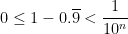
0 \le 1 - 0.\overline{9} < \displaystyle \frac{1}{10^n}

for every integer n. What’s the only number that’s greater than or equal to 0 and less than every decimal of the form 0.00\dots001? Clearly, the only such number is 0. Therefore,

1 - 0.\overline{9} = 0, or 0.\overline{9} = 1.

green lineI like this approach because it really gets at the heart of the difference between integers \mathbb{Z} and real numbers \mathbb{R}. For integers, there is always an integer to the immediate left and to the immediate right. In other words, if you give me any integer (say, 15), I can tell you the largest integer that’s less than your number (in our example, 14) and the smallest integer that’s bigger than your number (16).

Real numbers, however, do not have this property. There is no real number to the immediate right of 0. This is easy to prove by contradiction. Suppose x > 0 is the real number to the immediate left of 0. That means that there are no real numbers between 0 and x. However, x/2 is bigger than 0 and less than x, providing the contradiction.

(For what it’s worth, the above proof doesn’t apply to the set of integers \mathbb{Z} since x/2 doesn’t have to be an integer.)

By the same logic — visually, you can imagine reflecting the number line across the point x = 0.5 — there is no number to the immediate left of 1. So while 0.\overline{9} would appear to be to the immediate left of 1, they are in reality the same point.

Why does 0.999… = 1? (Part 4)

In this series, I discuss some ways of convincing students that 0.999\dots = 1 and that, more generally, a real number may have more than one decimal representation even though a decimal representation corresponds to only one real number. This can be a major conceptual barrier for even bright students to overcome. I have met a few math majors within a semester of graduating — that is, they weren’t dummies — who could recite all of these ways and were perhaps logically convinced but remained psychologically unconvinced.

Method #5. This is a proof by contradiction; however, I think it should be convincing to a middle-school student who’s comfortable with decimal representations. Also, perhaps unlike Methods #1-4, this argument really gets to the heart of the matter: there can’t be a number in between 0.999\dots and 1, and so the two numbers have to be equal.

In the proof below, I’m deliberating avoiding the explicit use of algebra (say, letting x be the midpoint) to make the proof accessible to pre-algebra students.

Suppose that 0.999\dots < 1. Then the midpoint of 0.999\dots and 1 has to be strictly greater than 0.999\dots, since

\displaystyle \frac{0.999\dots + 1}{2} > \displaystyle \frac{0.999\dots + 0.999\dots}{2} = 0.999\dots

Similarly, the midpoint is strictly less than 1:

\displaystyle \frac{0.999\dots + 1}{2} < \displaystyle \frac{1 +1}{2} =1

(For the sake of convincing middle-school students, a number line with three tick marks — for 0.999\dots, 1, and the midpoint — might be more believable than the above inequalities.)

So what is the decimal representation of the midpoint? Since the midpoint is less than 1, the decimal representation has to be 0.\hbox{something} Furthermore, the midpoint does not equal 0.999\dots. That means, somewhere in the decimal representation of the midpoint, there’s a digit that’s not equal to 9. In other words, the midpoint has to have one of the following 9 forms:

midpoint = 0.999\dots 990 \, \_ \, \_ \dots

midpoint = 0.999\dots 991 \, \_ \, \_ \dots

midpoint = 0.999\dots 992 \, \_ \, \_ \dots

midpoint = 0.999\dots 993 \, \_ \, \_ \dots

midpoint = 0.999\dots 994 \, \_ \, \_ \dots

midpoint = 0.999\dots 995 \, \_ \, \_ \dots

midpoint = 0.999\dots 996 \, \_ \, \_ \dots

midpoint = 0.999\dots 997 \, \_ \, \_ \dots

midpoint = 0.999\dots 998 \, \_ \, \_ \dots

In any event, 9 is the largest digit. That means that, no matter what, the midpoint is less than 0.999\dots, contradicting the fact that the midpoint is larger than 0.999\dots (if 0.999\dots < 1).

Why does 0.999… = 1? (Part 3)

In this series, I discuss some ways of convincing students that 0.999\dots = 1 and that, more generally, a real number may have more than one decimal representation even though a decimal representation corresponds to only one real number. This can be a major conceptual barrier for even bright students to overcome. I have met a few math majors within a semester of graduating — that is, they weren’t dummies — who could recite all of these ways and were perhaps logically convinced but remained psychologically unconvinced.

Method #4. This is a direct method using the formula for an infinite geometric series… and hence will only be convincing to students if they’re comfortable with using this formula. By definition,

0.999\dots = \displaystyle \frac{9}{10} + \frac{9}{100} + \frac{9}{1000} + \dots

This is an infinite geometric series. Its first term is \displaystyle \frac{9}{10}, and the common ratio needed to go from one term to the next term is \displaystyle \frac{1}{10}. Therefore,

0.999\dots = \displaystyle \frac{ \displaystyle \frac{9}{10}}{ \quad \displaystyle 1 - \frac{1}{10} \quad}

0.999\dots = \displaystyle \frac{ \displaystyle \frac{9}{10}}{ \quad \displaystyle \frac{9}{10} \quad}

0.999\dots = 1

Why does 0.999… = 1? (Part 2)

In this series, I discuss some ways of convincing students that 0.999\dots = 1 and that, more generally, a real number may have more than one decimal representation even though a decimal representation corresponds to only one real number. This can be a major conceptual barrier for even bright students to overcome. I have met a few math majors within a semester of graduating — that is, they weren’t dummies — who could recite all of these ways and were perhaps logically convinced but remained psychologically unconvinced.

Methods #2 and #3 are indirect methods. We start with a decimal representation that we know and end with 0.999\dots.

Method #2. This technique should be accessible to any student who can do long division. With long division, we know full well that

\displaystyle \frac{1}{3} = 0.333\dots

Multiply both sides by 3:

\displaystyle 3 \times \frac{1}{3} = 3 \times 0.333\dots

\displaystyle 1 = 0.999\dots

Though not logically necessary, this method could be reinforced for students by also considering

\displaystyle 1 = 9 \times \frac{1}{9} = 9 \times 0.111\dots = 0.999\dots

green line

Method #3. With long division, we know full well that

\displaystyle \frac{1}{3} = 0.333\dots \quad and ~ \quad \displaystyle \frac{2}{3} = 0.666\dots

Add them together:

\displaystyle \frac{1}{3} + \frac{2}{3} = 0.333\dots + 0.666\dots

\displaystyle 1 = 0.999\dots

Though not logically necessary, this method could be reinforced for students by also considering any (or all) of the following:

1 = \displaystyle \frac{1}{9} + \frac{8}{9} = 0.111\dots + 0.888\dots = 0.999\dots

1 = \displaystyle \frac{2}{9} + \frac{7}{9} = 0.222\dots + 0.777\dots = 0.999\dots

1 = \displaystyle \frac{4}{9} + \frac{5}{9} = 0.444\dots + 0.555\dots = 0.999\dots