Engaging students: Powers and exponents

In my capstone class for future secondary math teachers, I ask my students to come up with ideas for engaging their students with different topics in the secondary mathematics curriculum. In other words, the point of the assignment was not to devise a full-blown lesson plan on this topic. Instead, I asked my students to think about three different ways of getting their students interested in the topic in the first place.

I plan to share some of the best of these ideas on this blog (after asking my students’ permission, of course).

This student submission comes from my former student Kayla (Koenig) Lambert. Her topic, from Pre-Algebra: powers and exponents.

green line

A) Applications: What interesting word problems using this topic can your students do now?


I chose the problem below from http://www.purplemath.com because I think that solving a problem that deals with disease would be interesting to my students. People have to deal with sickness and disease everyday and I think that solving a real world problem would entice the students into wanting to learn more.

A biologist is researching a newly-discovered species of bacteria. At time t = 0 hours, he puts one hundred bacteria into what he has determined to be a favorable growth medium. Six hours later, he measures 450 bacteria. Assuming exponential growth, what is the growth constant “k” for the bacteria? (Round k to two decimal places.)

For this exercise, the units on time t will be hours, because the growth is being measured in terms of hours. The beginning amount P is the amount at time t = 0, so, for this problem, P = 100. The ending amount is A = 450 at t = 6. The only variable I don’t have a value for is the growth constant k, which also happens to be what I’m looking for. So I’ll plug in all the known values, and then solve for the growth constant:

A = Pe^{kt}

450 = 100 e^{6k}

4.5 = e^{6k}

\ln(4.5) = 6k

k = \displaystyle \frac{\ln(4.5)}{6} = 0.250679566129\dots

The growth constant is 0.25/hour.

I think this kind of problem would be beneficial to students because it would help them understand how bacteria grows and how easily they can get catch something and get sick.


green line

C) Culture: How has this topic appeared in pop culture?

Exponents and powers are everywhere around us without the students knowledge. Many movies and video games have ideas related to powers and exponents. Take, for example, the movie Contagion that was released in September 2011. This movie is about “the threat posed by a deadly disease and an international team of doctors contracted by the CDC to deal with the outbreak” (http://www.imdb.com/title/tt1598778). In this movie, there is a scene where the doctors are using mathematical equations with exponents to find out how fast the disease spreads and how much time they have left to save the majority of the population. There are many movies like this that involve powers and exponents, Contagion is just one example. There are also popular video games that deal with the spread of disease. For example, in the video game Call Of Duty: World At War the player is a soldier in WWII and his mission is to kill zombies, and zombie populations grow exponentially. Now, my brother plays this game and I know for a fact that he doesn’t think about the mathematics behind it, but I think talking about pop culture while teaching would really bring some excitement to the classroom and get the students thinking.


green line

D) History: Who were some of the people who contributed to the discovery of this topic?

Exponents and powers have been among humans since the time of the Babylonians in Egypt. “Babylonians already knew the solution to quadratic equations and equations of the second degree with two unknowns and could also handle equations to the third and fourth degree” (Mathematics History). The Egyptians also had a good idea about powers and exponents around 3400 BC. They used their “hieroglyphic numeral system” which was based on the scale of 10. When using their system, the Egyptians expressed any number using their symbols, with each symbol being “repeated the required number of times” (Mathematics History). However, the first actual recorded use of powers and exponents was in a book called “Artihmetica Integra” written by English author and Mathematician Michael Stifel in 1544 (History of Exponents). In the 14th century Nicole Oresme used “numbers to indicate powering”(Jeff Miller Pages). Also, James Hume used Roman Numerals as exponents in the book L’Algebre de Viete d’vne Methode Novelle in 1636. Exponents were used in modern notation be Rene Descartes in 1637. Also, negative integers as exponents were “first used in modern notation” by Issac Newton in 1676 (Jeff Miller Pages).


Works Cited

Ayers, Chuck. “The History of Exponents | eHow.com.” eHow | How to Videos, Articles & More – Discover the expert in you. | eHow.com. N.p., n.d. Web. 25 Jan. 2012. http://www.ehow.com/about_5134780_history-exponents.html.

“Contagion (2011) – IMDb.” The Internet Movie Database (IMDb). N.p., n.d. Web. 25 Jan. 2012. http://www.imdb.com/title/tt1598778/.

“Exponential Word Problems.” Purplemath. N.p., n.d. Web. 25 Jan. 2012. http://www.purplemath.com/modules/expoprob2.htm.

“Mathematics History.” ThinkQuest : Library. N.p., n.d. Web. 25 Jan. 2012. http://library.thinkquest.org/22584/.

juxtaposition.. “Earliest Uses of Symbols of Operation.” Jeff Miller Pages. N.p., n.d. Web. 25 Jan. 2012. http://jeff560.tripod.com/operation.html.


Engaging students: Solving proportions

In my capstone class for future secondary math teachers, I ask my students to come up with ideas for engaging their students with different topics in the secondary mathematics curriculum. In other words, the point of the assignment was not to devise a full-blown lesson plan on this topic. Instead, I asked my students to think about three different ways of getting their students interested in the topic in the first place.

I plan to share some of the best of these ideas on this blog (after asking my students’ permission, of course).

This student submission comes from my former student Kayla (Koenig) Lambert. Her topic, from Pre-Algebra: solving proportions.

green line

C. Culture: How has this topic appeared in the news?

Solving proportions, or the idea of a proportion being solved, appears in the news more often than not. One specific example that can be used is the effect of the economy on real estate companies. Say we are given 25% of 16 real estate companies that have closed their businesses due to poor economy. We can use proportions to determine the number of real estate companies that closed. We know that the percent is 25 and that the whole is 16. Therefore 25/100 = x/16 which gives us 4 real estate companies that closed (Review of Proportions). Proportions can also be used to determine how many miles we can drive on a certain amount of gas, and gas prices are constantly on the news. Also, this will be relevant to high school students who drive and need to find how much money they need to buy gas for the week, etc.
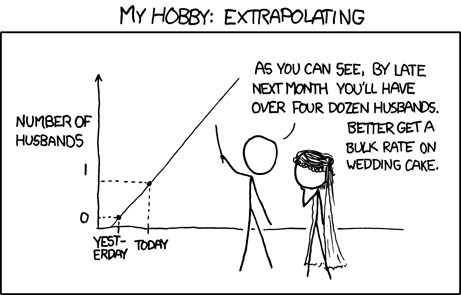
We can also use proportions to find the unit price of an item at a grocery store, or if an item costs a certain amount, you can find out how many of those items you can buy with a fixed amount of money you have. Buying items and saving money are also all over the news. If you find the unit price you can compare items therefore saving money by buying the item that you get the most out of your money.  Another way solving proportions can appear on the news is by the stock market. You can use proportions to find out how much the stock market will rise in a given amount of days given the current amount of points it has raised in a certain amount of days. Making a proportion problem for students to solve is relatively easy and can be related to anything that is on the news. We can use this to our advantage to get the students to be a little more interested in proportions (and mathematics) so they can see different ways it is related to real life.


green line

D. History: How was this topic adopted by the mathematical community?

The idea of proportions was adopted and used by many in the mathematical community. Proportions were used by Greek writers, including one named Nicomachus, who include proportions and ratios in arithmetic (Math Forum). Proportions were also adopted by Exodus who used them in geometry and by Theon of Smyrna who used proportions in music (Math Forum). In 2000 B.C., the Babylonians adopted proportions to represent place value notation (Pythagoras – Geometrical Algebra). Using proportions was accepted by mathematicians and was used to solve so many different equations used for so many different ideas, and is still used today. Early proportions were adopted by the Egyptians and were used to calculate fractions and measurement of farmland (Mathematics History). Later, proportions were adopted by so many more in the mathematical community like in Greece, China, India, and Babylonia in order to learn geometry. Greeks, like Plato, adopted proportions in order to study them with the Egyptians. I think that proportions were well liked by mathematicians and were adopted by many because you can use proportions to solve so many things.


green line

D. History: How did people’s conception of proportions change over time?

From the beginning, people have used proportions. Early humans used proportions to see if one tribe was twice as large as another or if one leather strap is only half as long as another (Math Forum). It is obvious that the idea solving proportions hasn’t really changed that much, but what we can use proportions to solve has changed. In 2000 B.C. Babylonians used proportions to evolve place value notation by allowing arbitrarily large numbers and fractions to be represented (An Overview of Egyptian Mathematics). Around 1600 B.C. in Egypt, proportions were used to calculate the fraction and superficial measure of farmland (Mathematics History). Egyptians then used proportions to find volumes of cylinders and areas of triangles.

Vitruvius thought of proportions in terms of unit fractions for their architecture calculations (Proportion (architecture)). Also, scribes used “unit fractions” for their calculations in Egypt and Mesopotamia. Egyptians based proportions on parts of their body and their symmetrical relation to each other; like fingers, palms, hands, etc. Multiples of body proportions would be found in the arrangement of fields and buildings people lived in (Proportion (architecture)) and from here, proportions evolved. In 600 B.C., the idea of using proportions evolved and was then used for geometry (Mathematics History). Proportions are still used in geometry, like in architecture and land, like it was 3000 years ago. When you think about it, proportions have evolved, but the use of proportions has evolved even greater. There are so many topics we can now solve using proportions!

Works Cited

“Math Forum – Ask Dr. Math.” The Math Forum @ Drexel University. 7 Mar. 2012. <http://www.mathforum.org/library/drmath/view/64539.html&gt;.

“Mathematics History.” ThinkQuest : Library. 7 Mar. 2012. <http://library.thinkquest.org/22584/&gt;.

“Proportion (architecture).” Wikipedia, the free encyclopedia. 7 Mar. 2012. <http://en.wikipedia.org/wiki/Proportion_%28architecture%29&gt;.

“Review of Proportions.” Self Instructional Mathematics Tutorials. 7 Mar. 2012. <http://www.cstl.syr.edu/fipse/decunit/ratios/revprop.htm&gt;.

“An Overview of Egyptian Mathematics.”  7 Mar. 2012. < http://www-groups.dcs.st-and.ac.uk/~history/HistTopics/Egyptian_mathematics.html >


Seismic waves

xkcdseismic_waves

Source: http://www.xkcd.com/723/

green line

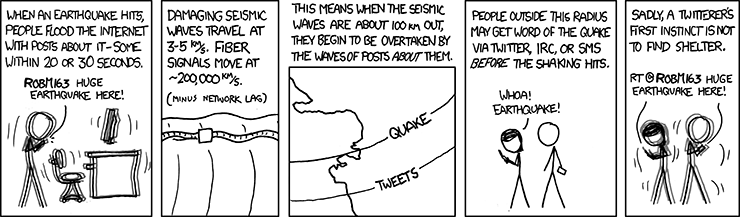
The above comic pretty much happened when a 5.8 earthquake hit Virgina in 2011, as people up and down the East Coast received tweets about an earthquake seconds before feeling the earthquake for themselves.

It also inspires the obvious word problem for Algebra I students.

When an earthquake hits, seismic waves travel at about 5 meters per second. Suppose that Alex tweets about the earthquake 30 seconds after feeling its seismic waves. The tweet travels at about 200,000,000 meters per second. How far away does someone have to be from Alex to receive the tweet before also feeling the seismic waves?

Engaging students: Finding points in the coordinate plane

In my capstone class for future secondary math teachers, I ask my students to come up with ideas for engaging their students with different topics in the secondary mathematics curriculum. In other words, the point of the assignment was not to devise a full-blown lesson plan on this topic. Instead, I asked my students to think about three different ways of getting their students interested in the topic in the first place.

I plan to share some of the best of these ideas on this blog (after asking my students’ permission, of course).

This student submission comes from my former student Derek Skipworth. His topic, from Pre-Algebra: finding points in the coordinate plane.

green line

A. Applications – How could you as a teacher create an activity or project that involves your topic?

When I think of the coordinate plane, one of the first things that come to mind is mapping.  When I think of my teenage years, I think of how I always wanted more money.  By using these two ideas together, an activity could easily be created to get the students involved in the lesson: a treasure map!

The first part of the activity would be providing the students with a larger grid.  Then provide them with a list of landmarks/items at different locations (i.e. skull cave at (3,2)) that would then be mapped onto the grid.  By starting out with one landmark, you could also build off previously identified landmarks, such as “move 3 units East and 4 units North to find the shipwreck.  The shipwreck is located at what coordinates?”   These steps could also be based off generic formulas with solutions for x and y.  After all landmarks were identified, there would be a guide below that would trace out a path to find the treasure, which is only discovered after the full path is completed.
treasuremapCourtesy of paleochick.blogspot.com

green line

B. Curriculum: How can this topic be used in your students’ future courses in mathematics or science?

One of the good things about the exercise above is that it integrates several different ideas into one. A big one that stands out to me is following procedures.  This is vital once you get into high school sciences.  By building the map step-by-step, which each one building off the previous step, you cannot find the treasure without replicating the map exactly if you miss/misinterpret a step along the way.

As far as the coordinate plane, finding locations on the plane is important when graphing functions.  Being able to find the intercepts and any asymptotes gives you starting points to work with.  From there you generally only need a few more points to create a line of the function based off plotted points.  This also has applications in science/math when creating bar graphs/line graphs and similar graphs.

green line

D.  How was this topic adopted by the mathematical community?

As discussed in my Geometry class this semester (Krueger), the Cartesian plane opened up a lot of doors in the world of Geometry.  Euclid had already established a great working knowledge of a vast amount of Geometric ideas and figures.  One thing he did not establish was length.  In his teachings, there were relative terms such as “smaller than” or “larger than”.  No values were ever assigned to his figures though.  By introducing the Cartesian plane (and in effect, being able to plot points on said plane), we were able to actually assign values to these figures and advance our mathematical knowledge.  The Cartesian plane acts as a bridge between Algebra and Geometry that did not exist before.  Because of this, we can know solve problems based in Geometry without ever even needing to draw the figure in the first place (example: Pythagorean Theorem).

Engaging students: Dividing fractions

In my capstone class for future secondary math teachers, I ask my students to come up with ideas for engaging their students with different topics in the secondary mathematics curriculum. In other words, the point of the assignment was not to devise a full-blown lesson plan on this topic. Instead, I asked my students to think about three different ways of getting their students interested in the topic in the first place.

I plan to share some of the best of these ideas on this blog (after asking my students’ permission, of course).

This student submission comes from my former student Dale Montgomery. His topic, from Pre-Algebra: dividing fractions.

green line

Applications

A Short Play On Numbers

By: Dale Montgomery

You see two brothers talking in the playground.

Timmy: (little brother) Gee Jonny, it sure was a good idea to sell Joe our old Pokémon deck. Now he finally has some cards to play with and we have some money to buy some new cards.

Jonny: (older brother) Yeah, I am glad we could help him get started. He has been wanting some cards for so long. Ok, you have the money so give me half.

Timmy: Ummm… (puzzling) Jonny I don’t know how to make half of 6 dollars and fifty cents, can you help?

Jonny: Of course Timmy, I learned how to divide fractions last week… lets see. (Jonny writes on the board 6 and ½ divided by 1/2 and does the division)

Timmy: How is half more than what we started with?

Jonny: I don’t know, this is the way my teacher taught me to do it. I guess you just have to find 13 dollars to give me so I can have half.

End Scene

Teacher: So class, what did Jonny do?

I came up with this idea thinking about the student asked question regarding dividing pie in half. I feel this could be a common misconception that would be addressed if we could teach students to think about math in context, rather than just a process. Dividing fractions is not the easiest thing to conceive. This short skit could be presented in any number of formats. I like the idea of having some sort of recorded show, just because it would make the intro to class go much faster. This skit introduces a situation that is very similar to word problems that children do. Also, the content can easily be modified to fit the majority class interest. For example it could have been an old Nintendo DS game that the brothers no longer play. This puts a problem that could be very real for the students right in front of them to figure out the correct process. It could lead to good discussion and make for a good lesson on dividing fractions.


green line

Manipulative

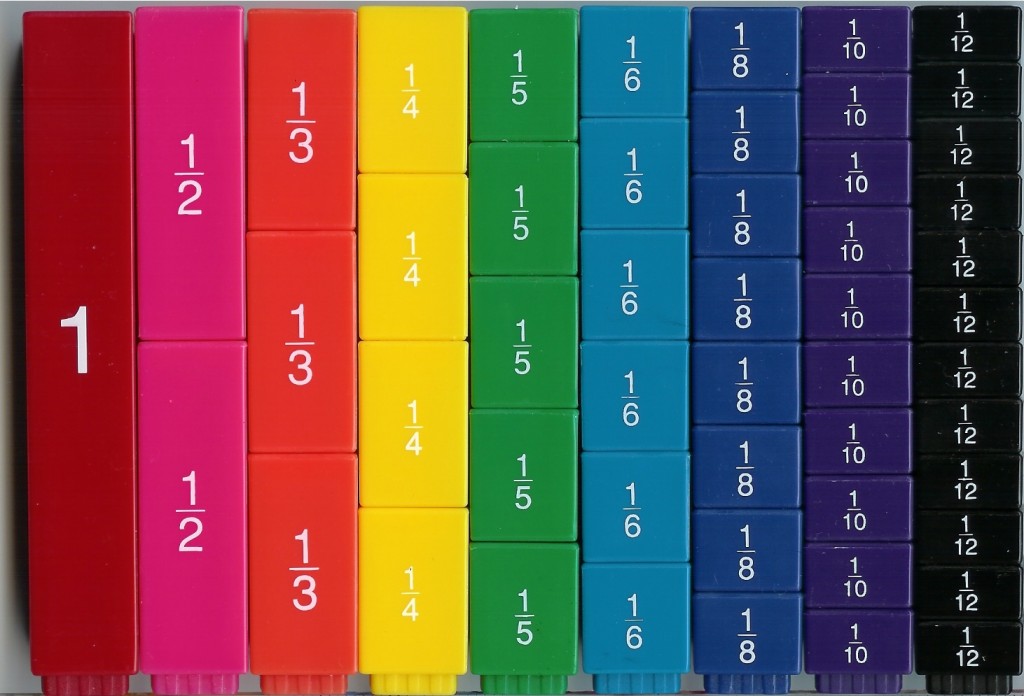
Fraction bars are great tools to help students visualize dividing fractions. For example, if you wanted to divide 2/3 by 1/6 you would line up two of the third bars alongside one of the sixth bar and find out how many times that fraction goes into 2 thirds. In this case it would be four. Fractions themselves are extremely difficult to visualize, and dividing by fractions seems conceptually ridiculous.  It can be difficult to adjust student’s thinking to this area. A manipulative like fraction bars are a good starting point in helping kids understand just how fractions work.

FractionBars


green line

Curriculum, future uses

The topic of dividing fractions has many uses in future courses. Primarily these will be in algebra 1 and 2 for most students. Having a good conceptual knowledge of fractions will help students tremendously in these courses. As an algebra student you would be required to use your knowledge of fractions on an almost daily basis. Being introduced to the concept of multiple variables and canceling them out as you divide polynomials is a very complicated process that gets even more complicated if you do not understand fractions. Laying this conceptual framework is important when you consider all that students must use these concepts for at the higher level math classes. As you consider this in the lessons don’t forget the previous concepts held here such as grouping into equal parts and counting by intervals (3,6,9).


Calculating course averages

And the end of every semester, instructors are often asked “What do I need on the final to make a ___ in the course?”, where the desired course grade is given. (I’ve never done a survey, but A appears to be the most desired course grade, followed by C, D, and B.) Here’s the do-it-yourself algorithm that I tell my students, in which the final counts for 20% of the course average.

Let F be the grade on the final exam, and let D be the up-to-date course average prior to the final. Then the course average is equal to 0.2F + 0.8D.

Somehow, students don’t seem comforted by this simple algebra.

green lineMore seriously, here’s a practical tip for students to determine what they need on the final to get a certain grade (hat tip to my friend Jeff Cagle for this idea). It’s based on the following principle:

If the average of x_1, x_2, \dots x_n is \overline{x}, then the average of x_1 + c, x_2 + c, \dots, x_n + c is \overline{x} + c. In other words, if you add a constant to a list of values, then the average changes by that constant.

As an application of this idea, let’s try to guess the average of 78, 82, 88, 90. A reasonable guess would be something like 85. So subtract 85 from all four values, obtaining -7, -3, 3, 5. The average of these four differences is (-7-3+3+5)/4 = -0.5. Therefore, the average of the original four numbers is 85 + (-0.5) = 84.5.

So here’s a typical student question: “If my average right now is an 88, and the final is worth 20\% of my grade, then what do I need to get on the final to get a 90?” Answer: The change in the average needs to be +2, so the student needs to get a grade +2/0.2 = +10 points higher than his/her current average. So the grade on the final needs to be 88 + 10 = 98.

Seen another way, we’re solving the algebra problem

88(0.8) + x(0.2) = 90

Let me solve this in an unorthodox way:

88(0.8) + x(0.2) = 88 + 2

88(0.8) + x(0.2) = 88(0.8+0.2) + 2

88(0.8) + x(0.2) = 88(0.8) + 88(0.2) + 2

x(0.2) = 88(0.2) + 2

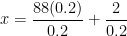
x = \displaystyle \frac{88(0.2)}{0.2} + \frac{2}{0.2}

x = 88 + \displaystyle \frac{2}{0.2}

This last line matches the solution found in the previous paragraph, x = 88 + 10 = 98.

Engaging students: Factoring quadratic polynomials

In my capstone class for future secondary math teachers, I ask my students to come up with ideas for engaging their students with different topics in the secondary mathematics curriculum. In other words, the point of the assignment was not to devise a full-blown lesson plan on this topic. Instead, I asked my students to think about three different ways of getting their students interested in the topic in the first place.

I plan to share some of the best of these ideas on this blog (after asking my students’ permission, of course).

This student submission comes from my former student Kelsie Teague. Her topic, from Algebra I and II: factoring quadratic polynomials.

green line

What interesting things can you say about the people who contributed to the discovery and/or the development of the topic?

In Renaissance times, polynomial factoring was a royal sport. Kings sponsored contests and the best mathematicians in Europe traveled from court to court to demonstrate their skills. Polynomial factoring techniques were closely guarded secrets.

http://www.ehow.com/info_8651462_history-polynomial-factoring.html

When reading this article, I found the fact that this topic was considered a royal sport very interesting. Students would also find that interesting because it would get their attention with the fact that kings thought this was very important. We could even have our own royal game for it. I think we could start off with a scavenger hunt to work on factoring just basic integers. Also, I think we could use the same idea to start the explore except to do it backwards and give them the polynomial already factored and have them FOIL it and get their polynomial. I want to see if they can see how to do it the other way around without being taught how. This game could show them that factoring is just the reverse of foiling.

green line

How can technology (YouTube, Khan Academy [khanacademy.org], Vi Hart, Geometers Sketchpad, graphing calculators, etc.) be used to effectively engage students with this topic?

I looked up factoring quadratic polynomials on Khan Academy and I found some really great videos. They have videos that show detail steps and also after a few videos they have parts where you can practice what you just watched and see if you understand it.  This website is great for at home practice or in class practice because with the practice sections it tells you if you are correct or not and will also give you hints if you don’t know where to start. Also, if you don’t have a clue how to do the problem given, you can hit “show me solution” and it will redirect you to a similar problem in a video to help out. I think this website is a great tool to let students know about to learn and practice.

Also I found a great video on YouTube it’s a rap about factoring that would certainly get gets engaged.

green line

Curriculum

Students first learn about the basic idea of factoring in elementary school and continue to learn and use this topic all the way through college. You need to factor polynomials in many different contexts in mathematics. It’s a fundamental skill for math in general and can make other calculations much easier. You use factoring for finding solutions of various equations, and such equations can come up in calculus when find maxima, minima, inflection points, solving improper integrals, limits, and partial fractions.  Students will need to know factoring all the way up in to their higher-level math classes in college, and also be able to use it in a career that is related to engineering, physics, chemistry and computer science.


Engaging students: Powers and exponents

In my capstone class for future secondary math teachers, I ask my students to come up with ideas for engaging their students with different topics in the secondary mathematics curriculum. In other words, the point of the assignment was not to devise a full-blown lesson plan on this topic. Instead, I asked my students to think about three different ways of getting their students interested in the topic in the first place.

I plan to share some of the best of these ideas on this blog (after asking my students’ permission, of course).

This student submission comes from my former student Kelsie Teague. Her topic, from Pre-Algebra: powers and exponents.

green line

What interesting word problem using this topic can your students do now?

For the topic of powers and exponents I want to bring in the idea of money, and doubling a salary. The word problem I would give them to start with and to get them thinking would be this:

Two companies were offering you a job. Company A is offering you a salary of $1,000 a day for 30 days and Company B is offering you a salary of $2 the first day and it doubles each day after that for 30 days. Which job is the better offer?

Since this is just my engage problem I’m not expecting them to be able to tell me that the answer is Company B because the answer is 2^{31}-2, but I am hoping they can get to the point of at least knowing that Company B will be paying the most. I want to get his or her attention and everyone loves money.

green line

How can this topic be used in your students’ future courses in Mathematics or Science?

I believe powers and exponents are important knowledge because students will be using them for the rest of their math career. This comes up when teaching functions, learning the graphs of functions, trig, pre-calculus, Calculus and etc. Powers and exponents are used extensively in algebra and it is important that students have a strong understand of how and why they work before continuing onto those higher classes. For example, when you have x^3, and talking about graphing a cubic function or x^2 and how it makes a parabola, and also when talking about factoring. If you have (x-2)^2 = (x-2)(x-2) =(x^2 -4x +4), students need to understand what it means to ^2 something.  Once students get to calculus that also use exponents and powers when doing derivatives and integrals. This isn’t a topic that is only based in math, it is also something used in science, engineering, and physics. Once students start college, no matter their major they will be taking at least one class that require some sort of knowledge with exponents and powers.

green line

What interesting things can you say about the people who contributed to the discovery and/or the development of this topic?

The earliest exponents came from the Babylonians. The number system was extremely different from modern mathematics. The earliest known mention of Babylon was mentioned on a tablet found around 23rd century BC. Even then they were messing with the concept of exponents.

I would show my students this picture and explain to them what the symbols mean and ask them if they feel any better about doing math in modern times rather than working with these symbols to add, subtract, divide, exponents, power and doing equations. This also shows that this concept has been around for many thousands of years and something that is obviously very important if we still use it in modern math. I might also bring up the website least below that talks about modern exponents and works backwards and talks about where they came from to give the students more depth in this knowledge.

Babylonian square

http://www.ehow.com/about_5134780_history-exponents.html

Engaging students: Solving for unknown parts of triangles and rectangles

In my capstone class for future secondary math teachers, I ask my students to come up with ideas for engaging their students with different topics in the secondary mathematics curriculum. In other words, the point of the assignment was not to devise a full-blown lesson plan on this topic. Instead, I asked my students to think about three different ways of getting their students interested in the topic in the first place.

I plan to share some of the best of these ideas on this blog (after asking my students’ permission, of course).

This student submission comes from my former student Michelle McKay. Her topic, from Algebra I: solving for unknown parts of triangles and rectangles.

green line

A. How could you as a teacher create an activity or project that involves your topic?

There are several different ideas that immediately come to mind on how to center a lesson around solving for unknown parts of rectangles and triangles. I would like to focus on and describe one. For this particular lesson, the student will start by making a prediction of which side(s) of a shape (triangle or rectangle) has the greatest length. Then, with a partner, they will use rulers and a handout to record the dimensions of both shapes. On the handout, they will work to fill out the chart provided. Then, we will reconvene as a class and talk about the discoveries made. For rectangles, I would ask first about what we found to be consistent for every rectangle. Using what we know, how we could find or solve for the length of one side if we only had certain parts of information? Similarly for triangles, I would begin by asking how each side differed from one another. Did the general shapes of the triangles make a difference? What was special about the right triangles? After these questions, I would introduce Pythagorean’s Theorem and have them solve for the side of triangles without rulers, then follow up with using rulers to verify their information.

green line

D. What interesting things can you say about the people who contributed to the discovery and/or the development of this idea?

Pythagoras of Samos: During Pythagoras’ time, math was considered to be a mixture of both religious and scientific beliefs and was often associated with secret societies and only those of very high social standing. As Pythagoras was one of the more influential mathematicians of his time, most details of his life were kept secret until centuries after his death, leaving very little reliable information to be pieced together in form of a biography. It is generally accepted that he was born on the island of Samos, which is now incorporated into the country of Greece. Little is known about his childhood, but most agree that he was very well educated and was acquainted with geometry before he traveled to Egypt. He was known to be almost sacrosanct and divine to those alive during his time and even a few well after his death. He founded a religious, and simultaneously mathematical, movement called Pythagoreanism, which consisted of two schools of thought: the “learners” and the “listeners”.

green line

D. What are the contributions of various cultures to this topic?

Time Period

Civilization

Contribution

Earliest known references:

23rd Century B.C.

Babylonians

–          Had rules for generating Pythagorean triples.

–          Comprehended the relationship of a right triangle’s sides.

–          Discovered the relationship of \sqrt{2}.


500 – 200 B.C.

Chinese

–          Gives a statement and geometrical demonstration of the Pythagorean Theorem (possibly before Pythagoras’ time).


570 – 495 B.C.

Greek

–          Golden rectangles were very vaguely referenced by Plato.

–          Euclid wrote a clear definition of what a rectangle is.

–          Pythagoras discovered a relationship between the sides of right triangles.


Earliest known references:
800 – 600 B.C.

Indian

–          Pythagorean Theorem was utilized in forming the proper dimensions for religious altars.

It is very hard to for historians to pinpoint with exact certainty which civilization was the first to discover what we know now as the Pythagorean Theorem. Many of the civilizations listed above existed during the same time period, but were geographically located on opposite ends of the map. Also due to loss of information from translations, damaged or completely destroyed texts, these dates and the authenticity of certain contributions are still debated to this day.

 Sources

  1. http://www-history.mcs.st-and.ac.uk/Biographies/Pythagoras.html
  2. http://ualr.edu/lasmoller/pythag.html
  3. http://www-history.mcs.st-and.ac.uk/Biographies/Euclid.html
  4. http://plato.stanford.edu/entries/pythagoreanism/