
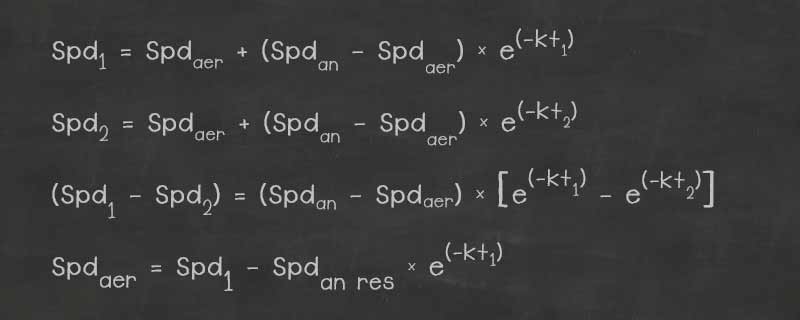
I enjoyed this surprising (well, surprising to me) application of exponential functions: training sprinters and other runners.
I enjoyed this surprising (well, surprising to me) application of exponential functions: training sprinters and other runners.
For anyone visiting my old stomping grounds of Washington, D.C., this summer, the Mathematical Association of America has compiled its Field Guide to Math on the National Mall. For example:
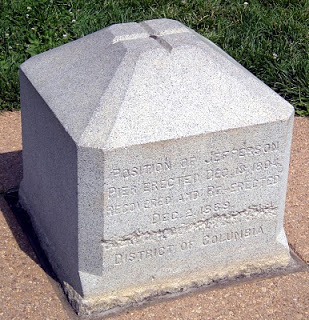
Washington, D.C., was planned around a large right triangle, with the White House at the triangle’s northern vertex and the U.S. Capitol at its eastern vertex, linked by Pennsylvania Avenue (as the hypotenuse). A 1793 survey established the location of the triangle’s 90° vertex, and Thomas Jefferson, when he was Secretary of State, had a wooden post installed to mark the spot. This post was replaced in 1804 by a more substantial marker, which came to be known as the Jefferson Pier.
I thought I had heard every silly mnemonic device for remembering mathematical formulas, but I recently heard a new one: the clowns BOBO, BOTU, and BETC for remembering how to graph rational functions.

Which naturally leads to this pearl of wisdom:

I didn’t believe this counterintuitive trick until I tried it myself… the instructions can be found at http://www.maa.org/…/horizons/RichesonImpossibleCylinder.pdf
From the UCLA news service:
From the second paragraph:
“In general, the animators and artists at the studios want as little to do with mathematics and physics as possible, but the demands for realism in animated movies are so high,” [UCLA mathematician Joseph] Teran said. “Things are going to look fake if you don’t at least start with the correct physics and mathematics for many materials, such as water and snow. If the physics and mathematics are not simulated accurately, it will be very glaring that something is wrong with the animation of the material.”
I recommend the whole article.
From Popular Mechanics: 5 Simple Math Problems No One Can Solve. The list:


 Mean Green Math