I'm a Professor of Mathematics and a University Distinguished Teaching Professor at the University of North Texas. For eight years, I was co-director of Teach North Texas, UNT's program for preparing secondary teachers of mathematics and science.
Recently, I announced that my paper Parabolic Properties from Pieces of String had been published in the magazine Math Horizons. The article had multiple aims; in chronological order of when I first started thinking about them:
Prove that string art from two line segments traces a parabola.
Prove that a quadratic polynomial satisfies the focus-directrix property of a parabola, which is the reverse of the usual logic when students learn conic sections.
Prove the reflective property of parabolas.
Accomplish all of the above without using calculus.
While I’m generally pleased with the final form of the article, the necessity of publication constraints somewhat abbreviated the original goal of this project: determining a pedagogically sound way of convincing a bright Algebra I student that string art unexpectedly produces a parabola. While all the necessary mathematics is in the article, I think the article is somewhat lacking on how to sell the idea to students. So, in this series of posts, I’d like to expand on the article with some pedagogical thoughts about connecting string art to parabolas.
As discussed previous posts, we begin our explorations with string art connecting evenly spaced points on line segments and with endpoints , , and . We will call these colored line segments “strings.” We then found the string with the largest coordinate at , resulting in the following picture:
However, perhaps it’s clearer to plot these points on a separate graph, without the clutter of the strings:
These points are definitely following some kind of curve. In the previous post, we established that the curve is a parabola by using the vertex form of a parabola .
In this post, we use the other general form. If the curve is a parabola, then the equation of the curve must be for some values of , , and . Since there are three unknowns, we need to have three equations to solve for them. This can be done by plugging in three pairs into this equation. While we can pick any three pairs that we wish, it seems convenient to use the points , and :
This simplifies to the system of linear equations
In general systems of linear equations can be challenging for students to solve. However, while this is technically a system, it’s clear that , and so this reduces to a system
or
or
.
In algebra, students are taught multiple ways of solving systems of linear equations, and any of these techniques can be used at this point to solve for and . Perhaps the easiest next step is subtracting the two equations:
Substituting into , we see that
.
We conclude that , , and , so that, if the points lie on a parabola, the equation of the parabola must be
.
By construction, this parabola passes through , , and . To show that this actually works, we can substitute the other six values of :
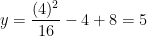
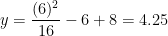
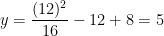
At :
At :
At :
At :
At :
At :
Therefore, the nine points in the above picture all lie on the parabola .
In the next post, we’ll discuss a third way of convincing students that the points lie on this parabola.
Recently, I announced that my paper Parabolic Properties from Pieces of String had been published in the magazine Math Horizons. The article had multiple aims; in chronological order of when I first started thinking about them:
Prove that string art from two line segments traces a parabola.
Prove that a quadratic polynomial satisfies the focus-directrix property of a parabola, which is the reverse of the usual logic when students learn conic sections.
Prove the reflective property of parabolas.
Accomplish all of the above without using calculus.
While I’m generally pleased with the final form of the article, the necessity of publication constraints somewhat abbreviated the original goal of this project: determining a pedagogically sound way of convincing a bright Algebra I student that string art unexpectedly produces a parabola. While all the necessary mathematics is in the article, I think the article is somewhat lacking on how to sell the idea to students. So, in this series of posts, I’d like to expand on the article with some pedagogical thoughts about connecting string art to parabolas.
As discussed previous posts, we begin our explorations with string art connecting evenly spaced points on line segments and with endpoints , , and . We will call these colored line segments “strings.” We then found the string with the largest coordinate at , resulting in the following picture:
However, perhaps it’s clearer to plot these points on a separate graph, without the clutter of the strings:
These points are definitely following some kind of curve. Let’s suppose that the curve is a parabola. The vertex form of a parabola is
.
If the curve is a parabola, then clearly the vertex will be the lowest point on the axis of symmetry. By inspection, this point is , which is labeled in the above picture. So, if it’s a parabola, the equation has the form
.
To find the value of , we note that the point must be on the parabola, so that
.
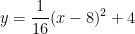
Therefore, the equation of the conjectured parabola is
.
So, if the curve is a parabola, it must follow the function this curve. By construction, this parabola passes through and . To show that this actually works, we can substitute the other seven values of :
At :
At :
At :
At :
At :
At :
At :
Therefore, the nine points in the above picture all lie on the parabola .
In the next couple of posts, we’ll discuss a couple of different ways of establishing that the points lie on this parabola.
Recently, I announced that my paper Parabolic Properties from Pieces of String had been published in the magazine Math Horizons. The article had multiple aims; in chronological order of when I first started thinking about them:
Prove that string art from two line segments traces a parabola.
Prove that a quadratic polynomial satisfies the focus-directrix property of a parabola, which is the reverse of the usual logic when students learn conic sections.
Prove the reflective property of parabolas.
Accomplish all of the above without using calculus.
While I’m generally pleased with the final form of the article, the necessity of publication constraints somewhat abbreviated the original goal of this project: determining a pedagogically sound way of convincing a bright Algebra I student that string art unexpectedly produces a parabola. While all the necessary mathematics is in the article, I think the article is somewhat lacking on how to sell the idea to students. So, in this series of posts, I’d like to expand on the article with some pedagogical thoughts about connecting string art to parabolas.
As discussed in the previous post, we begin our explorations with string art connecting evenly spaced points on line segments and with endpoints , , and . We will call these colored line segments “strings.”
We now ask the following two questions:
For each of $x = 2, 4, 6, 8, 10, 12,$ and , which string has the largest coordinate?
For each of these values of , what is the value of this largest coordinate?
Evidently, for , the brown string that connects to has the largest coordinate. This point is marked with the small brown circle. From the lines on the graph paper, it appears that this brown point is .
For , the horizontal green string appears to have the largest coordinate, and clearly that point is .
For , the pink string that connects to has the largest coordinate. From the lines on the graph paper, it appears that this point is .
Unfortunately, for , , , and , it’s evident which string has the largest coordinate, but it’s not so easy to confidently read off its value. For this example, this could be solved by using finer graph paper with marks at each quarter (instead of at the integers). However, it’s far better to actually use the point-slope formula to find the equation of the colored line segments.
For example, for , the red string has the largest coordinate. This string connects the points and , and so the slope of this string is . Using the point-slope form of a line, the equation of the red string is thus
Substituting , the coordinate of the highest string at is .
Similarly, at , the equation of the orange string turns out to be , and the coordinate of the highest string at is .
At , the equation of the blue string is , and the coordinate of the highest string at is .
Finally, at , the equation of the purple string is , and the coordinate of the highest string at is .
The interested student could confirm the values for , , and that were found earlier by just looking at the picture.
We now add the coordinates of these points to the picture.
However, perhaps it’s clearer to plot these points on a separate graph, without the clutter of the strings:
These points are definitely following some kind of curve. In the next post in this series, I’ll discuss a way of convincing students that the curve is actually a parabola.
Recently, I announced that my paper Parabolic Properties from Pieces of String had been published in the magazine Math Horizons. The article had multiple aims; in chronological order of when I first started thinking about them:
Prove that string art from two line segments traces a parabola.
Prove that a quadratic polynomial satisfies the focus-directrix property of a parabola, which is the reverse of the usual logic when students learn conic sections.
Prove the reflective property of parabolas.
Accomplish all of the above without using calculus.
While I’m generally pleased with the final form of the article, the necessity of publication constraints somewhat abbreviated the original goal of this project: determining a pedagogically sound way of convincing a bright Algebra I student that string art unexpectedly produces a parabola. While all the necessary mathematics is in the article, I think the article is somewhat lacking on how to sell the idea to students. So, in this series of posts, I’d like to expand on the article with some pedagogical thoughts about connecting string art to parabolas.
To begin, we use graph paper to sketch to draw coordinate axes, the point , the point , the point , line segment , and line segment .
Along , we mark the evenly spaced points , , , , , , and .
Along , we mark the evenly spaced points , , , , , , and .
Next, we draw line segments of different colors to connect:
and
and
and
and
and
and
and
The result should look something like the picture below:
It looks like the string art is tracing a parabola. In this series of posts, I’ll discuss one way that talented algebra students can convince themselves that the curve is indeed a parabola.
When I was in middle school, I remember my teacher telling me, after I learned the quadratic formula, that there was a general formula for solving cubic and quartic equations, but no such formula existed for solving the quintic. This was also when I first heard the infamous story of young Galois’s death from a duel.
Using my profound middle-school logic, I took this story as a challenge to devise my own formula for solving the quintic. Naturally, my efforts came up short.
When I was in high school, with this obsession still fully intact, I attempted to read through the wonderful monograph Field Theory and Its Classical Problems. Here’s the MAA review of this book:
Hadlock’s book sports one of the best prefaces I’ve ever read in a mathematics book. The rest of the book is even better: in 1984 it won the first MAA Edwin Beckenbach Book Prize for excellence in mathematical exposition.
Hadlock says in the preface that he wrote the book for himself, as a personal path through Galois theory as motivated by the three classical Greek geometric construction problems (doubling the cube, trisecting angles, and squaring the circle — all with just ruler and compass) and the classical problem of solving equations by radicals. Unlike what happens in most books on the subject, all three Greek problems are solved in the first chapter, with just the definition of field as a subfield of the real numbers, but without even defining degree of field extensions, much less proving its multiplicativity (this is done in chapter 2). Doubling the cube is proved to be impossible by proving that the cube root of 2 cannot be an element of a tower of quadratic extensions: if the cube root of 2 is in a quadratic extension, then it is actually in the base field. Repeating the argument, we conclude that it is not constructible because it is not rational. A similar argument works for proving that trisecting a 60 degree angle is impossible. Of course, proving that duplicating the cube is impossible needs a different argument: chapter 1 ends with Niven’s proof of the transcendence of π.
After this successful bare-hands attack at three important problems, Chapter 2 discusses in detail the construction of regular polygons and explains Gauss’s characterization of constructible regular polygons, including the construction of the regular 17-gon. Chapter 3 describes Galois theory and the solution of equations by radicals, including Abel’s theorem on the impossibility of solutions by radicals for equations of degree 5 or higher. Chapter 4, the last one, considers a special case of the inverse Galois problem and proves that there are polynomials with rational coefficients whose Galois group is the symmetric group, a result that is established via Hilbert’s irreducibility theorem.
Many examples, references, exercises, and complete solutions (taking up a third of the book!) are included and make this enjoyable book both an inspiration for teachers and a useful source for independent study or supplementary reading by students.
As I recall, I made it successfully through the first couple of chapters but started to get lost with the Galois theory somewhere in the middle of Chapter 3. Despite not completing the book, this was one of the most rewarding challenges of my young mathematical life. Perhaps one of these days I’ll undertake this challenge again.
Anyway, this year I came across the wonderful article The Abel–Ruffini Theorem: Complex but Not Complicated in the March issue of the American Mathematical Monthly. The article presents a completely different way of approaching the insolvability of the quintic that avoids Galois theory altogether.
The proof is elementary; I’m confident that I could have understood this proof had I seen it when I was in high school. That said, the word “elementary” in mathematics can be a bit loaded — this means that it is based on simple ideas that are perhaps used in a profound and surprising way. Perhaps my favorite quote along these lines was this understated gem from the book Three Pearls of Number Theory after the conclusion of a very complicated proof in Chapter 1:
You see how complicated an entirely elementary construction can sometimes be. And yet this is not an extreme case; in the next chapter you will encounter just as elementary a construction which is considerably more complicated.
I believe that a paid subscription to the Monthly is required to view the above link, but the main ideas of the proof can be found in the video below as well as this short PDF file by Leo Goldmakher.
In my capstone class for future secondary math teachers, I ask my students to come up with ideas for engaging their students with different topics in the secondary mathematics curriculum. In other words, the point of the assignment was not to devise a full-blown lesson plan on this topic. Instead, I asked my students to think about three different ways of getting their students interested in the topic in the first place.
I plan to share some of the best of these ideas on this blog (after asking my students’ permission, of course).
This student submission comes from my former student Emma White. Her topic, from Precalculus: finding the equation of a circle.
How has this topic appeared in pop culture (movies, TV, current music, video games, etc.)?
Ironically, this morning on the way to class I received a notification saying Coldplay dropped a new album called “ Music of the Spheres” and I couldn’t help but look into it more! Although we are talking about circles, as mathematicians (or other people who came across this blog), we realize that circles and spheres are related in some ways. Although that is a discussion for another time, I want to focus on this album and how it relates to our world. Circles are used in various ways when it comes to the “circle of life” or “time on a ticking clock”. One song talks about “Humankind” and how we’re designed. This is a continuous cycle as humans pass away and are born and the cycle continues. While this may be a more serious thing to think about, life happens and cycles (we also see this in history and cycles of conflicts, wars, and much more). Furthermore (and maybe on a more lighthearted feel), we see the concept of circle in “The Circle of Life” as seen in “The Lion King”. I encourage you to look at the lyrics below:
Whatever your background may be, we can agree that much in life happens in cycles (think of cells as well!) and that is done in a metaphorical circular motion. The moon rotates around the sun, the planets rotate around the sun, and so forth. Many songs capture the concept of “circling” or time (think of the Sundial), and I bet if we took the time to really dig deep, we could find more songs with this concept more than we think.
What interesting things can you say about the people who contributed to the discovery and/or the development of this topic?
According to many articles, the discovery of the circle goes way back before recorded history. It started with the Egyptians (the inventors of Geometry) who invented the wheel. I find this intriguing that the people following the Egyptians “investigated” a simple man made tool, the wheel, to go about finding the equation of a circle. I want to emphasize this point because there is so much in life relating to math if only we stop to look and/or think about it more in depth! Furthermore, Euclid (naturally), contributed to the finding of the properties of the circle and “problems of inscribing polygons” (“Circle”, n.d.). Around 650 BC, Thales, a mathematical philosopher who contributed to various elementary geometry theorems, contributed to the theorems regarding circles. Nearly 400 years later, Apollonius, “a Greek mathematician known as ‘The Great Geometer’”, also contributed to the finding of the equation for a circle, specifically the equation itself (J J O’Connor and E F Roberts). He founded the bipolar equation “ represent[ing] a circle whose centre divides the line segment between the two fixed points of the system in the ratio n to m” (“Circle”, n.d.). Needless to say, the people who helped create this equation were years apart and it’s pretty cool to see how their work built off of each other over time.
How can technology (YouTube, Khan Academy [khanacademy.org], Vi Hart, Geometers Sketchpad, graphing calculators, etc.) be used to effectively engage students with this topic?
When it comes to the equation of a circle, using technology would be a great way to visually show students what is happening and understand where the equation comes from. KhanAcademy is a great resource for students to work through problems and furthermore, Desmos could be a resource for students to use at home for homework to check their work and understand how different values for ‘x’ and ‘y’ change the circle. A beneficial video to share/watch with your students would be “Lesson Video: Equation of a Circle”, for it provides a visual representation of how to derive the equation (I think exposing students to how to derive the equation will make the equation easier to understand and how the equation formulated). Giving your students technological resources is beneficial and I bet the students appreciate having multiple resources to help them become more understanding of the subject matter.
Let be the proposition “I love her,” and let be the statement “I love to fish.” Translate the logical statement
This matches the opening words of Brad Paisley’s “I’m Gonna Miss Her,” providing a light-hearted example of how the conjunction but is nevertheless translated as .
Context: This semester, I taught discrete mathematics for the first time. Part of the discrete mathematics course includes an introduction to predicate and propositional logic for our math majors. As you can probably guess from their names, students tend to think these concepts are dry and uninteresting even though they’re very important for their development as math majors.
In an effort to making these topics more appealing, I spent a few days mining the depths of popular culture in a (likely futile) attempt to make these ideas more interesting to my students. In this series, I’d like to share what I found. Naturally, the sources that I found have varying levels of complexity, which is appropriate for students who are first learning prepositional and predicate logic.
When I actually presented these in class, I either presented the logical statement and had my class guess the statement in actual English, or I gave my students the famous quote and them translate it into predicate logic. However, for the purposes of this series, I’ll just present the statement in predicate logic first.
Let be the statement “I fear death,” and let be the statement “I fear pain.” Translate the logical statement
This matches one of the great lines of owyn, shieldmaiden of Rohan, in the book The Two Towers.
Context: Part of the discrete mathematics course includes an introduction to predicate and propositional logic for our math majors. As you can probably guess from their names, students tend to think these concepts are dry and uninteresting even though they’re very important for their development as math majors.
In an effort to making these topics more appealing, I spent a few days mining the depths of popular culture in a (likely futile) attempt to make these ideas more interesting to my students. In this series, I’d like to share what I found. Naturally, the sources that I found have varying levels of complexity, which is appropriate for students who are first learning prepositional and predicate logic.
When I actually presented these in class, I either presented the logical statement and had my class guess the statement in actual English, or I gave my students the famous quote and them translate it into predicate logic. However, for the purposes of this series, I’ll just present the statement in predicate logic first.
“Survey Ladies” is one of the classics shorts from the 90s cartoon Animaniacs. While none of the survey questions can be stated in predicate logic (after all, they’re questions), there are many, many silly and somewhat repetitive statements that can be motivated by this cartoon:
Let be the set of all people, let be the statement “ is watching a movie,” let be the statement “ is eating beans,” and let be the statement “ is with George Wendt.” Translate the following into symbolic logic:
Nobody is eating beans
Somebody is with George Wendt.
Somebody is not watching a movie.
Everyone watching a movie is eating beans.
Nobody watching a movie is with George Wendt.
Somebody is watching a movie but is not with George Wendt.
Nobody is both eating beans and is with George Wendt.
Everyone is watching a movie and is eating beans.
I’ll also share this for anyone who doesn’t remember the greatness of George Wendt:
Context: Part of the discrete mathematics course includes an introduction to predicate and propositional logic for our math majors. As you can probably guess from their names, students tend to think these concepts are dry and uninteresting even though they’re very important for their development as math majors.
In an effort to making these topics more appealing, I spent a few days mining the depths of popular culture in a (likely futile) attempt to make these ideas more interesting to my students. In this series, I’d like to share what I found. Naturally, the sources that I found have varying levels of complexity, which is appropriate for students who are first learning prepositional and predicate logic.
When I actually presented these in class, I either presented the logical statement and had my class guess the statement in actual English, or I gave my students the famous quote and them translate it into predicate logic. However, for the purposes of this series, I’ll just present the statement in predicate logic first.




























 in the above picture. So, if it’s a parabola, the equation has the form
 .
. must be on the parabola, so that



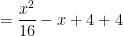
 .
. :
: 

 , which string has the largest
  , the brown string that connects
  to
to  has the largest
  .
. , the horizontal green string appears to have the largest
  , the pink string that connects
  to
to  has the largest
  .
. ,
,  ,
,  , and
, and  , it’s evident which string has the largest
  and
and  , and so the slope of this string is
 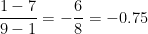 . Using the point-slope form of a line, the equation of the red string is thus


 .
. , and the
  .
. , and the
  .
. , and the
  .
. ,
,  ,
,  ,
,  .
.  ,
,  ,
,  ,
,  .
.
 represent[ing] a circle whose centre divides the line segment between the two fixed points of the system in the ratio n to m” (“Circle”, n.d.). Needless to say, the people who helped create this equation were years apart and it’s pretty cool to see how their work built off of each other over time.
 be the proposition “I love her,” and let
  be the statement “I love to fish.” Translate the logical statement
 .
.
 owyn, shieldmaiden of Rohan, in the book The Two Towers.
 be the set of all people, let
  be the statement “
 be the statement “
 be the statement “
 Mean Green Math