Different ways of computing a limit (Part 3)

One of my colleagues placed the following problem on an exam for his Calculus II course…

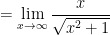
\displaystyle \lim_{x \to \infty} \frac{\sqrt{x^2+1}}{x}

and was impressed by the variety of correct responses that he received. I thought it would be fun to discuss some of the different ways that this limit can be computed.

Method #3. A trigonometric identity. When we see \sqrt{x^2+1} inside of an integral, one kneejerk reaction is to try the trigonometric substitution x = \tan \theta. So let’s use this here. Also, since x \to \infty, we can change the limit to be \theta \to \pi/2:

\displaystyle \lim_{x \to \infty} \frac{\sqrt{x^2+1}}{x} = \displaystyle \lim_{\theta \to \pi/2} \frac{\sqrt{\tan^2 \theta+1}}{\tan \theta}

= \displaystyle \lim_{\theta \to \pi/2} \frac{\sqrt{\sec^2 \theta}}{\tan \theta}

= \displaystyle \lim_{\theta \to \pi/2} \frac{ \sec \theta}{\tan \theta}

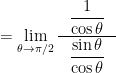
= \displaystyle \lim_{\theta \to \pi/2} \frac{ ~~\displaystyle \frac{1}{\cos \theta} ~~}{ ~~ \displaystyle \frac{\sin \theta}{\cos \theta} ~~ }

= \displaystyle \lim_{\theta \to \pi/2} \frac{ 1}{\sin \theta}

= 1.

Different ways of computing a limit (Part 2)

One of my colleagues placed the following problem on an exam for his Calculus II course…

\displaystyle \lim_{x \to \infty} \frac{\sqrt{x^2+1}}{x}

and was impressed by the variety of correct responses that he received. I thought it would be fun to discuss some of the different ways that this limit can be computed.

Method #2. Using L’Hopital’s Rule. The limit has the indeterminant form \infty/\infty, and so I can differentiate the top and the bottom with respect to x:

\displaystyle \lim_{x \to \infty} \frac{\sqrt{x^2+1}}{x} = \displaystyle \lim_{x \to \infty} \frac{ \displaystyle \frac{d}{dx} \left( \sqrt{x^2+1} \right) }{\displaystyle \frac{d}{dx} \left( x \right)}

= \displaystyle \lim_{x \to \infty} \frac{ \displaystyle \frac{1}{2} \left( x^2+1 \right)^{-1/2} \cdot 2x }{1}

= \displaystyle \lim_{x \to \infty} \frac{x}{\sqrt{x^2+1}}.

Oops… it looks like I just got the reciprocal of the original limit! Indeed, if I use L’Hopital’s Rule again, I’ll just return back to the original limit.

So that doesn’t look very helpful… except it is. If I define the value of this limit to be equal to L, then I’ve just shown that L = 1/L (assuming that the limit exists in the first place, of course). That means that L = 1 or L = -1. Well, clearly the limit of this nonnegative function can’t be negative, and so we conclude that the limit is equal to 1.

Different ways of solving a contest problem (Part 3)

The following problem appeared on the American High School Mathematics Examination (now called the AMC 12) in 1988:

If 3 \sin \theta = \cos \theta, what is \sin \theta \cos \theta?

When I presented this problem to a group of students, I was pleasantly surprised by the amount of creativity shown when solving this problem.

Yesterday, I presented a solution using a Pythagorean identity, but I was unable to be certain if the final answer was a positive or negative without drawing a picture. Here’s a third solution that also use a Pythagorean trig identity but avoids this difficulty. Again, I begin by squaring both sides.

9 \sin^2 \theta = \cos^2 \theta

9 (1 - \cos^2 \theta) = \cos^2 \theta

9 - 9 \cos^2 \theta = \cos^2 \theta

9 = 10 \cos^2 \theta

\displaystyle \frac{9}{10} = \cos^2 \theta

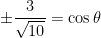
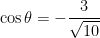
\displaystyle \pm \frac{3}{\sqrt{10}} = \cos \theta

Yesterday, I used the Pythagorean identity again to find \sin \theta. Today, I’ll instead plug back into the original equation 3 \sin \theta = \cos \theta:

3 \sin \theta = \cos \theta

3 \sin \theta = \displaystyle \frac{3}{\sqrt{10}}

\sin \theta = \displaystyle \pm \frac{1}{\sqrt{10}}

Unlike the example yesterday, the signs of \sin \theta and \cos \theta must agree. That is, if \cos \theta = \displaystyle \frac{3}{\sqrt{10}}, then \sin \theta = \displaystyle \frac{1}{\sqrt{10}} must also be positive. On the other hand, if \cos \theta = \displaystyle -\frac{3}{\sqrt{10}}, then \sin \theta = \displaystyle -\frac{1}{\sqrt{10}} must also be negative.

If they’re both positive, then

\sin \theta \cos \theta = \displaystyle \left( \frac{1}{\sqrt{10}} \right) \left( \frac{3}{\sqrt{10}} \right) =\displaystyle \frac{3}{10},

and if they’re both negative, then

\sin \theta \cos \theta = \displaystyle \left( -\frac{1}{\sqrt{10}} \right) \left( -\frac{3}{\sqrt{10}} \right) = \displaystyle \frac{3}{10}.

Either way, the answer must be \displaystyle \frac{3}{10}.

This is definitely superior to the solution provided in yesterday’s post, as there’s absolutely no doubt that the product \sin \theta \cos \theta must be positive.

Different ways of solving a contest problem (Part 2)

The following problem appeared on the American High School Mathematics Examination (now called the AMC 12) in 1988:

If 3 \sin \theta = \cos \theta, what is \sin \theta \cos \theta?

When I presented this problem to a group of students, I was pleasantly surprised by the amount of creativity shown when solving this problem.

Yesterday, I presented a solution using triangles. Here’s a second solution that I received: begin by squaring both sides and using a Pythagorean trig identity.

9 \sin^2 \theta = \cos^2 \theta

9 (1 - \cos^2 \theta) = \cos^2 \theta

9 - 9 \cos^2 \theta = \cos^2 \theta

9 = 10 \cos^2 \theta

\displaystyle \frac{9}{10} = \cos^2 \theta

\displaystyle \pm \frac{3}{\sqrt{10}} = \cos \theta

We use the Pythagorean identity again to find \sin \theta:

\displaystyle \frac{9}{10} = \cos^2 \theta

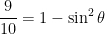
\displaystyle \frac{9}{10} = 1 - \sin^2 \theta

\sin^2 \theta = \displaystyle \frac{1}{10}

\sin \theta = \displaystyle \pm \frac{1}{\sqrt{10}}

Therefore, we know that

\sin \theta \cos \theta = \displaystyle \left( \pm \frac{1}{\sqrt{10}} \right) \left( \pm \frac{3}{\sqrt{10}} \right) = \displaystyle \pm \displaystyle \frac{3}{10},

so the answer is either \displaystyle \frac{3}{10} or \displaystyle -\frac{3}{10}. However, this was a multiple-choice contest problem and \displaystyle -\frac{3}{10} was not listed as a possible answer, and so the answer must be \displaystyle \frac{3}{10}.

green lineFor a contest problem, the above logic makes perfect sense. However, the last step definitely plays to the fact that this was a multiple-choice problem, and the concluding step would not have been possible had \displaystyle -\frac{3}{10} been given as an option.


Different ways of solving a contest problem (Part 1)

The following problem appeared on the American High School Mathematics Examination (now called the AMC 12) in 1988:

If 3 \sin \theta = \cos \theta, what is \sin \theta \cos \theta?

When I presented this problem to a group of students, I was pleasantly surprised by the amount of creativity shown when solving this problem.

Here’s the first solution that I received: draw the appropriate triangles for the angle \theta:

3 \sin \theta = \cos \theta

\tan \theta = \displaystyle \frac{1}{3}

Therefore, the angle \theta must lie in either the first or third quadrant, as shown. (Of course, \theta could be coterminal with either displayed angle, but that wouldn’t affect the values of \sin \theta or \cos \theta.)

AHSME problem

In Quadrant I, \sin \theta = \displaystyle \frac{1}{\sqrt{10}} and \cos \theta = \displaystyle \frac{3}{\sqrt{10}}. Therefore,

\sin \theta \cos \theta = \displaystyle \frac{1}{\sqrt{10}} \times \frac{3}{\sqrt{10}} = \displaystyle \frac{3}{10}.

In Quadrant III, \sin \theta = \displaystyle -\frac{1}{\sqrt{10}} and \cos \theta = -\displaystyle \frac{3}{\sqrt{10}}. Therefore,

\sin \theta \cos \theta = \displaystyle \left( - \frac{1}{\sqrt{10}} \right) \times \left( -\frac{3}{\sqrt{10}} \right) = \displaystyle \frac{3}{10}.

Either way, we can be certain that \sin \theta \cos \theta = \displaystyle \frac{3}{10}.

Issues when conducting political polls (Part 3)

The classic application of confidence intervals is political polling: the science of sampling relatively few people to predict the opinions of a large population. However, in the 2010s, the art of political polling — constructing representative samples from a large population — has become more and more difficult. FiveThirtyEight.com had a nice feature about problems that pollsters face today that were not issues a generation ago. A sampling:

The problem is simple but daunting. The foundation of opinion research has historically been the ability to draw a random sample of the population. That’s become much harder to do, at least in the United States. Response rates to telephone surveys have been declining for years and are often in the single digits, even for the highest-quality polls. The relatively few people who respond to polls may not be representative of the majority who don’t. Last week, the Federal Communications Commission proposed new guidelines that could make telephone polling even harder by enabling phone companies to block calls placed by automated dialers, a tool used in almost all surveys.

What about Internet-based surveys? They’ll almost certainly be a big part of polling’s future. But there’s not a lot of agreement on the best practices for online surveys. It’s fundamentally challenging to “ping” a random voter on the Internet in the same way that you might by giving her an unsolicited call on her phone. Many pollsters that do Internet surveys eschew the concept of the random sample, instead recruiting panels that they claim are representative of the population.

Previous posts in this series: Part 1 and Part 2.

Review of “Math Girls” by Hiroshi Yuki

When I have time to kill in a new library or bookstore, I inevitably find myself wandering to the math section — looking not for new textbooks but for decent books aimed at the popularization of mathematics. Sadly, the books I find are usually in one of three categories:

  1. Drill books with hundreds of problems for young students to practice certain skills and procedures.
  2. Cartoonish books aimed at a young elementary audience.
  3. Fact books featuring short paragraphs on various topics in advanced mathematics.

There’s nothing particularly wrong with any of these types of books — and there’s a few that I could recommend from each category — but it’s rare to find a good math book that doesn’t fit one of these molds.

Enter Math Girls, by Hiroshi Yuki, which features conversations between high school students talk about love and talk about math. I won’t write a full review — the one at MAA Reviews does a really good job at describing the book, as well as the one published in the Notices of the American Mathematical Society — but I will list some of the mathematical ideas that the book’s characters discuss:

  1. Functions and finding patterns
  2. The formula for the sum of the divisors of an integer.
  3. DeMoivre’s Theorem.
  4. Generating functions and the Fibonacci sequence.
  5. The arithmetic-geometric mean inequality.
  6. The binomial theorem.
  7. The Catalan numbers.
  8. The convergence and divergence of p-series
  9. Taylor series
  10. Vieta’s infinite product for \sin x (see Equation 22 from Mathworld)

What’s unique about Math Girls is that the logical development of all of these topics are present, as opposed a cursory summary typically found in a book of mathematical facts. That said, the logical development is not the clean and sanitized presentation that would be found in a textbook. Instead, the topics are presented as if the young characters were discovering them for themselves, with more than a few false starts and mistakes along the way. In other words, the book feels a bit like the work of real mathematicians, which makes it fairly unique for math books intended for a popular audience.

Again, I’ll defer to MAA Reviews. and the Notices of the AMS for anyone interested in a lengthier review of the book. There’s also a second volume (Math Girls 2: Fermat’s Last Theorem) that I haven’t read yet, but I presume that the style is very similar.

Engaging students: Factoring polynomials

In my capstone class for future secondary math teachers, I ask my students to come up with ideas for engaging their students with different topics in the secondary mathematics curriculum. In other words, the point of the assignment was not to devise a full-blown lesson plan on this topic. Instead, I asked my students to think about three different ways of getting their students interested in the topic in the first place.

I plan to share some of the best of these ideas on this blog (after asking my students’ permission, of course).

This student submission again comes from my former student Banner Tuerck. His topic, from Algebra: factoring polynomials.

green line

A1. What interesting (i.e., uncontrived) word problems using this topic can your students do now?

In relation to a specific case one can generate a word problem well within their students reach by relating the factors of a said quadratic polynomial to the length and width of a rectangle or perfect square. Many online resources, such as http://www.purplemath.com/, offer diverse and elaborate examples one could use in order to facilitate this concept. Nevertheless, this way of viewing a factored polynomial may appear more comfortable to a class because it is applying the students preexisting knowledge of area to the new algebraic expressions and equations. Furthermore, it has been my experience that geometric activities interrelating algebra aid in straying students away from ignoring the variable in an expression as a value.

A garden measuring 12 meters by 16 meters is to have a pedestrian pathway installed all around it, increasing the total area to 285 square meters. What will be the width of the pathway?
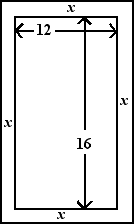
garden

The above problem is a prime example pulled from the Purple Math website one could use to illustrate a physical situation in which we need to actually determine the factors in order to formulate a quadratic expression to solve for the width. It should be noted that some of these particular word problems can quickly fall into a lesson relating more towards distributing and foiling factors to form an expanded form equation. However, as an instructor one can easily work backwards from an expanded equation to interpret what the factored form can tell us, say about the garden with respect to the example given above.


green line

B1. How can this topic be used in your students’ future courses in mathematics or science?

Factoring polynomials allows students to further comprehend the properties of these expressions before they are later applied as functions in areas such as mathematics and physics. For example, projectile motion stands as a great real world topic capable of enlightening students further on the factors of the polynomial. Specifically, how these factors come about geometrically and how knowing their role will benefit our understanding of the functions potential real world meaning. Lastly, factoring polynomials and evaluating them as roots during middle and high school mathematics will definitely be used when students approach college level calculus courses in relation to indefinite and definite integrals. The previous are just a few examples of how factoring polynomials plays a role in students’ future courses.


green line

How can technology (YouTube, Khan Academy [khanacademy.org], Vi Hart, Geometers Sketchpad, graphing calculators, etc.) be used to effectively engage students with this topic?

Doing a simple YouTube search of the phrase “factoring polynomials” allows anyone access to nearly 57,000 videos of various tutors, instructors, and professors discussing factoring and distributing respectfully. I would say that future generations will definitely not be without resources. That is not even to mention the revolutionary computation website that is www.wolframalpha.com. This website in and of itself will allow so many individuals to see various forms of a factored polynomial, as well as the graph, roots (given from factors), domain, range, etc. Essentially, computation websites like Wolfram Alpha are intended to allow students the opportunity to discover properties, relationships, and patterns independently. However, there is a potential risk for such websites to become a crutch the students use in order to get good grades as opposed to furthering their understanding. Similarly, with the advancing technology of graphing calculators students will become more engaged when discussing polynomial factorization for the first time in class. Many modern calculators have the ability to identify roots, give a table of coordinates, trace graphs, etc. Some even have a LCD screen or a backlit display to aid in viewing various graphs. Although, just as with computation engines, calculators could potentially distract students from thinking about their problem solving method by them just letting the calculator take over the calculation process. Therefore, I would suggest using caution regarding how soon calculators are introduced when initially engaging a class in factoring polynomials.


References:

http://www.purplemath.com/

http://www.purplemath.com/modules/quadprob2.htm

http://www.wolframalpha.com/

https://www.youtube.com/results?search_query=factoring+polynomials