My Mathematical Magic Show: Part 2c

Last March, on Pi Day (March 14, 2015), I put together a mathematical magic show for the Pi Day festivities at our local library, compiling various tricks that I teach to our future secondary teachers. I was expecting an audience of junior-high and high school students but ended up with an audience of elementary school students (and their parents). Still, I thought that this might be of general interest, and so I’ll present these tricks as well as the explanations for these tricks in this series. From start to finish, this mathematical magic show took me about 50-55 minutes to complete. None of the tricks in this routine are original to me; I learned each of these tricks from somebody else.

green line

For my first trick, I chose the most boring of the routine. Everyone in the audience had a piece of paper and many had calculators. Here is the patter for the first trick:

To begin this trick, write down any three-digit number on your piece of paper. Just make sure that the first digit and the last digit are different.

(pause)

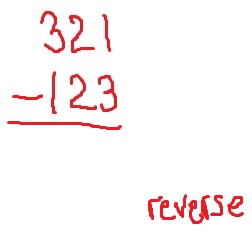
Now, reverse the digits and write down a new number. For example, if your number was 321, the new number will be 123.

(pause)

Now, subtract the small number from the big number. If your second number is larger, then put that number on top so that you can subtract the two numbers.

(pause)

Your difference is probably a three-digit number. However, if you ended up with a two-digit number, you can make it a three-digit number by putting a 0 in the hundreds place.

Next, I want you to reverse the digits of the difference to make a new three-digit number. Write this new number under the difference.

(pause)

Finally, add the last two three-digit numbers that you wrote down.

If everyone follows the instructions and does the arithmetic correctly, everyone will get a final answer of 1,089.

The next part of my mathematical magic show is showing everyone why the trick works. Yesterday, I gave an explanation suitable for upper elementary students. Today, I’ll give a more abstract explanation using algebra.

The succinct explanation can be found on Wikipedia:

The spectator’s 3-digit number can be written as 100 × A + 10 × B + 1 × C, and its reversal as 100 × C + 10 × B + 1 × A, where 1 ≤ A ≤ 9, 0 ≤ B ≤ 9 and 1 ≤ C ≤ 9. (For convenience, we assume A > C; if A < C, we first swap A and C.) Their difference is 99 × (AC). Note that if AC is 0 or 1, the difference is 0 or 99, respectively, and we do not get a 3-digit number for the next step.

99 × (A − C) can also be written as 99 × [(A − C) − 1] + 99 = 100 × [(A − C) − 1] − 1 × [(A − C) − 1] + 90 + 9 = 100 × [(A − C) − 1] + 90 + 9 − (A − C) + 1 = 100 × [(A − C) − 1] + 10 × 9 + 1 × [10 − (A − C)]. (The first digit is (A − C) − 1, the second is 9 and the third is 10 − (A − C). As 2 ≤ A − C ≤ 9, both the first and third digits are guaranteed to be single digits.)

Its reversal is 100 × [10 − (A − C)] + 10 × 9 + 1 × [(A − C) − 1]. The sum is thus 101 × [(A − C) − 1] + 20 × 9 + 101 × [10 − (A − C)] = 101 × [(A − C) − 1 + 10 − (A − C)] + 20 × 9 = 101 × [−1 + 10] + 180 = 1089.

However, I don’t particularly care for the succinct explanation, and so I’d prefer to give my audience the following explanation. Let’s write our original three-digit number as ABC, which of course stands for 100 \times A + 10 \times B + C. Then, when I reverse the digits, the new three-digit number will be CBA, or 100 \times C + 10 \times B + A.

1089trick10

Of course, because the first number is bigger than the second number, this means that the first hundreds digit is bigger than the second hundreds digit. This means that the first ones digit has to be less than the second ones digit. In other words, when we subtract, we have to borrow from the tens place. However, the tens digits are the same for both numbers. That means that I have to borrow from the hundreds place also.

I’ll illustrate this for both subtraction problems:
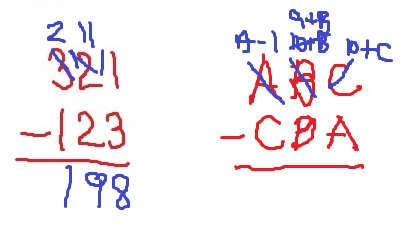
1089trick11Now I’ll subtract. The hundreds digit will be A - 1 - C. The tens digit will be 9 + B - B, or simply 9. Finally, the ones digit will be 10 + C - A. This is a little hard to write on a board, so I’ll add some dotted lines to separate the hundreds digits from the tens digit from the ones digit:

1089trick12The next step is to reverse the digits and add:

1089trick13I’ll begin with the ones digit:

(10 + C - A) + (A - 1 - C) = 10 - 1 = 9.

No matter what, the ones digit is a 9.

Continuing with the tens digits, I get 9 + 9 = 18. I’ll write down 8 and carry the 1 to the next column.

Finally, adding the hundreds digits (and the extra 1), I get

1 + (A - 1 + C) + (10 + C - A) = 1 - 1 + 10.

Therefore, no matter the values of A, B, and C, the end result must be 1089.

green lineTo complete the routine, I’ll ask a volunteer (usually a young child) to play the magician and repeat the trick for the audience. I consider this an important pedagogical step — the child enjoys being the magician on stage, while the audience lets the routine sink in one more time before I move on to the next magic trick.
My Mathematical Magic Show: Part 2b

Last March, on Pi Day (March 14, 2015), I put together a mathematical magic show for the Pi Day festivities at our local library, compiling various tricks that I teach to our future secondary teachers. I was expecting an audience of junior-high and high school students but ended up with an audience of elementary school students (and their parents). Still, I thought that this might be of general interest, and so I’ll present these tricks as well as the explanations for these tricks in this series. From start to finish, this mathematical magic show took me about 50-55 minutes to complete. None of the tricks in this routine are original to me; I learned each of these tricks from somebody else.

green line

For my first trick, I chose the most boring of the routine. Everyone in the audience had a piece of paper and many had calculators. Here is the patter for the first trick:

To begin this trick, write down any three-digit number on your piece of paper. Just make sure that the first digit and the last digit are different.

(pause)

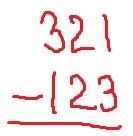
Now, reverse the digits and write down a new number. For example, if your number was 321, the new number will be 123.

(pause)

Now, subtract the small number from the big number. If your second number is larger, then put that number on top so that you can subtract the two numbers.

(pause)

Your difference is probably a three-digit number. However, if you ended up with a two-digit number, you can make it a three-digit number by putting a 0 in the hundreds place.

Next, I want you to reverse the digits of the difference to make a new three-digit number. Write this new number under the difference.

(pause)

Finally, add the last two three-digit numbers that you wrote down.

If everyone follows the instructions and does the arithmetic correctly, everyone will get a final answer of 1,089.

The next part of my mathematical magic show is showing everyone why the trick works. The explanation depends on the mathematical sophistication of the audience. Today, I’ll give an explanation suitable for upper elementary students. Tomorrow, I’ll give a different explanation using algebra.

For today’s explanation, I’ll give an example:

1089trick2

Of course, because the first number is bigger than the second number, this means that the first hundreds digit is bigger than the second hundreds digit. This means that the first ones digit has to be less than the second ones digit. In other words, when we subtract, we have to borrow from the tens place.

However, the tens digits are the same for both numbers. That means that I have to borrow from the hundreds place also.

1089trick5

So, when I subtract, I’m guaranteed that the middle number will be a 9. Also, I’m guaranteed that the hundreds digit and the ones digit will add up to 9. In this example, the sum of the hundreds digits and the ones digits is equal to

2 - 1 + 11 - 3.

We know that 11-1 is equal to 10, and adding 2 and subtracting 3 is like subtracting 1. Therefore, the sum of the hundreds digit and the ones digit must be equal to 9.1089trick9

The next step was reversing the digits of the difference:

1089trick7

Finally, I asked you to add these last two numbers. Remember, I had rigged things so that the hundreds and ones digits add up to 9. So the last digit of the sum must be 9. Also, I rigged things so that the tens digit must be 9. So, when I add, I get a sum of 18, and I leave the 8 and carry the 1. Finally, the hundreds and ones digits add up to 9 again. Adding the extra 1, I write down a sum of 10.

1089trick8In tomorrow’s post, I’ll explain how the trick works using algebra.

My Mathematical Magic Show: Part 2a

Last March, on Pi Day (March 14, 2015), I put together a mathematical magic show for the Pi Day festivities at our local library, compiling various tricks that I teach to our future secondary teachers. I was expecting an audience of junior-high and high school students but ended up with an audience of elementary school students (and their parents). Still, I thought that this might be of general interest, and so I’ll present these tricks as well as the explanations for these tricks in this series. From start to finish, this mathematical magic show took me about 50-55 minutes to complete. None of the tricks in this routine are original to me; I learned each of these tricks from somebody else.

green line

For my first trick, I chose the most boring of the routine. Everyone in the audience had a piece of paper and many had calculators. I also had a small white board to write on at the front of the room. I began,

To begin this trick, write down any three-digit number on your piece of paper. Just make sure that the first digit and the last digit are different.

After waiting 10 seconds, I then said,

Now, reverse the digits and write down a new number. For example, if your number was 321, the new number will be 123.

And, to be sure my instructions are clear, I’ll write these numbers on my white board:

1089trick1

Next, I’ll say:

Now, subtract the small number from the big number. If your second number is larger, then put that number on top so that you can subtract the two numbers.

1089trick2

After waiting a minute or so, I’ll say,

Your difference is probably a three-digit number. However, if you ended up with a two-digit number, you can make it a three-digit number by putting a 0 in the hundreds place.

Next, I want you to reverse the digits of the difference to make a new three-digit number. Write this new number under the difference.

1089trick3

After everyone’s done, I’ll give my final instruction:

Finally, add the last two three-digit numbers that you wrote down.

1089trick4After everyone’s done, I’ll point to someone and say, “Your final number was 1,089.” If he followed my instructions and did the arithmetic correctly, he’ll say, “You’re right.” Then I’ll point to someone else and say, “You also got 1,089.” She’ll also say, :”You’re right.” Then I’ll say, “Everyone got 1,089, right?”

Another (and more dramatic) way to end the routine is to hand a book of mine to someone, with the following instructions:

Your last number should have four digits. Cross out the last digit; you now will have a number with only three digits. Turn to that page number in this book. Then find the word on that page corresponding to the number you crossed out. For example, if you crossed out a one, point to the first word on the page. If you crossed out a two, point to the second word on the page. And so on.

Got it? The word you’re pointing to is XXXXXX.

And of course, I’ll get this right because, before starting the routine, I had already memorized the ninth word on page 108 of my book (the XXXXXX above). This looks really dramatic because it looks essentially random to the audience.

In tomorrow’s post, I’ll explain how the trick works.

My Mathematical Magic Show: Part 1

Last March, on Pi Day (March 14, 2015), I put together a mathematical magic show for the Pi Day festivities at our local library, compiling various tricks that I teach to our future secondary teachers. I thought that this might be of general interest, and so I’ll present these tricks as well as the explanations for these tricks in this series.

Before showing my own tricks, however, I have to pay homage to Arthur Benjamin, who is a Professor of Mathematics at Harvey Mudd College who’s also made a second career doing mathematical magic shows. See his Amazon page for the books that he’s published and his webpage at Harvey Mudd.

Halloween math humor

Math With Bad Drawings recently posted a mathematical horror story just in time for Halloween: The Polynomials That Were Annihilated One By One By Derivatives, As Told By The One Survivor (An Exponential Function).

The opening paragraphs:

The constant functions perished first.

Everyone began planning a vigil, a sort of funerary service in honor of their memory. I don’t mean spit on anybody’s grave, but let’s be honest about who the constants were: simpletons. They stagnated in time. Never grew, never shrank, never changed. I pity them not so much for their grisly demise as for the bland, purposeless life that had come before. Call me an elitist and an unfeeling snob, but to me, a constant’s existence is no existence at all.

Not that they deserved their fate. Nobody deserves that.

I came for the vigil, of course. (I’m an exponential, not a monster.) I held my tongue and let the lower-order polynomials drain their tears on eulogies. They told anecdotes of the constants’ reliability, their steadfastness. They told self-aggrandizing stories of intersection and tangency, moments when the constants had told, say, a quadratic, something about itself: where it was, where it was going. Simpleton wisdom. Charming stuff, I guess, but not my cup of tea.

Filing out of the vigil was when I first heard the word. It rode a wave of terrified whispers across the crowd, uttered like the name of a demon or a plague.

The Differentiation.

I highly recommend the whole thing.


Thoughts on Infinity (Part 3g)

We have seen in recent posts that

$latex  \displaystyle 1 – \frac{1}{2} + \frac{1}{3} – \frac{1}{4} + \frac{1}{5} – … = \ln 2$

One way of remembering this fact is by using the Taylor series expansion for \ln(1+x):

\ln(1+x) = x - \displaystyle \frac{x^2}{2} + \frac{x^3}{3} - \frac{x^4}{4} + \frac{x^5}{5} \dots

“Therefore,” the first series can be obtained from the second series by substituting x=1.

I placed “therefore” in quotation marks because this reasoning is completely invalid, even though it happens to stumble across the correct answer in this instance. The radius of convergence for the above Taylor series is 1, which can be verified by using the Ratio Test. So the series converges absolutely for |x| < 1 and diverges for |x| > 1. The boundary of |x| = 1, on the other hand, has to be checked separately for convergence.

In other words, plugging in x=1 might be a useful way to remember the formula, but it’s not a proof of the formula and certainly not a technique that I want to encourage students to use!

It’s easy to find examples where just plugging in the boundary point happens to give the correct answer (see above). It’s also easy to find examples where plugging in the boundary point gives an incorrect answer because the series actually diverges: for example, substituting x = -1 into the geometric series

\displaystyle \frac{1}{1-x} = 1 + x + x^2 + x^3 + x^4 + \dots

However, I’ve been scratching my head to think of an example where plugging in the boundary point gives an incorrect answer because the series converges but converges to a different number. I could’ve sworn that I saw an example like this when I was a calculus student, but I can’t see to find an example in reading Apostol’s calculus text.


Thoughts on Infinity (Part 3f)

In recent posts, we’ve seen the curious phenomenon that the commutative and associative laws do not apply to a conditionally convergent series or infinite product: while

\displaystyle 1 - \frac{1}{2} + \frac{1}{3} - \frac{1}{4} + \frac{1}{5} - ... = \ln 2,

a rearranged series can be something completely different:

\displaystyle 1 + \frac{1}{3} - \frac{1}{2} + \frac{1}{5} + \frac{1}{7} - \frac{1}{4} + \frac{1}{9} + \frac{1}{11} - \frac{1}{6} ... = \displaystyle \frac{3}{2} \ln 2.

This very counterintuitive result can be confirmed using commonly used technology — in particular, Microsoft Excel. In the spreadsheet below, I typed:

  • =IF(MOD(ROW(A1),3)=0,ROW(A1)*2/3,IF(MOD(ROW(A1),3)=1,4*(ROW(A1)-1)/3+1,4*(ROW(A1)-2)/3+3)) in cell A1
  • =POWER(-1,A1-1)/A1 in cell B1
  • =B1 in cell C1
  • I copied cell A1 into cell A2
  • =POWER(-1,A2-1)/A2 in cell B2
  • =C1+B2 in cell C2

The unusual command for cell A1 was necessary to get the correct rearrangement of the series.

Then I used the FILL DOWN command to fill in the remaining rows. Using these commands cell C9 shows the sum of all the entries in cells B1 through B9, so that

\displaystyle 1 + \frac{1}{3} - \frac{1}{2} + \frac{1}{5} + \frac{1}{7} - \frac{1}{4} + \frac{1}{9} + \frac{1}{11} - \frac{1}{6} \approx 0.961544012

log2series6

Filling down to additional rows demonstrates that the sum converges to \displaystyle \frac{3}{2}\ln 2 and not to \ln 2. Here’s the sum up to 10,000 terms… the entry in column E is the first few digits in the decimal expansion of \displaystyle \frac{3}{2} \ln 2. log2series7

Clearly the partial sums are not approaching \ln 2 \approx 0.693, and there’s good visual evidence to think that the answer is \displaystyle \frac{3}{2} \ln 2 instead. (Incidentally, the 10,000th partial sum is very close to the limiting value because 10,000 is one more than a multiple of 3.)


Thoughts on Infinity (Part 3e)

In recent posts, we’ve seen the curious phenomenon that the commutative and associative laws do not apply to a conditionally convergent series or infinite product. Here’s another classic example of this fact that’s attributed to Cauchy.

We’ve already seen in this series (pardon the pun) that

\displaystyle 1 - \frac{1}{2} + \frac{1}{3} - \frac{1}{4} + \frac{1}{5} - ... = \ln 2.

Let’s now see what happens if I rearrange the terms of this conditionally convergent series. Let

T = \displaystyle 1 + \frac{1}{3} - \frac{1}{2} + \frac{1}{5} + \frac{1}{7} - \frac{1}{4} + \frac{1}{9} + \frac{11} - \frac{1}{6} \dots,

where two positive numbers alternate with a single negative term. By all rights, this shouldn’t affect anything… right?

Let s_n be the nth partial sum of this series, so that s_{3n} contains 2n positive terms with odd denominators and n negative terms with even denominators:

s_{3n} = \displaystyle \sum_{k=1}^{2n} \frac{1}{2n-1} - \sum_{k=1}^n \frac{1}{2n}.

Let me now add and subtract the “missing” even terms in the first sum:

s_{3n} = \displaystyle \sum_{k=1}^{2n} \frac{1}{2n-1} + \sum_{k=1}^{2n} \frac{1}{2n} - \sum_{k=1}^{2n} \frac{1}{2n} - \sum_{k=1}^n \frac{1}{2n}

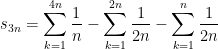
s_{3n} = \displaystyle \sum_{k=1}^{4n} \frac{1}{n} - \sum_{k=1}^{2n} \frac{1}{2n} - \sum_{k=1}^n \frac{1}{2n}

s_{3n} = \displaystyle \sum_{k=1}^{4n} \frac{1}{n} - \frac{1}{2} \sum_{k=1}^{2n} \frac{1}{n} - \frac{1}{2} \sum_{k=1}^n \frac{1}{n}.

For reasons that will become apparent, I’ll now rewrite this as

s_{3n} = \displaystyle \int_1^{4n} \frac{dx}{x} + \left( \sum_{k=1}^{4n} \frac{1}{k} - \displaystyle \int_1^{4n} \frac{dx}{x} \right)

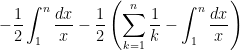
- \displaystyle \frac{1}{2} \int_1^{2n} \frac{dx}{x} - \frac{1}{2} \left( \sum_{k=1}^{2n} \frac{1}{k} - \int_1^{2n} \frac{dx}{x} \right)

- \displaystyle \frac{1}{2} \int_1^{n} \frac{dx}{x} - \frac{1}{2} \left( \sum_{k=1}^{n} \frac{1}{k} - \int_1^{n} \frac{dx}{x} \right),

or

s_{3n} = \ln(4n) - \ln 1 + \displaystyle \left( \sum_{k=1}^{4n} \frac{1}{k} - [\ln(4n) - \ln 1]\right)

- \displaystyle \frac{1}{2}[\ln (2n) - \ln 1] - \displaystyle \frac{1}{2} \left( \sum_{k=1}^{2n} \frac{1}{k} - [\ln (2n) - \ln 1]\right)

- \displaystyle \frac{1}{2}[\ln n - \ln 1] - \displaystyle \frac{1}{2} \left( \sum_{k=1}^{n} \frac{1}{k} - [\ln n - \ln 1]\right)

Since \ln 1 = 0, \ln(2n) = \ln 2 + \ln n, and \ln(4n) = \ln 4 + \ln n = 2\ln 2 + \ln n, we have

s_{3n} = 2\ln 2 + \ln n + \displaystyle \left( \sum_{k=1}^{4n} \frac{1}{k} - \ln 4n \right)

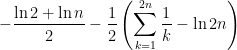
\displaystyle - \frac{\ln 2 + \ln n}{2} - \displaystyle \frac{1}{2} \left( \sum_{k=1}^{2n} \frac{1}{k} - \ln 2n \right)

\displaystyle - \frac{\ln n}{2} - \frac{1}{2} \displaystyle \left( \sum_{k=1}^{n} \frac{1}{k} - \ln n \right),

or

s_{3n}= \displaystyle \frac{3}{2}\ln 2 + \displaystyle \left( \sum_{k=1}^{4n} \frac{1}{k} - \ln 4n \right) - \frac{1}{2}\left( \sum_{k=1}^{2n} \frac{1}{k} - \ln 2n\right) - \frac{1}{2}\left( \sum_{k=1}^{n} \frac{1}{k} - \ln n\right).

I now take the limit as m \to \infty:

\displaystyle \lim_{n \to \infty} s_{3n} = \displaystyle \frac{3}{2}\ln 2 + \lim_{n \to \infty} \left( \sum_{k=1}^{4n} \frac{1}{k} - \ln 4n \right) - \frac{1}{2} \lim_{n \to \infty} \left( \sum_{k=1}^{2n} \frac{1}{k} - \ln 2n\right) - \frac{1}{2} \lim_{n \to \infty} \left( \sum_{k=1}^{n} \frac{1}{k} - \ln n\right).

This step reveals why I added and subtracted the integrals above: those gymnastics were necessary in order to reach a limit that converges.

As shown earlier in this series, if

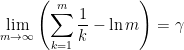
\displaystyle \lim_{m \to \infty} \left( \sum_{k=1}^m \frac{1}{k} - \ln m \right) = \gamma,

the Euler-Mascheroni constant. Therefore, since the limit of any subsequence must converge to the same limit, we have

Applying these above, we conclude

\displaystyle \lim_{m \to \infty} s_{3n} = \displaystyle \frac{3}{2}\ln 2 + \gamma - \frac{1}{2}\gamma - \frac{1}{2} \gamma = \displaystyle \frac{3}{2} \ln 2,

which is different than \ln 2.

Technically, I’ve only shown so far that the limit of partial sums 3, 6, 9, … is \displaystyle\frac{3}{2} \ln 2. For the other partial sums, I note that

\displaystyle \lim_{n \to \infty} t_{3n+1} = \displaystyle \lim_{n \to \infty} \left(s_{3n} + \displaystyle \frac{1}{4n+1} \right) = \displaystyle \frac{3}{2} \ln 2 + 0 = \displaystyle \frac{3}{2} \ln 2

and

\displaystyle \lim_{n \to \infty} t_{3n-1} = \displaystyle \lim_{n \to \infty} \left(s_{3n} - \displaystyle \frac{1}{2n} \right) = \displaystyle \frac{3}{2} \ln 2 - 0 = \displaystyle \frac{3}{2} \ln 2.

Therefore, I can safely conclude that

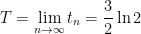
T = \displaystyle \lim_{n \to \infty} t_n = \displaystyle \frac{3}{2} \ln 2,

which is different than the original sum S.

Thoughts on Infinity (Part 3d)

In recent posts, we’ve seen the curious phenomenon that the commutative and associative laws do not apply to a conditionally convergent series or infinite product. Here’s another classic example of this fact that’s attributed to Cauchy.

In yesterday’s post, I showed that

\displaystyle 1 - \frac{1}{2} + \frac{1}{3} - \frac{1}{4} + \frac{1}{5} - ... = \ln 2.

This can be (sort of) confirmed using commonly used technology — in particular, Microsoft Excel. In the spreadsheet below, I typed:

  • 1 in cell A1
  • =POWER(-1,A1-1)/A1 in cell B1
  • =B1 in cell C1
  • =A1+1 in cell A2
  • =POWER(-1,A2-1)/A2 in cell B2
  • =C1+B2 in cell C2
  • Then I used the FILL DOWN command to fill in the remaining rows. Using these commands cell C10 shows the sum of all the entries in cells B1 through B10, so that

1 - \displaystyle \frac{1}{2} + \frac{1}{3} - \frac{1}{4} + \frac{1}{5} - \frac{1}{6} + \frac{1}{7} - \frac{1}{8} + \frac{1}{9} - \frac{1}{10} \approx 0.645634921

log2series1


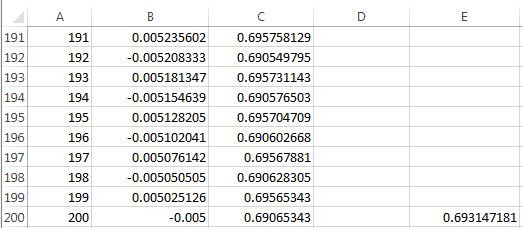
Filling down to additional rows demonstrates that the sum converges to \ln 2, albeit very slowly (as is typical for conditionally convergent series). Here’s the sum up to 200 terms… the entry in column E is the first few digits in the decimal expansion of \ln 2.

log2series2

Here’s the result after 2000 terms:

log2series3

20,000 terms:

log2series4

And finally, 200,000 terms. (It takes a few minutes for Microsoft Excel to scroll this far.)

log2series5We see that, as expected, the partial sums are converging to \ln 2, as expected. Unfortunately, the convergence is extremely slow — we have to compute 10 times as many terms in order to get one extra digit in the final answer.


Thoughts on Infinity (Part 3c)

In recent posts, we’ve seen the curious phenomenon that the commutative and associative laws do not apply to a conditionally convergent series or infinite product. Here’s another classic example of this fact that’s attributed to Cauchy.

Define

S = \displaystyle 1 - \frac{1}{2} + \frac{1}{3} - \frac{1}{4} + \frac{1}{5} - ...

By the alternating series test, this series converges. However,

\displaystyle \sum_{n=1}^\infty |a_n| = \displaystyle \sum_{n=1} \frac{1}{n},

which is the divergent harmonic series which was discussed earlier in this series. Therefore, the series S converges conditionally and not absolutely.

To calculate the value of S, let s_n = \displaystyle \sum_{k=1}^n \frac{(-1)^{k-1}}{k}, the nth partial sum of S. Since the series converges, we know that \displaystyle \lim_{n \to \infty} s_n converges. Furthermore, the limit of any subsequence, like \displaystyle \lim_{n \to \infty} s_{2n}, must also converge to S.

If n is even, so that n = 2m and m is an integer, then

s_{2m} = \displaystyle \sum_{k=1}^n \frac{(-1)^{k-1}}{k}

= \displaystyle \sum_{k=1}^{m} \frac{1}{2k-1} - \sum_{k=1}^m \frac{1}{2k}

= \displaystyle \left( \sum_{k=1}^{2m} \frac{1}{k} - \sum_{k=1}^m \frac{1}{2k} \right) - \sum_{k=1}^m \frac{1}{2k}

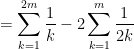
= \displaystyle \sum_{k=1}^{2m} \frac{1}{k} - 2 \sum_{k=1}^m \frac{1}{2k}

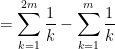
= \displaystyle \sum_{k=1}^{2m} \frac{1}{k} - \sum_{k=1}^m \frac{1}{k}.

For reasons that will become apparent, I’ll now rewrite this as

s_{2m} = \displaystyle \int_1^{2m} \frac{dx}{x} + \left( \sum_{k=1}^{2m} \frac{1}{k} - \displaystyle \int_1^{2m} \frac{dx}{x} \right) - \displaystyle \int_1^m \frac{dx}{x} - \left( \sum_{k=1}^m \frac{1}{k} - \int_1^m \frac{dx}{x} \right),

or

s_{2m} = \ln(2m) - \ln 1 + \displaystyle \left( \sum_{k=1}^{2m} \frac{1}{k} - [\ln(2m) - \ln 1]\right)

- [\ln m - \ln 1] - \displaystyle \left( \sum_{k=1}^m \frac{1}{k} - [\ln m - \ln 1]\right).

Since ln 1 = 0 and \ln(2m) = \ln 2 + \ln m, we have

s_{2m} = \ln 2 + \ln m + \displaystyle \left( \sum_{k=1}^{2m} \frac{1}{k} - \ln 2m \right) - \ln m - \displaystyle \left( \sum_{k=1}^m \frac{1}{k} - \ln m \right)

= \ln 2 + \displaystyle \left( \sum_{k=1}^{2m} \frac{1}{k} - \ln 2m \right) - \left( \sum_{k=1}^m \frac{1}{k} - \ln m\right).

I now take the limit as m \to \infty:

\displaystyle \lim_{m \to \infty} s_{2m} = \ln 2 + \displaystyle \lim_{m \to \infty} \left( \sum_{k=1}^{2m} \frac{1}{k} - \ln 2m\right) - \lim_{m \to \infty} \left( \sum_{k=1}^m \frac{1}{k} - \ln m \right).

This step reveals why I added and subtracted the integrals above: those gymnastics were necessary in order to reach a limit that converges.

In yesterday’s post, I showed that if

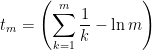
t_m = \displaystyle \left( \sum_{k=1}^m \frac{1}{k} - \ln m \right)

\displaystyle \lim_{m \to \infty} t_m = \displaystyle \lim_{m \to \infty} \left( \sum_{k=1}^m \frac{1}{k} - \ln m \right) = \gamma,

the Euler-Mascheroni constant. Therefore, the limit of any subsequence must converge to the same limit; in particular,

\displaystyle \lim_{m \to \infty} t_{2m} =\displaystyle \lim_{m \to \infty} \left( \sum_{k=1}^{2m} \frac{1}{k} - \ln 2m \right)= \gamma.

Applying these above, we conclude

\displaystyle \lim_{m \to \infty} s_{2m} = \ln 2 + \gamma - \gamma,

or

S = \ln 2.