How many ways can you arrange 128 tennis balls?

I found this bit of computational mathematics fascinating. From http://www.joh.cam.ac.uk/how-many-ways-can-you-arrange-128-tennis-balls-researchers-solve-apparently-impossible-problem:

Imagine that you have 128 soft spheres, a bit like tennis balls. You can pack them together in any number of ways. How many different arrangements are possible?

The answer, it turns out, is something like 10250 (1 followed by 250 zeros). The number, also referred to as ten unquadragintilliard, is so huge that it vastly exceeds the total number of particles in the universe.

Far more important than the solution, however, is the fact that the researchers were able to answer the question at all. The method that they came up with can help scientists to calculate something called configurational entropy – a term used to describe how structurally disordered the particles in a physical system are.
An Interview with Randall Munroe

FiveThirtyEight.com interviewed Randall Munroe, the author of the wildly popular xkcd webcomic. I recommend the whole interview, but I thought that the follow few paragraphs were exceptionally insightful.

One thing that bothers me is large numbers presented without context. We’re always seeing things like, “This canal project will require 1.15 million tons of concrete.” It’s presented as if it should mean something to us, as if numbers are inherently informative. So we feel like if we don’t understand it, it’s our fault.

But I have only a vague idea of what one ton of concrete looks like. I have no idea what to think of a million tons. Is that a lot? It’s clearly supposed to sound like a lot, because it has the word “million” in it. But on the other hand, “The Adventures of Pluto Nash” made $7 million at the box office, and it was one of the biggest flops in movie history.

It can be more useful to look for context. Is concrete a surprisingly large share of the project’s budget? Is the project going to consume more concrete than the rest of the state combined? Will this project use up a large share of the world’s concrete? Or is this just easy, space-filling trivia? A good rule of thumb might be, “If I added a zero to this number, would the sentence containing it mean something different to me?” If the answer is “no,” maybe the number has no business being in the sentence in the first place.

Why Reluctant Students Still Should Learn Math

I love this quote from Math With Bad Drawings about why students should learn math:

In every walk of life, humans need to reason. So of course, they can learn these intellectual skills in other places. You don’t need math. But gosh, does math make it easier!

You can learn to taxonomize in biology, by considering the classification of organisms. But your taxonomies will never be perfect, because life doesn’t fit into neat little boxes. (I’m looking at you, protists.)

Life doesn’t… but math does.

Or you can learn to dissect arguments in civics. But emotions will flare. It’ll be tough to agree on premises. And even if you do, words like “justice,” “freedom,” and “common good” are subject to fuzzy interpretations and subtle misunderstandings. All words are like that: a little vague, tricky to pin down.

Except in math.

Logic shows up everywhere. But in math, it’s the whole game. Math isolates the operations of logic and reason so that we can master them.

In short: math is the playground of reason.

I recommend the entire article: https://mathwithbaddrawings.com/2016/06/08/a-quadratic-of-solace-or-maybe-math-class-has-a-purpose-question-mark/

Another poorly written word problem (Part 9)

Textbooks have included the occasional awful problem ever since Pebbles Flintstone and Bamm-Bamm Rubble chiseled their homework on slate tablets while attending Bedrock Elementary. But even with the understanding that there have been children have been doing awful homework problems since the dawn of time (and long before the advent of the Common Core), this one is a doozy.

While the ball is on the 20-yard line, a defensive end is suddenly cursed so that he commits a penalty every down that causes the following:

a. The ball is moved half the distance to the goal line, and
b. The down is replayed.

Show that the ball will eventually travel the entire 20-yard distance to the goal.

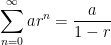
Sigh. The textbook expects students to use the formula for an infinite geometric series

\displaystyle \sum_{n=0}^\infty ar^n = \displaystyle \frac{a}{1-r}

with a = 10 and r = 0.5. However, this series only works if there are an infinite number of terms, so that any finite partial sum will be less than 20. Therefore, saying that the ball “will eventually travel” all 20 yards is misleading, as this implies that this happens after a finite amount of time.