

Source: http://www.xkcd.com/1725/
Source: http://www.xkcd.com/1725/
The Riemann Hypothesis (see here, here, and here) is perhaps the most famous (and also most important) unsolved problems in mathematics. Gamma (page 207) provides a way of writing down this conjecture in a form that only uses notation that is commonly taught in high school:
If
and
for some pair of real numbers
and
, then
.
As noted in the book, “It seems extraordinary that the most famous unsolved problem in the whole of mathematics can be phrased so that it involves the simplest of mathematical ideas: summation, trigonometry, logarithms, and [square roots].”

When I researching for my series of posts on conditional convergence, especially examples related to the constant 
Boy, was I wrong. As I turned every page, it seemed I hit a new factoid that I had not known before.
In this series, I’d like to compile some of my favorites — while giving the book a very high recommendation.
Let 


This is a very difficult result to prove. However, Gamma (page 172) provides a heuristic argument that suggests that this answer might be halfway reasonable.
Consider all of the integers between 

If we repeat for all primes less than or equal to 

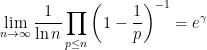
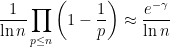
From this point, we can use Mertens product formula
to conclude that
if
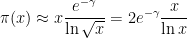
Though not a formal proof, it’s a fast way to convince students that the unusual fraction 
When I researching for my series of posts on conditional convergence, especially examples related to the constant
Boy, was I wrong. As I turned every page, it seemed I hit a new factoid that I had not known before.
In this series, I’d like to compile some of my favorites — while giving the book a very high recommendation.
Let
This is a very difficult result to prove. However, Gamma (page 172) provides a heuristic argument that suggests that this answer might be halfway reasonable.
Consider all of the integers between
If we repeat for all primes less than or equal to
From this point, we can use Mertens product formula
to conclude that
if
Though not a formal proof, it’s a fast way to convince students that the unusual fraction
When I researching for my series of posts on conditional convergence, especially examples related to the constant
Boy, was I wrong. As I turned every page, it seemed I hit a new factoid that I had not known before.
In this series, I’d like to compile some of my favorites — while giving the book a very high recommendation.
I did not know — until I read Gamma (page 168) — that there actually is a formula for generating
![p_n = 1 + \displaystyle \sum_{m=1}^{2^n} \left[ n^{1/n} \left( \sum_{i=1}^m \cos^2 \left( \pi \frac{(i-1)!+1}{i} \right) \right)^{-1/n} \right]](https://s0.wp.com/latex.php?latex=p_n+%3D+1+%2B+%5Cdisplaystyle+%5Csum_%7Bm%3D1%7D%5E%7B2%5En%7D+%5Cleft%5B+n%5E%7B1%2Fn%7D+%5Cleft%28+%5Csum_%7Bi%3D1%7D%5Em+%5Ccos%5E2+%5Cleft%28+%5Cpi+%5Cfrac%7B%28i-1%29%21%2B1%7D%7Bi%7D+%5Cright%29+%5Cright%29%5E%7B-1%2Fn%7D+%5Cright%5D&bg=ffffff&fg=000000&s=0&c=20201002)
where the outer brackets ![[~ ]](https://s0.wp.com/latex.php?latex=%5B%7E+%5D&bg=ffffff&fg=000000&s=0&c=20201002)
This mathematical curiosity has no practical value, as determining the 10th prime number would require computing 
When I researching for my series of posts on conditional convergence, especially examples related to the constant
Boy, was I wrong. As I turned every page, it seemed I hit a new factoid that I had not known before.
In this series, I’d like to compile some of my favorites — while giving the book a very high recommendation.
I hadn’t heard of the worm-on-a-rope problem until I read Gamma (page 133). From Cut-The-Knot:
A worm is at one end of a rubber rope that can be stretched indefinitely. Initially the rope is one kilometer long. The worm crawls along the rope toward the other end at a constant rate of one centimeter per second. At the end of each second the rope is instantly stretched another kilometer. Thus, after the first second the worm has traveled one centimeter, and the length of the rope has become two kilometers. After the second second, the worm has crawled another centimeter and the rope has become three kilometers long, and so on. The stretching is uniform, like the stretching of a rubber band. Only the rope stretches. Units of length and time remain constant.
It turns out that, after 
and 


If 
When I researching for my series of posts on conditional convergence, especially examples related to the constant
Boy, was I wrong. As I turned every page, it seemed I hit a new factoid that I had not known before.
In this series, I’d like to compile some of my favorites — while giving the book a very high recommendation.
I hadn’t heard of the crossing-the-desert problem until I read Gamma (page 127). From Wikipedia:
There are n units of fuel stored at a fixed base. The jeep can carry at most 1 unit of fuel at any time, and can travel 1 unit of distance on 1 unit of fuel (the jeep’s fuel consumption is assumed to be constant). At any point in a trip the jeep may leave any amount of fuel that it is carrying at a fuel dump, or may collect any amount of fuel that was left at a fuel dump on a previous trip, as long as its fuel load never exceeds 1 unit…
The jeep must return to the base at the end of every trip except for the final trip, when the jeep travels as far as it can before running out of fuel…
[T]he objective is to maximize the distance traveled by the jeep on its final trip.
The answer is, if

Since the right-hand side approaches infinity as
When I researching for my series of posts on conditional convergence, especially examples related to the constant
Boy, was I wrong. As I turned every page, it seemed I hit a new factoid that I had not known before.
In this series, I’d like to compile some of my favorites — while giving the book a very high recommendation.
Let 



As noted in Gamma,
Two arbitrary chosen examples are revealing. The Radcliffe Meteorological Station in Oxford has data for rainfall in Oxford between 1767 and 2000 and there are five record years; this is a span of 234 recorded years and
. For Central Park, New York City, between 1835 and 1994 there are six record years over the 160-year period and
, providing good evidence that English weather is that bit more unpredictable.
When I researching for my series of posts on conditional convergence, especially examples related to the constant
Boy, was I wrong. As I turned every page, it seemed I hit a new factoid that I had not known before.
In this series, I’d like to compile some of my favorites — while giving the book a very high recommendation.
The Euler-Mascheroni constant
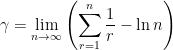
What I didn’t know, until reading Gamma (page 117), is that there are at least two ways to generalize this definition.
First,
![\gamma = \displaystyle \lim_{n \to \infty} \left( \sum_{r=1}^n \frac{1}{\hbox{length of~} [0,r]} - \ln n \right)](https://s0.wp.com/latex.php?latex=%5Cgamma+%3D+%5Cdisplaystyle+%5Clim_%7Bn+%5Cto+%5Cinfty%7D+%5Cleft%28+%5Csum_%7Br%3D1%7D%5En+%5Cfrac%7B1%7D%7B%5Chbox%7Blength+of%7E%7D+%5B0%2Cr%5D%7D+-+%5Cln+n+%5Cright%29&bg=ffffff&fg=000000&s=0&c=20201002)
and so this can be generalized to two dimensions as follows:

where 


Second, let 

Euler (not surprisingly) had the bright idea of changing the function 

producing Euler’s generalized constants. Alternatively (from Stieltjes), we could choose

When I researching for my series of posts on conditional convergence, especially examples related to the constant
Boy, was I wrong. As I turned every page, it seemed I hit a new factoid that I had not known before.
In this series, I’d like to compile some of my favorites — while giving the book a very high recommendation.
Suppose 


where 

Holy cow, what a formula. Let’s take a look at just a small part of it.
Let’s look at the amazing function 


after using a calculator.
This function grows extremely slowly. What value of 
What value of
That’s a number with 1,656,421 digits! At the rapid rate of 5 digits per second, it would take over 92 hours (nearly 4 days) just to write out the answer by hand!
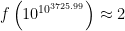
Finally, how large does
Let’s simplify things slightly by letting 
This is a transcendental equation in 


Therefore, 
One final note: despite what’s typically taught in high school, mathematicians typically use 

And this sets up a standard joke, also printed in Gamma:
Q: What noise does a drowning analytic number theorist make?
A: Log… log… log… log…
When I researching for my series of posts on conditional convergence, especially examples related to the constant
Boy, was I wrong. As I turned every page, it seemed I hit a new factoid that I had not known before.
In this series, I’d like to compile some of my favorites — while giving the book a very high recommendation.




![= \displaystyle \ln \ln \left[ \ln \left(10^{100} \right) + \ln \ln 10 \right]](https://s0.wp.com/latex.php?latex=%3D+%5Cdisplaystyle+%5Cln+%5Cln+%5Cleft%5B+%5Cln+%5Cleft%2810%5E%7B100%7D+%5Cright%29+%2B+%5Cln+%5Cln+10+%5Cright%5D&bg=ffffff&fg=000000&s=0&c=20201002)
![= \displaystyle \ln \ln \left[ 100 \ln 10 + \ln \ln 10 \right]](https://s0.wp.com/latex.php?latex=%3D+%5Cdisplaystyle+%5Cln+%5Cln+%5Cleft%5B+100+%5Cln+10+%2B+%5Cln+%5Cln+10+%5Cright%5D&bg=ffffff&fg=000000&s=0&c=20201002)
![= \displaystyle \ln \ln \left[ 100 \ln 10 \left( 1 + \frac{\ln \ln 10}{100 \ln 10} \right) \right]](https://s0.wp.com/latex.php?latex=%3D+%5Cdisplaystyle+%5Cln+%5Cln+%5Cleft%5B+100+%5Cln+10+%5Cleft%28+1+%2B+%5Cfrac%7B%5Cln+%5Cln+10%7D%7B100+%5Cln+10%7D+%5Cright%29+%5Cright%5D&bg=ffffff&fg=000000&s=0&c=20201002)
![= \displaystyle \ln \left( \ln [ 100 \ln 10] + \ln \left( 1 + \frac{\ln \ln 10}{100 \ln 10} \right)\right)](https://s0.wp.com/latex.php?latex=%3D+%5Cdisplaystyle+%5Cln+%5Cleft%28+%5Cln+%5B+100+%5Cln+10%5D+%2B+%5Cln+%5Cleft%28+1+%2B+%5Cfrac%7B%5Cln+%5Cln+10%7D%7B100+%5Cln+10%7D+%5Cright%29%5Cright%29&bg=ffffff&fg=000000&s=0&c=20201002)











![\displaystyle \ln \ln \left[ \ln \left(10^{x} \right) + \ln \ln 10 \right] = 2](https://s0.wp.com/latex.php?latex=%5Cdisplaystyle+%5Cln+%5Cln+%5Cleft%5B+%5Cln+%5Cleft%2810%5E%7Bx%7D+%5Cright%29+%2B+%5Cln+%5Cln+10+%5Cright%5D+%3D+2&bg=ffffff&fg=000000&s=0&c=20201002)
![\displaystyle \ln \ln \left[ x\ln 10 + \ln \ln 10 \right] = 2](https://s0.wp.com/latex.php?latex=%5Cdisplaystyle+%5Cln+%5Cln+%5Cleft%5B+x%5Cln+10+%2B+%5Cln+%5Cln+10+%5Cright%5D+%3D+2&bg=ffffff&fg=000000&s=0&c=20201002)
![\displaystyle \ln \ln \left[ x\ln 10 \left( 1 + \frac{\ln \ln 10}{x\ln 10} \right) \right] = 2](https://s0.wp.com/latex.php?latex=%5Cdisplaystyle+%5Cln+%5Cln+%5Cleft%5B+x%5Cln+10+%5Cleft%28+1+%2B+%5Cfrac%7B%5Cln+%5Cln+10%7D%7Bx%5Cln+10%7D+%5Cright%29+%5Cright%5D+%3D+2&bg=ffffff&fg=000000&s=0&c=20201002)
![\displaystyle \ln \left( \ln [ x\ln 10] + \ln \left( 1 + \frac{\ln \ln 10}{x \ln 10} \right)\right) = 2](https://s0.wp.com/latex.php?latex=%5Cdisplaystyle+%5Cln+%5Cleft%28+%5Cln+%5B+x%5Cln+10%5D+%2B+%5Cln+%5Cleft%28+1+%2B+%5Cfrac%7B%5Cln+%5Cln+10%7D%7Bx+%5Cln+10%7D+%5Cright%29%5Cright%29+%3D+2&bg=ffffff&fg=000000&s=0&c=20201002)


 Mean Green Math