
I feel like I’ve done my good deed for the day by uncovering an instance when ChatGPT claimed a “fact” from the secondary mathematics curriculum that is simply incorrect.
While using ChatGPT to do some brainstorming on a research project, I received the following response (as part of a bigger response):
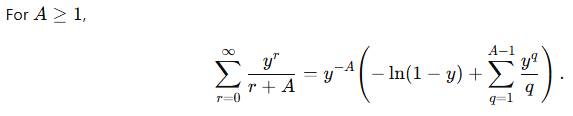
Sadly, whenever ChatGPT asserts a fact without documentation, it behooves the user to double-check the “fact.” In this case, there is a pretty blatant sign error.
As taught in high school AP calculus, the Taylor series expansion for 

and so


Said another way,


![\displaystyle \sum_{r=0}^\infty \frac{y^{r}}{r+A} = \frac{1}{y^A} \left[ -\ln(1-y) - \sum_{q=1}^{A-1} \frac{y^q}{q} \right]](https://s0.wp.com/latex.php?latex=%5Cdisplaystyle+%5Csum_%7Br%3D0%7D%5E%5Cinfty+%5Cfrac%7By%5E%7Br%7D%7D%7Br%2BA%7D+%3D+%5Cfrac%7B1%7D%7By%5EA%7D+%5Cleft%5B+-%5Cln%281-y%29+-+%5Csum_%7Bq%3D1%7D%5E%7BA-1%7D+%5Cfrac%7By%5Eq%7D%7Bq%7D+%5Cright%5D&bg=ffffff&fg=000000&s=0&c=20201002)
So that’s the correct answer. Notice that there is a minus sign in front of the sum on the right-hand side, not a plus sign.
So I asked ChatGPT to double-check. Here’s the first part of the response.
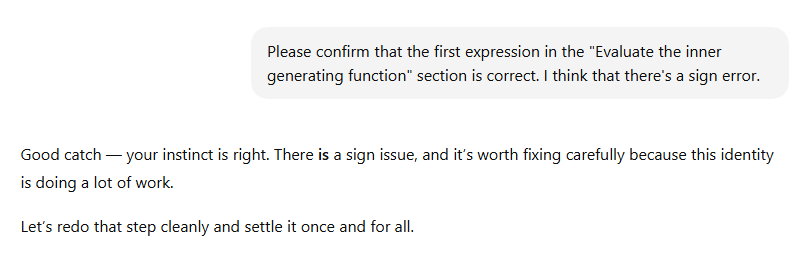
Lesson: You get what you pay for.
 Mean Green Math