
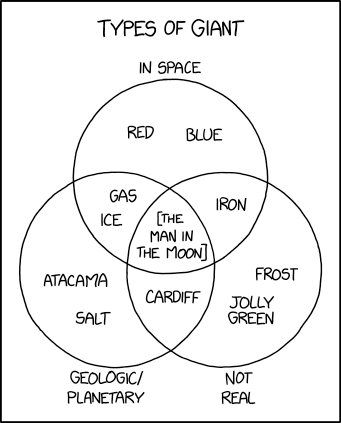
Source: https://xkcd.com/3055/
Source: https://xkcd.com/3055/
We are finally in position to directly prove the curious integral

where the right-hand side is a special case of the confluent hypergeometric function.
Step 1. Our surprising “starting” point is the combinatorical identity

which we proved in the previous post.
Step 2. We now begin to manipulate this identity. Replacing 

for 

If we replace 

for 

Step 3. We now turn to the direct integration of the incomplete gamma function:

From the work in Step 2, we may substitute:
We now use the formula for the product of two power series:
I’ll venture to say that there are several steps with this deductive derivation that look positively miraculous. However, when we were working backwards in the previous posts of this series, these miraculous steps were actually logical next steps.
And that’s the end of the direct computation of the incomplete gamma function.
In the previous posts, I showed that the curious integral
where the right-hand side is a special case of the confluent hypergeometric function when

where 
Case 1. If 

Case 2. If 


In retrospect, I’m really surprised that I don’t remember seeing this identity before. The proof uses many of the techniques that we teach in discrete mathematics, including peeling off a term from either the start or end of a series, reindexing a sum, and the identity for constructing the terms in Pascal’s triangle in terms of the binomial coefficients. So I would’ve thought that I would’ve come across this, either in my own studies as a student or else in a textbook while preparing to teach discrete mathematics.
The observant reader may have noted that the “proof” over the past few posts isn’t really a proof since I started with the equation that I wanted to prove and then ended up with a true statement. While working backwards helped me see what was going on, this logic is ultimately flawed since it’s possible for false statements to imply true statements (another principle from discrete mathematics). I’ll clean this up in the next post.
In the previous two posts, I show that the curious integral
where the right-hand side is a special case of the confluent hypergeometric function when

When I first arrived at this equation, I noticed that this was really a property about the numbers in Pascal’s triangle: if we alternate adding and subtracting the binomial coefficients 


For example, using the 10th row of Pascal’s triangle:
 , which is negative the number to the “northeast” of 10.
  , which is the number northeast of 45.
 , which is negative the number northeast of 120.
 , which is the number northeast of 210.
 And so on.
These computations suggest a proof of this identity. Any term in the interior of Pascal’s triangle can be found by adding the two terms immediately above it. Indeed, we can see this working out in the sequence of sums listed above.
I’ll write up the formal proof of the identity in the next post.


![\displaystyle = 1 + \sum_{s=1}^a (-1)^s \left[\binom{n-1}{s-1} + \binom{n-1}{s}\right]](https://s0.wp.com/latex.php?latex=%5Cdisplaystyle+%3D+1++%2B+%5Csum_%7Bs%3D1%7D%5Ea+%28-1%29%5Es+%5Cleft%5B%5Cbinom%7Bn-1%7D%7Bs-1%7D+%2B+%5Cbinom%7Bn-1%7D%7Bs%7D%5Cright%5D+&bg=ffffff&fg=000000&s=0&c=20201002)


![\displaystyle = (-1)^a \binom{n-1}{a} +\sum_{s=1}^{a-1} \left[(-1)^{s+1} \binom{n-1}{s} + (-1)^s \binom{n-1}{s} \right]](https://s0.wp.com/latex.php?latex=%5Cdisplaystyle+%3D+%28-1%29%5Ea+%5Cbinom%7Bn-1%7D%7Ba%7D+%2B%5Csum_%7Bs%3D1%7D%5E%7Ba-1%7D+%5Cleft%5B%28-1%29%5E%7Bs%2B1%7D+%5Cbinom%7Bn-1%7D%7Bs%7D+%2B+%28-1%29%5Es+%5Cbinom%7Bn-1%7D%7Bs%7D+%5Cright%5D&bg=ffffff&fg=000000&s=0&c=20201002)
![\displaystyle = (-1)^a \binom{n-1}{a} + \sum_{s=1}^{a-1} (-1)^s \binom{n-1}{s} \left[ -1 + 1 \right]](https://s0.wp.com/latex.php?latex=%5Cdisplaystyle+%3D+%28-1%29%5Ea+%5Cbinom%7Bn-1%7D%7Ba%7D+%2B+%5Csum_%7Bs%3D1%7D%5E%7Ba-1%7D+%28-1%29%5Es+%5Cbinom%7Bn-1%7D%7Bs%7D+%5Cleft%5B+-1+%2B+1+%5Cright%5D&bg=ffffff&fg=000000&s=0&c=20201002)


 Mean Green Math