
The following problem appeared in Volume 131, Issue 9 (2024) of The American Mathematical Monthly.
Let
and
be independent normally distributed random variables, each with its own mean and variance. Show that the variance of
is smaller than the variance of
In previous posts, we reduced the problem to showing that if 


is the cumulative distribution function of the standard normal distribution. If we can prove this, then the original problem will be true.
When I was solving this problem for the first time, my progress through the first few steps was hindered by algebra mistakes and the like, but I didn’t doubt that I was progressing toward the answer. At this point in the solution, however, I was genuinely stuck: nothing immediately popped to mind for showing that 

So I turned to Mathematica, just to make sure I was on the right track. Based on the graph, the function of 
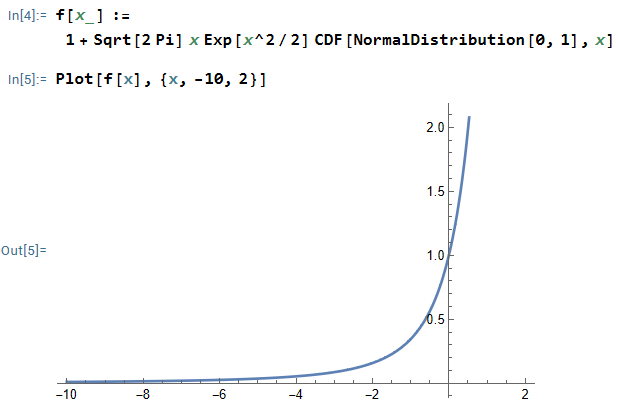
What’s more, the graph suggests attempting to prove a couple of things: 


I started by trying to show

I vaguely remembered something about the asymptotic expansion of the above integral from a course decades ago, and so I consulted that course’s textbook, by Bender and Orszag, to refresh my memory. To derive the behavior of 


![= \displaystyle x e^{x^2/2} \left[ -\frac{1}{t} e^{-t^2/2} \right]_{-\infty}^x - x e^{x^2/2} \int_{-\infty}^x \frac{d}{dt} \left(\frac{1}{t} \right) \left( -e^{-t^2/2} \right) \, dt](https://s0.wp.com/latex.php?latex=%3D+%5Cdisplaystyle++x+e%5E%7Bx%5E2%2F2%7D+%5Cleft%5B+-%5Cfrac%7B1%7D%7Bt%7D+e%5E%7B-t%5E2%2F2%7D+%5Cright%5D_%7B-%5Cinfty%7D%5Ex+-+x+e%5E%7Bx%5E2%2F2%7D+%5Cint_%7B-%5Cinfty%7D%5Ex+%5Cfrac%7Bd%7D%7Bdt%7D+%5Cleft%28%5Cfrac%7B1%7D%7Bt%7D+%5Cright%29+%5Cleft%28+-e%5E%7B-t%5E2%2F2%7D+%5Cright%29+%5C%2C+dt&bg=ffffff&fg=000000&s=0&c=20201002)
![= \displaystyle x e^{x^2/2} \left[ -\frac{1}{x} e^{-x^2/2} - 0 \right] + |x| e^{x^2/2} \int_{-\infty}^x \frac{1}{t^2} e^{-t^2/2} \, dt](https://s0.wp.com/latex.php?latex=%3D+%5Cdisplaystyle++x+e%5E%7Bx%5E2%2F2%7D+%5Cleft%5B+-%5Cfrac%7B1%7D%7Bx%7D+e%5E%7B-x%5E2%2F2%7D+-+0+%5Cright%5D+%2B+%7Cx%7C+e%5E%7Bx%5E2%2F2%7D+%5Cint_%7B-%5Cinfty%7D%5Ex+%5Cfrac%7B1%7D%7Bt%5E2%7D+e%5E%7B-t%5E2%2F2%7D+%5C%2C+dt&bg=ffffff&fg=000000&s=0&c=20201002)


This is agonizingly close: the leading term is
So, once again, I consulted Bender and Orszag, which outlined how to show this. We note that

Therefore,

so that

Therefore,

or
So (I thought) I was halfway home with the solution, and all that remained was to show that
And I was completely stuck at this point for a long time.
Until I realized — much to my utter embarrassment — that showing
 Mean Green Math
One thought on “Solving Problems Submitted to MAA Journals (Part 7h)”