
The following problem appeared in Volume 96, Issue 3 (2023) of Mathematics Magazine.
Let
be arbitrary events in a probability field. Denote by
the event that at least
of
occur. Prove that
.
I’ll admit when I first read this problem, I didn’t believe it. I had to draw a couple of Venn diagrams to convince myself that it actually worked:
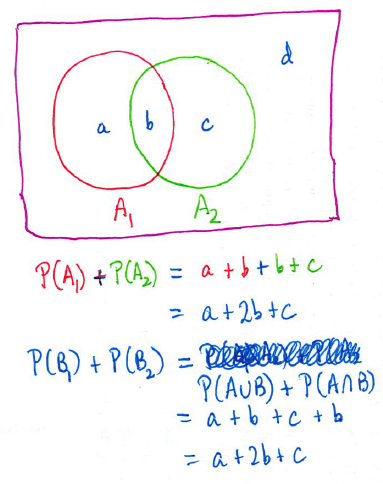
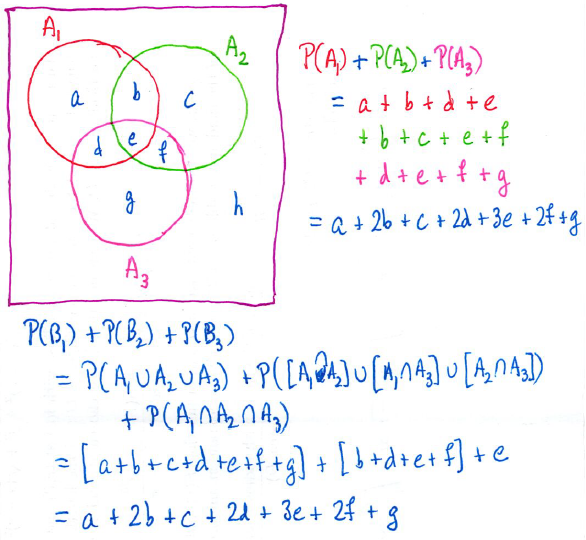
Of course, pictures are not proofs, so I started giving the problem more thought.
I wish I could say where I got the inspiration from, but I got the idea to define a new random variable 


At this point, my Spidey Sense went off: that’s the tail-sum formula for expectation! Since

Said another way, 
Therefore, to solve the problem, it remains to show that 


Then 
![E(N) = \displaystyle \sum_{k=1}^n E(I_k) =\sum_{k=1}^n [1 \cdot P(A_k) + 0 \cdot P(A_k^c)] =\sum_{k=1}^n P(A_k)](https://s0.wp.com/latex.php?latex=E%28N%29+%3D+%5Cdisplaystyle+%5Csum_%7Bk%3D1%7D%5En+E%28I_k%29+%3D%5Csum_%7Bk%3D1%7D%5En+%5B1+%5Ccdot+P%28A_k%29+%2B+0+%5Ccdot+P%28A_k%5Ec%29%5D+%3D%5Csum_%7Bk%3D1%7D%5En+P%28A_k%29&bg=ffffff&fg=000000&s=0&c=20201002)
Equating the two expressions for 
 Mean Green Math
One thought on “Solving Problems Submitted to MAA Journals (Part 4)”