Confirming Einstein’s Theory of General Relativity With Calculus, Part 7b: Predicting Precession II

In this series, I’m discussing how ideas from calculus and precalculus (with a touch of differential equations) can predict the precession in Mercury’s orbit and thus confirm Einstein’s theory of general relativity. The origins of this series came from a class project that I assigned to my Differential Equations students maybe 20 years ago.

We have shown that the motion of a planet around the Sun, expressed in polar coordinates (r,\theta) with the Sun at the origin, under general relativity is

u(\theta) \approx  \displaystyle \frac{1 + \epsilon \cos \theta}{\alpha} + \frac{ \delta\epsilon}{\alpha^2} \theta \sin \theta,

where u = \displaystyle \frac{1}{r}, \displaystyle \frac{1}{\alpha} = \frac{GMm^2}{\ell^2}, \delta = \displaystyle \frac{3GM}{c^2}, G is the gravitational constant of the universe, m is the mass of the planet, M is the mass of the Sun, \ell is the constant angular momentum of the planet, and c is the speed of light.

We will now simplify this expression, using the facts that \delta is very small and \alpha is quite large, so that \delta/\alpha is very small indeed. We will use the two approximations

\cos x \approx 1 \qquad \hbox{and} \qquad \sin x \approx x \qquad \hbox{if} \qquad x \approx 0;

these approximations can be obtained by linearization or else using the first term of the Taylor series expansions of \cos x and \sin x about x = 0.

We will also need the trig identity

\cos(\theta_1 - \theta_2) = \cos \theta_1 \cos \theta_2 + \sin \theta_1 \sin \theta_2.

With these tools, we can now simplify u(\theta):

u(\theta) \approx  \displaystyle \frac{1 + \epsilon \cos \theta}{\alpha} + \frac{ \delta\epsilon}{\alpha^2} \theta \sin \theta

=  \displaystyle \frac{1}{\alpha} \left[1 + \epsilon \cos \theta + \frac{ \delta\epsilon}{\alpha} \theta \sin \theta \right]

=  \displaystyle \frac{1}{\alpha} \left[1 + \epsilon \left(\cos \theta + \frac{ \delta}{\alpha} \theta \sin \theta \right) \right]

=  \displaystyle \frac{1}{\alpha} \left[1 + \epsilon \left(\cos \theta \cdot 1 + \sin \theta \cdot \frac{ \delta \theta}{\alpha}  \right) \right]

\approx  \displaystyle \frac{1}{\alpha} \left[1 + \epsilon \left(\cos \theta \cdot \cos \frac{\delta \theta}{\alpha} + \sin \theta \cdot \sin \frac{ \delta \theta}{\alpha}  \right) \right]

\approx  \displaystyle \frac{1}{\alpha} \left[1 + \epsilon \cos \left( \theta - \frac{\delta \theta}{\alpha}  \right) \right].

Confirming Einstein’s Theory of General Relativity With Calculus, Part 7a: Predicting Precession I

In this series, I’m discussing how ideas from calculus and precalculus (with a touch of differential equations) can predict the precession in Mercury’s orbit and thus confirm Einstein’s theory of general relativity. The origins of this series came from a class project that I assigned to my Differential Equations students maybe 20 years ago.

We have shown that the motion of a planet around the Sun, expressed in polar coordinates (r,\theta) with the Sun at the origin, under general relativity is

u(\theta) =  \displaystyle \frac{1 + \epsilon \cos \theta}{\alpha} + \frac{\delta}{\alpha^2} + \frac{\delta \epsilon^2}{2\alpha^2} + \frac{ \delta\epsilon}{\alpha^2} \theta \sin \theta - \frac{ \delta \epsilon^2}{6\alpha^2} \cos 2\theta - \frac{\delta(3+\epsilon^2)}{3\alpha^2} \cos \theta,

where u = \displaystyle \frac{1}{r}, \displaystyle \frac{1}{\alpha} = \frac{GMm^2}{\ell^2}, \delta = \displaystyle \frac{3GM}{c^2}, G is the gravitational constant of the universe, m is the mass of the planet, M is the mass of the Sun, \ell is the constant angular momentum of the planet, and c is the speed of light.

We notice that the first term of the above solution,

\displaystyle \frac{1 + \epsilon \cos \theta}{\alpha} ,

is the same as the solution found earlier under Newtonian physics, without general relativity. Therefore, the remaining terms describe the perturbation due to general relativity. All of these terms contain the small factor \delta, and so these can be expected to be small adjustments to an elliptical orbit.

Of these terms, the terms

\displaystyle \frac{\delta}{\alpha^2} + \frac{\delta \epsilon^2}{2\alpha^2}

are constants, while the terms

- \displaystyle \frac{ \delta \epsilon^2}{6\alpha^2} \cos 2\theta -  \frac{\delta(3+\epsilon^2)}{3\alpha^2} \cos \theta

is bounded since -1 \le \cos \theta \le 1 and -1 \le \cos 2\theta \le 1. By contrast, the term

\displaystyle \frac{ \delta\epsilon}{\alpha^2} \theta \sin \theta

grows without bound. Therefore, for large values of \theta, the planet’s orbit may be accurately described by only including this last perturbation:

u(\theta) =  \displaystyle \frac{1 + \epsilon \cos \theta}{\alpha} + \frac{ \delta\epsilon}{\alpha^2} \theta \sin \theta.

In the next post, we simplify this even further.

Confirming Einstein’s Theory of General Relativity With Calculus, Part 6k: Solving New Differential Equation with Method of Undetermined Coefficients

In this series, I’m discussing how ideas from calculus and precalculus (with a touch of differential equations) can predict the precession in Mercury’s orbit and thus confirm Einstein’s theory of general relativity. The origins of this series came from a class project that I assigned to my Differential Equations students maybe 20 years ago.

We have shown that the motion of a planet around the Sun, expressed in polar coordinates (r,\theta) with the Sun at the origin, under general relativity follows the initial-value problem

u''(\theta) + u(\theta) = \displaystyle \frac{1}{\alpha} + \frac{\delta}{\alpha^2} + \frac{\delta \epsilon^2}{2\alpha^2} + \frac{2\delta \epsilon \cos \theta}{\alpha^2} + \frac{\delta \epsilon^2 \cos 2\theta}{2\alpha^2},

u(0) = \displaystyle \frac{1}{P},

u'(0) = 0,

where u = \displaystyle \frac{1}{r}, \displaystyle \frac{1}{\alpha} = \frac{GMm^2}{\ell^2}, \delta = \displaystyle \frac{3GM}{c^2}, G is the gravitational constant of the universe, m is the mass of the planet, M is the mass of the Sun, \ell is the constant angular momentum of the planet, c is the speed of light, and P is the smallest distance of the planet from the Sun during its orbit (i.e., at perihelion).

In recent posts, we used the method of undetermined coefficients to show that the general solution of the differential equation is

u(\theta) = c_1 \cos \theta + c_2 \sin \theta + \displaystyle \frac{1}{\alpha} + \frac{\delta}{\alpha^2} + \frac{\delta \epsilon^2}{2\alpha^2} +\frac{\delta \epsilon}{\alpha^2} \theta \sin \theta- \frac{\delta \epsilon^2}{6\alpha^2} \cos 2\theta.

We now use the initial conditions to find the constants c_1 and c_2. (We did this earlier when we solved the differential equation via variation of parameters, but we repeat the argument here for completeness.) From the initial condition u(0) = \displaystyle \frac{1}{P} = \frac{1+\epsilon}{\alpha}, we obtain
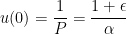
u(0) = \displaystyle c_1 \cos 0 + c_2 \sin 0 + \displaystyle \frac{1}{\alpha} +  \frac{\delta}{\alpha^2} + \frac{\delta \epsilon^2}{2\alpha^2} + \frac{\delta \epsilon \cdot 0 \cdot \sin 0}{\alpha^2} -\frac{\delta \epsilon^2 \cos 0}{6\alpha^2}

\displaystyle \frac{1+\epsilon}{\alpha} = c_1 + \displaystyle \frac{1}{\alpha} +  \frac{\delta}{\alpha^2} + \frac{\delta \epsilon^2}{2\alpha^2}  -\frac{\delta \epsilon^2}{6\alpha^2}

\displaystyle \frac{\epsilon}{\alpha} = c_1 + \displaystyle \frac{3\delta +\delta \epsilon^2}{3\alpha^2},

so that

c_1 = \displaystyle \frac{\epsilon}{\alpha} - \frac{\delta(3 + \epsilon^2)}{3\alpha^2}.

Next, we compute u'(\theta) and use the initial condition u'(0) = 0:

u'(\theta) = \displaystyle -c_1 \sin \theta + c_2 \cos \theta + \frac{\delta \epsilon}{\alpha^2} (\sin \theta + \theta \cos \theta) + \frac{\delta \epsilon^2 \sin 2\theta}{3\alpha^2}

u'(0) = \displaystyle -c_1 \sin 0 + c_2 \cos 0 + \frac{\delta \epsilon}{\alpha^2} (\sin 0 + 0  \cos 0) + \frac{\delta \epsilon^2 \sin 0}{3\alpha^2}

0 = c_2.

Substituting these values for c_1 and c_2, we finally arrive at the solution

u(\theta) = \displaystyle \left(\frac{\epsilon}{\alpha} - \frac{\delta(3 + \epsilon^2)}{3\alpha^2} \right) \cos \theta + \displaystyle \frac{1}{\alpha} +  \frac{\delta}{\alpha^2} + \frac{\delta \epsilon^2}{2\alpha^2} + \frac{\delta \epsilon \theta \sin \theta}{\alpha^2} -\frac{\delta \epsilon^2 \cos 2\theta}{6\alpha^2}

= \displaystyle \frac{1 + \epsilon \cos \theta}{\alpha} + \frac{\delta}{\alpha^2} + \frac{\delta \epsilon^2}{2\alpha^2} + \frac{ \delta\epsilon}{\alpha^2} \theta \sin \theta - \frac{ \delta \epsilon^2}{6\alpha^2} \cos 2\theta - \frac{\delta(3+\epsilon^2)}{3\alpha^2} \cos \theta.