Confirming Einstein’s Theory of General Relativity With Calculus, Part 5a: Confirming Orbits under Newtonian Mechanics with Calculus

In this series, I’m discussing how ideas from calculus and precalculus (with a touch of differential equations) can predict the precession in Mercury’s orbit and thus confirm Einstein’s theory of general relativity. The origins of this series came from a class project that I assigned to my Differential Equations students maybe 20 years ago.

We previously showed that if the motion of a planet around the Sun is expressed in polar coordinates (r,\theta), with the Sun at the origin, then under Newtonian mechanics (i.e., without general relativity) the motion of the planet follows the differential equation

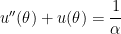
u''(\theta) + u(\theta) = \displaystyle \frac{1}{\alpha},

where u = 1/r and \alpha is a certain constant. We will also impose the initial condition that the planet is at perihelion (i.e., is closest to the sun), at a distance of P, when \theta = 0. This means that u obtains its maximum value of 1/P when \theta = 0. This leads to the two initial conditions

u(0) = \displaystyle \frac{1}{P} \qquad \hbox{and} \qquad u'(0) = 0;

the second equation arises since u has a local extremum at \theta = 0.

In the next few posts, we’ll discuss the solution of this initial-value problem. Today’s post would be appropriate for calculus students, which is confirming that

u(\theta) = \displaystyle \frac{1 + \epsilon \cos \theta}{\alpha}

solves this initial-value problem, where \epsilon = \displaystyle \frac{\alpha-P}{P}. Since r is the reciprocal of u, we infer that

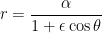
r = \displaystyle \frac{\alpha}{1 + \epsilon \cos \theta}.

As we’ve already seen in this series, this means that the orbit of the planet is a conic section — either a circle, ellipse, parabola, or hyperbola. Since the orbit of a planet is stable and \epsilon = 0 is extremely unlikely, this means that the planet orbits the Sun in an ellipse, with the Sun at one focus of the ellipse.

So, for a calculus student to verify that planets move in ellipses, one must check that

u(\theta) = \displaystyle \frac{1 + \epsilon \cos \theta}{\alpha}

is a solution of the initial-value problem

u''(\theta) + u(\theta) = \displaystyle \frac{1}{\alpha},

u(0) = \displaystyle \frac{1}{P},

u'(0) = 0.

The second line is easy to check:

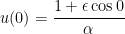
u(0) = \displaystyle \frac{1 + \epsilon \cos 0}{\alpha}

= \displaystyle \frac{1 + \epsilon}{\alpha}

= \displaystyle \frac{1 + \displaystyle \frac{\alpha-P}{P}}{\alpha}

= \displaystyle \frac{1}{\alpha} \frac{P + \alpha - P}{P}

= \displaystyle \frac{1}{\alpha} \frac{\alpha}{P}

= \displaystyle \frac{1}{P}.

The third line is also easy to check:
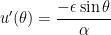
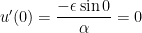
u'(\theta) = \displaystyle \frac{-\epsilon \sin \theta}{\alpha}

u'(0) = \displaystyle \frac{-\epsilon \sin 0}{\alpha} = 0.

To check the first line, we first find u''(\theta):

u''(\theta) = \displaystyle \frac{-\epsilon \cos \theta}{\alpha},

so that

u''(\theta) + u(\theta) = \displaystyle \frac{-\epsilon \cos \theta}{\alpha} + \frac{1 + \epsilon \cos \theta}{\alpha} = \frac{1}{\alpha},

thus confirming that u(\theta) = \displaystyle \frac{1 + \epsilon \cos \theta}{\alpha} solves the initial-value problem.

While the above calculations are well within the grasp of a good Calculus I student, I’ll be the first to admit that this solution is less than satisfying. We just mysteriously proposed a solution, seemingly out of thin air, and confirmed that it worked. In the next post, I’ll proposed a way that calculus students can be led to guess this solution. Then, we talk about finding the solution of this nonhomogeneous initial-value problem using standard techniques from differential equations.

One thought on “Confirming Einstein’s Theory of General Relativity With Calculus, Part 5a: Confirming Orbits under Newtonian Mechanics with Calculus

Leave a comment

This site uses Akismet to reduce spam. Learn how your comment data is processed.