In this series, I’m discussing how ideas from calculus and precalculus (with a touch of differential equations) can predict the precession in Mercury’s orbit and thus confirm Einstein’s theory of general relativity. The origins of this series came from a class project that I assigned to my Differential Equations students maybe 20 years ago.
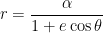
In the previous post, we showed that the polar equation
converts to
in rectangular coordinates. Furthermore, if , then this represents an ellipse with eccentricity whose semi-major axis lies along the axis with one focus at the origin.
It turns out that, for different non-negative values of , the same polar equation represents different conic sections. These are not particularly relevant for our study of precession, but I’m including this anyway in this series as a small tangential discussion.
Let’s take a look at the easy case of . With this substitution, the equation in rectangular coordinates simplifies to
.
Of course, this is the equation of a circle that is centered at the origin with radius .
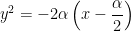
The other easy case is , so that . Then the equation in rectangular coordinates simplifies to
This matches the form of a parabola that opens to the left with a horizontal axis of symmetry:
.
In this case, the vertex of the parabola is located at
,
while the focus of the parabola is located a distance to the left of the vertex. In other words, the origin is the focus of the parabola. (For what it’s worth, the directrix of the parabola would be the vertical line , located to the right of the vertex.)
I'm a Professor of Mathematics and a University Distinguished Teaching Professor at the University of North Texas. For eight years, I was co-director of Teach North Texas, UNT's program for preparing secondary teachers of mathematics and science.
View all posts by John Quintanilla
Published
One thought on “Confirming Einstein’s Theory of General Relativity With Calculus, Part 2c: Circles, Parabolas, and Polar Coordinates”








 Mean Green Math
One thought on “Confirming Einstein’s Theory of General Relativity With Calculus, Part 2c: Circles, Parabolas, and Polar Coordinates”