Confirming Einstein’s Theory of General Relativity With Calculus, Part 2b: Ellipses and Polar Coordinates

In this series, I’m discussing how ideas from calculus and precalculus (with a touch of differential equations) can predict the precession in Mercury’s orbit and thus confirm Einstein’s theory of general relativity. The origins of this series came from a class project that I assigned to my Differential Equations students maybe 20 years ago.

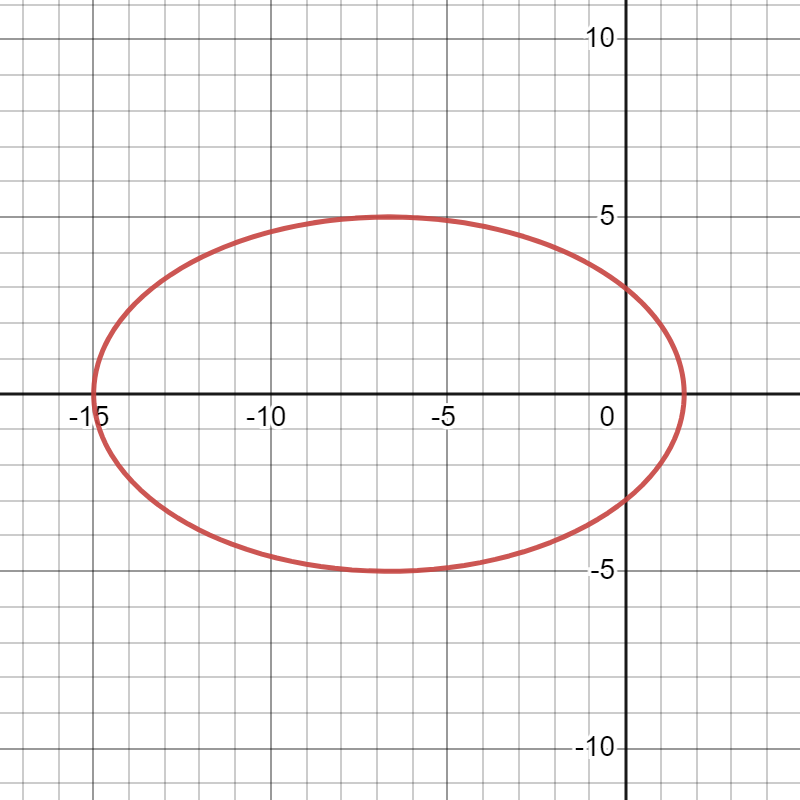
As part of our derivation, we’ll need to use the fact that, in polar coordinates, the graph of
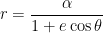
r = \displaystyle \frac{\alpha}{1 + e \cos \theta}

turns out to be an ellipse if 0 < e < 1, with the origin at one focus.

We now prove this. Clearing the denominator, we obtain

r + re \cos \theta = \alpha.

Switching to rectangular coordinates, this becomes

\sqrt{x^2 + y^2} + e x = \alpha

\sqrt{x^2 + y^2} = \alpha - ex

x^2 + y^2 = (\alpha - ex)^2

x^2 + y^2 = \alpha^2 - 2\alpha ex + e^2 x^2

x^2 (1-e^2) + 2 \alpha e x + y^2 = \alpha^2

(1-e^2)\left(x^2 + 2 \displaystyle \frac{\alpha e}{1-e^2} x \right) + y^2 = \alpha^2

(1-e^2)\left(x^2 + 2 \displaystyle \frac{\alpha e}{1-e^2} x + \frac{\alpha^2 e^2}{(1-e^2)^2} \right) + y^2 = \alpha^2 + \displaystyle \frac{\alpha^2e^2}{1-e^2}

(1-e^2) \left(x + \displaystyle \frac{\alpha e}{1-e^2} \right)^2 + y^2 = \displaystyle \frac{\alpha^2(1-e^2)+\alpha^2 e^2}{1-e^2}

(1-e^2) \left(x + \displaystyle \frac{\alpha e}{1-e^2} \right)^2 + y^2 = \displaystyle \frac{\alpha^2}{1-e^2}

\displaystyle \frac{(1-e^2)^2}{\alpha^2} \left(x + \displaystyle \frac{\alpha e}{1-e^2} \right)^2 + \frac{1-e^2}{\alpha^2} y^2 = 1

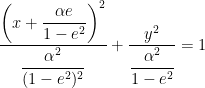
\displaystyle \frac{\left(x + \displaystyle \frac{\alpha e}{1-e^2} \right)^2}{\displaystyle \frac{\alpha^2}{(1-e^2)^2}} + \frac{y^2}{\displaystyle \frac{\alpha^2}{1-e^2}} = 1

Since we assumed that 0 < e < 1, we have 0 < 1 - e^2 < 1 so that

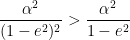
\displaystyle \frac{\alpha^2}{(1-e^2)^2} > \displaystyle \frac{\alpha^2}{1-e^2}.

Therefore, this matches the usual form of an ellipse in rectangular coordinates
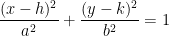
\displaystyle \frac{(x-h)^2}{a^2} + \frac{(y-k)^2}{b^2} = 1,

where the center of the ellipse is located at
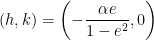
(h,k) = \displaystyle \left( -\displaystyle \frac{\alpha e}{1-e^2}, 0 \right),

the semi-major axis is horizontal with length

a = \displaystyle \frac{\alpha}{1-e^2},

and the semi-minor axis is vertical with length

b = \displaystyle \frac{\alpha}{\sqrt{1-e^2}}.

Furthermore, the distance c of the foci from the center of the ellipse satisfies the equation

b^2 + c^2 = a^2,

so that

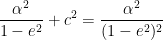
\displaystyle \frac{\alpha^2}{1-e^2} + c^2 = \displaystyle \frac{\alpha^2}{(1-e^2)^2}

c^2 = \displaystyle \frac{\alpha^2}{(1-e^2)^2} - \displaystyle \frac{\alpha^2}{1-e^2}

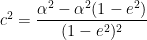
c^2 = \displaystyle \frac{\alpha^2 - \alpha^2(1-e^2)}{(1-e^2)^2}

c^2 = \displaystyle \frac{\alpha^2 e^2}{(1-e^2)^2}

c = \displaystyle \frac{\alpha e}{1-e^2}

From this, we derive two nice properties of the ellipse. First, looking back on previous work, we see that c = -h. Therefore, since the foci of the ellipse are distance c away from the center along the major axis, we conclude that one focus of the ellipse is located at (-h+c,0), or (0,0). That is, the origin is one focus of the ellipse. (For the little it’s worth, the other focus is located at (-2h,0).

Second, the eccentricity of the ellipse is defined to be the ratio c/a. This is now easily computed:

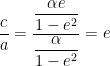
\displaystyle \frac{c}{a} = \displaystyle \frac{\displaystyle \frac{\alpha e}{1-e^2}}{\displaystyle \frac{\alpha}{1-e^2}} = e.

In other words, the letter e was well-chosen to represent the eccentricity of the ellipse.

For what it’s worth, here’s an alternate derivation of the formulas for a and b. For this ellipse, the planet’s closest approach to the Sun occurs at \theta = 0:

r(0) = \displaystyle \frac{\alpha}{1 + e \cos 0} = \frac{\alpha}{1 + e},

and the planet’s further distance from the Sun occurs at \theta = \pi:

r(\pi) = \displaystyle \frac{\alpha}{1 + e \cos \pi} = \frac{\alpha}{1 - e}.

Therefore, the length 2a of the major axis of the ellipse is the sum of these two distances:

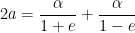
2a =  \displaystyle \frac{\alpha}{1 + e} +  \frac{\alpha}{1 - e}

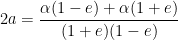
2a = \displaystyle \frac{\alpha(1-e) + \alpha(1+e)}{(1 + e)(1 -e)}

2a= \displaystyle \frac{2\alpha}{1  - e^2}

a =  \displaystyle \frac{\alpha}{1  - e^2}.

Since c = a\epsilon, we can also compute b:

b^2 = a^2 - c^2

b^2 = a^2 - a^2 e^2

b^2 = a^2 ( 1-e^2)

b^2 = \displaystyle \frac{\alpha^2}{(1  - e^2)^2} (1-e^2)

b^2 = \displaystyle \frac{\alpha^2}{1  - e^2}

b =  \displaystyle \frac{\alpha}{\sqrt{1  - e^2}}

One thought on “Confirming Einstein’s Theory of General Relativity With Calculus, Part 2b: Ellipses and Polar Coordinates

Leave a comment

This site uses Akismet to reduce spam. Learn how your comment data is processed.