
I normally hate these math-is-hard jokes, but this one made me laugh. Forgiving somebody is harder than computing 
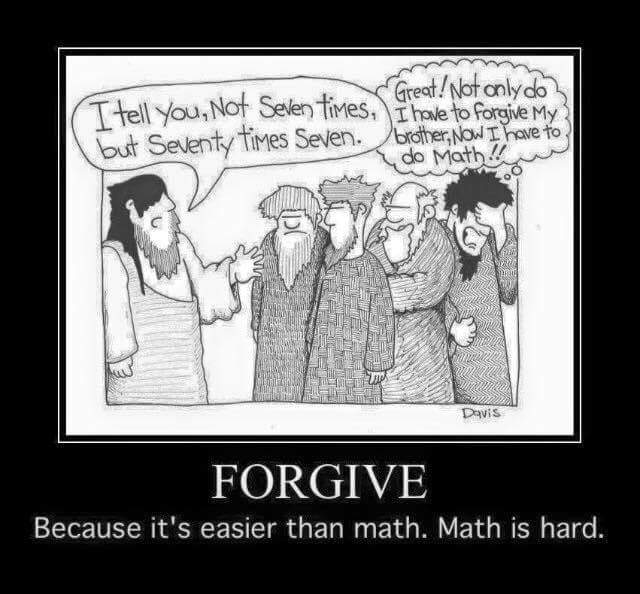
I don’t know who created this cartoon; I’ll be happy to credit it if anybody knows.
I normally hate these math-is-hard jokes, but this one made me laugh. Forgiving somebody is harder than computing
I don’t know who created this cartoon; I’ll be happy to credit it if anybody knows.
From the YouTube description:
Mathematics is everywhere, and the golf course is no exception. Many aspects of the game of golf can be illuminated or improved through mathematical modeling and analysis. We will discuss a few examples, employing mathematics ranging from simple high school algebra to computational techniques at the frontiers of contemporary research.
Last November, CBS Sports caused a tempest in a teapot with an article with the sensational headline “Patriots have no need for probability, win coin flip at impossible rate.” From the opening paragraphs:
Bill Belichick is never unprepared. Or at least that’s the perception. When other coaches struggle with when to use timeouts or how to manage the clock, the Patriots coach, almost effortlessly, always seems to make the right decision.
Belichick has also been extremely lucky. The Pats have won the coin toss 19 of the last 25 times, according to the Boston Globe‘s Jim McBride.
For some perspective: Assuming the coin toss is a 50/50 proposition, the probability of winning it at least 19 times in 25 tries is 0.0073. That’s less than three-quarters of one percent.
As far as the math goes, the calculation is correct. Using the binomial distribution,

Unfortunately, this is far too simplistic an analysis to accuse someone of “winning the coin flip at an impossible rate.” Rather than re-do the calculations myself, I’ll just quote from the following article from the Harvard Sports Analysis Collective. The article begins by noting that while the Patriots may have been lucky the last 25 games, it’s not surprising that some team in the NFL was lucky (and the lucky team just happened to be the Patriots).
But how impossible is it? Really, we are interested in not only the probability of getting 19 or more heads but also a result as extreme in the other direction – i.e. 6 or fewer. That probability is just 2*0.0073, or 0.0146.
That is still very low, however given that there 32 teams in the NFL, the probability of any one team doing this is much higher. To do an easy calculation we can assume that all tosses are independent, which isn’t entirely true as when one team wins the coin flip the other team loses. The proper way to do this would be via simulation, but assuming independence is much easier and should yield pretty similar results. The probability of any one team having a result that extreme, as shown before, is 0.0146. The probability of a team NOT having a result that extreme is 1-0.0146 = 0.9854. The probability that, with 32 teams, there is not one of them with a result this extreme is 0.985432 = 0.6245998. Therefore, with 32 teams, we would expect at least one team to have a result as extreme as the Patriots have had over the past 25 games 1- 0.6245998 = 0.3754002, or 37.5% of the time. That is hardly significant. Even if you restricted it to not all results as extreme in either direction but just results of 19 or greater, the probability of one or more teams achieving that is still nearly 20%.
The article goes on to note the obvious cherry-picking used in selecting the data… in other words, picking the 25 consecutive games that would make the Patriots look like they were somehow cheating on the coin flip.
In addition the selection of looking at only the last 25 games is surely a selection made on purpose to make Belichick look bad. Why not look throughout his career? Did he suddenly discover a talent for predicting the future? Furthermore, given the length of Belichick’s career, we would almost expect him to go through a period where he wins 19 of 25 coin flips by random chance alone. We actually simulate this probability. Given that he has coached 247 games with the Patriots, we can randomly generate a string of zeroes and ones corresponding to lost and won con flips respectively. We can then check the string for a sequence of 25 games where there was 19 or more heads. I did this 10,000 times – in 38.71% of these simulations there was at least one sequence with 19 or more heads out of 25.
The author makes the following pithy conclusion:
To be fair, the author of this article did not seem to insinuate that the Patriots were cheating, rather he was just remarking that it was a rare event (although, in reality, it shouldn’t be as unexpected as he makes it out to be). The fault seems to rather lie with who made the headline and pubbed it, although their job is probably just to get pageviews in which case I guess they succeeded.
At any rate, the Patriots lost the coin flip in the 26th game.
One of the basic notions of functions that’s taught in Precalculus and in Discrete Mathematics is the notion of an inverse function: if 




If 
In other words, if the function 


If I have a few country music fans in the class, this always generates a bit of a laugh.
See also the amazing duet with Carrie Underwood and Steven Tyler at the 2011 ACM awards:
A friend of mine recently posted this trick for subtracting any number from any multiple of 
Pedagogically, I don’t think I’d recommend requiring every elementary school student to learn this trick. But this does make a nice enrichment activity for talented elementary school students, as it requires conceptual understanding of subtraction and not just the ability to follow a procedure.

Here’s another approach, taken from the comments of the above webpage: consider 5000 as 500 groups of 10 and 0 groups of 1, and then regroup.

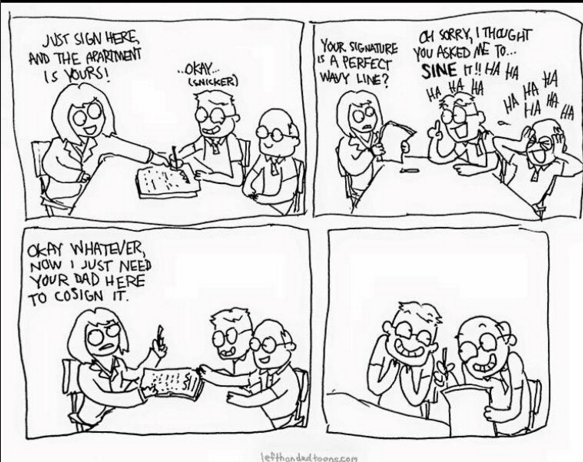
I received this one via e-mail; I’ll be happy to cite the source if anyone knows it. (Late edit: http://www.lefthandedtoons.com/1835/)
To give my students a little appreciation for their elders, I’ll demonstrate for them how to use a slide rule. Though I have my own slide rule which I can pass around the classroom, demonstrating how to use a slide rule is a little cumbersome since they don’t have their own slide rules to use.
I recently found an applet to make this demonstration a whole lot easier: https://code.google.com/p/java-slide-rule/
Textbooks have included the occasional awful problem ever since Pebbles Flintstone and Bamm-Bamm Rubble chiseled their homework on slate tablets while attending Bedrock Elementary. But even with the understanding that there have been children have been doing awful homework problems since the dawn of time (and long before the advent of the Common Core), this one is a doozy.

There’s no sense having a debate about standards for elementary mathematics if textbook publishers can’t write reasonable homework problems.
My reaction to this problem is pretty much echoed by the following post: http://www.patheos.com/blogs/friendlyatheist/2015/10/22/sometimes-estimating-is-better-than-getting-the-exact-answer/:
Suppose you’re buying groceries. You have four items in your cart that cost $1.99, $4.93, $6.03, and $5.14.
If all you have is $20 in your wallet, is that enough to pay for the items?
I think that’s a very realistic question.
It would take you at least a little bit of time to add up those numbers individually and get an exact number. Would it answer your question? Absolutely. But you don’t need an exact answer.
The smarter thing to do would be to simply round the numbers. We should be saying to ourselves, “2 + 5 + 6 + 5 equals 18… throw in some tax… and I should still be under $20.”
Why is that better? Because the exact amount doesn’t really make a difference. You just need to be close enough.
I have deep and profound theological differences with the author of this post. But on this math issue, he’s right on the money (pardon the pun).
Here in Texas, public universities are trying to figure out how they’re going to comply with a recently enacted state campus-carry law so that licensed handgun owners can bring their firearms to campus. A small sampling of local news articles and websites on this topic:
And in the midst of this debate, I found the opportunity for a mathematical wisecrack.

I’ve used this wisecrack in my probability class to great effect, as the joke pedagogically illustrates the important difference between 


For what it’s worth, here’s the version of the joke as I first saw it (in the book Absolute Zero Gravity):
Then there was the statistician who hated to fly because he had nightmares about terrorists with bombs. Yes, he knew that it was a million to one chance, but that wasn’t good enough. So he took a lot of trains until he realized what he had to do.
Now, whenever he flies, he packs a bomb in his own suitcase. Hey, do you know what the odds are against an airplane carrying two bombs?
Two final notes:
 Mean Green Math