I’ve accidentally stumbled on a very curious looking trigonometric identity:
if ,
if ,
if .
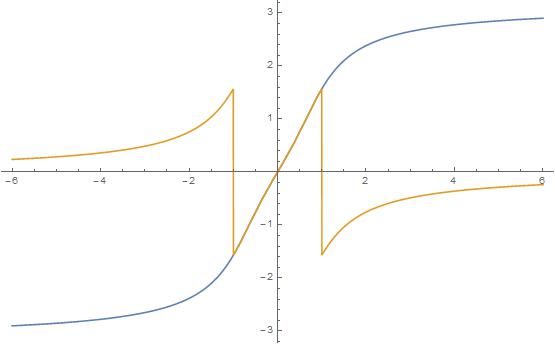
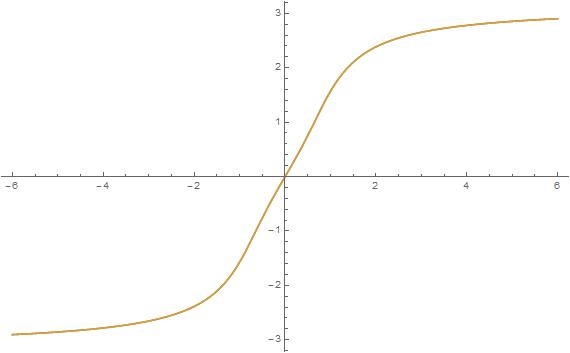
The extra and are important. Without them, the graphs of the left-hand side and right-hand sides are clearly different if or :
However, they match when those constants are included:
Let’s see if I can explain why this trigonometric identity occurs without resorting to the graphs.
Since assumes values between and , I know that
,
,
and so
.
However,
,
and so and must differ if is in the interval or in the interval .
I also notice that
,
,
and so
.
However, this difference can only be equal to a multiple of , and there are only three multiples of in the interval , namely , , and .
To determine the values of where this happens, I also note that , , and are increasing functions, and so must also be an increasing function. Therefore, to determine where lies in the interval ,it suffices to determine the unique value so that . Likewise, to determine where lies in the interval ,it suffices to determine the unique value so that .
In summary, I have shown so far that
if ,
if ,
if ,
where and are the unique values so that
,
.
So, to complete the proof of the trigonometric identity, I need to show that and . I will do this in tomorrow’s post.
I'm a Professor of Mathematics and a University Distinguished Teaching Professor at the University of North Texas. For eight years, I was co-director of Teach North Texas, UNT's program for preparing secondary teachers of mathematics and science.
View all posts by John Quintanilla
Published
One thought on “The antiderivative of 1/(x^4+1): Part 8”
















![[-\pi,-\pi/2]](https://s0.wp.com/latex.php?latex=%5B-%5Cpi%2C-%5Cpi%2F2%5D&bg=ffffff&fg=000000&s=0&c=20201002)
![[\pi/2,\pi]](https://s0.wp.com/latex.php?latex=%5B%5Cpi%2F2%2C%5Cpi%5D&bg=ffffff&fg=000000&s=0&c=20201002)






 Mean Green Math
One thought on “The antiderivative of 1/(x^4+1): Part 8”