This antiderivative has arguable the highest ratio of “really hard to compute” to “really easy to write”:
As we’ve seen in this series, the answer is
It turns out that this can be simplified somewhat as long as and . I’ll use the trig identity
When I apply this trig identity for and , I obtain
.
So we can conclude that
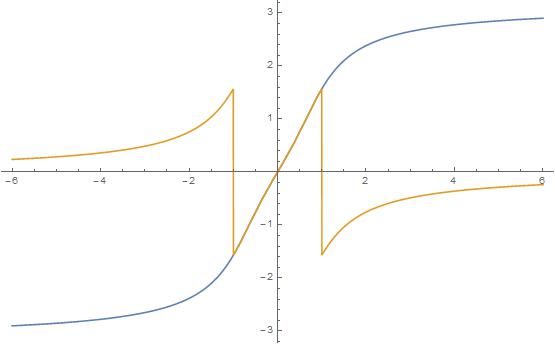
for some integer that depends on . The is important, as a cursory look reveals that and have different graphs. (The vertical lines in the orange graph indicate where the right-hand side is undefined when or .
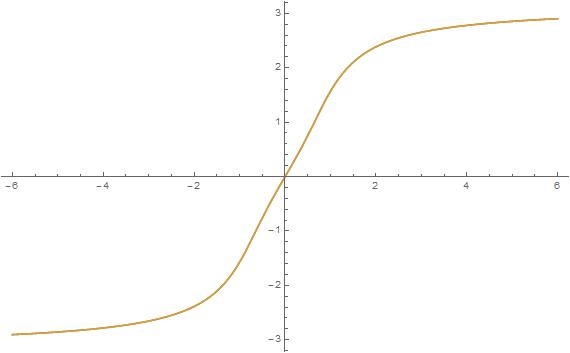
The two graphs coincide when but differ otherwise. However, it appears that the two graphs differ by a constant. Indeed, if I subtract from the orange graph if and add to the orange graph if , then they match:
So, evidently
if ,
if ,
if .
So as long as and , this constant , , or can be absorbed into the constant :
.
However, a picture may be persuasive but is not a proof, and there are some subtle issues with this simplification. I’ll discuss these further details in tomorrow’s post.
I'm a Professor of Mathematics and a University Distinguished Teaching Professor at the University of North Texas. For eight years, I was co-director of Teach North Texas, UNT's program for preparing secondary teachers of mathematics and science.
View all posts by John Quintanilla
Published
One thought on “The antiderivative of 1/(x^4+1): Part 7”





![\tan \left[ \tan^{-1} ( x\sqrt{2} - 1 ) + \tan^{-1}( x \sqrt{2} + 1) \right] = \displaystyle \frac{x \sqrt{2} - 1 + x \sqrt{2} + 1}{1 - (x\sqrt{2} - 1)(x\sqrt{2} + 1)}](https://s0.wp.com/latex.php?latex=%5Ctan+%5Cleft%5B+%5Ctan%5E%7B-1%7D+%28+x%5Csqrt%7B2%7D+-+1+%29+%2B+%5Ctan%5E%7B-1%7D%28+x+%5Csqrt%7B2%7D+%2B+1%29+%5Cright%5D+%3D+%5Cdisplaystyle+%5Cfrac%7Bx+%5Csqrt%7B2%7D+-+1+%2B+x+%5Csqrt%7B2%7D+%2B+1%7D%7B1+-+%28x%5Csqrt%7B2%7D+-+1%29%28x%5Csqrt%7B2%7D+%2B+1%29%7D&bg=ffffff&fg=000000&s=0&c=20201002)












 Mean Green Math
One thought on “The antiderivative of 1/(x^4+1): Part 7”