Different ways of solving a contest problem (Part 3)

The following problem appeared on the American High School Mathematics Examination (now called the AMC 12) in 1988:

If 3 \sin \theta = \cos \theta, what is \sin \theta \cos \theta?

When I presented this problem to a group of students, I was pleasantly surprised by the amount of creativity shown when solving this problem.

Yesterday, I presented a solution using a Pythagorean identity, but I was unable to be certain if the final answer was a positive or negative without drawing a picture. Here’s a third solution that also use a Pythagorean trig identity but avoids this difficulty. Again, I begin by squaring both sides.

9 \sin^2 \theta = \cos^2 \theta

9 (1 - \cos^2 \theta) = \cos^2 \theta

9 - 9 \cos^2 \theta = \cos^2 \theta

9 = 10 \cos^2 \theta

\displaystyle \frac{9}{10} = \cos^2 \theta

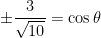
\displaystyle \pm \frac{3}{\sqrt{10}} = \cos \theta

Yesterday, I used the Pythagorean identity again to find \sin \theta. Today, I’ll instead plug back into the original equation 3 \sin \theta = \cos \theta:

3 \sin \theta = \cos \theta

3 \sin \theta = \displaystyle \frac{3}{\sqrt{10}}

\sin \theta = \displaystyle \pm \frac{1}{\sqrt{10}}

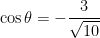
Unlike the example yesterday, the signs of \sin \theta and \cos \theta must agree. That is, if \cos \theta = \displaystyle \frac{3}{\sqrt{10}}, then \sin \theta = \displaystyle \frac{1}{\sqrt{10}} must also be positive. On the other hand, if \cos \theta = \displaystyle -\frac{3}{\sqrt{10}}, then \sin \theta = \displaystyle -\frac{1}{\sqrt{10}} must also be negative.

If they’re both positive, then

\sin \theta \cos \theta = \displaystyle \left( \frac{1}{\sqrt{10}} \right) \left( \frac{3}{\sqrt{10}} \right) =\displaystyle \frac{3}{10},

and if they’re both negative, then

\sin \theta \cos \theta = \displaystyle \left( -\frac{1}{\sqrt{10}} \right) \left( -\frac{3}{\sqrt{10}} \right) = \displaystyle \frac{3}{10}.

Either way, the answer must be \displaystyle \frac{3}{10}.

This is definitely superior to the solution provided in yesterday’s post, as there’s absolutely no doubt that the product \sin \theta \cos \theta must be positive.

One thought on “Different ways of solving a contest problem (Part 3)

Leave a comment

This site uses Akismet to reduce spam. Learn how your comment data is processed.